
1. Overview
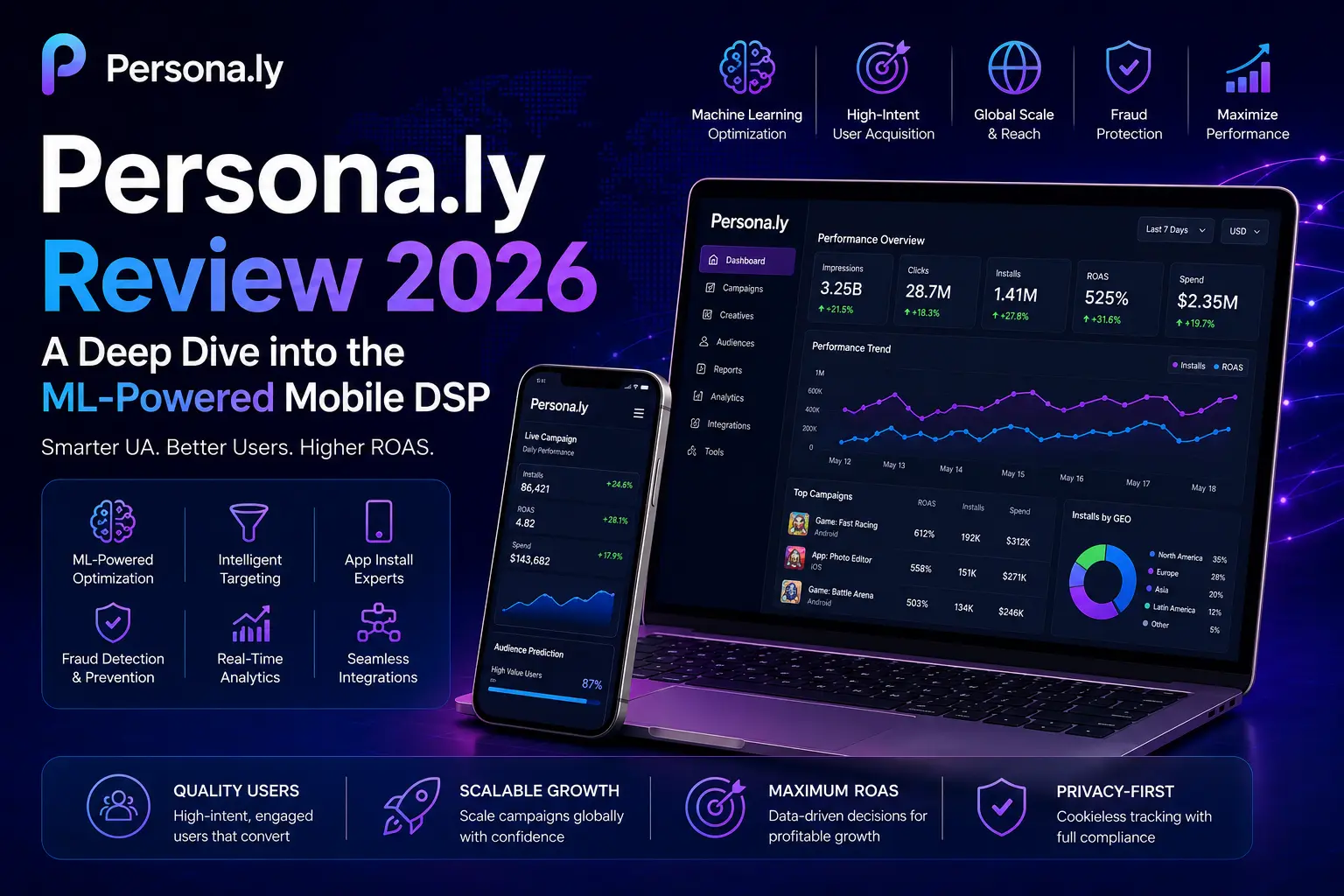
If you've spent any time in the mobile advertising ecosystem, you've probably seen the name Persona.ly floating around DSP comparison lists and programmatic UA discussions. Founded as a data-driven mobile demand-side platform, Persona.ly has positioned itself at the intersection of machine learning and performance marketing — serving both advertisers who need quality installs and publishers who want to monetize their apps without destroying the user experience.
What drew me to review Persona.ly specifically was the gap between its technical reputation and its public footprint. On one hand, the platform claims to process 4 million ad auctions per second and analyze over 60 data points before serving a single impression
. On the other hand, end-user reviews on Trustpilot paint a frustrating picture of support experiences — though it's critical to note those reviews come from consumers completing offers, not from the publishers and advertisers who actually use the platform's B2B tools.
Persona.ly operates primarily as a programmatic mobile DSP with a focus on user acquisition (UA), retargeting, and re-engagement. Unlike consumer-facing offerwall providers like Tapjoy or AdGem, Persona.ly sits one layer deeper in the stack — it powers the ad delivery infrastructure that connects advertisers with app inventory. If you're a publisher looking for an offerwall SDK to drop into your game, or an advertiser looking to scale installs outside of Meta and Google, this review is written for you.
2. Who Is It For?
Persona.ly is built for two distinct audiences, and understanding which one you are matters enormously before you sign up.
For Advertisers: Mobile app developers, gaming studios, fintech apps, and e-commerce brands looking to acquire users programmatically at scale. If you're running CPI (cost-per-install) or CPA (cost-per-action) campaigns and want machine learning to optimize toward in-app events rather than just installs, Persona.ly's bidder is designed for this exact use case. Their case studies mention clients like Ubisoft seeing 55% more installs and 200% higher D7 retention compared to baseline campaigns
.
For Publishers: App and game developers who want to monetize through programmatic demand rather than traditional offerwalls. If you're already using a mediation platform like AppLovin MAX or Unity LevelPlay and want to add another demand source, Persona.ly functions as a DSP partner that buys your inventory through RTB auctions.
This is not a platform for individual users looking to earn money by completing surveys or downloading apps. If that's your goal, you'd be better served reading our breakdown of GPT sites vs. survey sites vs. cashback platforms to find the right consumer-facing platform for your needs.
3. Supported Platforms
Persona.ly is fundamentally a mobile-first platform. Their infrastructure is built around iOS and Android ecosystems, with specific optimization for post-iOS 14.5 attribution challenges.
The platform supports:
- iOS (including SKAdNetwork campaigns)
- Android
- Mobile web (to a lesser extent)
What you won't find here is desktop web or CTV (connected TV) support. Persona.ly has stayed disciplined in its focus — they do mobile programmatic advertising, and they do it with a depth that generalist platforms often lack. For developers building cross-platform experiences, this means Persona.ly works best as a specialized mobile demand source rather than your only monetization partner.
4. Website Support
The advertiser-facing side of Persona.ly runs through a self-serve dashboard where campaigns can be created, managed, and optimized. Publishers don't get a consumer-facing website to send traffic to — instead, they integrate Persona.ly's demand through their existing ad serving or mediation stack.
For advertisers, the web dashboard provides:
- Campaign creation and budget management
- Creative upload and A/B testing
- Real-time performance metrics
- Audience segmentation controls
The platform's documentation and blog are hosted on their main domain, and they maintain active content around fraud prevention, reporting improvements, and audience segmentation — which suggests a team that invests in educating its B2B users rather than just acquiring them.
5. App Support
Persona.ly is app-native by design. Their entire value proposition revolves around in-app advertising — whether that's serving playable ads inside mobile games or delivering native ads within utility apps.
For publishers, this means:
- SDK integration for direct ad serving
- RTB integration through existing mediation platforms
- Support for both gaming and non-gaming app verticals
The platform emphasizes non-intrusive ad formats that maintain user satisfaction, which is critical for publishers worried about retention impact
. From my perspective, this is table stakes in 2026 — users have zero tolerance for disruptive ad experiences, and any network that doesn't prioritize UX is effectively burning publisher LTV.
6. Game Support
Gaming represents a significant portion of Persona.ly's advertiser demand, particularly in the mid-core and casual categories. The platform supports playable ads — interactive 30-second experiences that let users try a game before downloading — which consistently outperform static creatives for game UA campaigns
.
For game publishers monetizing with Persona.ly, the available formats include:
- Rewarded video
- Interstitials
- Playable ads
- Native ads
- Banners
The rewarded video and playable formats are particularly relevant for game developers. In an era where offerwall eCPMs can range from $10 — $50 globally and even higher in Tier 1 markets, having diverse, high-engagement formats matters. Persona.ly's ML-driven creative optimization — which uses a Multi-Armed Bandit algorithm to progressively shift budget toward winning creatives — is a genuine differentiator here
.
7. Integration Methods
Persona.ly offers multiple integration paths depending on your technical setup and business model:
- SDK Integration — Direct implementation for publishers who want Persona.ly as a primary or secondary demand source.
- RTB/Exchange Integration — For publishers already running mediation, Persona.ly connects through standard programmatic pipes.
- API Integration — For advertisers managing campaigns at scale or publishers with custom reporting needs.
- mParticle Integration — Documented support for audience data syncing through mParticle
- .
The flexibility here is solid. Whether you're a solo indie developer with one Unity game or a publisher with a complex waterfall setup across multiple mediation platforms, Persona.ly has an integration path that fits.
8. API Availability
Yes — Persona.ly provides API access for both campaign management and audience data synchronization. The mParticle integration documentation confirms that Persona.ly issues API Keys and Client IDs for authenticated data exchange, supporting user identity forwarding and device ID matching (IDFA and GAID)
.
For advertisers, this means you can:
- Pull campaign performance data into your BI tools
- Push audience segments from your DMP or CDP
- Automate reporting workflows
For publishers, API access is typically arranged through your account manager rather than being fully self-serve. This is common in the DSP world — RTB integrations usually happen at the exchange level, while direct API access requires a certain volume commitment.
9. iFrame Availability
Persona.ly does not appear to offer a consumer-facing offerwall that runs in an iFrame on third-party websites. This is consistent with its positioning as a B2B programmatic DSP rather than a B2C rewards platform.
If you're building a web-based offerwall website and need an iFrame-based provider, you'd be looking at networks like AdGate Media, Revlum, or CPX Research instead. Persona.ly's value proposition is in-app programmatic demand, not web offerwalls.
10. SDK Availability
Yes — Persona.ly provides a lightweight SDK for both iOS and Android integration
.
The SDK supports:
- Ad format rendering (rewarded video, interstitial, native, banner, playable)
- User attribution and event tracking
- Privacy compliance frameworks
For mobile developers, SDK weight matters. Every megabyte counts against your app store conversion rate, and Persona.ly's emphasis on a lightweight implementation is a genuine plus. If you're also evaluating how to add an offerwall SDK to Android and iOS apps, the same architectural principles around secure postbacks and wallet ledgers apply regardless of which network you're integrating.
11. Postback System
Persona.ly operates on a server-to-server (S2S) postback model for conversion tracking, which is the industry standard for programmatic advertising. When a user completes a target action (install, purchase, level achievement), the attribution provider or integrated SDK fires a postback to Persona.ly's servers, confirming the conversion and triggering billing.
For publishers running Persona.ly demand through mediation, postbacks are handled at the exchange level — you don't need to implement custom postback endpoints unless you're doing a direct SDK integration. For advertisers, Persona.ly supports postback integration with major mobile measurement partners (MMPs) including AppsFlyer, Adjust, and Branch.
The reliability of this system is critical. As anyone who's built an offerwall backend knows, duplicate postbacks, unverified callbacks, and missing transaction IDs are where revenue leaks happen. Persona.ly's infrastructure appears to handle this at scale, though publishers should still implement idempotency checks on their end.
12. Tracking
Tracking on Persona.ly happens at multiple levels:
Device-Level Tracking:
- Apple IDFA (where available)
- Google Advertising ID (GAID)
- Device fingerprinting as fallback
Campaign-Level Tracking:
- Creative performance by format and placement
- In-app event tracking (registration, purchase, retention milestones)
- ROAS optimization signals
Privacy-Compliant Tracking:
- SKAdNetwork support for iOS 14.5+ campaigns
- Contextual targeting using NLP to determine app-to-app relevance without user-level identifiers
The contextual targeting approach is particularly noteworthy. In a post-ATT world, Persona.ly uses NLP to model the "contextual distance" between advertiser apps and publisher apps, allowing their bidder to make intelligent placement decisions even when IDFA is unavailable. This isn't theoretical — it's actively running in SKAdNetwork campaigns.
13. Attribution Window
Persona.ly doesn't publicly disclose a fixed attribution window on their website, which is common for DSPs that customize terms based on campaign type and advertiser vertical. Standard industry practice for mobile programmatic ranges from:
- 7-day click, 1-day view for casual games
- 30-day click, 7-day view for fintech and subscription apps
- Custom windows for high-LTV verticals
What Persona.ly does emphasize is engagement optimization rather than just install attribution. Their ML models optimize toward downstream events — retention, in-app purchases, ROAS — rather than stopping at the install
.
For publishers, this means you're more likely to see demand from advertisers who value quality over quantity. That typically translates to higher eCPMs but potentially lower fill rates compared to networks that optimize purely for volume.
14. Offer Types
Persona.ly supports performance-based offer types aligned with programmatic buying:
- CPI (Cost Per Install) — Advertiser pays when the app is installed and opened
- CPA (Cost Per Action) — Advertiser pays when a specific in-app event occurs (registration, deposit, level reached)
- CPM (Cost Per Mille) — Used primarily for brand awareness campaigns, though Persona.ly is heavily performance-focused
- ROAS-based bidding — Their ML bidder optimizes toward return on ad spend rather than fixed CPI targets
For publishers, this translates to ad formats rather than "offers" in the traditional GPT sense. You're not displaying a list of survey tasks or game downloads — you're serving programmatic ads that pay based on engagement and conversion quality.
If you're looking for traditional offerwall inventory (surveys, app installs, trial signups), check our guide on how the $5 billion GPT economy works to understand the consumer-facing side of this market.
15. GEO Coverage
Persona.ly operates with global reach, directly integrated with major SSPs (Supply-Side Platforms) and OEMs to access inventory across diverse markets
.
Their demand appears strongest in:
- Tier 1 markets: US, UK, Germany, Japan (highest advertiser bids)
- Tier 2 markets: Western Europe, Australia, Canada
- Emerging markets: Available but with lower bid density
For publishers, this means your eCPM will vary significantly by user geography — a pattern that holds true across every ad network. An app with 80% US traffic will earn roughly 3x the programmatic revenue of an identical app with 20% US traffic, based on industry eCPM benchmarks.
16. Survey Inventory
Persona.ly is not a survey provider. They do not operate consumer survey routers or market research panels. Their inventory is entirely advertising-based — app installs, brand campaigns, retargeting ads.
If you need survey inventory for an offerwall or rewards platform, you'd integrate with dedicated survey routers like CPX Research, Pollfish, or TapResearch. For a complete breakdown of how survey monetization fits into the broader GPT ecosystem, see our GPT market deep dive.
17. Gaming Inventory
Gaming is one of Persona.ly's core verticals. The platform actively serves ads within:
- Casual games (match-3, puzzle, hyper-casual)
- Mid-core games (RPG, strategy, simulation)
- Casino and social gaming
Their playable ad format is particularly relevant here — it allows users to interact with a mini-version of the advertised game before committing to a download. Persona.ly's ML creative selection engine automatically promotes best-performing playables while testing new variants through a Multi-Armed Bandit approach
.
For game publishers, this means the ads served through Persona.ly tend to be high-quality, interactive creatives that generate better user engagement than static interstitials — which can translate to higher eCPMs and better user retention compared to lower-tier networks.
18. Fraud Prevention
This is where Persona.ly invests heavily, and it shows in their technical documentation. The platform employs machine learning-based anomaly detection at both the pre-bid and post-bid stages
.
Specific fraud prevention measures include:
- Pre-bid filtering: ML models analyze 60+ data points to identify suspicious traffic patterns before bidding
- Post-bid validation: Continuous monitoring of conversion quality to detect install farms, click injection, and bot traffic
- DMP aggregation: Cross-referencing traffic against their Data Management Platform to identify anomalies
- Brand safety guarantees: Working only with trusted SSPs and exchanges to ensure premium placements
In an industry where ad fraud costs billions annually, this multi-layered approach is essential. For advertisers, it means lower invalid traffic rates. For publishers, it means your inventory is valued more highly because the demand side trusts the quality of your users.
19. Reporting
Persona.ly provides a granular reporting dashboard that gives advertisers visibility into:
- Campaign performance by creative, placement, and audience segment
- Conversion rates from impression to click to install
- In-app event tracking (retention, purchases, ROAS)
- SKAdNetwork performance data for iOS campaigns
The dashboard emphasizes transparency — advertisers can see where ads were displayed and how each creative performed in real time
.
For publishers, reporting is typically delivered through your mediation platform's dashboard or through direct API pulls. Persona.ly doesn't appear to offer a standalone publisher portal comparable to AdMob or AppLovin — which is a gap worth noting if you're used to self-serve publisher analytics.
20. Reward Flexibility
Persona.ly is not a rewards platform. They don't manage point systems, gift card redemptions, or user wallets. Reward flexibility is determined by the publisher's own monetization stack — Persona.ly simply provides the ad demand that generates revenue.
If you're building a rewards platform and need to understand how to structure payouts, our guide to GPT platform economics covers the unit economics of offer walls, CPA margins, and reward distribution.
21. Payout Model
For publishers, Persona.ly operates on standard programmatic revenue share terms. You earn based on:
- CPM impressions served
- CPI/CPA conversions generated
- RTB auction wins in your inventory
The exact revenue split isn't publicly disclosed and likely varies by publisher volume, geography, and inventory quality. This is standard practice in the DSP/publisher relationship — top publishers negotiate better terms than smaller ones.
For advertisers, Persona.ly offers performance-based pricing:
- CPI campaigns for app installs
- CPA campaigns for downstream events
- ROAS-optimized bidding where their ML manages bids to hit your return targets
Their bid shading technology is worth highlighting here — the ML algorithm predicts the optimal auction price based on audience attributes, ensuring you don't overpay in first-price auctions
.
22. Payment Methods
Persona.ly's payment infrastructure follows standard B2B ad tech practices. For publishers, typical arrangements include:
- Wire transfer (most common for larger publishers)
- PayPal (available for smaller accounts)
- Net-30 terms as the industry standard
Exact minimum thresholds and payment schedules aren't publicly listed and require discussion with their partnerships team. This opacity is frustrating for smaller publishers evaluating networks, but it's unfortunately common among premium DSPs that focus on enterprise relationships.
For advertisers, payment is typically managed through insertion orders (IOs) with pre-funded account balances or monthly invoicing.
23. Approval Requirements
Getting started with Persona.ly requires going through their sales and partnerships team. Unlike self-serve platforms like AdMob or Facebook Ads, Persona.ly operates on a managed service model where:
- Advertisers work with dedicated campaign managers
- Publishers are vetted for inventory quality and traffic volume
- Integration requires technical coordination
You'll need:
- A legitimate app or website with real users
- Compliance with platform policies and privacy regulations
- For advertisers: a minimum budget threshold (undisclosed publicly)
- For publishers: sufficient inventory volume to justify direct integration
24. Minimum Traffic
Persona.ly doesn't publish a specific minimum traffic threshold, which suggests they evaluate publishers on a case-by-case basis. Based on industry norms for DSP integrations:
- Direct SDK integration: Typically requires 50,000+ daily active users
- RTB/exchange integration: Lower thresholds possible if you're already connected to major SSPs
- Geographic requirements: Tier 1 traffic is more valuable and more likely to be accepted
If you're below these thresholds, you're likely better served starting with aggregation platforms like AppLovin MAX or Unity LevelPlay, which bundle demand from multiple DSPs including Persona.ly without requiring direct relationships.
25. Publisher Support
Publisher support at Persona.ly appears to be account-manager-driven rather than ticket-based. This has pros and cons:
Pros:
- Dedicated point of contact who understands your inventory
- Technical integration assistance
- Strategic optimization recommendations
Cons:
- No self-serve support portal for quick questions
- Response times depend on your account tier
- Smaller publishers may get less attention than enterprise clients
The Trustpilot reviews from end users (not publishers) mention poor support experiences, but these complaints relate to consumer offer completion issues — not publisher account management
. For B2B publishers, my assessment is that support quality likely correlates with your spend or inventory volume, which is standard for the industry.
26. Strengths
- Advanced ML Bidding: The 60+ data point analysis and bid shading technology genuinely differentiate Persona.ly from rule-based DSPs.
- Fraud Prevention: Pre-bid and post-bid ML anomaly detection provides strong traffic quality assurance.
- Creative Optimization: Multi-Armed Bandit approach to creative selection improves campaign performance automatically.
- Contextual Targeting: NLP-based contextual distance modeling for post-ATT iOS campaigns.
- Premium Demand: Direct SSP and OEM integrations provide access to high-quality inventory.
- Transparent Dashboard: Real-time creative and placement performance visibility for advertisers.
- Lightweight SDK: Minimal app size impact for publishers doing direct integration.
27. Weaknesses
- No Self-Serve Publisher Portal: Unlike AdMob or AppLovin, you can't just sign up and start monetizing — you need to go through sales.
- Opaque Pricing: Revenue shares, minimum thresholds, and budget requirements aren't publicly disclosed.
- Limited Web Support: No iFrame or web offerwall solution for publishers building desktop or mobile web reward platforms.
- B2B-Only: Individual developers or small apps may struggle to get approved without significant traffic.
- Trustpilot Reputation: While the negative reviews are from end users (not publishers), they highlight potential issues with the consumer-facing side of campaigns run through their network.
- No Survey Inventory: If you need diversified offer types beyond ads, you'll need additional integrations.
28. Best Use Case
Persona.ly shines in two specific scenarios:
Scenario A: You're a mobile game developer or fintech app with a $10K+ monthly UA budget, and you want to diversify beyond Meta and Google. You need a DSP that optimizes toward ROAS, not just installs, and you value machine learning over manual campaign management.
Scenario B: You're a mid-size to large publisher (100K+ DAU) with quality inventory, and you want to add a premium programmatic demand source to your mediation stack. You're already working with AppLovin MAX or similar, and you want direct DSP relationships to improve yield.
In both cases, Persona.ly works best as part of a diversified strategy rather than a single-source solution.
29. Who Should Avoid It
Avoid Persona.ly if:
- You're an individual looking to earn money completing offers (use a GPT site instead)
- You're building a web-based offerwall and need iFrame integration
- Your app has fewer than 50,000 daily active users
- You need self-serve access with instant approval
- You require survey or market research inventory alongside ads
- You want transparent, published pricing without sales calls
30. Alternatives
Depending on your specific needs, consider these alternatives:
For Advertisers (UA-focused):
- AppLovin — Stronger gaming focus with MAX mediation
- Unity LevelPlay — Best if you're already in the Unity ecosystem
- Moloco — ML-powered DSP with strong ROAS optimization
- Liftoff — Excellent for mobile gaming UA
- Adikteev — Specialized in retargeting and re-engagement
For Publishers (Monetization-focused):
- Google AdMob — Default choice, high fill rates, easy integration
- AppLovin MAX — Best-in-class mediation with 25+ networks
- ironSource — Now part of Unity, strong offerwall and video
- Tapjoy — Pioneer in offerwall monetization, now under Unity
- Mintegral — Rising player with strong APAC demand and interactive formats
For a broader view of the monetization landscape, see our 2026 guide to AdMob alternatives.
31. Final Rating
Table
| Criteria Rating Notes | ||
| Technology & ML | — | Best-in-class bidding and fraud detection |
| Publisher Accessibility | — | Opaque requirements, no self-serve portal |
| Advertiser Value | — | Strong ROAS optimization, premium pricing |
| Integration Ease | — | Good SDK and API, but requires technical resources |
| Support Quality | — | Account-manager model, quality varies by tier |
| Transparency | — | Dashboard is good, but pricing is opaque |
| Overall | 7.8 / 10 | Excellent DSP for established players; not for beginners |
Bottom Line: Persona.ly is a technically sophisticated mobile DSP that delivers real value for advertisers and publishers who meet its threshold requirements. The machine learning infrastructure is genuinely impressive — 4 million auctions per second, 60+ data points per impression, and bid shading that prevents overpayment. But the lack of self-serve access, opaque pricing, and B2B-only model make it a poor fit for small developers or anyone looking for a plug-and-play monetization solution.
If you're running serious mobile UA or monetizing a large app portfolio, Persona.ly deserves a spot in your evaluation shortlist. If you're just starting out, build volume first through aggregation platforms, then graduate to direct DSP relationships like Persona.ly once you have the scale and technical resources to support them.
Disclaimer: This review is based on publicly available information, official documentation, and industry analysis. Some operational details (exact pricing, minimum thresholds, specific payment terms) require direct contact with Persona.ly's sales team. Always conduct your own due diligence before committing advertising budgets or integrating third-party SDKs.


Comments (0)
No comments yet. Be the first to share your thoughts!