
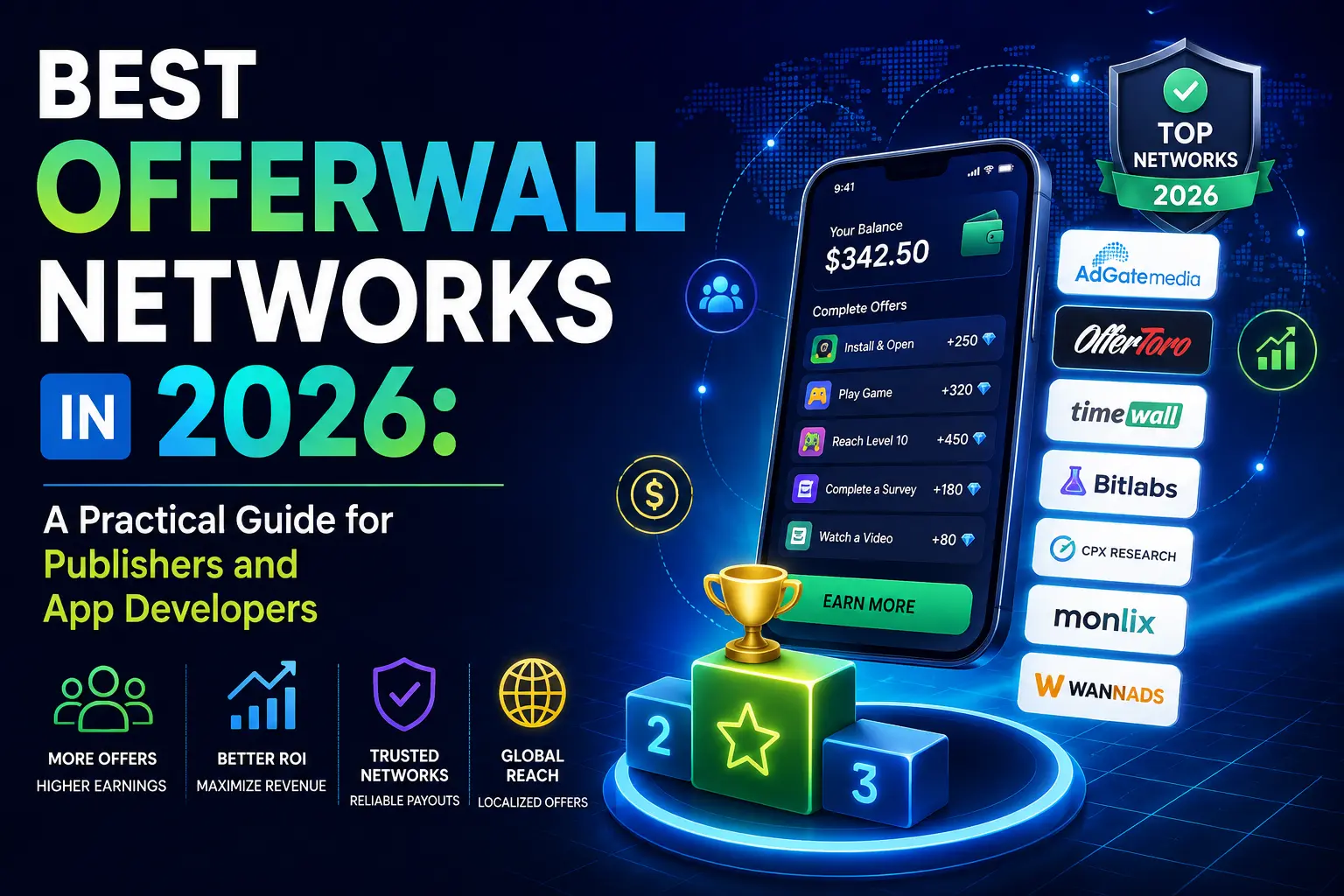
Choosing the best offerwall network is not simply a matter of finding the platform with the highest advertised payout.
An offerwall that looks excellent on paper can perform poorly for your particular audience because the available offers depend on country, device, user profile, traffic quality, placement, reward economics, and advertiser demand.
That is why the better question is:
Which offerwall network is best for my users, platform, geography, and integration model?
In 2026, several established networks stand out for different reasons. RevU is particularly attractive when an SDK-free integration is important, Lootably offers several integration paths including an Offers API, AdGem provides web, SDK, and API options, ayeT-Studios offers extensive API controls and current publisher tooling, BitLabs is particularly relevant for survey-heavy products, and TheoremReach combines survey inventory with web, mobile SDK, API, and S2S options.
This guide compares them from a publisher and developer perspective, with particular attention to integration, postbacks, customization, offer inventory, fraud controls, and the economics behind a real offerwall business.
What Makes an Offerwall Network Good?
An offerwall provider sits between your users and advertisers.
The basic model looks like this:
That looks straightforward until you start measuring what actually happens.
A good network needs to provide more than a list of campaigns.
Offer depth
Users need enough relevant offers to keep returning.
A wall with 500 offers is not necessarily better than one with 50. What matters is how many of those offers are actually eligible for your users.
For example:
The final number can be dramatically smaller than the headline campaign count.
Geographic coverage
An offerwall performing extremely well in the United States may perform very differently in Egypt, Saudi Arabia, Indonesia, Germany, Brazil, or India.
This is one of the most important reasons not to choose a provider solely from another publisher's revenue screenshots.
Offer types
Different audiences respond to different offer categories.
Common categories include:
A mobile gaming application may benefit heavily from game-install and CPE campaigns.
A GPT website may need a more balanced combination of surveys, CPA offers, registrations, and shopping opportunities.
Integration flexibility
The technical integration can significantly affect development cost.
Some providers offer:
Others concentrate on a smaller subset.
For example, Lootably documents iFrame, direct-link, and Offers API integrations.
AdGem offers direct-link and iFrame/WebView web integration, while its Offer API can return available offers for a publisher-controlled interface.
RevU currently promotes an SDK-free model with hosted, iFrame, and API options.
Postback quality
For a rewards platform, this is one of the most important technical criteria.
The flow should be:
A provider with excellent offer inventory but poor conversion reporting can be more expensive than a provider with slightly lower revenue but reliable callbacks and support.
Fraud and reversal handling
You should know what happens when a conversion is later reversed.
The ideal reward system supports:
rather than silently modifying historical balances.
Best Offerwall Networks in 2026
There is no universal #1 network. The strongest shortlist depends on what you are building.
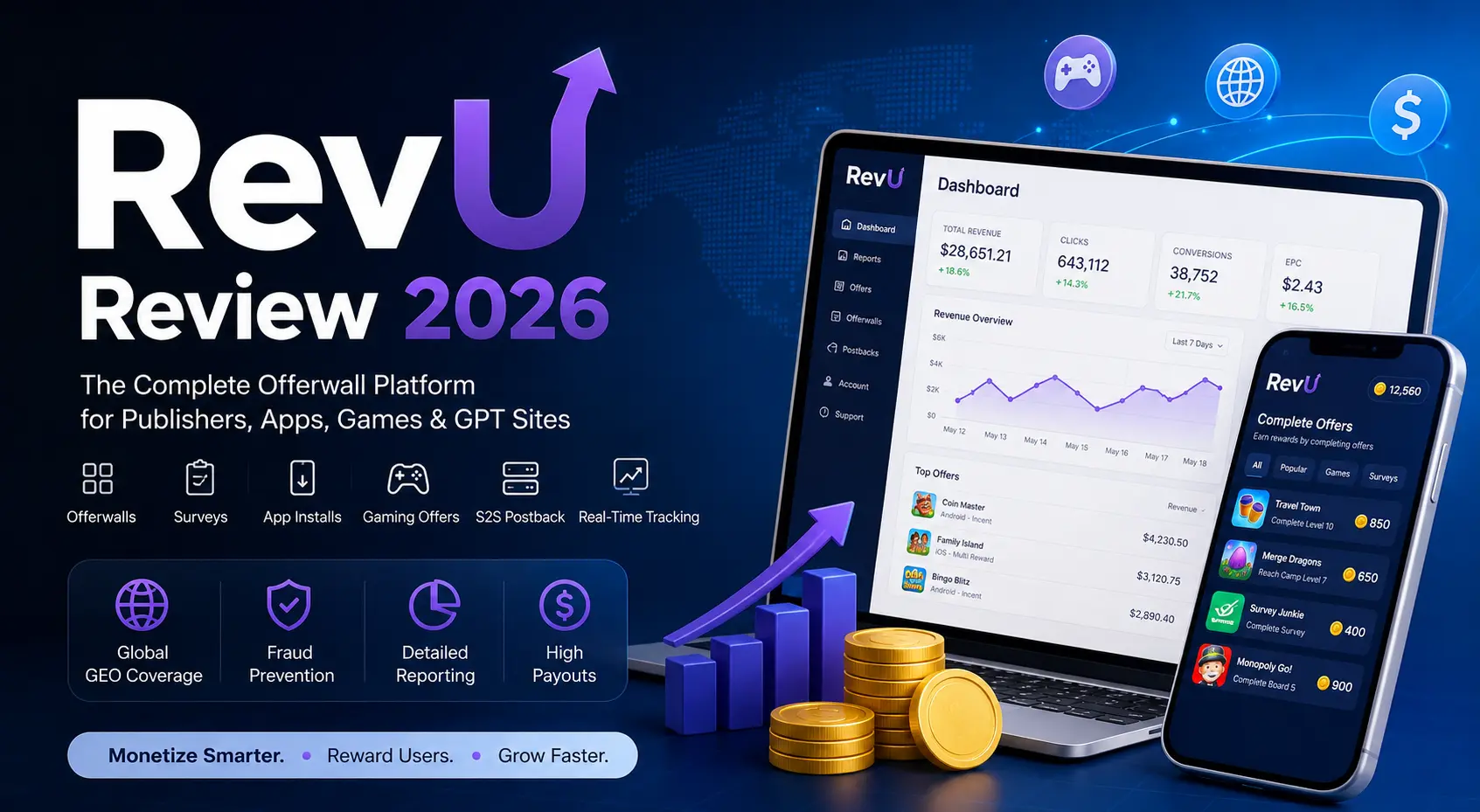
1. RevU — Best for SDK-Free Integration and Flexible Deployment
Best for: web publishers, mobile developers who do not want a native SDK, games, and publishers that want to launch quickly.
RevU is currently positioning itself around an SDK-free offerwall architecture. Its publisher documentation lists a hosted page, iFrame, and whitelabeled API, with support for Unity, iOS, Android, and web. It also requires publishers to configure server-side postbacks for reward signaling.
That is attractive when your development team wants to avoid:
RevU's current integration documentation also provides a testing mechanism for postbacks, allowing publishers to simulate a reward without manually completing an offer.
The network also provides a catalog API for publishers that want to control how offers are rendered. The API exposes offer data including payouts, multi-step events, targeting restrictions, capping information, creatives, and other metadata.
Why choose RevU:
RevU's own current guidance also makes an important point for publishers: headline eCPM numbers are difficult to compare because geography, impression definitions, reward ratios, and placement can all change the result.
That is exactly the mindset a serious publisher should use.
2. Lootably — Best for Flexible Web and API Integration
Best for: GPT websites, reward platforms, games, and developers who want both a ready-made offerwall and API access.
Lootably provides several integration choices rather than forcing every publisher into one UI model.
Its current documentation lists:
The iFrame is described as the simplest integration, while the API is intended for publishers that want more control over presentation.
Lootably's API documentation distinguishes between user-level results and catalog-style data. User-specific APIs can handle targeting such as country, device, and OS restrictions, while catalog integration gives the publisher more control over filtering.
Lootably also currently publishes platform-level statistics on its website, including conversions, monthly active users, active campaigns, and publisher payments. Those figures are self-reported by Lootably and should be treated as company-provided metrics rather than independent market rankings.
Why choose Lootably:
For a GPT website where you want to launch quickly and later replace the hosted wall with your own interface, this flexibility can be valuable.
3. AdGem — Best for Developers Wanting API or Native Integration
Best for: mobile games, apps, web applications, and development teams that want several integration levels.
AdGem currently supports a web offerwall through direct links and iFrame/WebView integration. Its documentation also requires publisher approval and a server-side postback endpoint for web integration.
For developers who want more control, AdGem also provides an Offer API. Its current API documentation describes the API as a REST service that returns available offers and is intended for server-side polling. It can provide both single- and multi-reward offers and goal information.
The advantage is architectural flexibility:
AdGem is also actively maintaining its SDK and integration documentation. Its changelog shows a June 2026 Android SDK release with explicit initialization and other breaking API changes, which is a useful reminder that native integrations require active dependency management.
Why choose AdGem:
This makes it especially interesting when you expect your product to evolve from a simple wall into a more deeply integrated rewards experience.
4. ayeT-Studios — Best for Advanced Offer API Control
Best for: experienced mobile developers, games, publishers with custom offer experiences, and teams that care about campaign-level data.
ayeT-Studios currently operates a publisher API with active 2026 documentation. Its Offerwall API supports publishers who want control over how offers are presented on Android, iOS, and websites.
The current API changelog is particularly interesting from a developer's perspective. Recent 2026 updates include:
Those features make the platform more than a simple "load an offerwall" solution. They give publishers more information for building custom experiences and ranking offers.
ayeT-Studios also supports web offerwalls, although its documentation notes that its web integration is intended for real browsers rather than being the preferred approach for in-app WebViews.
Its current publisher site reports 550+ active publishers, 12M+ monthly active users, and more than 200,000 successful mobile and web campaigns; these are company-reported figures.
Why choose ayeT-Studios:
It is particularly compelling for teams that want to build their own offer ranking, UI, and reward discovery experience instead of simply embedding a provider's wall.
5. BitLabs — Best for Survey-Heavy Reward Platforms
Best for: GPT websites, survey apps, fintech/reward products, and platforms where surveys are an important part of the earning experience.
BitLabs describes its platform as providing offers, surveys, receipt scanning, and cashback opportunities.
Its publisher documentation supports:
For websites, BitLabs supports both an iframe and a link-based offerwall. Its documentation also provides server-to-server callbacks for reward processing.
One particularly useful feature is the ability to pass custom parameters through the offerwall and receive them in callbacks. That can simplify user attribution when your internal user ID needs to travel through the offer lifecycle.
BitLabs also provides a user investigation area where publishers can inspect earnings, offer activity, survey history, cashback, and other events. That is valuable for customer support and missing-reward investigations.
Why choose BitLabs:
For a survey-heavy GPT platform, this makes BitLabs worth testing even when another provider is used as the primary general-purpose offerwall.
6. TheoremReach — Best for Survey + Multi-Platform Infrastructure
Best for: survey-driven reward products and developers who want both managed integrations and API-level control.
TheoremReach's current publisher documentation exposes a broad integration surface:
The documentation also includes survey APIs, eligibility handling, routing models, and callback testing.
That combination makes it suitable when a publisher wants to start with a hosted experience but may later move toward a custom survey interface.
Why choose TheoremReach:
7. AdGate Media — Best for a Broad General-Purpose Offerwall
Best for: publishers looking for a traditional general-purpose offerwall with web, mobile, and API options.
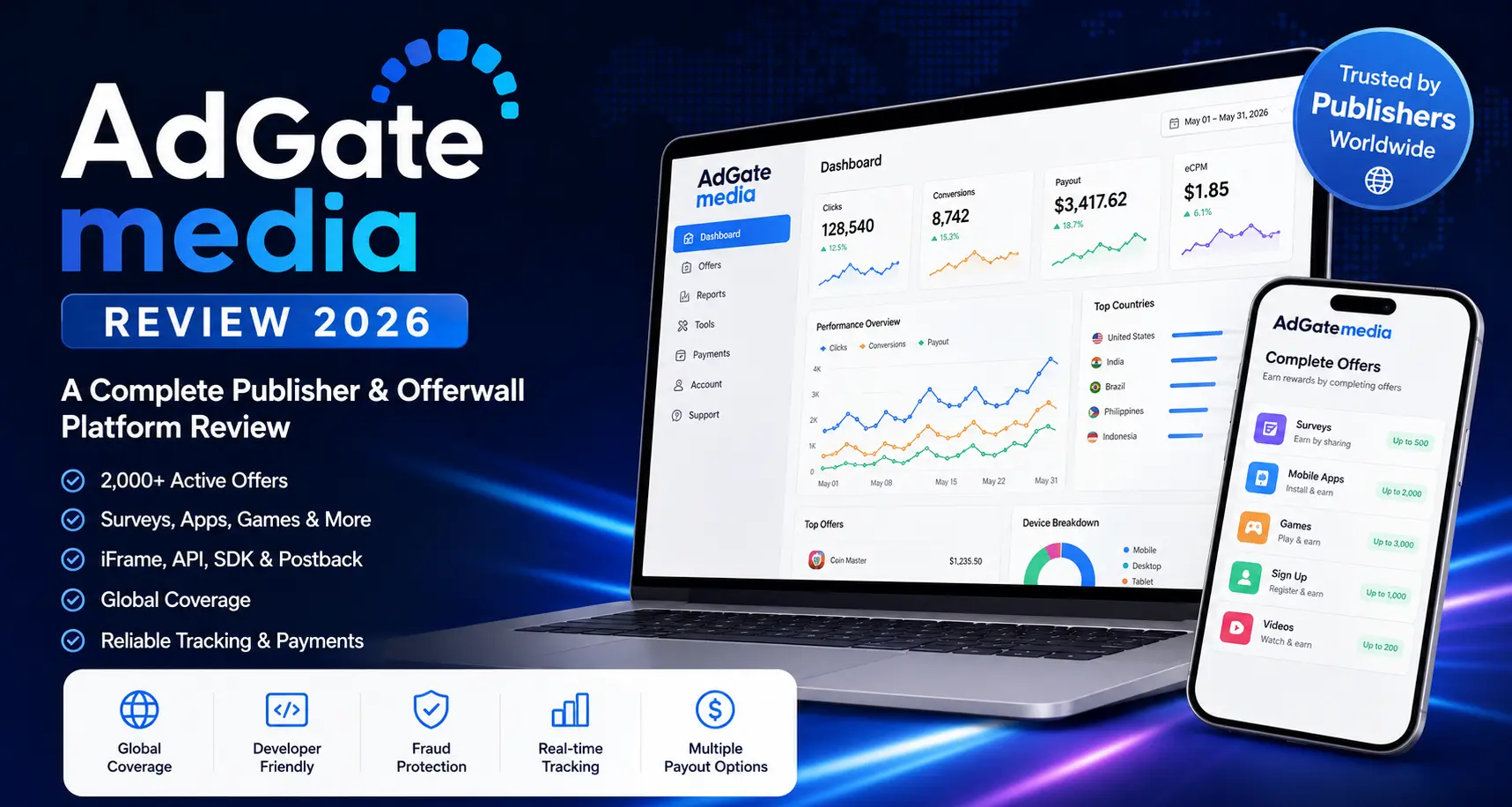
AdGate Media has been operating an offerwall model for many years and currently offers several publisher integration choices, including a web offerwall, SDK, WebView, and API integration.
Its current monetization page describes offers covering surveys, quizzes, and app trials, along with the ability to block individual campaigns or categories that do not fit the publisher's audience.
That last feature matters more than it might appear.
A publisher should have the ability to decide:
Instead of accepting every campaign automatically.
AdGate also positions its network around both user acquisition and publisher monetization, meaning its supply side and demand side are part of the same ecosystem.
Why choose AdGate Media:
Quick Comparison
| NetworkBest fitIntegrationS2S / callbacksStrongest reason to test | ||||
| RevU | Web, games, mobile without SDK | Hosted, iFrame, API | Yes | SDK-free architecture |
| Lootably | GPT, web, games | iFrame, link, API | Yes | Flexible integration |
| AdGem | Mobile apps and games | Web, SDK, API | Yes | Developer control |
| ayeT-Studios | Advanced publishers | API, web, SDK ecosystem | Yes | Rich offer/campaign data |
| BitLabs | Survey-heavy products | Web, SDKs, APIs | Yes | Surveys + earning products |
| TheoremReach | Survey platforms | Web, SDKs, APIs | Yes | Multi-platform survey stack |
| AdGate Media | General-purpose offerwalls | Web, SDK, API, WebView | Provider-supported | Broad integration options |
These are not fixed rankings. They are use-case recommendations based on currently documented capabilities. Revenue, offer availability, approval, and effective RPM can vary substantially by publisher and geography.
How to Compare Offerwall Networks Without Getting Misled by eCPM
One of the biggest mistakes publishers make is putting provider A's advertised eCPM beside provider B's advertised eCPM and selecting the larger number.
RevU's own August 2026 analysis explicitly warns against doing this because eCPM can change based on geography, impression definitions, reward conversion ratios, and placement quality.
Instead, compare net revenue per active user.
For example:
Network B has a lower headline revenue figure but may actually leave you with more money.
Measure the entire funnel
Track:
You can then calculate:
These numbers tell you far more than a single eCPM screenshot.
Geography Can Completely Change the Winner
Suppose you run:
The best provider for this audience may not be the best provider for:
This is why your test should report revenue by country.
A simple report might look like:
| Country | Network A | Network B | Network C |
| US | $8.20 | $7.60 | $8.70 |
| UK | $6.90 | $8.10 | $7.40 |
| Germany | $5.80 | $6.40 | $5.90 |
| Egypt | $1.40 | $2.10 | $1.70 |
| Indonesia | $1.20 | $1.80 | $1.30 |
The "winner" is no longer obvious.
That is exactly why multi-network offerwall products often perform better than relying on a single provider.
How to Run a Proper Offerwall Network Test
Do not test one provider today and another next month
User behavior changes over time.
Seasonality changes.
Advertiser budgets change.
Campaign caps change.
A fair comparison should run providers against similar traffic during approximately the same period.
Use comparable placements
Do not put Provider A on your homepage and Provider B behind a settings menu.
The placement itself can change performance.
Use:
Keep the reward ratio consistent
If:
your revenue comparison is meaningless.
The user's incentive level changes the conversion rate.
RevU's current 2026 guidance specifically calls out currency conversion ratio as one of the factors that can distort eCPM comparisons.
Compare support quality
When a user reports:
"I completed this offer and did not receive my reward."
You need an answer quickly.
Evaluate:
Support can become a revenue metric because unresolved reward issues can reduce user trust and repeat usage.
Offerwall Integration: The Backend Matters More Than the UI
A modern offerwall can be embedded in minutes.
The harder part is safely processing conversions.
The architecture should look like:
Never credit the wallet from the client
Avoid:
The browser or mobile application should display the user's balance.
It should not be the authority that decides whether a conversion happened.
Use provider transaction IDs
Your database should enforce something equivalent to:
That prevents:
from becoming a double reward.
Support chargebacks and reversals
A mature provider may report a reversal or chargeback after the original conversion.
Your ledger should support:
while preserving both records.
ayeT-Studios' current API documentation, for example, explicitly exposes separate callback types for conversions and chargebacks.
Ask providers about callback security
Before integrating, ask:
TheoremReach currently documents HMAC security and S2S reward callbacks, while RevU documents configurable S2S postbacks and testing.
Use Multiple Offerwall Networks
For a serious GPT website or rewards application, a multi-network strategy can make more sense than selecting one provider and stopping there.
For example:
Your backend becomes the aggregation layer:
The user does not need to understand which network generated the reward.
They see:
Your backend knows:
That abstraction becomes extremely valuable when you start optimizing revenue by geography.
Which Networks Work Well Together?
For a GPT website
A sensible initial combination could be:
Why?
This is not a guaranteed highest-revenue combination. It is a sensible test portfolio because the providers can cover different earning behaviors.
For a mobile game
A stronger testing set might be:
The goal would be to compare:
rather than simply comparing total offer counts.
For a survey application
Start with:
Then test another general offerwall alongside them to capture users who do not want to answer surveys.
Which Offerwall Network Should You Choose?
There is no universal winner, but the shortlist becomes much easier when you start with your actual requirements.
Choose RevU when:
RevU's current publisher offering is explicitly built around SDK-free deployment.
Choose Lootably when:
Lootably documents both ready-made and API-based integration paths.
Choose AdGem when:
Its current documentation supports both hosted and custom API approaches.
Choose ayeT-Studios when:
Its active 2026 publisher API includes detailed targeting, reward-status, KPI, and callback capabilities.
Choose BitLabs when:
BitLabs explicitly supports offers, surveys, receipt scanning and cashback, with APIs and callbacks for publisher integrations.
Choose TheoremReach when:
Its current publisher documentation covers web, mobile, Unity, APIs, and S2S callback infrastructure.
Choose AdGate Media when:
AdGate currently documents web, SDK, API, and WebView integration options and gives publishers the ability to block offers or categories.
Frequently Asked Questions
What is the best offerwall network in 2026?
There is no single network that is best for every publisher. RevU is a strong choice for SDK-free deployment, Lootably is attractive for flexible web/API integration, AdGem is well suited to developer-controlled mobile integrations, ayeT-Studios offers deep API capabilities, and BitLabs and TheoremReach are particularly relevant for survey-heavy products.
Which offerwall pays the most?
There is no reliable universal answer. Your effective revenue depends on geography, user quality, offer eligibility, placement, reward ratios, conversion rates, reversals, and advertiser demand. A provider with the highest advertised eCPM may not produce the highest net revenue for your audience.
What is the best offerwall for a GPT website?
Start by testing networks that support web integration and S2S callbacks. Lootably, RevU, BitLabs, and AdGate Media are reasonable candidates for a first comparison because they provide web-oriented integration paths.
What is the best offerwall for mobile games?
A developer should test providers such as AdGem, RevU, and ayeT-Studios, especially when game installs, CPE campaigns, and multi-step rewards matter. The right winner still depends on the game's countries and player profile.
Are offerwalls suitable for websites as well as apps?
Yes. Several providers explicitly support websites as well as mobile applications. Lootably provides iFrame and direct-link integration; AdGem documents web offerwalls; RevU supports websites; BitLabs supports web offerwalls; and ayeT-Studios provides web integrations.
Should I use one offerwall network or several?
For a serious rewards platform, testing several providers often makes more sense because offer availability varies by geography and user profile. A unified backend can normalize conversions from multiple providers into one wallet.
What is an S2S postback?
A server-to-server postback is a notification sent directly from the offer provider to your backend after a conversion. Your server can authenticate and process the event without trusting the user's browser or mobile application.
How do I prevent duplicate rewards?
Store the provider's external transaction ID and enforce a unique database constraint. Then process the reward atomically inside a database transaction.
Can I use an offerwall without an SDK?
Yes. RevU explicitly promotes an SDK-free architecture, while Lootably, AdGem, BitLabs, and other providers document web, iFrame, API, or hosted integration options.
Should I choose the network with the largest number of offers?
Not necessarily.
The better question is:
How many eligible, high-quality, converting offers does this network provide to my users?
A smaller catalog can outperform a huge catalog if the offers are better matched to the audience.
Final Verdict
The best offerwall network is the one that produces the strongest net result for your actual audience, not the one with the most impressive marketing number.
A practical 2026 shortlist looks like this:
The smartest strategy is usually not to make a permanent decision after reading a comparison article.
Instead:
For developers building an offerwall website, the backend architecture matters just as much as the provider. The network supplies offers, tracking, and conversion events; your platform remains responsible for user identity, idempotency, reward accounting, fraud controls, and withdrawals.
That is why the best long-term setup is usually a multi-network offerwall architecture with a single wallet and a normalized conversion layer.
The network can change.
Your reward system should not have to.
Related Hansal Dev Resources
For the implementation side, continue with How to Create an Offerwall Website: A Comprehensive Builder's Guide, which covers database design, S2S postbacks, wallet ledgers, fraud controls, withdrawals, and provider adapters.
For Android and iOS products, see How to Add an Offerwall SDK to Android & iOS Apps.
For additional development and monetization resources, visit the Hansal Dev Blog.



Comments (0)
No comments yet. Be the first to share your thoughts!