 Aug 20, 2026
How Does an Offerwall Work? Complete Guide for Publishers, Apps & GPT Sites
How Does an Offerwall Work?
An offerwall looks simple from the user's side.
You open an app or website, see a list of tasks, choose one, complete it, and receive points, credits, virtual currency, or another reward.
Behind that apparently simple experience is a fairly sophisticated advertising and tracking system.
An offerwall connects users, publishers, advertisers, offerwall networks, tracking systems, and reward systems. The advertiser pays when a qualifying action occurs, the offerwall provider tracks and verifies that action, the publisher receives revenue, and the user receives a share of that value as a reward.
That is the basic idea.
But the interesting part is what happens between the click and the reward.
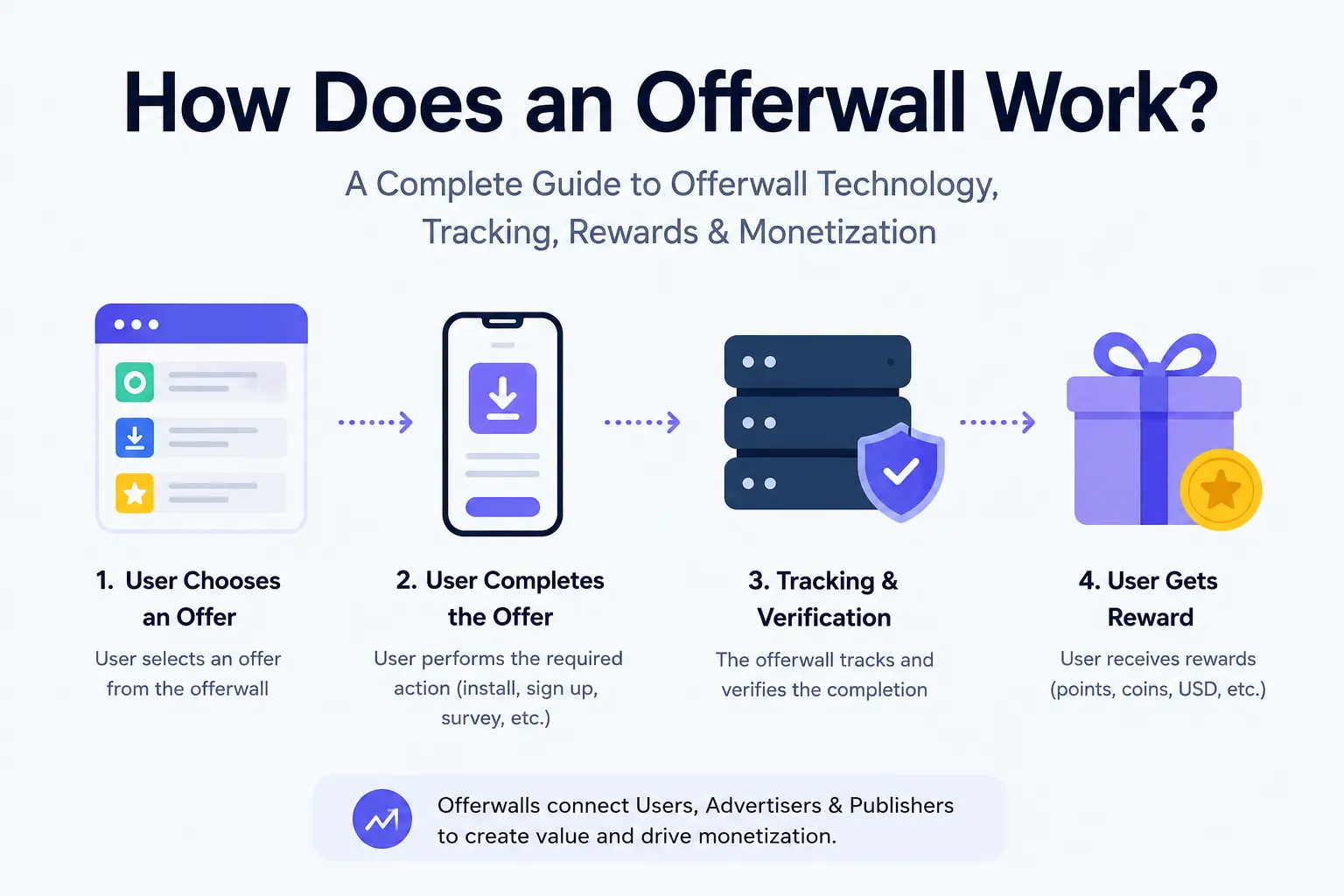
A typical flow looks like this:
User → Offerwall → Tracking Link → Advertiser → Conversion → Postback → Publisher → User Reward
Once you understand that chain, most of the offerwall industry becomes much easier to understand.
I have spent enough time looking at offerwall integrations, APIs, postbacks, reward systems, and GPT platforms to learn one important lesson: the visible offer list is the easy part. The real product is the tracking and accounting infrastructure underneath it.
This article explains exactly how that infrastructure works.
What Is an Offerwall?
An offerwall is a monetization format that presents users with a collection of advertiser-sponsored activities in exchange for rewards.
According to Adjust, offerwalls are typically used to reward users with virtual currency, features, or content after they complete advertiser-defined actions such as surveys, app installs, subscriptions, or other engagement tasks.
Common offerwall environments include:
- Mobile games
- Mobile applications
- GPT (Get-Paid-To) websites
- Reward platforms
- Loyalty programs
- Community platforms
- Fintech and utility applications
The crucial difference between an offerwall and a traditional banner ad is user intent.
A banner is generally displayed to the user.
An offerwall is normally something the user chooses to open and interact with.
That makes the format a form of opt-in or value-exchange advertising. The user performs an action that has value to an advertiser and receives something in return. The Interactive Advertising Bureau has also described this broader category as opt-in value exchange advertising, where consumers receive something of value in exchange for their attention or actions.
The Three Main Players in an Offerwall
To understand the economics, start with the three most important participants.
1. The Advertiser
The advertiser wants a measurable result.
For example:
- A mobile game wants new players.
- A subscription company wants new customers.
- A financial service wants qualified registrations.
- A market research company wants completed surveys.
- An e-commerce business wants new buyers.
Instead of simply paying for impressions, the advertiser can pay for a defined action.
That action may be:
- Installing an app
- Registering an account
- Completing a tutorial
- Reaching a game level
- Completing a survey
- Starting a subscription
- Making a purchase
- Completing multiple milestones
The advertiser defines the campaign requirements and payout.
2. The Offerwall Network
The offerwall network acts as the technology and distribution layer between campaigns and publishers.
It manages things such as:
- Offer inventory
- Tracking
- Attribution
- Campaign targeting
- Conversion reporting
- Publisher APIs
- Postbacks
- Reward event reporting
- Reversals
- Fraud detection
- Geographic and device targeting
Some providers expose a hosted offerwall that requires minimal development.
Others provide APIs and SDKs so the publisher can create a fully customized experience.
For example, ayeT-Studios documents an Offerwall API that allows publishers to retrieve matching offers and control how those offers are presented in their own interface.
AdGem similarly provides an Offer API designed to return available offers for publisher-controlled interfaces. Its documentation specifically describes the API as a server-side integration rather than something intended for every real-time client request.
3. The Publisher
The publisher owns the app, website, game, or platform where the offerwall appears.
For example:
Mobile game → in-game currency
GPT website → points or cash balance
Reward app → credits
Loyalty platform → loyalty points
The publisher usually earns revenue when users complete qualifying offers.
The publisher can then share part of that revenue with the user.
That creates the basic economic relationship:
Advertiser pays → Network tracks → Publisher earns → User gets rewarded
The Complete Offerwall Flow
Now let's walk through what actually happens.
Step 1: The User Opens the Offerwall
A user logs into a website or application and clicks something such as:
Earn More
Complete Offers
Get Free Coins
Rewards
Offerwall
The platform identifies the user.
This identification is extremely important because the reward system needs to know which account should receive the eventual credit.
Offerwall providers commonly require a stable user identifier such as a user ID, external identifier, or sub-ID. Offerwall Ad, for example, explicitly recommends passing a stable user identifier so conversions can later be associated with the correct user.
Step 2: The Offerwall Loads Available Offers
The platform then requests or displays a set of available offers.
There are several ways this can happen.
Hosted Offerwall
The provider hosts the offerwall interface.
The publisher may simply open a URL or embedded experience.
This is generally the easiest option.
iFrame or Web Integration
The offerwall is embedded inside the publisher's website.
This gives the publisher a more integrated experience without building the entire offer catalog from scratch.
SDK
A provider can provide a mobile SDK for Android, iOS, Unity, or another platform.
This is common in mobile games and applications.
API
The publisher retrieves offers using an API and creates its own interface.
This provides much greater control over:
- Design
- Sorting
- Filtering
- Categories
- User experience
- Offer ranking
- Branding
AdGem, for example, documents a REST Offer API where publishers authenticate, retrieve current offers, and use postbacks to handle completed rewards.
ayeT-Studios also provides Offerwall API integration for websites and mobile apps, with callbacks and security mechanisms for conversion handling.
Step 3: The User Sees Personalized Offers
The number of offers shown to a user is not necessarily the same as the total number of campaigns available in a network.
This distinction is important.
Imagine an offerwall network has 1,000 campaigns.
A particular user may only qualify for 30.
Why?
Because offer availability can depend on:
- Country
- Device
- Operating system
- Existing installs
- User profile
- Advertiser targeting
- Campaign caps
- Previous participation
- Geographic restrictions
- Traffic quality
This explains one of the biggest misconceptions about offerwalls.
A network having thousands of offers does not mean every user will see thousands of offers.
Offer availability is dynamic.
ayeT-Studios notes that campaign availability can change because of targeting, daily caps, and campaign status. Its documentation recommends refreshing certain API integrations because campaigns may become unavailable or change their targeting or bid.
AdGem similarly describes its offer feed as the current available set and recommends polling and caching rather than making uncontrolled client-side requests.
Step 4: The User Clicks an Offer
Suppose the user sees:
Install an app and reach Level 10 — Earn 2,500 points
The user clicks the offer.
At this point, the tracking system becomes critical.
The user is not simply sent to the advertiser.
The offerwall typically needs to attach identifiers so the conversion can later be attributed correctly.
A conceptual tracking URL might look like:
https://tracking.example.com/click
    ?offer_id=123
    &user_id=98765
    &publisher_id=456
    &click_id=abc123
The exact parameters vary by provider.
The important concept is that the click creates a relationship between:
User + Offer + Publisher + Tracking Event
That relationship must survive until the advertiser reports the conversion.
Step 5: The Advertiser Tracks the User
After clicking, the user may be redirected through one or more tracking systems before reaching the advertiser's landing page or app store.
The advertiser or its attribution platform then determines whether the user performed the required action.
For a game campaign, the process might be:
Click offer
↓
Install game
↓
Open game
↓
Create account
↓
Reach level 5
↓
Reach level 10
↓
Qualified conversion
The advertiser does not necessarily pay for the initial click.
The payment can depend on completing the specific requirement defined by the campaign.
This distinction is particularly important in CPE — Cost Per Engagement offers.
Instead of one conversion, the campaign can have several reward milestones.
For example:
| Goal | User Reward |
|---|---|
| Install | 100 points |
| Create account | 200 points |
| Reach Level 5 | 500 points |
| Reach Level 10 | 1,000 points |
| Reach Level 20 | 2,000 points |
This is one reason modern offerwalls can feel more like progress systems than traditional advertisements.
Step 6: The Advertiser Reports the Conversion
Once the required action occurs, the conversion must be reported back.
This can happen through technologies such as:
- Server-to-server postbacks
- Webhooks
- Conversion callbacks
- Attribution APIs
- SDK callbacks
For publisher reward systems, the server-to-server approach is especially important because the publisher should not rely on the user's browser or mobile device to declare that a conversion happened.
AdGem describes server-to-server postbacks as its recommended production reward mechanism and uses structured reward events to notify the publisher server when qualifying actions occur.
What Is an Offerwall Postback?
A postback is essentially a message sent from the offerwall provider or tracking system to the publisher's server telling it that a conversion occurred.
Conceptually:
POST https://example.com/postback

transaction_id=abc123
user_id=98765
offer_id=123
payout=1.50
reward=1500
conversion_type=reward
The actual payload differs between networks.
The key idea remains the same:
The provider tells your backend about a conversion.
The publisher then decides whether to credit the user.
This is where a professional reward platform differs from a basic script that simply adds points whenever somebody reaches a URL.
Why the Publisher Should Never Trust the Browser
Imagine your website gives a user 1,000 points because the frontend says:
"Offer completed."
That would be extremely dangerous.
A malicious user could manipulate the browser and attempt to send a fake completion request.
The safer architecture is:
Advertiser / Network
↓
Verified Server Postback
↓
Publisher Backend
↓
Validation
↓
Reward Ledger
↓
User Balance
This architecture means the user's browser is not the authority on whether money was earned.
The provider's server-side conversion event is.
Step 7: The Publisher Validates the Postback
A professional reward system should validate incoming conversion events.
Typical checks include:
Signature validation
Many providers use a cryptographic signature or security hash.
ayeT-Studios documents HMAC-based verification for callback requests, allowing the publisher to calculate a signature and compare it with the provider's supplied value.
User identification
The publisher confirms that the supplied user ID actually exists.
Offer identification
The system confirms which offer generated the event.
Transaction ID
The publisher records the unique transaction or event identifier.
Duplicate detection
The same conversion must not generate multiple rewards.
This is called idempotency.
Offerwall Ad explicitly recommends storing the transaction or event ID after crediting so repeated callbacks cannot create duplicate rewards.
This is one of those details that looks boring until a network retries the same callback and suddenly a user receives the same reward twice.
Step 8: The User Receives the Reward
Once the postback passes validation, the platform credits the user's balance.
For example:
Advertiser payout: $1.50
Publisher share: $1.10
User reward: 1,000 points
The exact economics depend on the business model.
The platform may define its own internal exchange rate.
For example:
1,000 points = $1
or:
10,000 coins = $5
The user may then:
- Save points
- Spend points inside the app
- Exchange points for gift cards
- Withdraw cash
- Purchase premium features
- Unlock content
In a game, the reward might not have cash value at all.
It may simply be:
- Gems
- Coins
- Extra lives
- Energy
- Items
- Game credits
This is one reason the term rewarded engagement is broader than simply "making money."
Where Does the Money Come From?
This is the question many newcomers ask.
The user is not being paid by magic.
The advertiser has an acquisition or marketing budget.
Suppose an advertiser is willing to pay:
$2.00
for a qualified customer acquisition.
The offerwall network may pass part of that value to the publisher.
The publisher then passes part of its earnings to the user.
A simplified example:
Advertiser pays:        $2.00
          ↓
Offerwall network:      $0.40
          ↓
Publisher:              $0.60
          ↓
User reward:             $1.00
These numbers are only illustrative.
Actual commercial terms vary dramatically by:
- Campaign
- Country
- Device
- Conversion type
- User quality
- Advertiser demand
- Network agreement
- Publisher agreement
The important concept is that the reward is funded by advertising or acquisition spend.
The advertiser believes the completed action is worth more than the amount it pays.
Offerwall vs Traditional Advertising
It is useful to compare an offerwall with ordinary advertising.
| Traditional Ad | Offerwall |
| User sees ad | User chooses offer |
| Often impression-based | Usually action-based |
| Low interaction depth | High interaction depth |
| Banner/video creative | Task or campaign |
| Publisher monetizes exposure | Publisher monetizes completed actions |
| User usually gets nothing | User can receive a reward |
Google separately documents rewarded advertising as a format in which users receive rewards for engaging with an ad, while also emphasizing user choice and reward handling.
Offerwalls extend that idea into more complex actions such as app installs, surveys, registrations, purchases, and multi-step engagements.
Why Offerwalls Work So Well for GPT Websites
Offerwalls are especially important in the GPT (Get-Paid-To) ecosystem.
A GPT website needs three things:
- Activities users can complete
- Advertisers willing to pay for those activities
- A mechanism for turning those payments into user rewards
The offerwall provides the connection.
A typical GPT architecture looks like:
Advertisers
     ↓
Offerwall Networks
     ↓
GPT Platform
     ↓
User
     ↓
Completed Offer
     ↓
Postback
     ↓
Wallet Ledger
     ↓
Withdrawal
That is why offerwalls are effectively the economic engine behind many reward platforms.
For a deeper look at this model, see:
How the Get-Paid-To (GPT) Business Model Works
What Types of Offers Exist?
An offerwall can contain many different campaign models.
App Install Offers
The user installs an application.
The campaign may reward the install or require additional actions after installation.
Game Offers
These are some of the most recognizable offers.
The user might need to:
- Reach a certain level
- Complete a specific mission
- Play for a certain amount of time
- Purchase something
- Reach a progression milestone
Surveys
Users answer market research questions.
The survey provider may target users based on particular criteria.
Not every user will qualify for every survey.
Registration Offers
The user creates an account or submits information.
Subscription Offers
The user starts a qualifying subscription or trial.
Purchase Offers
The user must make a qualifying transaction.
Multi-Reward / CPE Offers
The user progresses through several milestones and receives rewards at different stages.
These campaigns are particularly interesting because the offerwall is not simply tracking one event.
It is tracking a user journey.
ayeT-Studios, for example, documents CPE offer status APIs that can be used to track progress through multi-reward campaigns.
Offerwall API vs Hosted Offerwall
This is an important decision for developers.
Hosted Offerwall
The provider controls the user interface.
Advantages
- Fast deployment
- Minimal development
- Provider manages the offer interface
- Good for testing an idea
Disadvantages
- Limited customization
- Less control over ranking
- Less control over the visual experience
- Harder to build deeply integrated product flows
API-Based Offerwall
The provider supplies the offer data while you build the frontend.
Advantages
- Full UI control
- Custom categories
- Better branding
- Custom ranking
- Better integration into your application
Disadvantages
- More development work
- You must handle offer caching
- You need to manage filtering
- You need stronger backend architecture
- Tracking becomes your responsibility
AdGem explicitly documents its Offer API as a method for publishers who want to display offers in their own UI.
ayeT-Studios similarly positions its Offerwall API for publishers that want control over presentation.
Why Offer Availability Changes
One of the most frustrating experiences for both publishers and users is when an offer disappears.
This is normal.
Campaigns have:
- Daily caps
- Geographic targeting
- Budgets
- Start and end dates
- Device restrictions
- User eligibility rules
- Traffic-quality requirements
A campaign may be available at 10 AM and unavailable at 3 PM.
That means a serious offerwall system should treat offers as dynamic inventory, not permanent database records.
This is also why API integrations often need caching and periodic synchronization.
AdGem recommends polling its offer API and treating the response as the current available set rather than assuming an offer feed is static.
What Happens When an Offer Is Reversed?
This is another piece that many people overlook.
Suppose:
- A user completes an offer.
- The publisher credits 2,000 points.
- The advertiser later determines the conversion was invalid.
- The original revenue is reversed.
Now the reward platform has a problem.
If the user still keeps the full reward while the publisher loses the revenue, the platform absorbs the loss.
That is why offerwall systems need reversal handling.
A reversal can be represented as:
Original conversion:
+2,000 points

Reversal:
-2,000 points
ayeT-Studios explicitly documents reversal callbacks that allow publishers to automatically process reversed conversions.
A robust wallet system should therefore maintain a transaction history rather than simply storing:
balance = 24500A better architecture is:
Transaction #1001   +1000
Transaction #1002   +2500
Transaction #1003   -1000
Transaction #1004   +500
The balance is calculated from the ledger.
That makes auditing and dispute resolution much easier.
Fraud Is a Core Offerwall Problem
Whenever money and rewards are involved, fraud becomes part of the engineering problem.
Common abuse attempts include:
- Fake conversions
- Multiple accounts
- VPN or proxy abuse
- Device farms
- Emulator abuse
- Repeated signups
- Incentive manipulation
- Duplicate callbacks
- Self-referrals
- Suspicious withdrawal patterns
Not every suspicious user is necessarily fraudulent, so the goal should not be to block everyone who behaves differently.
The goal is to build risk signals.
Useful signals can include:
- Account age
- Number of completed offers
- Conversion velocity
- IP patterns
- Device fingerprints
- Geographic consistency
- Offer completion timing
- Withdrawal history
- Reversal rate
The reward engine can then assign a transaction status such as:
Pending
Approved
Held
Reversed
That is much safer than instantly transferring every conversion into withdrawable cash.
A Secure Offerwall Architecture
For developers building their own platform, the architecture can be simplified to:
                ┌──────────────┐
                │   Advertiser │
                └──────┬───────┘
                       │
                  Conversion
                       │
                       ▼
                ┌──────────────┐
                │ Offer Network│
                └──────┬───────┘
                       │
                   S2S Postback
                       │
                       ▼
                ┌──────────────┐
                │  API/Backend │
                └──────┬───────┘
                       │
              Verify + Deduplicate
                       │
                       ▼
                ┌──────────────┐
                │ Reward Ledger│
                └──────┬───────┘
                       │
                       ▼
                ┌──────────────┐
                │ User Balance │
                └──────┬───────┘
                       │
                       ▼
                ┌──────────────┐
                │  Withdrawal  │
                └──────────────┘
This architecture has one important principle:
The reward is created by the backend, not by the frontend.
That is the right foundation for a serious GPT or rewards platform.
For a practical implementation guide, see:
How to Create an Offerwall Website: Complete Builder's Guide
Why Server-to-Server Postbacks Matter So Much
I would consider S2S postbacks one of the most important technical parts of an offerwall integration.
Without them, developers are tempted to trust client-side events.
That creates obvious security problems.
With S2S:
Network
   ↓
HTTPS request
   ↓
Your server
   ↓
Signature verification
   ↓
Transaction ID check
   ↓
Reward transaction
The server can then answer:
- Who earned the reward?
- Which offer generated it?
- Which provider sent it?
- What was the payout?
- What was the reward?
- Has this transaction already been processed?
- Was it later reversed?
This auditability is critical once an offerwall platform starts processing significant user balances.
Offerwall Economics: Why Revenue Varies So Much
Two publishers can use the same offerwall provider and earn very different amounts.
That is not necessarily because one publisher negotiated a better deal.
The difference can come from the audience itself.
Consider two platforms.
Platform A
- 70% US traffic
- High-value users
- iOS-heavy
- Gaming audience
- High completion rate
Platform B
- 70% lower-paying geographies
- Mixed device quality
- Lower advertiser demand
- Higher abandonment rate
Even with identical integration, their RPM can be dramatically different.
This is why looking at another website's screenshots and assuming you will earn the same amount is usually a mistake.
The right way to evaluate a network is to measure your own:
- Offer impressions
- Click-through rate
- Conversion rate
- Revenue per user
- Revenue per country
- Revenue per offer category
- Reversal rate
- User retention
For more context, see:
The Real Economics Behind a Successful GPT Platform
Why Country Matters More Than Most Beginners Expect
Offerwall inventory is highly dependent on geography.
A campaign that pays well in the United States may not exist for a user in another country.
This is caused by advertiser targeting and market economics.
A financial service campaign, for example, may only want users in a specific country.
A survey provider may need respondents from a particular demographic.
A mobile game advertiser may have separate budgets for different markets.
As a publisher, you should therefore track performance by country rather than looking only at one global revenue number.
A simple report can include:
| Country | Offer Clicks | Conversions | Revenue | Revenue/User |
| United States | 10,000 | 1,800 | $5,200 | $0.52 |
| United Kingdom | 4,000 | 620 | $1,450 | $0.36 |
| Germany | 3,000 | 430 | $980 | $0.33 |
| Egypt | 5,000 | 340 | $390 | $0.08 |
The numbers above are illustrative, but the principle is real:
The best offerwall is the one that performs well for your actual audience.
Offerwall Technology Is More Than an Offer List
From the outside, people often think an offerwall is simply:
[Offer 1]
[Offer 2]
[Offer 3]
[Offer 4]
Technically, that is only the presentation layer.
The real system includes:
Offer ingestion
Fetching current campaigns from one or more providers.
Targeting
Determining which offers should be shown to which users.
Click tracking
Recording user interactions and tracking identifiers.
Attribution
Connecting an eventual conversion back to the original user and offer.
Postbacks
Receiving conversion events.
Verification
Checking signatures, identifiers, and event validity.
Idempotency
Preventing duplicate rewards.
Ledger
Recording financial and reward transactions.
Reversals
Handling later conversion cancellations.
Fraud controls
Reducing abuse and invalid earnings.
Withdrawal system
Allowing users to redeem their balances.
When these pieces work together, the offerwall becomes a genuine monetization platform rather than merely an embedded page.
How to Choose an Offerwall Provider
There is no universal "best" provider.
Instead, evaluate providers according to your actual platform.
Look at:
Offer inventory
How many relevant offers are available for your countries and audience?
Integration options
Does the provider offer:
- Hosted wall
- iFrame
- API
- SDK
- Web integration
- Mobile integration?
Postbacks
Can you receive secure server-to-server conversion callbacks?
Security
Does the provider support signatures, HMAC, secrets, or equivalent verification methods?
Reversals
Can reversed conversions be reported automatically?
Reporting
Can you understand performance by offer, country, device, and user?
Support
When users complain about missing rewards, can your team get an answer?
Commercial terms
What are the payment terms, minimum payout, revenue share, and approval rules?
For a current comparison, see:
Best Offerwall Networks in 2026: A Practical Guide for Publishers and App Developers
Hosted Offerwall or Your Own Offerwall?
There is no single correct answer.
A hosted wall is usually better when your priority is:
Launch quickly.
An API-based custom offerwall is better when your priority is:
Build a product around offers.
A custom offerwall lets you do things such as:
- Rank offers
- Create categories
- Highlight high-value offers
- Build progress indicators
- Add your own analytics
- Integrate loyalty systems
- Personalize the user experience
- Combine multiple providers
The trade-off is engineering complexity.
Once you control the UI, you also inherit more responsibility.
You become responsible for:
- Offer caching
- Availability
- Tracking parameters
- UI state
- Error handling
- User identity mapping
- Conversion presentation
- Analytics
That is why I would recommend starting with the simplest reliable architecture and adding customization only when the economics justify it.
A Real-World Example
Let's put everything together.
Imagine a user called Alex.
Alex has an account on a GPT website.
The website shows:
Install Game X and reach Level 15 — Earn 4,500 points
Alex clicks the offer.
1. Click
The website records:
user_id = 8271
offer_id = GAME_X_15
click_id = 91abc
2. Redirect
Alex is sent through the offer tracking system and reaches the advertiser.
3. Install
Alex installs the game.
4. Engagement
Alex reaches Level 5, then Level 10, then Level 15.
5. Conversion
The advertiser's tracking infrastructure determines that the required goal has been completed.
6. Postback
The offerwall provider sends a secure server-to-server callback.
7. Validation
The GPT site checks:
- Signature
- User ID
- Transaction ID
- Offer
- Payout
- Duplicate status
8. Ledger Entry
The system creates:
Transaction: 87431
User: 8271
Offer: GAME_X_15
Type: Reward
Amount: +4500 points
Status: Approved
9. Balance
Alex's wallet increases by 4,500 points.
10. Withdrawal
Later, Alex reaches the minimum withdrawal threshold and exchanges the points for a supported reward.
That entire experience may take weeks to develop correctly.
The user sees one button.
The backend sees a financial transaction pipeline.
Common Offerwall Mistakes
Giving Rewards Based Only on Client-Side Events
This is a major security weakness.
Use verified server-side conversion events.
Not Implementing Idempotency
A provider may resend an event.
If your backend credits the user every time it receives the callback, the same conversion may be rewarded multiple times.
Use transaction IDs.
Ignoring Reversals
Not every conversion remains valid forever.
Your accounting system needs to handle negative adjustments.
Storing Only the User Balance
A single balance number is difficult to audit.
Use a transaction ledger.
Treating Offers as Static
Campaign inventory changes constantly.
Use API synchronization and caching strategies appropriate for the provider.
Choosing a Network Based Only on Advertised Payouts
The highest headline payout does not automatically mean the highest revenue for your users.
Inventory quality and geographic coverage matter.
The Future of Offerwalls
Offerwalls are evolving beyond simple lists of tasks.
The next generation will increasingly focus on:
Personalization
Show users offers aligned with their behavior and interests.
Dynamic ranking
Prioritize offers based on conversion probability rather than simply payout.
Multi-step journeys
Track progress through several milestones.
Multi-network aggregation
Combine inventory from multiple providers.
Better fraud detection
Use behavioral signals to identify suspicious activity.
Native reward economies
Connect offers directly to virtual currencies, loyalty systems, and in-app progression.
More customizable experiences
Move from generic offer pages toward offerwall experiences that feel native to the product.
Google's current advertising documentation also demonstrates how modern monetization systems can integrate custom monetization flows into offerwall experiences rather than limiting publishers to a single predefined interaction.
Final Thoughts: How Does an Offerwall Really Work?
The simplest answer is:
An offerwall connects advertisers that want specific actions with users willing to complete those actions in exchange for rewards.
But the real technical flow is:
User
↓
Offerwall
↓
Tracking
↓
Advertiser
↓
Qualified Action
↓
Conversion
↓
Server-to-Server Postback
↓
Publisher Verification
↓
Reward Ledger
↓
User Balance
The offer list itself is only the visible part.
The difficult part is building a system that can reliably answer:
Who completed the offer?
Which offer did they complete?
Which provider reported it?
Was the event authentic?
Have we already credited it?
Could the conversion later be reversed?
Where is the corresponding ledger entry?
Those questions are what separate a basic offerwall integration from a reliable reward platform.
For publishers, app developers, and GPT operators, the biggest opportunity is not simply displaying more offers. It is building a system where tracking, reward economics, user experience, fraud prevention, and accounting work together.
That is where an offerwall stops being "an advertising widget" and becomes a real monetization engine.
Further Reading
Hansal Dev
Best Offerwall Networks in 2026
How to Create an Offerwall Website: Complete Builder's Guide
How to Add an Offerwall SDK to Android & iOS Apps
How the Get-Paid-To (GPT) Business Model Works
The Real Economics Behind a Successful GPT Platform
Trusted External Resources
Adjust — What Is an Offerwall?
Google Developers — Rewarded Ads
AdGem — Server-to-Server Postbacks





Comments (0)
No comments yet. Be the first to share your thoughts!