
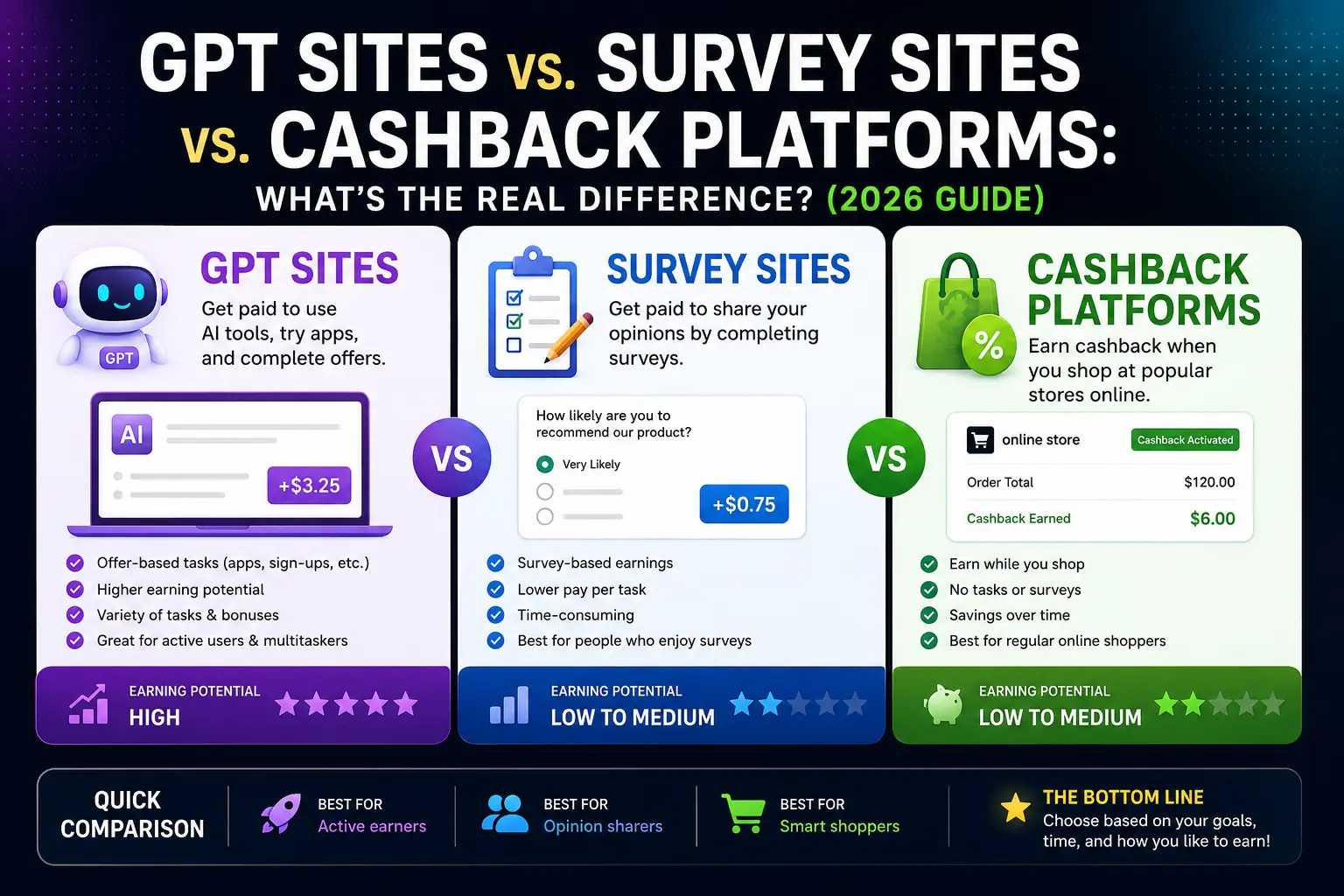
GPT Sites vs. Survey Sites vs. Cashback Platforms: What's the Real Difference?
Short answer, before you read another 5,000 words: GPT sites pay you for doing tasks (surveys, app trials, games, offer walls). Survey sites pay you specifically for sharing your opinion. Cashback platforms pay you a percentage back on money you were already going to spend. They overlap more than most "make money online" articles admit, and the smartest approach — the one I actually use — is running one of each at the same time instead of picking a single winner.
I want to get one thing out of the way immediately: nothing in this article is going to replace a paycheck. If you've landed here searching for a way to quit your job, this isn't it, and anyone who tells you otherwise is trying to sell you something. What this article will do is explain, honestly, how these three types of platforms actually work under the hood, where the money genuinely comes from, which ones are worth your time, and how to avoid the ones that will waste it. I've used all three categories for years — some good months, some months where I forgot I even had an account — so this isn't theory. It's what I've actually seen happen to my own PayPal balance.
Let's start by untangling the terminology, because "get paid to," "paid surveys," and "cashback" get thrown around interchangeably in YouTube thumbnails, and they really shouldn't be.
The Core Difference in One Paragraph
Think of it as three different relationships with your time and money:
- GPT sites monetize your attention and effort. You do something — download an app, reach level 12 in a game, watch a video, sign up for a free trial — and an advertiser pays the platform a "cost per action" fee, most of which the platform shares with you.
- Survey sites monetize your opinion. Market research firms need consumer data for product decisions, and they pay panel companies to recruit people who match specific demographics. You're the product being recruited, and the survey site is the recruiter taking a cut.
- Cashback platforms monetize purchases you were already making. Retailers pay affiliate commissions to sites that send them paying customers. Instead of keeping that commission, cashback apps split it with you.
None of these are charities. Every dollar you earn is a slice of a marketing budget that a company decided was worth spending to reach you specifically. Understanding that is the key to understanding why some platforms pay well and others don't: it comes down to how much the advertiser values the action, the opinion, or the purchase.
What Are GPT (Get-Paid-To) Sites?
GPT is short for "get-paid-to," and it's the broadest of the three categories. A GPT site is essentially a rewards marketplace: it plugs into dozens of third-party "offer walls" (companies like AdGem, Bitlabs, Revlum, and Tapjoy that run the actual advertiser campaigns) and displays all of them in one dashboard. You pick a task, complete it, and points or cash land in your account — usually after a short verification delay so the advertiser can confirm you actually did what you said you did.
The task menu on a typical GPT site is genuinely varied. Based on what platforms like Freecash, Swagbucks, PrizeRebel, and ySense currently offer, you'll typically see:
- Surveys (yes, GPT sites usually include these too — they're just one tab among many)
- App and game installs, often tiered so you get paid more for hitting level 10, then again for level 25
- Free trial sign-ups for streaming services, subscription boxes, or financial apps
- Watching video ads or using a search engine for a set number of searches
- Offer walls that bundle dozens of these tasks from third-party networks into one scrollable list
- Referral programs, which can be a meaningful income stream if you actually have an audience to share with
The most-cited names in this space are worth knowing by reputation. Swagbucks has been running since 2008 and is one of the most recognizable brands in the category, though several independent reviews now note its per-task payout rates have slipped as the platform has aged, with newer competitors often out-earning it per hour. PrizeRebel has operated since 2007 and built its reputation on a genuinely low cashout minimum. Freecash has climbed rankings quickly on the back of strong Trustpilot scores and a wide variety of withdrawal options including PayPal, crypto, and gift cards.
If you want to sanity-check a GPT site before signing up (and you should), SurveyPolice maintains hundreds of user-submitted reviews specifically for this category, and it's one of the more useful independent resources for cross-referencing payout claims against real user experiences rather than the platform's own marketing copy.
The honest downside: disqualifications and tracking failures are real. You'll occasionally complete a game task, hit the required level, and never get credited because the advertiser's tracking pixel didn't fire correctly. Reputable GPT sites have support teams that will manually verify and pay you if you provide proof (screenshots, timestamps). Sketchy ones will ignore you. This is the single biggest differentiator between a good GPT site and a waste of an evening.
What Are Survey Sites?
Survey sites are the narrower, more specialized cousin of GPT platforms. Instead of a grab-bag of tasks, the entire business model is built around one thing: connecting market research companies with people willing to answer questions about their habits, opinions, and purchasing decisions.
Here's the mechanic that most articles skip over: when you sign up for a survey site, you're not actually joining one panel — you're joining a router. The site collects your demographic profile (age, income bracket, location, shopping habits, health conditions, whatever you've disclosed) and then, every time a market research firm needs, say, "women aged 35 — 44 who buy pet food online," the router checks whether you match. If you do, you get invited. If a survey fills up its quota for your demographic before you finish it, you get disqualified partway through — which is exactly why disqualification rates on survey sites are notoriously high and a genuine point of user frustration.
The best-known names here include:
- Survey Junkie, which has built a reputation around shorter, more targeted surveys rather than the marathon 40-minute ones some competitors run
- Branded Surveys, which layers a loyalty-tier system ("Branded Elite") on top of standard survey payouts, rewarding consistent monthly activity
- LifePoints, a long-running international panel with flexible payout options but a Trustpilot score that sits solidly in "it works, but manage expectations" territory
- Respondent, which is genuinely different — it pays for longer, higher-value research sessions (think $20 — $150 for a 30 — 60 minute interview) rather than penny-per-click surveys, because it's targeting researchers and UX studies rather than casual consumer polling
One thing I'll say from direct experience: survey sites reward patience more than any other category on this list. The sign-up profiling questions matter enormously — the more accurately and completely you fill out your initial profile, the fewer disqualifications you'll hit later, because the router gets better at matching you to surveys you'll actually qualify for. Skipping the profile setup to "get to the money faster" is the single most common mistake new users make, and it costs them dozens of wasted disqualifications in the first week.
What Are Cashback Platforms?
Cashback is the odd one out on this list, and honestly, it's the one I'd point a skeptical friend toward first — because unlike GPT and survey sites, it doesn't require you to do anything you weren't already doing. You shop. You were going to buy the thing anyway. The platform just makes sure part of the retailer's marketing spend ends up in your pocket instead of disappearing into an ad budget you never see.
Here's how the mechanic actually works: retailers pay affiliate networks a commission — typically 1% to 10% of the sale, sometimes more for specific promotions — for every customer sent their way through a tracked link. Cashback platforms are affiliates. Instead of pocketing the whole commission the way a coupon blog or influencer might, they share most of it back with you, keeping a smaller cut for themselves.
The two names that dominate this category in the US are:
- Rakuten (formerly Ebates), which has been running since 1997 and currently partners with several thousand retailers, letting you earn cashback through its browser extension, mobile app, or by clicking through its site before you shop
- Ibotta, which has paid out more than a billion dollars in cumulative rewards since 2012 and works a little differently — it's especially strong for grocery and in-store cashback via receipt scanning, in addition to online shopping
Internationally, TopCashback and ShopBack run comparable models in the UK, EU, and parts of Asia. It's also worth flagging that this space has had real casualties — Australia's Cashrewards, for example, ceased operations in 2025 — which is a useful reminder that even established cashback platforms aren't risk-free, and you shouldn't let a large cashback balance sit unclaimed for months when you could be withdrawing it periodically.
The mechanics that trip people up: cashback is tracked through cookies and click-throughs, which means ad blockers, other browser extensions (especially other coupon or cashback tools), and even just opening a new tab before completing checkout can break the tracking chain. If a purchase doesn't show up in your account within a day or two, most platforms have a "missing cashback" claim form — use it, because tracking failures are common enough that legitimate platforms build entire support workflows around fixing them.
A Closer Look at Each Category's "Big Names"
It helps to actually picture the platforms behind the category labels, because "GPT site" or "survey site" can otherwise feel abstract. Here's a slightly deeper look at how a handful of the most-referenced platforms differentiate themselves from each other — useful context whether you're picking your first platform or deciding which second or third one to add.
Freecash has climbed to the top of a lot of independent rankings largely on the strength of its Trustpilot volume (over 200,000 reviews, mostly positive) and a genuinely low $5 minimum cashout. It leans heavily on game-offer tasks, which tend to pay more per completed task than pure survey work, at the cost of requiring several days of actual play to hit milestone rewards.
Swagbucks is the platform most people have heard of even if they've never used a GPT site, largely because it's been running since 2008 and layers cashback shopping directly into its GPT dashboard — meaning it technically blurs the line between two categories in this article. Several current reviews note that its per-task rates have softened as the platform has scaled, which is a common pattern in this industry: older, larger platforms often get outpaced on a per-hour basis by newer, leaner competitors, even while retaining a stronger overall brand reputation.
PrizeRebel has been operating continuously since 2007, which in this industry is a meaningful trust signal on its own — a huge share of "get rich quick" platforms don't survive two years, let alone two decades. It's built its loyal base on predictable, low-friction cashouts rather than headline-grabbing task payouts.
Survey Junkie differentiates itself within the survey category by keeping its questionnaires shorter and more targeted, rather than running the 30 — 45 minute marathon surveys some competing panels rely on. That design choice trades a lower per-survey payout for a noticeably better completion rate, which — once you account for how much time gets burned on disqualifications elsewhere — often nets out favorably on an hourly basis.
Respondent is worth calling out separately because it doesn't really compete with the other survey sites at all — it's aimed at UX researchers and academic studies needing qualified participants for longer interviews, and it pays accordingly ($20 to $150+ per session is typical). If you have a specific professional background or niche demographic profile, it's worth a look precisely because it's the exception to the "surveys pay pennies" rule.
Rakuten is the cashback platform most US shoppers will recognize by its former name, Ebates, and its core value proposition hasn't changed in decades: click through before you shop, or install the browser extension so it happens automatically, and a percentage comes back to you on a rolling basis, typically paid out quarterly.
Ibotta covers similar ground online but has built a genuinely distinct niche in grocery cashback — scan a receipt after an in-store purchase and get credited for specific rebated products, which is something Rakuten's link-based model can't do for cash or card purchases made without clicking through first.
Side-by-Side Comparison Table
| Factor GPT Sites Survey Sites Cashback Platforms | |||
| What you're paid for | Completing tasks (installs, trials, offer walls) | Sharing opinions and demographic data | Purchases you make anyway |
| Effort required | Moderate to high | Moderate (time-intensive per dollar) | Minimal — mostly a habit shift |
| Typical earning rate | $1 — $5/hour, occasionally $10 — $50 for high-value game offers | $0.25 — $3 per survey, roughly $2 — $3/hour average | 1% — 10% of what you were spending anyway |
| Speed to first payout | Often same-day to a few days | Days to a couple of weeks | Weeks (many platforms hold cashback until it "confirms") |
| Best-known platforms | Freecash, Swagbucks, PrizeRebel, ySense | Survey Junkie, Branded Surveys, LifePoints, Respondent | Rakuten, Ibotta, TopCashback |
| Biggest frustration | Tracking failures on offer completion | High disqualification rates | Cookie/tracking conflicts breaking credit |
| Requires new spending | No | No | No — only redirects existing spending |
| Realistic monthly ceiling for a casual user | $30 — $150 | $20 — $75 | Depends entirely on spending habits, often $10 — $40 |
Where the Money Actually Comes From
I promised I'd be direct about this, because it matters for judging whether a platform is trustworthy. In all three models, you are being paid out of someone else's marketing or research budget, not out of thin air. This is actually reassuring once you understand it, because it means the incentives are aligned: legitimate companies genuinely want you to complete the survey, install the app, or click through before buying, and they've already allocated real money to make that happen.
The moment a "platform" asks you to pay them — a registration fee, a "verification" charge, a fee to "unlock" your earnings — you've left this legitimate ecosystem entirely. The Federal Trade Commission's consumer guidance is consistent across every category of work-from-home offer: legitimate companies do not charge people money to let them work, and anyone asking you to deposit a check and wire part of it back is running a classic advance-fee scam, not a real earning opportunity. Keep that single rule in your back pocket and you'll filter out the vast majority of scams in this space without needing to research each platform individually.
Realistic Earnings: What You Can Actually Expect
I'll be more specific here than most articles are willing to be, because vague promises are how this whole category gets a bad reputation.
GPT sites: Independent estimates and review sites tracking this space consistently land in a similar range — casual users spending 15 — 30 minutes a day tend to land around $30 — $75 a month, while people who treat it more like a genuine side hustle and chase higher-value game or app offers can push toward $150 — $300. The gap between those two numbers comes almost entirely from task selection: surveys and offer-wall clicks pay pennies, while completed game milestones and financial app sign-ups can pay $5 — $50 each, just with a much longer completion window (sometimes several days of active play to hit a required level).
Survey sites: Expect something closer to $2 — $3 per hour once you account for disqualifications, which is genuinely lower than most GPT tasks. The upside is consistency — if you have fifteen minutes waiting for an appointment, there's almost always a survey attempt available, even if you don't qualify for all of them. Specialist platforms like Respondent break this pattern entirely by paying flat rates of $20+ for longer research sessions, but those opportunities are far less frequent and usually require specific professional or demographic profiles.
Cashback platforms: This one isn't really about an hourly rate at all — it's a percentage of spending you were doing regardless. If you spend $500 a month online and average 3% cashback across your purchases, that's $15 a month for essentially zero extra time invested beyond clicking through a browser extension before checkout. It won't feel like "earning money" in the way a survey payout does, but over a year it adds up to a genuinely free $150 — $200, which is a better return on effort than almost anything else on this list.
None of these numbers are going to be the thing that changes your financial situation. What they can do is cover a streaming subscription, offset a grocery bill, or fund a "fun money" account without touching your actual budget — which, honestly, is the realistic and sustainable way to think about this whole category.
Pros and Cons of Each Model
GPT Sites
Pros:
- Widest variety of tasks, so there's almost always something to do
- Highest per-task ceiling (game offers and financial sign-ups can pay well)
- Fast payout thresholds on several platforms, some as low as $1 — $5
- Multiple payout options — PayPal, gift cards, crypto on many platforms
Cons:
- Tracking failures are the most common complaint across review sites
- Requires active time investment; nothing here is passive
- Task availability varies heavily by country — US, UK, and Canadian users generally see far more offers than users elsewhere
Survey Sites
Pros:
- Low barrier to entry — no app downloads, no reaching specific game levels
- Can be done in short bursts (a single survey rarely takes more than 15 — 20 minutes)
- Specialist platforms like Respondent pay significantly above the category average for qualified users
Cons:
- High disqualification rates waste time without paying anything
- Lower hourly rate than most other GPT tasks
- Some panels ask for fairly personal information (health conditions, financial habits) — worth reading the privacy policy before you disclose more than you're comfortable with
Cashback Platforms
Pros:
- Zero extra effort beyond a browser extension or checking before you buy
- No risk of "wasting time" the way a disqualified survey does
- Stacks with store sales, coupons, and credit card rewards in most cases
Cons:
- Tracking can silently fail, and you may not notice unless you check your dashboard
- Cashback is often not "confirmed" (available to withdraw) for 30 — 90 days, since the platform has to wait out the retailer's own return window
- Doesn't work for cash purchases, in-person deals outside of receipt-scanning platforms, or purchases where you forgot to click through first
How to Spot a Scam vs. a Legit Platform
This is the section I'd want a friend to read before they hand over their email address to yet another "make $500 a day" landing page. A few consistent, boring, reliable checks:
- It should be free to join. No registration fees, no "activation" charges, no requirement to deposit and wire back a check. This is the FTC's core guidance across every category of work-from-home offer, and it's the single most reliable filter available.
- Check third-party review platforms, not just the site's own testimonials. Trustpilot, the BBB, and the Google Play or App Store review sections are harder to fake at scale than a testimonials page the company controls itself. Look specifically for recent reviews mentioning actual payouts, not just sign-up bonuses.
- Look for a real minimum cashout and confirm people are hitting it. Sites that keep raising the bar right before you reach your first payout, or that have a suspiciously high minimum ($50+) combined with low per-task rates, are a common complaint pattern in this space.
- Be skeptical of platforms with no public company information. A legitimate GPT, survey, or cashback platform will usually have an identifiable company behind it, a real privacy policy, and — for survey sites in particular — a named market research parent company.
- Never give out financial account credentials directly. Legitimate cashback platforms use tracked affiliate links or receipt scanning; they don't need your online banking login to pay you cashback.
- Trust the disqualification pattern, not just the rating. A platform with a low star rating driven mostly by "I got disqualified from every survey" complaints is frustrating but not necessarily a scam — that's a real limitation of the survey-router model. A platform with reviews describing withheld payouts after reaching the cashout threshold is a different and much more serious red flag.
Which One Is Right for You?
Honestly, the answer depends less on which platform is "best" and more on what kind of dead time you're trying to fill, and how much friction you're willing to tolerate for the payout.
- If you have short, unpredictable pockets of free time — waiting rooms, commutes, ad breaks — survey sites fit that rhythm best, since most surveys are self-contained in 10 — 20 minutes.
- If you have longer stretches and don't mind some setup — an evening where you're already scrolling your phone anyway — GPT sites reward that better, especially game-offer tasks that pay more the longer you stick with them.
- If you want something that requires essentially no behavior change, cashback platforms are the obvious starting point, because the "work" is a five-second browser extension click before checkout on purchases you were making regardless.
My Honest Strategy: Running All Three Together
I don't pick one. I run a cashback browser extension permanently in the background because it costs me nothing — I genuinely forget it's there until a rebate shows up. I keep one GPT site open on my phone for commute time or the ten minutes before a show starts, specifically because the task variety keeps it from getting boring the way a single-purpose survey app does. And I keep a survey site bookmarked for the very specific scenario of sitting in a waiting room with nothing else to do, because it doesn't require me to be at a computer or mid-game-session to be worth opening.
The compounding effect is real, but it's modest, and I want to be honest about that instead of oversell it: across a typical month, this combination nets me somewhere in the range independent trackers report for casual multi-platform users — enough to cover a subscription or two, not enough to call it income. What actually makes it worthwhile isn't the dollar figure, it's that none of it competes with time I'd otherwise spend productively. It's money extracted from time that was already being spent scrolling, commuting, or shopping.
The mistake I'd caution against is treating any single one of these as a job. The moment you start budgeting around GPT or survey income, or spending money you wouldn't have spent anyway just to chase cashback, the math flips against you. Used as a background layer on top of habits you already have, this category is genuinely worth the minimal setup. Used as a primary income strategy, it isn't, and no honest article in this space should tell you otherwise.
A specific example from my own account history: I once completed a game-offer task on a GPT site that required reaching a certain in-game rank, which took about four days of playing on and off in the evenings. It paid $14. On paper that sounds like a terrible hourly rate if you count every minute the game was open, but realistically, that game replaced time I'd have spent on a different, unpaid mobile game anyway — so the honest way to value it isn't against a wage, it's against the alternative use of that specific stretch of downtime. That reframing is, I think, the single most useful mental model for this entire category: don't measure it against your day job's hourly rate, measure it against what you'd otherwise be doing with that exact block of time.
Availability by Country and Why It Matters
One limitation that rarely gets mentioned upfront: task and survey availability is heavily skewed toward a handful of countries, primarily the US, UK, Canada, and Australia. Market research firms and advertisers concentrate their budgets where their target consumers are, so a GPT or survey site with a genuinely global sign-up page can still leave users in less-represented countries staring at an empty task list most of the time. Several platforms are upfront about this in their FAQs; others aren't, and you won't find out until after you've created an account and profile. If you're outside the US/UK/Canada/Australia cluster, it's worth checking a platform's country-availability page or recent reviews from users in your specific region before investing setup time, rather than assuming a "worldwide" claim means equal task volume everywhere.
Cashback platforms have a milder version of the same issue — Rakuten and Ibotta are strongest for US retailers, while TopCashback and ShopBack cover UK, EU, and parts of Asia respectively — so the right cashback platform genuinely depends on where you shop, not just which one has the best marketing.
Taxes, Payouts, and Other Fine Print Nobody Mentions
A few practical notes that tend to get skipped in the excitement of a first payout:
- In the US, earnings can be taxable income. If a single platform pays you $600 or more in a calendar year, you may receive a 1099 form, and even below that threshold, the IRS generally expects you to report income regardless of whether a form was issued. Keep basic records of what you've earned across platforms.
- Cashback is usually treated differently from GPT or survey earnings for tax purposes in many jurisdictions, since it's often considered a rebate on your own spending rather than income — but rules vary by country, so this isn't something to assume without checking current guidance for your situation.
- Payout minimums matter more than headline earning rates. A platform advertising high per-task payouts is meaningless if you can never actually reach the withdrawal threshold. Check the minimum cashout and realistic time-to-reach-it before investing significant time.
- Gift card payouts often process faster than cash. If speed matters more to you than flexibility, several platforms process Amazon or retailer gift cards same-day while PayPal transfers take longer to clear.
Frequently Asked Questions
Are GPT sites, survey sites, and cashback platforms actually legit? The established, well-known platforms in each category are legitimate businesses with real revenue models, verifiable payout histories, and public reviews. Legitimacy varies by individual platform, though, so the vetting steps above (no fees, third-party reviews, verifiable payout history) matter more than the category itself.
Can I use more than one at the same time? Yes, and most experienced users do. There's no meaningful overlap or conflict between running a cashback extension, a GPT app, and a survey site simultaneously, since they monetize completely different behaviors.
Why do I keep getting disqualified from surveys? Survey routers match you to research quotas based on your profile. If a demographic quota fills before you finish, you're screened out — this isn't personal or a sign the site is broken, it's an inherent limitation of how survey routing works. Completing your profile as thoroughly and accurately as possible reduces this over time.
Do cashback apps track my purchases even when I'm not trying to earn cashback? Reputable cashback platforms only track purchases made through their tracked links or extension, and have public privacy policies describing exactly what data they collect. Read the privacy policy before installing any browser extension, since browser extensions in general can have broad access to your browsing activity.
Is it worth using multiple GPT sites instead of just one? Often yes — the same task or offer can pay noticeably different amounts on different platforms, since GPT sites individually negotiate rates with advertisers. Comparison tools that check the same offer across several platforms exist specifically because this price variation is common.
What's the single biggest red flag across all three categories? Any request for payment to join, activate, or "unlock" earnings. This is the consistent pattern behind fraudulent versions of every legitimate model described in this article, and it's the one rule worth memorizing.
Final Verdict
GPT sites, survey sites, and cashback platforms aren't competitors — they're three different tools solving three different problems, and the "which one is best" framing that most articles lead with is a little bit of a false choice. GPT sites are the most active and highest-ceiling option if you're willing to put in real time. Survey sites are the lowest-commitment option for short, unpredictable pockets of downtime. Cashback platforms are the closest thing on this list to genuinely free money, because they don't ask you to change your behavior at all.
None of them will replace a job. All three, used sensibly and stacked together, will quietly put a little bit of money back in your pocket for time and spending you were already doing. That's a modest promise, but it's an honest one — and in a category full of "make $1,000 a week from home" thumbnails, honest is worth more than it sounds.

Comments (0)
No comments yet. Be the first to share your thoughts!