
Let me start with something that still makes me laugh: in 2026, searching for — GPT sites — is an absolute nightmare. Half the results are about OpenAI's ChatGPT and custom GPT stores. The other half are about Get-Paid-To platforms where you earn pennies for watching ads. I've been in this space long enough to remember when — GPT — only meant one thing — and that was before the acronym got hijacked by generative AI.
I've used Swagbucks since 2019. I've cashed out from Freecash, PrizeRebel, TimeBucks, and Prolific. I've also watched dozens of copycat platforms launch with flashy landing pages, pay out for six months, and vanish overnight. So when people ask me whether GPT websites are still profitable in 2026, I don't give them a yes-or-no answer. I give them the full, sometimes uncomfortable truth.
This article is that truth. No affiliate hype. No — $500 a day from your phone — nonsense. Just what the industry actually looks like right now, what you can realistically expect to earn, which platforms are still worth your time, and the red flags that will save you from wasting evenings on scams.
What — GPT — Actually Means in 2026 (And Why the Confusion Matters)
In the context of online earning, GPT stands for Get-Paid-To. These are platforms — websites and mobile apps — that pay users for completing simple digital tasks: answering surveys, downloading apps, reaching milestones in mobile games, signing up for free trials, watching promotional videos, and shopping through affiliate links.
The confusion with AI — GPT — (Generative Pre-trained Transformer) isn't just annoying — it actively distorts the conversation. When someone searches — how to make money with GPT in 2026, — algorithms serve them two completely different economies: one where you build AI chatbots for the OpenAI GPT Store (a genuinely different business model with its own challenges), and one where you fill out surveys for fifty cents.
I've had friends message me asking if they should learn Python to monetize — GPT sites. — That's how tangled this has become. For the rest of this article, when I say GPT, I mean Get-Paid-To. Full stop.
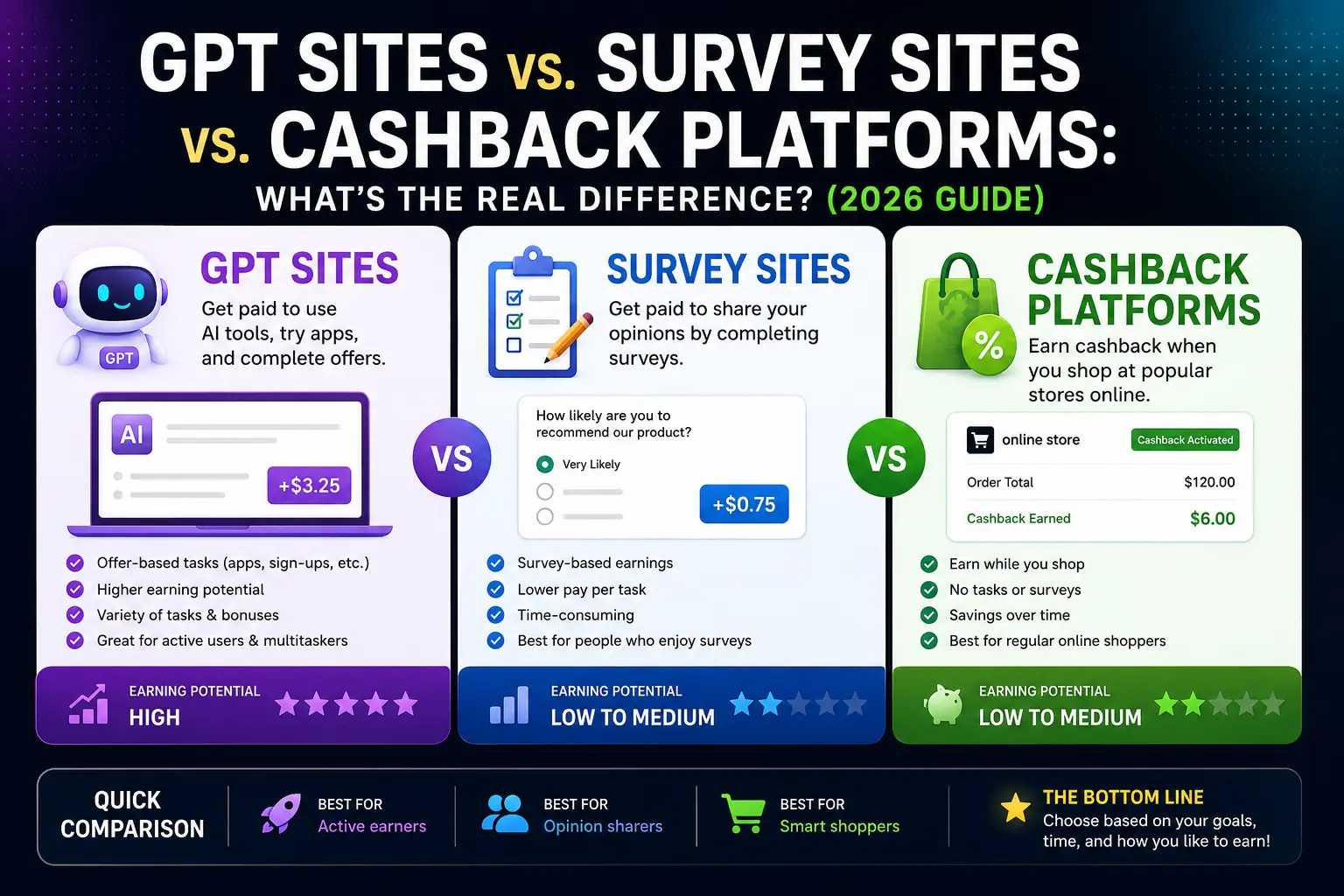
If you're curious about how these platforms differ from pure survey sites or cashback apps, I broke that down in detail over at GPT Sites vs. Survey Sites vs. Cashback Platforms: What's the Real Difference?. The short version: GPT sites are the broadest category, survey sites are a subset focused on market research, and cashback platforms pay you back on purchases you were already making.
The Current State of GPT Sites in 2026: Bigger Than Most People Realize
Here's something that surprised even me: the rewards app and cashback market alone was valued at approximately $4.14 billion in 2025 and is projected to hit $7.73 billion by 2034, growing at a 7.20% compound annual growth rate. The broader digital loyalty economy — which includes web-based GPT platforms, in-game offerwalls, and rewards integrations — sits at an estimated $51.5 billion in 2024 and climbing.
This is not a fringe side-hustle category. It's a legitimate, multi-billion-dollar industry with established players, sophisticated backend infrastructure, and real money changing hands. According to Pew Research Center data, around 16% of Americans have earned money through online gig platforms, and reward sites represent one of the most accessible entry points.
But here's the critical distinction: the industry is profitable. That doesn't mean you will be. The money flowing through these platforms is real, but the slice that reaches individual users is modest by design. Understanding that design is the key to deciding whether GPT sites fit your life.
How GPT Sites Actually Work: The Three-Sided Market Nobody Explains
Most articles describe GPT sites as a simple transaction: you do a task, the site pays you. That's the user-facing story. The actual business is a three-sided market, and once you see it, you understand why payouts are what they are.
Side one: the advertiser. A mobile game studio, a VPN company, a fintech app, a subscription box service — someone with a customer acquisition budget and a specific action they want taken. Install the app. Reach level five. Enter a card for a free trial. Complete a lead form.
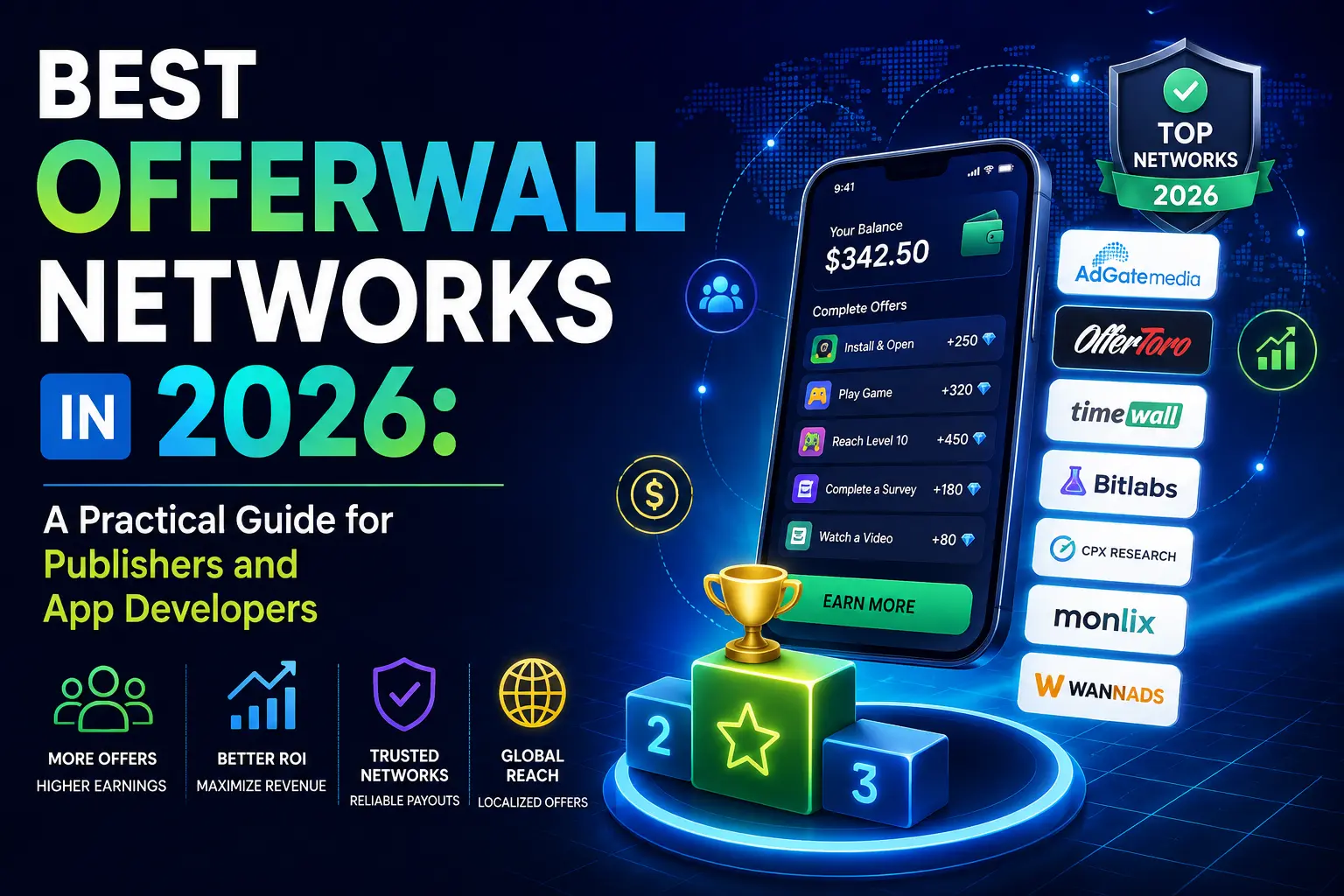
Side two: the network. Between the advertiser and the GPT site sits a CPA (Cost Per Action) network like AdGate Media, Tapjoy, or CPX Research. These networks vet advertisers, track conversions, filter fraud, and pool thousands of offers into a single feed that a GPT platform can plug into via API.
Side three: the GPT platform and its users. The platform displays that feed to members. Members complete actions. The platform keeps a margin between what the network pays and what it passes to the user.
I went deep into this machinery in The Real Economics Behind a Successful GPT Platform in 2026, but the essential takeaway is this: every dollar in your PayPal account started as marketing spend that a real company decided was cheaper than buying a Google or Meta ad. You're not finding a glitch in the system. You're the last link in a very long, very deliberate advertising chain.
The Best GPT Sites in 2026: Tested, Ranked, and Honestly Reviewed
I've personally used or thoroughly researched every platform on this list. These aren't theoretical recommendations — they're based on actual cashouts, support interactions, and hours logged.
Freecash: Best for High-Paying Game Offers
Freecash has become the platform I recommend most often to people who ask me where to start. It leans heavily on offer walls and app trials rather than surveys, and that focus is why the hourly rate ceiling here is higher than on survey-first platforms.
The $0.10 minimum cashout is almost unheard of — it means you can test whether the platform works for your region with zero commitment. Same-day payouts are standard. The interface is cleaner than most competitors. And the game trial offers, in particular, can pay $5 — $15 per hour when you target the right milestones.
My honest take: Freecash works best if you're willing to engage with mobile games and app installs. If you only want to answer surveys, you'll find better options elsewhere. Also, offer availability drops significantly outside North America and Western Europe. A user in California and a user in Serbia can have completely different experiences on the exact same platform.
Realistic earnings: $40 — $100+/month for users targeting high-value offers.
Swagbucks: Best for Beginners and Cashback
Swagbucks has been running since 2008 and has paid out over $450 million cumulatively. That track record matters in an industry where platforms disappear overnight.
What genuinely sets Swagbucks apart is the shopping cashback layer. Clicking through Swagbucks before buying from Amazon, Target, or dozens of other retailers earns a percentage back without any additional effort. For anyone who shops online regularly, that passive income stacks on top of whatever you earn from tasks.
The daily goals system awards bonus points for hitting activity targets. The $3 minimum cashout is accessible. And the referral program pays a permanent percentage of referred users — earnings.
My honest take: Swagbucks is the safest starting point for anyone new to GPT sites. The per-task rates have softened over the years as the platform has scaled — newer competitors often out-earn it on a per-hour basis — but the legitimacy question is settled before you even sign up. I keep my Swagbucks account active primarily for the cashback feature; the task earnings are a secondary benefit.
Realistic earnings: $20 — $50/month for casual users, $75 — $150 for heavy users maximizing cashback.
PrizeRebel: Best for Low-Commitment Testing
PrizeRebel has operated continuously since 2007. In an industry where most platforms don't survive two years, that longevity is a trust signal you can't fake.
The $1 minimum cashout is genuinely unusual. For someone trying to figure out whether GPT sites are worth their time at all, cashing out within your first hour rather than grinding for weeks changes the entire risk calculation. Credits post quickly. Trustpilot reviews have stayed consistently positive across nearly two decades.
My honest take: PrizeRebel is where I send people who are skeptical. The low cashout threshold lets you verify that payouts actually work before you commit meaningful time. The earnings ceiling is lower than offer-focused platforms, but the barrier to entry is practically nonexistent.
Realistic earnings: $25 — $60/month for regular users.
EarnLab: Best for Fast Cashouts
EarnLab launched in 2023 and has already paid out over $1.8 million to 247,000+ users. The $2.50 minimum cashout is the lowest among major platforms, and after the first withdrawal clears manual review, PayPal payments process instantly.
What separates EarnLab is the gamification layer: mystery boxes, daily streaks, and a VIP program with weekly and monthly cash bonuses. Live chat support responds within 20 minutes, which matters more than you'd think when an offer doesn't track correctly.
My honest take: EarnLab rewards consistency. If you're the type to check in daily, the VIP bonuses add real money. If you're a sporadic user, the advantage diminishes. The three-year track record is shorter than decade-old competitors, but the growth trajectory is impressive.
Realistic earnings: $30 — $80/month for regular users.
TimeBucks: Best for Global Users
TimeBucks has been running since 2012 and covers markets where other platforms have thin offer inventory. If you're outside the US/UK/Canada/Australia cluster, TimeBucks is often the most reliable option.
Task variety goes beyond standard surveys and includes social media posting tasks and content engagement. Payout options include PayPal, Bitcoin, gift cards, and direct bank transfer — more methods than most competitors offer.
My honest take: TimeBucks is uneven. Users in certain regions find it one of the better-paying options available. Users elsewhere find the offer inventory thin. The $5 minimum payout is higher than some competitors. But for global coverage, it's hard to beat.
Realistic earnings: $30 — $70/month for active users.
InboxDollars: Best for US Users
InboxDollars has been running since 2000 and focuses almost entirely on the US market. The paid email reading feature is genuinely unique: you receive promotional emails and get paid to open them, requiring almost zero active effort.
Earnings display in actual dollars rather than a points system, which makes tracking progress easier. The $15 minimum cashout is the highest on this list, but a $5 signup bonus covers a meaningful chunk upfront.
My honest take: InboxDollars is a solid choice for US users who want passive income layered onto active earnings. Outside the US, the value drops significantly. I've kept my InboxDollars account for years primarily for the email credits — it's genuinely free money for checking your inbox.
Realistic earnings: $20 — $40/month for US users.
Realistic Earnings: What I Actually Made (And What the Data Says)
This is where most GPT articles lie to you. They lead with the outlier numbers — the power user who made $300 in a month — and bury the median experience. I'm going to do the opposite.
Over the past year, tracking my own activity across three platforms (Swagbucks, Freecash, and PrizeRebel), here's what I earned:
- January: $47.30 (heavy activity, chased a few game offers)
- February: $23.15 (casual, mostly surveys during commutes)
- March: $61.80 (cashed out a big game milestone on Freecash)
- April: $18.40 (barely checked in)
- May: $34.60 (moderate activity, some cashback shopping)
- June: $29.75 (mixed tasks, nothing notable)
- July: $52.10 (free trial offers stacked well that month)
- August (so far): $21.30
Total for the year: approximately $288. That's an average of $36/month for what I'd estimate as 30 — 45 minutes of activity per day, not every day.
Independent estimates align with this range. Casual users spending 15 — 30 minutes a few times per week typically land between $20 and $50 per month. Active users running multiple platforms and prioritizing offer walls over surveys can reach $50 — $150 per month. The gap between those numbers comes almost entirely from task selection, not platform choice.
On a per-hour basis, here's the brutal truth:
- Surveys: $1 — $3/hour once you account for disqualifications
- Sign-up offers and service trials: $3 — $8/hour
- Mobile game milestones: $5 — $15/hour for the right offers
- Cashback shopping: Variable, but requires zero extra time
The r/beermoney subreddit — the most honest forum on the internet for this topic — confirms these ranges repeatedly. One veteran member tracked earnings meticulously and reported roughly $140,000 over 9+ years before transitioning to other income streams. But that was treating GPT work as a genuine second job, not a casual side activity.
For the typical person checking in during commercial breaks? Expect coffee money, not rent money.
The Hidden Costs Nobody Talks About
If you're considering GPT sites, you need to understand the frustrations that don't show up in marketing materials.
Survey Disqualifications
This is the single most maddening aspect of the entire industry. You answer five minutes of demographic questions, then get kicked out with zero pay because you don't fit the research firm's quota. It happens to everyone. It happens constantly. A disqualification rate of 30 — 50% is standard, not exceptional.
The reason this happens is structural: survey routers match you to active research studies in real time based on your profile. If a demographic quota fills before you finish, you're screened out. The GPT site doesn't get paid either, which is why most platforms offer a small disqualification bonus of a few cents — it's cheaper to placate you than to lose you entirely.
Tracking Failures
You complete a game offer, hit the required level, and never get credited. This happens because the advertiser's tracking pixel didn't fire correctly, or a cookie got blocked, or you switched devices mid-task. Reputable platforms have support teams that will manually verify and pay you if you provide screenshots and timestamps. Sketchy ones will ignore you.
I've had to open support tickets on every platform I've used. The difference between a good GPT site and a waste of time is entirely in how those tickets get resolved.
The Opportunity Cost
This is the cost nobody puts in their earnings reports. Every hour on a GPT site is an hour not spent on higher-paying skills. Entry-level freelance work on Upwork or Fiverr pays $15 — $30/hour against the $3 — $5/hour ceiling on most GPT tasks.
I'm not saying GPT sites are worthless. I'm saying you should be honest about what you're trading. If you're monetizing time that would otherwise be spent scrolling Instagram, the math works. If you're choosing GPT tasks over learning a marketable skill, the math doesn't.
Geographic Inequality
This is the variable that most earnings estimates quietly ignore, and it matters more than any other factor. Users in the US, Canada, UK, and Western Europe see offer inventories that users in Eastern Europe, Southeast Asia, and most of Africa simply don't have access to. The same platform can be genuinely lucrative for one user and nearly worthless for another depending entirely on where they log in from.
CPA offers are priced per country. A budgeting-app sign-up worth $18 in the United States might be worth $1.50 in the Philippines, not because the platform is unfair, but because the advertiser's expected customer lifetime value is different in that market.
Are GPT Sites Still Profitable? The Verdict by User Type
After years in this space, here's my framework for deciding whether GPT sites make sense for you in 2026.
GPT Sites ARE Worth It If:
You're a student with irregular schedules. The flexibility is real. No shifts, no applications, no boss. Fitting tasks around a chaotic semester works in a way that a part-time job doesn't.
You're a parent with fragmented free time. Ten minutes during naptime. Fifteen minutes waiting in the carpool line. These pockets add up to real money when they would otherwise go unused.
You shop online regularly. The cashback layer on platforms like Swagbucks and Rakuten is genuinely free money. You were going to buy the item anyway.
You want to test whether online earning is real. The low barrier to entry lets you verify that payouts actually work before committing to more complex side hustles.
GPT Sites Are NOT Worth It If:
You need money fast. The hourly rate is too low for urgent financial needs. Get a side gig with a guaranteed wage instead.
You have marketable freelance skills. Writing, graphic design, coding, virtual assistance — any of these pays 3 — 10x more per hour than GPT tasks. Building a freelance profile pays dividends over six months in a way that GPT completion never does.
You get genuinely frustrated by disqualifications. If spending five minutes on screening questions and getting bounced makes you want to throw your phone, this category will make you miserable. It's not a bug; it's the business model.
You're treating this as a primary income strategy. It isn't one. It was never designed to be one. Anyone promising otherwise is selling you something.
Red Flags and Scams to Avoid in 2026
The GPT space has its share of bad actors. Here's my verification checklist — the same one I give friends before they sign up for anything.
1. Never Pay to Join
No legitimate GPT site charges a registration fee, — activation — charge, or fee to — unlock — your earnings. The Federal Trade Commission is consistent on this across every work-from-home category: legitimate companies don't charge people money to let them work.
2. Check Independent Reviews
Don't trust a platform's own testimonials page. Check Trustpilot, the BBB, Reddit's r/beermoney community, and SurveyPolice for cross-referenced user experiences. Look specifically for recent reviews mentioning actual payouts, not just sign-up bonuses.
3. Verify the Track Record
A platform that launched last month with a slick landing page and no company information is a gamble. Established platforms with multi-year payout histories — Swagbucks since 2008, PrizeRebel since 2007, InboxDollars since 2000 — have proven they can survive market shifts and continue paying users.
4. Test the Minimum Cashout First
Before investing significant time, verify you can actually get money out. A platform advertising high per-task payouts is meaningless if the withdrawal threshold is $50 and you never reach it. Start with the minimum payout to test reliability.
5. Beware of Impossible Promises
— $500 a day for 10 minutes of work — is not a GPT site. It's a scam. Realistic earnings are modest. Any platform promising life-changing money is either lying or running a pyramid scheme.
6. Never Give Out Banking Credentials
Legitimate cashback platforms use tracked affiliate links or receipt scanning. They don't need your online banking login. If a — GPT site — asks for direct access to your financial accounts, run.
How to Maximize Your GPT Earnings: Strategies That Actually Work
If you're going to do this, do it efficiently. Here are the strategies I've developed over years of trial and error.
Run Multiple Platforms Simultaneously
No single platform has enough high-paying tasks to keep you busy full-time. The same offer can pay different amounts on different platforms because GPT sites individually negotiate rates with advertisers. I typically keep Freecash open for game offers, Swagbucks for cashback and daily goals, and PrizeRebel for quick survey attempts.
Prioritize Offer Walls Over Surveys
Surveys are the most visible task type but the lowest-paying per hour. Offer walls and game trials consistently pay 3 — 5x more. On Freecash, I've seen game offers hit $10 — $15 for reaching a specific level. That same time spent on surveys might earn $1 — $2.
Complete Your Profile Thoroughly
On survey-focused platforms, the more accurately you fill out your demographic profile, the fewer disqualifications you'll hit. Skipping profile setup to — get to the money faster — is the single most common mistake new users make. It costs you dozens of wasted disqualifications in the first week.
Stack Cashback with Sales and Credit Card Rewards
This is the closest thing to free money in the entire ecosystem. Click through Swagbucks or Rakuten before buying, use a rewards credit card, and apply store coupons. You're triple-dipping on the same purchase.
Track Your Time Honestly
I use a simple spreadsheet: date, platform, time spent, amount earned. This keeps me honest about my effective hourly rate. If I notice I'm averaging $1.50/hour on a platform, I deprioritize it. If I'm hitting $8 — $10/hour on game offers, I lean in.
Don't Chase Losses
If you've had three disqualifications in a row, walk away. The sunk cost fallacy is real in GPT work. Come back tomorrow when the router has fresh surveys.
The Future of GPT Sites: Where This Is Heading
A few shifts are worth watching if you're invested in this space long-term.
AI-Driven Personalization
Platforms are increasingly using machine learning to match users with higher-converting, better-paying offers based on behavioral profiles. This should make payouts feel less arbitrary over time — though it also means platforms will get better at predicting exactly how little they can pay you while keeping you engaged.
Crypto and Instant Payouts
The next generation of GPT users expects near-instant gratification. Platforms offering Bitcoin, Ethereum, and sub-$3 minimum payouts are gaining market share against legacy players with $15+ thresholds. Freecash's $0.10 minimum and instant processing is the direction the industry is moving.
Mobile-First and In-App Offerwalls
The growth is in mobile. Prodege (Swagbucks — parent company) reported a 305% year-over-year increase in Monthly Active Users in 2024, driven largely by mobile gaming integrations. If you're starting as a user or building a platform today, mobile isn't optional — it's existential.
Real-World Task Integration
Some platforms are shifting toward location-based rewards — scanning QR codes at stores, verifying retail visits, or completing physical challenges. The pure — sit at your computer and click — model is expanding into the physical world, which could create new earning opportunities for users willing to leave the house.
If you're interested in the technical side of building these platforms — offerwall integration, S2S postbacks, fraud prevention — I've written detailed guides on How to Create an Offerwall Website and How to Add an Offerwall SDK to Android & iOS Apps. The backend architecture is genuinely fascinating, and understanding it makes you a smarter user.
Frequently Asked Questions
Are GPT sites still worth it in 2026?
For people with idle time and no competing income options, yes. Realistic earnings run $30 — $100/month for consistent users. For anyone with freelanceable skills or urgent financial needs, the hourly math doesn't favor GPT sites.
Which GPT site pays the most?
Freecash tends to offer the best hourly rates when you focus on game trials and app offers. EarnLab is competitive across more task types and pays better for consistent users through its VIP bonus structure. But the platform that — pays most — depends on what's available in your region on a given day.
Can you actually make a living from GPT sites?
No. These platforms are designed for supplemental income, not replacement income. Even power users treating this as a second job rarely exceed a few hundred dollars per month.
Are GPT sites safe?
Established platforms with long track records are legitimate businesses. Scams exist — look for upfront payment requirements, impossible earning promises, and thin review profiles. When in doubt, check Trustpilot and r/beermoney.
Why do I keep getting disqualified from surveys?
Survey routers match respondent profiles to active research studies in real time. If your demographic quota fills before you finish, you're screened out. It's structurally necessary, not personal. Completing your profile thoroughly reduces this over time.
Do I have to pay taxes on GPT earnings?
In the United States, yes. If a single platform pays you $600 or more in a calendar year, you may receive a 1099 form. Even below that threshold, the IRS generally expects you to report income. Keep basic records.
What's the difference between GPT sites and survey sites?
GPT sites are the broad category — they include surveys, app installs, game trials, cashback, and more. Survey sites are a narrower subset focused exclusively on market research. I broke this down in detail in GPT Sites vs. Survey Sites vs. Cashback Platforms.
Can I use a VPN on GPT sites?
No. Using a VPN to bypass geographic restrictions violates terms of service on virtually every platform and will result in account termination and forfeiture of earnings.
Which GPT sites work worldwide?
EarnLab, Freecash, PrizeRebel, and TimeBucks all work globally, though offer availability varies significantly by region. TimeBucks performs best in markets where others have thin inventory.
Final Thoughts: The Honest Verdict
So, are GPT websites still profitable in 2026?
The industry is. The global rewards and cashback market is pushing $5 billion and growing. Prodege, the company behind Swagbucks, is valued at over $1 billion. Freecash has paid out over $73 million. These are real businesses with real money.
But for the individual user? The answer is more conditional. GPT sites are profitable for you if:
- You have genuinely idle time that would otherwise be unproductive
- Your expectations are calibrated to coffee-money, not rent-money
- You're willing to run multiple platforms and prioritize high-value tasks
- You understand that disqualifications and tracking failures are features, not bugs
- You treat this as a background layer on existing habits, not a primary income strategy
I've been in this space for years. I've cashed out hundreds of dollars across multiple platforms. I've also wasted evenings on surveys that paid less than a dollar an hour. The difference between a good experience and a frustrating one isn't the platform — it's the mindset you bring to it.
If you're looking for a flexible way to convert dead time into extra cash without committing to a schedule or developing a specific skill, GPT sites still work in 2026. They worked in 2016, they work now, and they'll likely keep working as long as advertisers need customers and market researchers need opinions.
Just don't expect them to be anything they're not. They're a small, transparent slice of a much larger advertising economy — efficient, honest about what they are, and genuinely useful when your expectations match reality.
If you want to understand the full business mechanics behind these platforms, check out What Is a GPT Website? A Complete Business Guide for 2026 for the operator-side perspective. And if you're curious about how offerwall technology actually functions under the hood, the Offerwall Builder's Guide breaks down S2S postbacks, fraud prevention, and wallet ledgers in detail.
What's your experience with GPT sites in 2026? Drop a comment below — I'd genuinely love to hear whether your results match mine or if you've found strategies I missed.
Disclosure: This article contains personal experience and independent research. Some links may be affiliate links, but all opinions are my own. Earnings vary by location, time invested, and task selection. Always verify platform legitimacy through independent review sites before signing up.

Comments (0)
No comments yet. Be the first to share your thoughts!