
Introduction: The Five Dollars That Changed How I See the Internet
I still remember the first time a website paid me five dollars for filling out a survey about laundry detergent. I was in college, broke, and half-convinced I'd found a glitch in the internet. It took me years — and a stint working adjacent to the performance-marketing industry — to realize there was no glitch at all. I was standing at the very end of a long, carefully engineered chain of advertising spend, and the five dollars I received was the leftover crumb of a transaction I never actually saw.
That's what this article is about. Not — how to make money on GPT sites — — there are a thousand listicles for that already. Instead, we're pulling back the curtain on the business models that make these platforms possible. If you've ever wondered why a website will pay you $1.50 to watch a 30-second video, or $40 to deposit money into a trading app, or why survey disqualifications feel so maddeningly random, the answer lives in the economics of CPA, CPI, CPE, surveys, cashback, and offerwalls.
By the end of this guide, you'll understand not just how users earn, but how platforms like Swagbucks, Freecash, and InboxDollars turn your attention into sustainable revenue — and why some platforms have paid out hundreds of millions over nearly two decades while others vanish within a year.
If you're building a GPT platform, investing in one, or simply trying to separate legitimate opportunities from scams, this is the deep dive you need.
Related read: For a technical breakdown of how offerwall infrastructure actually works under the hood, see our complete builder's guide to creating an offerwall website.
What — GPT — Actually Means (And Why It's Confusing in 2026)
Quick disambiguation, because in 2026 the letters — GPT — get used two very different ways online. In this article, GPT means Get-Paid-To — reward platforms where users complete tasks (surveys, offers, app trials, cashback shopping, watching ads) in exchange for points, cash, or gift cards. It has nothing to do with OpenAI's — Generative Pre-trained Transformer — models, though the acronym collision muddies search results constantly.
Get-paid-to sites have existed since the early 2000s, and they've matured into a genuine corner of the internet economy. According to Precedence Research, the global cashback and rewards app market alone was valued at approximately $4.14 billion in 2025 and is projected to reach $7.73 billion by 2034, expanding at a CAGR of 7.20%. That figure doesn't even capture the full breadth of web-based GPT platforms, offerwall integrations inside mobile games, and the broader digital loyalty economy.
This is not a fringe industry. It is a legitimate, scalable, and increasingly competitive business model.
Related read: For a foundational overview of what defines a GPT website and how the three-party ecosystem works, check out our complete business guide to GPT websites for 2026.
The Three-Sided Market Nobody Talks About
Most explainers describe GPT sites as a simple two-way exchange: you do a task, the site pays you. That's the user-facing story. The actual business is a three-sided market, and understanding all three sides is the key to understanding GPT economics.
Side one: the advertiser. A VPN company, a mobile game studio, a fintech app, an online casino, a subscription box service — someone with a customer acquisition budget and a specific, trackable action they want a stranger to take. Install the app. Reach level five. Enter a card number for a free trial. Complete a lead form.
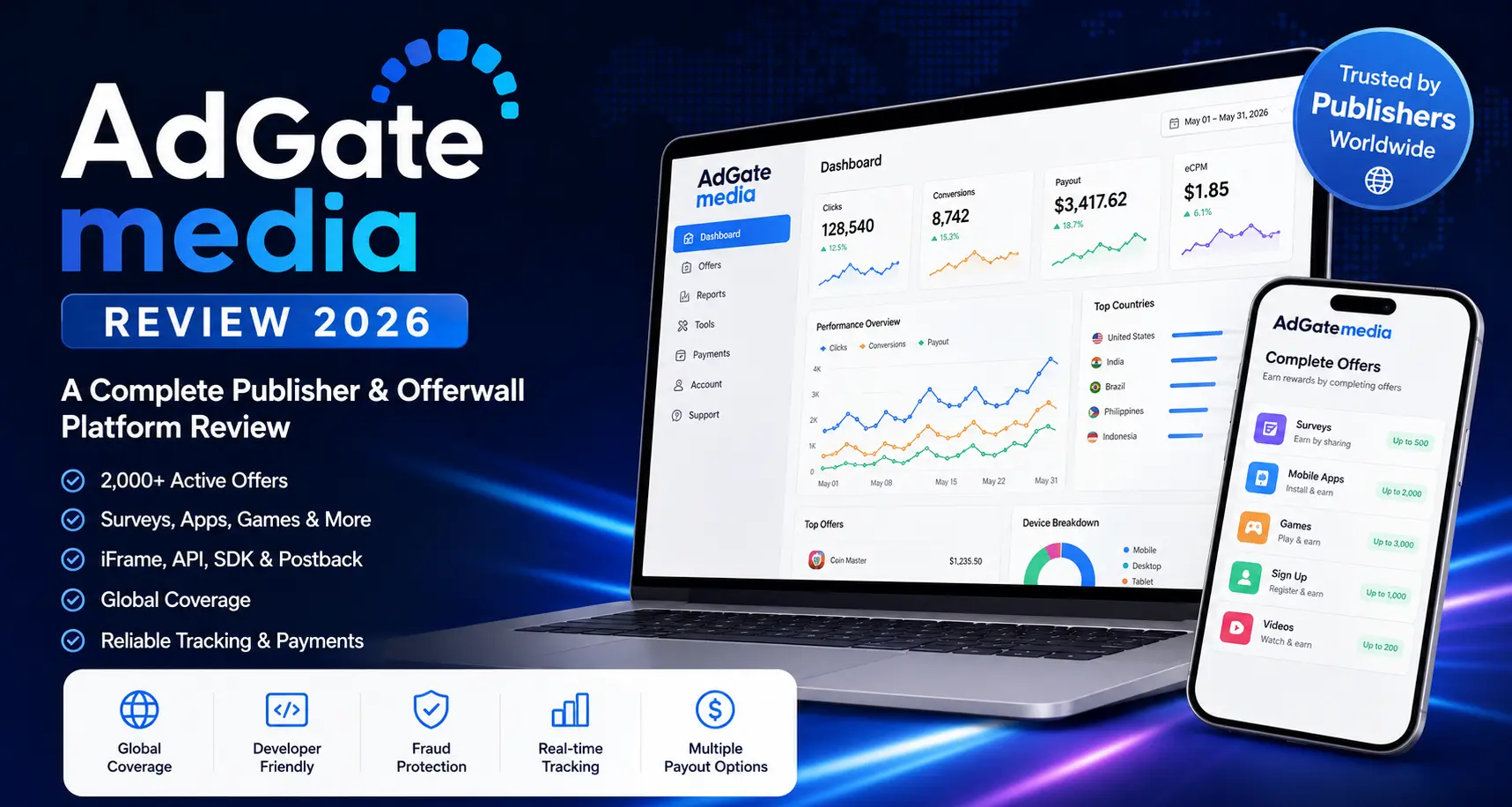
Side two: the network. Between the advertiser and the GPT site sits a layer of infrastructure — CPA networks and offerwall aggregators such as AdGate Media, Tapjoy, PubScale, or CPX Research — that vets advertisers, tracks conversions, filters fraud, and pools thousands of individual offers into a single feed a GPT site can plug into with an API key.
Side three: the GPT platform and its users. The platform displays that feed to its members, and members complete the actions in exchange for a slice of what the platform gets paid.
This structure creates a value exchange that, at least in theory, benefits everyone in the chain: users get rewarded for trying products they might genuinely want, advertisers get new customers at a predictable acquisition cost, and the platform keeps a margin between what it collects from the network and what it pays out to users. As the monetization platform RevBoost explains, GPT sites are one of the most proven and scalable business models in affiliate marketing, generating millions of dollars annually by connecting users who want to earn money online with advertisers who want new customers.
Nobody in that chain is doing anyone a favor. Every dollar that lands in your PayPal account started as marketing spend that a real company decided was cheaper than buying a Google or Meta ad.
Model #1: CPA — Cost Per Action (The Financial Engine)
What CPA Actually Means
CPA stands for Cost Per Action (sometimes called Cost Per Acquisition). It is a performance-based advertising model where businesses pay only when a specific customer action occurs — a sign-up, app install, purchase, form submission, or free trial registration.
Unlike CPC (Cost Per Click) or CPM (Cost Per Mille), where advertisers pay for impressions or clicks regardless of outcomes, CPA revolves around actual conversions. A business running a CPA campaign only pays when a user completes an action, making it a low-risk, high-ROI strategy.
How CPA Fits Into GPT Economics
This is the foundational revenue model of nearly every GPT site on the internet. Here's the flow:
- A mobile game developer wants new installs. They go to a CPA network and say, — I'll pay $4.00 for every user who downloads my game and reaches Level 5. —
- The CPA network lists this offer.
- The GPT platform pulls that offer into its interface and tells you, — Download this game and reach Level 5 — earn $2.50. —
- You complete the task. The advertiser pays the CPA network $4.00. The CPA network pays the GPT platform $3.50. The GPT platform pays you $2.50. Everyone keeps a slice.
This is CPA arbitrage, and it explains nearly every design decision a GPT platform makes — from why some offers pay $40 and others pay four cents, to why your account occasionally gets flagged for — unusual activity — after a perfectly innocent survey.
Real CPA Benchmarks by Vertical
CPA payouts vary enormously by industry, geography, and offer type. Here are benchmarks from active campaigns:
- VPN offers: $10 — $15 per install/trial signup in the US and UK; $5 — $12 in DACH markets; lower in Tier-2 markets.
- B2B SaaS: Around $116 on average, reflecting longer sales cycles and higher lifetime value.
- iGaming (casino/betting): $30 to $150+ per depositing player, varying significantly by GEO and deposit threshold.
- E-commerce: $15 — $40 for first purchase; subscription products sometimes push $50 — $80 for the initial conversion.
As Serge Abramov, Head of Media Buying at PropellerAds, put it: acceptable CPA benchmarks are largely driven by the expected lifetime value of a user, and industries such as iGaming will pay a higher cost per action because a single player can generate significant long-term revenue.
That's why the payout table on a GPT site looks almost random: ten cents for downloading a casual mobile game, three dollars for a twenty-minute survey, forty-five dollars for depositing money into a trading app. It isn't random at all — it's a direct reflection of what each advertiser has calculated a real customer is worth.
CPA vs. CPC vs. CPM: The Comparison
| Model You Pay For Best For Risk Level | |||
| CPA | Completed action (signup, purchase, install) | Direct response, verified outcomes | Low for advertisers |
| CPC | Each click on an ad | Driving traffic to landing pages | Medium |
| CPM | Every 1,000 impressions | Brand awareness at scale | High |
Related read: For a data-backed look at how offer walls, CPA networks, and unit economics determine platform profitability, read our deep dive on the real economics behind successful GPT platforms in 2026.
Model #2: CPI — Cost Per Install (The Mobile Growth Engine)
What Is CPI?
CPI, or Cost Per Install, is a pricing model used specifically in digital campaigns designed to increase app installations. The advertiser pays only when a user installs their app.
The average CPI cost worldwide is around $2.25, though rates can reach $3 or higher depending on the vertical and geography.
Why CPI Matters for GPT Sites
CPI is the dominant model for mobile game and app offers on GPT platforms. When you see — Download GameX and earn 500 points, — that's almost certainly a CPI deal — often with additional CPA milestones layered on top (reach Level 5 for another 1,000 points).
The performance-based nature means the ad network takes the risk, not the advertiser. Advertisers only pay for concrete installs, making CPI less risky than click-based or impression-based models.
The Retention Problem
There is a genuine tradeoff with CPI: retention rates tend to be lower than CPA campaigns that target post-install events. A user who installs an app just for the reward may never open it again. That's why sophisticated GPT platforms and advertisers are increasingly shifting from pure CPI to CPE — Cost Per Engagement — where the payout only triggers after the user completes a meaningful in-app action.
Model #3: CPE — Cost Per Engagement (The Quality Filter)
What Is CPE?
CPE stands for Cost Per Engagement. It is a digital advertising pricing model where advertisers are charged only when a user meaningfully interacts with their ad — through likes, comments, shares, saves, video views, or other defined actions.
The formula is straightforward:
CPE = Total Ad Spend ?? Total Engagements
So if you spent $1,000 on a campaign and received 5,000 engagements, your CPE would be $0.20.
CPE in the GPT Ecosystem
Within GPT platforms, CPE manifests as milestone-based offers: — Play this game for 30 minutes, — — Reach Level 10, — — Complete the tutorial. — These aren't simple installs — they're engagement targets. Networks like SpawnTap, Adjoe, and Mistplay specialize in this model.
CPE is ideal for brand awareness campaigns, social media advertising, influencer partnerships, and interactive ad formats where interaction is the primary objective.
Platform Benchmarks for CPE
| Platform Typical CPE Range | |
| Facebook / Instagram | $0.01 — $0.10 |
| TikTok | $0.02 — $0.10 |
| $0.50 — $3.00+ | |
| X (Twitter) | $0.03 — $0.50 |
| YouTube | $0.05 — $0.30 |
For GPT platforms, CPE offers typically pay users more than CPI offers because the advertiser is getting a higher-quality user — someone who actually engages with the product rather than just installing and deleting it.
Model #4: Paid Surveys (The Market Research Pipeline)
How Surveys Actually Work
Surveys are the revenue stream most people associate with GPT sites historically, but the mechanics are often misunderstood.
Market research firms need statistically representative respondents fast. They pay survey routers to find people who match specific demographic quotas. The router pays the GPT site for every completed survey. The GPT site passes a portion to you.
This is why survey disqualifications exist. Research firms only want responses from specific demographics — say, women aged 25-34 who own a hybrid vehicle. If you don't fit the profile, you get bounced. The GPT site doesn't get paid, so you don't get paid. It's frustrating, but it's structurally necessary.
The Scale of the Market Research Industry
The market research industry is enormous. The UK market alone is projected to climb at a compound annual growth rate of roughly 5.6% through 2025 — 26, reaching ??6.8 billion, fueled largely by rising demand for online and digital research methods.
Major panel providers include Cint, Dynata, Prolific, Toluna, and Respondent. These companies maintain panels of hundreds of thousands to tens of millions of profiled people and charge on a cost-per-complete basis.
Survey Economics on GPT Sites
- Typical payout per survey: $0.25 to $2.00 on standard GPT platforms
- Specialist platforms (Respondent): $20 to $150+ for longer research sessions
- Disqualification rates: 30 — 50% is standard
- Effective hourly rate: $1 to $5 per hour for most casual survey work
Related read: For a detailed comparison of how GPT sites, survey sites, and cashback platforms differ in mechanics, earnings, and effort required, see our 2026 guide to GPT vs. Survey vs. Cashback platforms.
Model #5: Cashback (The Affiliate Commerce Engine)
How Cashback Actually Works
Cashback is the odd one out on this list because unlike GPT tasks or surveys, it doesn't require you to do anything you weren't already doing. You shop. You were going to buy the thing anyway. The platform just makes sure part of the retailer's marketing spend ends up in your pocket.
Here's the mechanic: retailers pay affiliate networks a commission — typically 1% to 10% of the sale — for every customer sent their way through a tracked link. Cashback platforms are affiliates. Instead of pocketing the whole commission, they share most of it back with you.
The Major Players
- Rakuten (formerly Ebates): Running since 1997, partners with thousands of retailers
- Ibotta: Paid out more than $1 billion cumulatively since 2012; strong in grocery and in-store cashback via receipt scanning
- TopCashback: Major player in the UK and EU
- ShopBack: Strong presence in Asia
Cashback rates typically range from 1-10% of the purchase price, with some categories like fashion and beauty offering higher rates (5-15%) during promotions.
Why Cashback Scales Differently
Cashback is the one revenue stream in the GPT playbook that isn't capped by — how many minutes of attention does this user have today. — A user's weekly grocery run or a $1,200 laptop purchase can generate more platform revenue in a single click than an entire evening of survey attempts, and it costs the user nothing they weren't already going to spend.
Swagbucks has been operating since 2008 and has paid out more than $450 million to members cumulatively, and its shopping cashback feature is arguably its most durable differentiator.
Model #6: Offers & Offerwalls (The Aggregation Layer)
What Is an Offerwall?
An offerwall is a monetization interface that shows a curated list of CPA offers to a user and rewards them with points, virtual currency, or cash for completing an action such as signing up for a service, downloading an app, or filling out a form.
When a user completes an offer, the CPA network pays the platform operator the full advertiser payout, and the operator keeps a margin after passing along the user's reward. That margin — often somewhere between roughly 20% and 50% — is the entire revenue model of a GPT site in one sentence.
Major Offerwall Networks in 2026
The offerwall landscape has matured significantly. Top networks include:
- Tapjoy — One of the largest, with deep gaming integrations and massive global reach
- AdGate Media — Flexible mix of surveys, installs, and subscription offers
- PubScale — CPE-focused with AI-driven offer matching and fraud prevention
- BitLabs — Survey-first offerwall favored by reward apps and GPT platforms
- AdGem — Premium UI and merchandising controls for a native feel
- AyeT-Studios — Strong EMEA demand with reliable monthly payouts
- AppsPrize — Milestone-based multi-reward structure
Integration Approaches
There are two main ways GPT platforms integrate offers:
Widget Integration (Fastest): Embed an iframe or JavaScript widget from the network. Live in hours, but limited design control.
Custom API Integration (Most Control): Pull offer data via API and display in a custom interface. More development work, but better conversion rates through optimized presentation.
Most new platforms start with widgets to validate the model, then migrate to custom APIs once volume justifies the investment.
Related read: For developers looking to integrate offerwalls into mobile apps, our Android & iOS offerwall SDK integration guide covers secure S2S postbacks, idempotency, and fraud-resistant reward processing.
Unit Economics: The Math That Decides Whether a GPT Site Survives
This is the part most articles skip entirely, and it's the part that actually determines whether a platform lasts eighteen years or eighteen months.
Revenue Per Completed Action
Every offer, survey, and cashback click generates a payout from the network side. The platform's gross margin is the gap between what the network pays and what the platform rewards the user — typically structured so the user receives somewhere between roughly 50% and 80% of the advertiser payout.
Breakage
This is the quiet, unglamorous secret of every points-based loyalty economy. Breakage is the value of points or rewards that users earn but never redeem — because they fall below the minimum cashout threshold, lose interest, forget their account exists, or get banned before cashing out. A platform that requires a $10 or $25 minimum payout isn't being stingy for no reason; it's deliberately engineering a share of earned-but-unclaimed balances that never actually become a cash outflow.
CAC vs. LTV
A GPT platform has its own acquisition funnel to fund — app store ads, affiliate marketing, and referral programs. The platform only turns a profit on a new user if that user's lifetime engagement generates more net margin than it cost to acquire them. GPT sites simply have unusually thin margins per transaction, which means they live or die on volume and retention.
Fraud and Chargeback Risk
Because GPT sites route real advertiser money to real users, they're a constant target for bots, VPN farms, and multi-accounting fraud rings. Offerwall networks build in bot filtering and fraud detection specifically because low-quality or fraudulent completions eat directly into publisher revenue and can get an entire platform blacklisted by advertisers.
When a legitimate user's account gets frozen for — suspicious activity, — it's almost always this fraud-prevention layer overcorrecting — an annoying but economically necessary cost of doing business.
A Numbers Walkthrough: Following One Dollar Through the System
Let's trace one realistic transaction end to end.
Say a budgeting app wants new verified sign-ups in the United States. Based on its internal data, it knows a user who links a bank account and stays active for thirty days is worth roughly $60 in expected subscription revenue over their lifetime. To hit growth targets, the app is willing to pay up to $18 per verified sign-up.
That $18 offer goes into a CPA network's catalog, tagged for US traffic. A GPT platform pulls that offer into its offerwall feed. A user sees — Link your bank account with BudgetApp — Earn $9.00, — completes the sign-up, and the app confirms the action seven days later (most networks hold payouts for a verification window). At that point, the network releases the full $18 to the GPT platform. The platform pays the user their promised $9, and keeps the remaining $9 as gross revenue.
Multiply that single $9 margin by tens of thousands of completed actions a month, blend in survey commissions running at a smaller margin per action but far higher volume, add shopping cashback commissions that require zero task-completion cost, and you start to see how a platform with millions of registered users can generate real, durable revenue.
How Geography Quietly Rewrites the Entire Economic Model
One detail that rarely gets explained clearly: CPA offers are priced per country, and the spread between the best-paying and worst-paying markets is enormous — often five to twenty times, offer for offer.
A budgeting-app sign-up worth $18 in the United States might be worth $1.50 in the Philippines, not because the platform is being unfair, but because the advertiser's own economics are different in that market: lower average revenue per user, lower ad rates, and a smaller addressable subscription price.
This is why earnings figures thrown around in GPT marketing content vary so wildly, and why the same platform can be genuinely lucrative for one user and nearly worthless for another depending entirely on where they log in from.
Four Platform Archetypes and How Each Makes Money Differently
Not every GPT platform is built the same way:
The Generalist Reward Hub: Platforms like Swagbucks and InboxDollars run every revenue stream at once — offers, surveys, cashback, video, search — deliberately spreading risk across as many advertiser relationships as possible. This is the most resilient model, but also the most expensive to build and operate.
The Offer-and-Survey Specialist: Platforms like Freecash and TimeBucks lean heavily on aggregating the deepest possible catalog of offers and survey routers, competing primarily on payout speed, low minimum cashouts, and interface quality.
The Gaming-and-In-App Rewards Layer: Platforms such as Idle Empire monetize largely through CPI and CPE deals aimed at a younger, mobile-first audience. Lower average payout per action, offset by much larger volume.
The Passive-Resource Model: Platforms like Honeygain sidestep the task-completion economy entirely, monetizing a user's unused internet bandwidth by reselling it to data-collection clients, then sharing a portion back.
Regulatory and Trust Considerations
Because real money and real advertiser relationships are involved, GPT platforms operate under the same general advertising-disclosure and consumer-protection expectations as any performance-marketing business. The U.S. Federal Trade Commission's guidance on endorsements, online advertising, and consumer reviews is a useful baseline for the kind of disclosure a trustworthy site should provide.
Key trust signals to look for:
- Transparent ownership and business address
- Reasonable earning promises (not — $500/day for 10 minutes — )
- Established payout history (Swagbucks: $650M+; InboxDollars: 20+ years)
- Clear terms of service
- Active community presence on Reddit and Trustpilot
The Future of GPT Business Models: Where This Is Heading
Several shifts are reshaping the landscape in 2026:
1. AI-Driven Personalization: Platforms are using AI to match users with higher-converting, better-paying offers based on behavioral profiles, increasing both user satisfaction and platform revenue.
2. Shift Toward CPE Over CPI: Advertisers are increasingly demanding engagement-based payouts rather than simple installs, which means milestone offers ( — Reach Level 10 — ) will continue displacing pure install offers.
3. Crypto and Instant Payouts: The next generation of GPT users expects near-instant gratification. Platforms offering crypto withdrawals and sub-$3 minimum payouts are gaining market share against legacy players with $15+ thresholds.
4. Mobile-First and In-App Offerwalls: Prodege (Swagbucks — parent company) reported a 305% year-over-year increase in Monthly Active Users in 2024, driven largely by mobile gaming integrations. If you're starting a platform today, mobile responsiveness isn't optional — it's existential.
5. Data Privacy as a Differentiator: With increasing regulation (GDPR, CCPA) and consumer awareness, platforms that transparently explain how user data is used — and give users control — will win trust.
Final Thought: An Honest Business Once You See the Chain
The thing that stuck with me most, once I understood how this industry actually works, wasn't cynicism about it. It's a strange kind of respect for how efficiently the whole chain operates. An advertiser somewhere needs new trial users for a budgeting app. A network matches that need to available inventory. A platform in your browser presents it as — earn $2. — And you, doing something you'd probably have scrolled past anyway, get paid a sliver of a marketing budget that would otherwise have gone entirely to Meta or Google.
It's not a way to get rich. It was never designed to be. But as a small, transparent slice of a much larger advertising economy, it's a surprisingly honest business once you can see the whole chain.
Frequently Asked Questions
How do GPT sites make money if they're paying users cash?
They keep a margin between what advertisers and CPA networks pay per completed action and what they pass along to users as rewards — typically retaining 20 — 50% of every offer, survey, or cashback transaction.
What's the difference between CPA, CPI, and CPE?
CPA (Cost Per Action) pays for completed actions like sign-ups or purchases. CPI (Cost Per Install) pays specifically for app installations. CPE (Cost Per Engagement) pays for meaningful interactions like reaching a game level or spending time in an app.
Are GPT sites a scam?
Established platforms with long track records, transparent payout minimums, and verifiable payment histories are legitimate businesses. The category also attracts short-lived copycat apps that inflate earning claims and quietly stop paying — track record and independent reviews matter enormously.
Why do survey sites disqualify me so often?
Survey routers match respondent profiles to specific research studies in real time. If you don't fit the demographic quota a client needs, you're routed out. Completing your profile thoroughly and accurately reduces disqualifications over time.
Can you actually make good money on GPT sites?
Realistically, most users earn modest supplemental income — $20 — $150 per month depending on time invested and country of residence. It's a legitimate side-income stream, not a replacement for employment.
External Resources & Further Reading:
- Swagbucks Official Site
- InboxDollars Official Site
- Freecash Official Site
- Rakuten Cashback
- Prolific Academic Research Panel
- FTC Consumer Guidance
- SurveyPolice GPT Rankings
- PropellerAds CPA Marketing Guide
- Mailchimp CPE Guide
- Fingerprint Bot Detection
- YepAds CPA Marketing Guide
- PubScale Offerwall Networks
- SpawnTap Offerwall Platform

Comments (0)
No comments yet. Be the first to share your thoughts!