
1. Overview
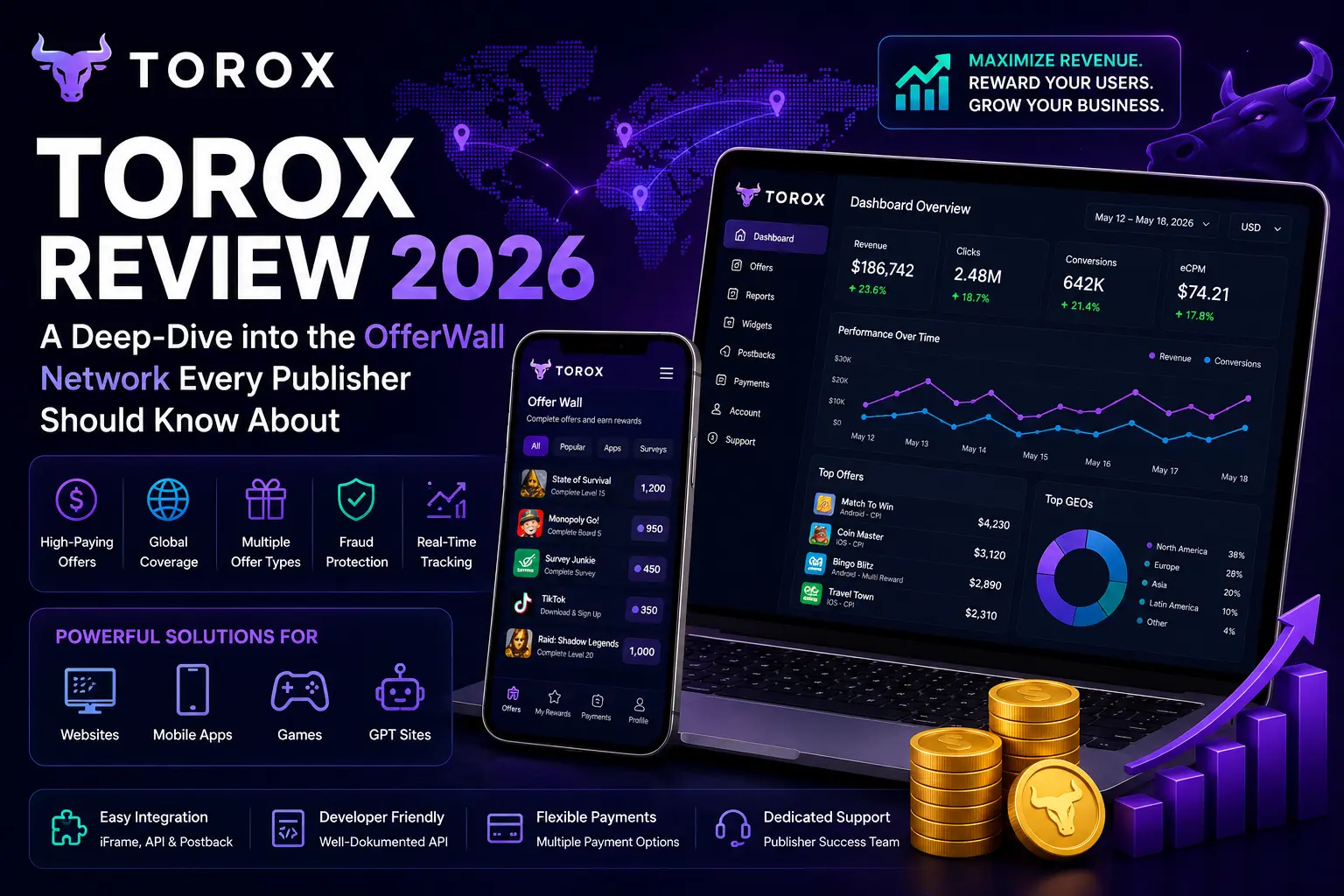
If you have been around the performance marketing space for more than a few months, you have probably seen the name Torox (formerly OfferToro) floating across GPT platforms, reward apps, and mobile game dashboards. Torox is an offerwall and performance advertising network operated by EagleTech LTD, built to bridge the gap between advertisers looking for user acquisition and publishers who want to monetize non-paying users through rewarded engagements.
At its core, Torox delivers a simple promise: users complete offers — install apps, reach game milestones, fill out surveys, sign up for trials — and publishers earn revenue while users get rewarded in virtual currency. It is a model that has fueled the multi-billion dollar get-paid-to economy, and Torox has carved out a notable slice of that pie.
But here is the thing I have learned after reviewing dozens of these networks: not all offerwalls are built the same. Some prioritize advertiser relationships. Others obsess over publisher support. And a few seem to operate in a gray zone where tracking failures and slow support tickets become the norm. In this review, I am going to pull back the curtain on Torox based on real user data, official documentation, and my own analysis of how this network stacks up in 2026.
If you are a publisher evaluating whether Torox deserves a spot in your monetization stack, keep reading. This is the review I wish I had before I integrated my first offerwall.
2. Who Is It For?
Torox is designed for publishers who already have — or are building — a platform with a virtual currency economy. Think mobile games where players earn coins for watching ads or completing tasks, GPT websites that reward users for micro-tasks, or loyalty apps that issue points redeemable for gift cards or crypto.
If your users can be incentivized with virtual rewards, Torox fits. The network explicitly states that its solutions are built for publishers who have "a game economy or a platform that can reward the user with virtual currency or other benefits."
That said, Torox is not for everyone. If you run a pure content website with no reward mechanism, or if you are an individual looking to earn directly from completing offers yourself, Torox is an intermediary — not an end-user platform. You access Torox through a publisher partner like Freecash, Lootably, or a custom integration.
3. Supported Platforms
Torox supports a multi-platform ecosystem. You can integrate their offerwall into:
- Websites and web apps — via iFrame or API
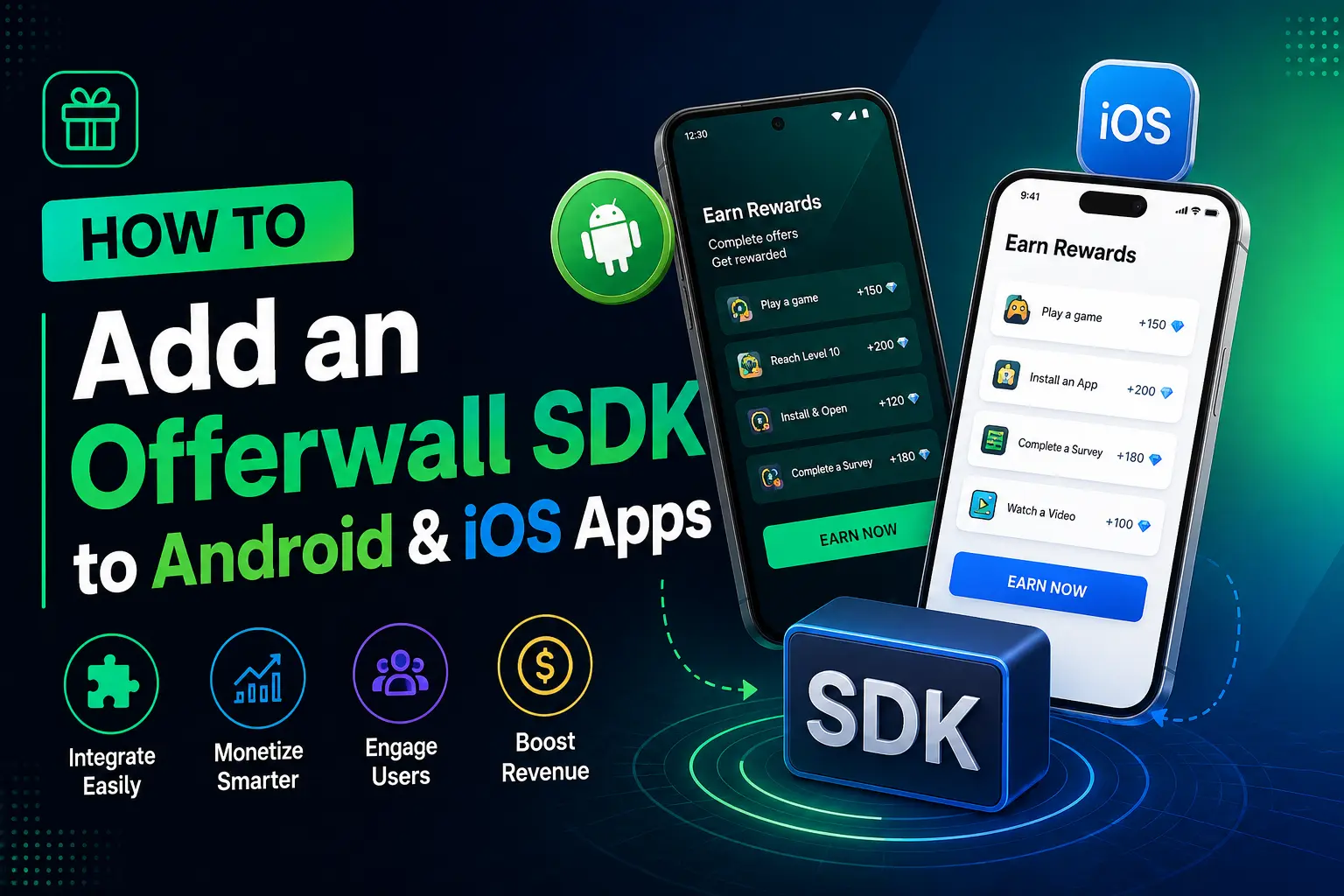
- Mobile applications — via lightweight SDK for iOS and Android
- Custom platforms — via their REST API for full control
This cross-platform flexibility is one of Torox's stronger selling points. Whether you are running a browser-based GPT site, a Unity mobile game, or a hybrid web-to-app funnel, Torox has a technical path for you.
4. Website Support
For web publishers, Torox provides a web-based offerwall that can be dropped into any site with minimal technical overhead. The web offerwall is responsive, which means it adapts to desktop and mobile browsers without requiring separate implementations.
From a user experience standpoint, the web wall presents campaigns, offers, and surveys in a sortable, filterable interface. Users can browse categories, compare payouts, and choose actions that match their interests.
The web integration is particularly popular among GPT site operators who want to add another revenue stream without rebuilding their entire platform. If you are curious about how the broader website monetization landscape works, our guide on how to create an offerwall website breaks down the technical architecture behind these systems.
5. App Support
Torox shines in the mobile app space. Their SDK is marketed as lightweight and seamless, designed not to bog down your app's performance or inflate your binary size.
The SDK integrates natively into your app, meaning the offerwall feels like a built-in feature rather than a clunky third-party popup. This matters more than most publishers realize — user retention drops sharply when monetization layers feel intrusive or foreign to the core experience.
Both Android and iOS are supported, and the SDK handles offer rendering, user tracking, and reward callbacks automatically. For game developers specifically, this is a critical advantage because mobile gamers are notoriously sensitive to friction.
6. Game Support
Gaming is arguably Torox's strongest vertical. The network has built deep relationships with mobile game advertisers, resulting in a robust inventory of milestone-based game offers. These are the high-ticket items — offers where users download a game, reach a specific level or achievement, and get paid out in your virtual currency.
In Tier 1 countries like the US, UK, Canada, and Australia, Torox game offers routinely range from $100 to $450 for deep milestone completions.
In Latin America — particularly Brazil and Mexico — Torox also leads the pack for game coverage, with early-milestone offers that pay fairly even at lower regional rates.
If you run a mobile game with a coin economy or a reward platform that caters to gamers, Torox's game inventory alone could justify the integration.
7. Integration Methods
Torox gives publishers three primary integration paths:
- Web Offerwall (iFrame) — Fastest setup. Drop an iFrame into your site and the wall loads automatically. Good for publishers who want to go live in hours, not days.
- Mobile SDK — Native iOS and Android integration. Best for apps and games where user experience is paramount.
- REST API — Full control. Pull offers programmatically, build custom UI, and manage reward logic on your end.
This three-tier approach is smart. It lets small publishers get started quickly while giving enterprise-level developers the flexibility to build deeply customized experiences. If you want to understand the trade-offs between iFrame and API integrations at a conceptual level, Klink Labs has a solid breakdown of iFrame vs. API integration for offerwalls.
8. API Availability
Yes, Torox offers a REST API for publishers who want programmatic access to their offer inventory. With the Torox API, you can automatically pull live offers, filter by category or GEO, and display only the campaigns that match your audience.
The API is particularly useful if you want to:
- Build a fully custom offerwall UI that matches your brand
- A/B test different offer categories against each other
- Dynamically adjust which offers appear based on user behavior
- Combine Torox offers with other networks in a single aggregated wall
API documentation is available through the Torox publisher portal, though in my experience, the depth of documentation is adequate but not exceptional. Expect to do some trial and error if you are building a complex integration.
9. iFrame Availability
Yes. The iFrame integration is Torox's fastest deployment option. You embed a single iFrame tag, and the entire offerwall renders inside it. The wall updates automatically as new offers enter the system, so you are not manually curating campaigns.
The iFrame is customizable to a degree — you can adjust branding elements like colors and currency values so the wall does not feel completely alien to your users. For publishers who want to test offerwall monetization without committing engineering resources, this is the route to take.
10. SDK Availability
Torox provides a dedicated SDK for mobile publishers. The SDK is available for both Android and iOS and is described as "lightweight," which is an important claim in an era where app store review teams scrutinize binary sizes and performance metrics.
The SDK handles:
- Offer wall rendering
- User session tracking
- Postback communication for reward verification
- Sorting and filtering UI out of the box
For game developers using Unity or native mobile stacks, the SDK integration is straightforward and typically goes live within a few hours according to G2 reviews.
11. Postback System
Torox supports server-to-server (S2S) postback URLs for conversion tracking. This is the industry standard for reliable attribution, especially in a world where browser cookies are becoming less dependable.
Here is how it works in practice: when a user clicks an offer, your tracking system passes a unique click ID to Torox. When the user completes the offer, Torox fires a postback to your designated URL containing that click ID, the payout amount, and conversion details. Your server validates the postback and credits the user's account.
Torox postbacks can be configured globally (one URL for all offers) or offer-specific, depending on your tracking setup. For publishers using Swaarm or similar tracking platforms, Torox provides a standardized postback template that maps common parameters.
If you are new to postback tracking, AnyTrack has an excellent guide to postback URLs that explains the mechanics better than most network documentation.
12. Tracking
Tracking reliability is where Torox gets mixed feedback. On the positive side, the network uses in-house tracking technology, which means they are not dependent on third-party platforms that might introduce latency or data loss.
However, user-reported experiences tell a more complicated story. On Trustpilot, a significant number of users report that offers — particularly high-value game milestones — fail to track properly even when completed correctly. Some users claim they submitted undeniable proof via screenshots and screen recordings only to receive generic rejection responses weeks later.
From a publisher perspective, this creates a liability. If your users complete offers and do not get credited, they blame your platform — not Torox. That is a reputation risk you need to weigh carefully.
My recommendation: test Torox with a small user segment first, monitor credit rates closely, and always have backup offerwalls ready.
13. Attribution Window
Torox does not publicly disclose a fixed attribution window for all offers, which is frustrating for publishers who need clarity for their own attribution modeling. In practice, attribution windows vary by advertiser and offer type:
- App install offers: Typically 7 to 30 days from click to install
- Game milestone offers: Usually tied to the offer's stated time limit (commonly 7, 14, or 30 days)
- Survey and registration offers: Often instant or same-day attribution
The lack of a standardized, publisher-facing attribution window document is a gap. Most tier-one networks clearly state their default windows (e.g., 30-day click, 1-day view-through). Torox leaves this ambiguous, which can lead to disputes when conversions fall outside an advertiser's hidden window.
If attribution precision is critical to your business, you may want to supplement Torox with an MMP (mobile measurement partner) or a dedicated tracking platform like CPV Lab Pro, which has a pre-built Torox integration.
14. Offer Types
Torox runs a broad, general-purpose catalog. The typical offer mix includes:
- App Installations (CPI) — Download and open an app
- Game Milestones (CPE) — Reach a specific level or achievement in a mobile game
- Surveys — Complete market research questionnaires
- Registrations (CPL) — Sign up for a service or platform
- Trials and Subscriptions — Start a free trial or purchase a subscription
- Sign-Up Offers — Create accounts on various platforms
This diversity is a strength. Unlike survey-only routers such as BitLabs or CPX Research, Torox gives users multiple ways to earn, which tends to improve engagement rates across different user personas.
15. GEO Coverage
Torox has excellent global reach, with particular strength in:
- Tier 1: USA, UK, Canada, Australia — highest payouts, deepest inventory
- Western Europe: Germany, France, Netherlands, Nordics, Spain, Italy — strong game and survey coverage
- Latin America: Brazil, Mexico, Argentina, Colombia, Chile — best-in-class game offers for the region
- Asia: India, Philippines, Indonesia — moderate inventory, mostly app installs and light game offers
- Africa: Limited inventory, mostly through routed offers
If your user base is concentrated in the US or Western Europe, Torox is a no-brainer. If you are targeting emerging markets, you will want to pair Torox with a more globally inclusive wall like TimeWall to fill coverage gaps.
16. Survey Inventory
Torox carries survey offers, but surveys are not its primary strength. The survey inventory is decent in Tier 1 and Western European markets, where advertisers have budgets for consumer research. However, if surveys are your main monetization vertical, dedicated survey routers like BitLabs, TheoremReach, or CPX Research will likely deliver better fill rates and higher qualification success.
Torox works best as a diversified wall where surveys supplement game and install offers — not as a survey-first solution.
17. Gaming Inventory
This is where Torox earns its keep. The network has built a reputation for high-paying mobile game offers, particularly multi-reward milestone campaigns. A single game offer on Torox can pay anywhere from $0.50 for a quick install-and-open to $450 for reaching deep milestones in strategy or RPG titles.
The game catalog spans casual games, mid-core strategy titles, casino simulators, and RPGs. Users can sort and filter by payout, category, and difficulty, which helps them self-select offers that match their commitment level.
For publishers in the mobile gaming or GPT space, Torox's gaming inventory is probably the single biggest reason to integrate.
18. Fraud Prevention
Torox has a multi-layered fraud prevention system that includes fraud detection algorithms, IP filtering, and compliance monitoring.
From a publisher standpoint, the terms are strict — and they need to be. Torox audits every publisher's traffic daily, and accounts engaged in "blatant fraudulent activities" are permanently banned without payout.
The network also reserves the right to charge back payouts resulting from fraud, which is standard in the industry but worth noting if you are working with user-generated traffic that might include incentivized or low-quality sources.
For advertisers, Torox's fraud controls are reasonably robust for a mid-tier network. However, they do not appear to offer the same level of SDK attestation or device fingerprinting that premium networks like AppsFlyer or TrafficGuard provide. If you are an advertiser running high-budget campaigns, you may want to layer additional fraud detection on top.
19. Reporting
Torox provides a publisher dashboard with real-time reporting on clicks, conversions, revenue, and offer performance. The in-house tracking tech gives publishers visibility into which campaigns are converting and which are dead weight.
That said, the granularity of reporting is a point of contention. While you can see top-level metrics, some publishers report that drilling down into sub-ID performance or user-level attribution requires exporting data manually. There is no public mention of advanced features like cohort analysis, LTV tracking, or automated anomaly detection.
For basic campaign optimization, the dashboard is sufficient. For data-driven publishers who want to build custom attribution models, the API is your best friend — but be prepared to do the heavy lifting yourself.
20. Reward Flexibility
Torox operates on a virtual currency model. You define your in-app currency, and Torox dynamically adjusts reward values based on advertiser payouts, offer complexity, and user location. This means a user in the US might earn 500 coins for an install while a user in Brazil earns 150 coins for the same action — but both represent fair market value for their respective GEOs.
Publishers have control over:
- Currency naming and branding
- Exchange rates (how many coins equal one dollar)
- Which offer categories to display
- Whether to show surveys, games, installs, or all three
This flexibility is essential for maintaining a healthy virtual economy. Price your rewards too high, and you hemorrhage margin. Price them too low, and users abandon your platform. Torox gives you the dials to tune this balance.
21. Payout Model
Torox operates primarily on a CPA (Cost Per Action) and CPI (Cost Per Install) model. Publishers earn when users complete defined actions, not when they merely view or click an ad. This performance-based structure aligns incentives — advertisers only pay for results, and publishers are motivated to drive quality completions.
For game offers, the model is typically CPE (Cost Per Engagement), where payouts trigger at specific milestones (e.g., reach level 10, complete tutorial, make first purchase). Multi-reward structures are common, meaning users earn partial payouts for early milestones and larger payouts for deep progression.
22. Payment Methods
Torox pays publishers via:
- PayPal
- Bank Transfer (Wire)
Payments are issued in USD on a Net-30 basis, meaning earnings from January are paid out by the end of February.
The minimum payout threshold is $200. If you do not hit $200 in a given month, your balance rolls over to the next month until the threshold is met.
One important caveat: if you cross the threshold but have not entered valid payment information, Torox will attempt to contact you for three months. After that, they stop trying, and your earnings sit in limbo until you update your details.
Net-30 with a $200 minimum is fairly standard for the industry, though some competitors like CPX Research also offer Bitcoin payouts, which Torox does not currently advertise.
23. Approval Requirements
Torox does not appear to have a rigid, public-facing approval rubric like some premium networks. You sign up as a publisher, submit your application, and wait for review. The key requirement is that your platform must support a virtual currency or reward system that can be used for in-app purchases, premium features, or real-world redemptions.
Torox also expects publishers to maintain a compliant privacy policy, adhere to GDPR if serving EU users, and follow platform rules (e.g., Google Play and Apple Store guidelines).
The approval process is generally described as straightforward, though response times can vary. If you are running a legitimate app or website with real users, you should not face significant hurdles.
24. Minimum Traffic
Torox does not publish a hard minimum traffic requirement. This is both good and bad. It means small publishers and indie developers can get approved without hitting arbitrary monthly active user (MAU) thresholds. However, it also means the network is less selective than premium alternatives, which can result in lower average offer quality or higher fraud rates among publisher partners.
In practice, if you have fewer than 1,000 monthly active users, your earnings will likely struggle to reach the $200 payout minimum consistently. My advice: have at least 5,000 — 10,000 engaged users before integrating Torox as a primary monetization channel.
25. Publisher Support
Here is where Torox gets divisive. On G2, reviewers praise the team as "highly responsive" with dedicated account managers.
On Trustpilot, the story is different. Multiple users report ticket response times stretching into weeks or months, with generic replies that do not address the specific issue. One user noted seven outstanding tickets dating back three months with zero response.
The discrepancy likely comes from who is asking. Publishers with high volume probably get priority support and dedicated account managers. End-users completing offers through a GPT site are routed through the GPT site's support first, and only escalated to Torox if necessary — a process that introduces delays.
As a publisher, your experience will depend on your volume and your relationship with the network. Do not expect white-glove support unless you are driving serious revenue.
26. Strengths
- Deep game inventory with high-paying milestone offers, especially in T1 and LATAM markets
- Three flexible integration methods (iFrame, SDK, API) covering web and mobile
- Lightweight SDK that does not bloat app binaries
- Broad GEO coverage with strong performance in the US, UK, CA, AU, Brazil, and Mexico
- In-house tracking technology providing real-time data and transparent reporting
- No minimum traffic requirement, making it accessible to smaller publishers
- Risk-free partnership — no upfront costs or commitments required
27. Weaknesses
- Support inconsistency — end-user complaints about slow ticket resolution are widespread and well-documented
- Tracking failures on high-value offers — game milestones occasionally fail to credit even with proof submitted
- No public attribution window documentation — publishers must guess or test to determine click-to-conversion windows
- Limited payment methods — PayPal and wire only; no crypto, Payoneer, or Wise options
- $200 minimum payout — manageable for mid-sized publishers but a barrier for small sites just starting out
- No advanced fraud tooling for publishers — you rely on Torox's internal audits without granular visibility
28. Best Use Case
Torox is best suited for mobile game publishers and GPT site operators with a virtual currency economy who want to monetize non-paying users through high-value game offers. If your audience is concentrated in the US, UK, Canada, Australia, Brazil, or Mexico, Torox's game inventory can become a significant revenue driver.
It is also an excellent secondary or tertiary offerwall. Smart publishers run Torox alongside AdGate Media and Adscend Media, letting users compare payouts and choose the best offer across walls.
If you are building a new offerwall platform from scratch, our complete builder's guide covers the technical stack, postback architecture, and fraud prevention systems you will need to support networks like Torox properly.
29. Who Should Avoid It
You should probably skip Torox if:
- You run a content site with no virtual currency or reward mechanism
- You need dedicated, white-glove publisher support from day one
- Your user base is primarily in Africa or parts of Southeast Asia where inventory is thin
- You require payment methods beyond PayPal and wire transfer
- You are an end-user trying to earn directly — Torox is B2B, not a consumer-facing platform
- Your platform has fewer than 1,000 active users and cannot realistically hit the $200 payout threshold
30. Alternatives
The offerwall space is crowded, and Torox is far from the only player. Here are the most credible alternatives depending on your needs:
Table
| Network Best For Key Differentiator | |||
| AdGate Media | High offer volume, steady rotation | One of the largest, longest-running networks with broad vertical coverage | |
| Adscend Media | Surveys + video offers | Strong in T1 and EU markets with reliable survey inventory | |
| MyChips | Game milestones, app installs | Strong T1 focus with responsive support (24-hour ticket resolution per user reports) | |
| BitLabs | Survey-focused monetization | Dedicated survey router with prequalifying screeners | |
| CPX Research | European survey markets | German-based with 25,000+ surveys and local-language support | |
| Tapjoy | Deep gaming integrations | Unity-owned with massive gaming publisher relationships | |
| AdGem | Deep game offers with detailed instructions | Higher single-payout potential but more tracking friction | |
| AyeT-Studios | Milestone-based game offers | Reliable tracking with clear milestone ladders | |
| Lootably | Sign-up offers and trials | Exclusive T1 trial offers not found on other walls | |
| TimeWall | Global coverage, tasks and clicks | Most inclusive for emerging markets and low-GEO users |
If you want a deeper comparison of how offerwalls fit into the broader online earning ecosystem, check out our analysis of GPT sites vs. survey sites vs. cashback platforms to understand where offerwall monetization sits in the value chain.
31. Final Rating
After weighing the technical capabilities, publisher feedback, inventory depth, and support quality, here is my assessment:
Table
| Criteria Rating Notes | ||
| Offer Inventory | 8/10 | Excellent game coverage, decent diversity, surveys are secondary |
| GEO Coverage | 7.5/10 | Strong in T1 and LATAM, weaker in Africa and parts of Asia |
| Integration Ease | 8.5/10 | iFrame, SDK, and API options cover most use cases well |
| Tracking Reliability | 6/10 | Good for simple offers, problematic for high-value game milestones |
| Publisher Support | 5.5/10 | Responsive for big publishers, slow and generic for everyone else |
| Payout Terms | 7/10 | Net-30 is standard, but $200 minimum and limited methods hurt small publishers |
| Fraud Prevention | 7/10 | Adequate for the price point, not enterprise-grade |
| Overall | 7/10 | A solid mid-tier offerwall with standout game inventory but support and tracking gaps that keep it from tier-one status |
Verdict: Torox is a legitimate, functional offerwall network that deserves a spot in most publishers' monetization stacks — but not as the only wall. Use it for its unbeatable game inventory in T1 and LATAM markets, pair it with AdGate or MyChips for coverage redundancy, and always monitor credit rates closely. If you go in with realistic expectations and a backup plan, Torox can be a profitable partner. If you expect flawless tracking and instant support, you will be disappointed.
The get-paid-to economy is projected to keep growing, and offerwalls like Torox are a core piece of that machinery. If you are serious about monetizing non-paying users, understanding how these networks actually work — not just what their homepages claim — is the difference between a revenue stream and a support headache. For more on the economics behind these platforms, read our deep-dive into the real economics of GPT platforms in 2026.
Disclaimer: This review is based on publicly available information, official Torox documentation, user feedback from Trustpilot and G2, and industry analysis as of August 2026. Offerwall performance varies by publisher, GEO, and vertical. Always conduct your own testing before committing significant traffic to any network.





Comments (0)
No comments yet. Be the first to share your thoughts!