
The Real Economics Behind a Successful GPT (Get-Paid-To) Platform
I still remember the first time I got paid five dollars for filling out a survey about laundry detergent. I was in college, broke, and half-convinced I'd found a glitch in the internet. It took me years — and a stint working adjacent to the performance-marketing industry — to realize there was no glitch at all. I was standing at the very end of a long, carefully engineered chain of advertising spend, and the five dollars I received was the leftover crumb of a transaction I never actually saw.
That's really what this article is about: not "how to make money on GPT sites" (there are a thousand listicles for that already), but how the sites themselves make money — why some of them have quietly paid out hundreds of millions of dollars over nearly two decades while others vanish within a year, and what the unit economics actually look like once you pull back the curtain. If you're building one of these platforms, investing in one, or just curious why a website will pay you $1.50 to watch a 30-second video, this is for you.
What "GPT" Actually Means (and Why the Term Gets Confusing in 2026)
Quick disambiguation, because in 2026 the letters "GPT" get used two very different ways online. In this article, GPT means Get-Paid-To — reward platforms like Swagbucks, InboxDollars, Freecash, and Honeygain, where users complete tasks (surveys, offers, app trials, cashback shopping, watching ads) in exchange for points, cash, or gift cards. It has nothing to do with OpenAI's "Generative Pre-trained Transformer" models, though the acronym collision muddies search results constantly. If you've researched this topic recently, you've probably noticed both meanings tangled together in the same results page — that's a real, current SEO headache for anyone writing in this niche, not just a coincidence.
Get-paid-to sites have existed as a category since the early 2000s, and they've matured into a genuine, if modest, corner of the internet economy. Reward and offerwall sites are among the more accessible entry points into the broader online gig economy — no car, no delivery bag, no client pitch required. But "accessible for users" and "profitable to operate" are two very different questions, and the second one is where the real economics live.
The Three-Sided Market Nobody Talks About
Most explainers describe GPT sites as a simple two-way exchange: you do a task, the site pays you. That's the user-facing story. The actual business is a three-sided market, and understanding all three sides is the key to understanding GPT economics.
Side one: the advertiser. A VPN company, a mobile game studio, a fintech app, an online casino, a subscription box service — someone with a customer acquisition budget and a specific, trackable action they want a stranger to take. Install the app. Reach level five. Enter a card number for a free trial. Complete a lead form.
Side two: the network. Between the advertiser and the GPT site sits a layer of infrastructure — CPA (cost-per-action) networks and offerwall aggregators such as AdGate Media, Tapjoy, or CPX Research — that vets advertisers, tracks conversions, filters fraud, and pools thousands of individual offers into a single feed a GPT site can plug into with an API key rather than negotiating with every advertiser directly.
Side three: the GPT platform and its users. The platform displays that feed to its members, and members complete the actions in exchange for a slice of what the platform gets paid.
This structure creates a value exchange that, at least in theory, benefits everyone in the chain: users get rewarded for trying products they might genuinely want, advertisers get new customers at a predictable acquisition cost, and the platform keeps a margin between what it collects from the network and what it pays out to users, as the monetization platform RevBoost explains in its offerwall glossary. Nobody in that chain is doing anyone a favor. Every dollar that lands in your PayPal account started as marketing spend that a real company decided was cheaper than buying a Google or Meta ad.
Where the Money Actually Comes From: CPA at the Core
The financial engine underneath almost every GPT site is cost-per-action advertising, sometimes called cost-per-acquisition. It's worth understanding properly, because it explains nearly every design decision a GPT platform makes — from why some offers pay $40 and others pay four cents, to why your account occasionally gets flagged for "unusual activity" after a perfectly innocent survey.
In a CPA arrangement, a business defines a specific action it wants a user to take — filling out a lead form, starting a free trial, finishing a purchase, or installing an app — and pays a commission only once that action is verified, as Shopify's guide to CPA marketing lays out clearly. This is fundamentally different from the display-advertising model most people picture when they think of "internet ads." Nobody is paying for impressions or clicks here; advertisers pay for a completed, trackable outcome, which is one reason Wikipedia's entry on cost per action notes that direct-response marketers often consider it the most efficient way to buy online advertising, since the desired outcome is defined and measured up front.
That single design choice — pay for outcomes, not attention — is what makes the entire GPT economy possible. A gambling app or a subscription-box brand can afford to pay a rewards site $15 for a verified sign-up because it already knows, from its own internal data, roughly what that new customer is worth over time. As Serge Abramov, Head of Media Buying at PropellerAds, put it in PropellerAds' guide to CPA calculation, acceptable CPA benchmarks are largely driven by the expected lifetime value of a user, and industries such as iGaming will pay a higher cost per action because a single player — sometimes a disproportionately high-spending "whale" — can generate significant long-term revenue, while lower-value verticals settle for a smaller acceptable CPA because expected revenue per user is smaller and more evenly distributed.
That's why, if you've spent any time on a GPT site, the payout table looks almost random: ten cents for downloading a casual mobile game, three dollars for a twenty-minute survey, forty-five dollars for depositing money into a trading app and completing a trade. It isn't random at all — it's a direct reflection of what each advertiser has calculated a real customer is worth, filtered down through several layers of margin before it ever reaches your balance.
The Offerwall: Where the Transaction Actually Happens
The interface most users interact with — a scrollable wall of app icons and "Earn $X" buttons — is called an offerwall, and it deserves its own explanation because it's the single most important piece of GPT infrastructure.
An offerwall is a monetization interface that shows a curated list of CPA offers to a user and rewards them with points, virtual currency, or cash for completing an action such as signing up for a service, downloading an app, or filling out a form — and this same mechanism powers not just standalone GPT sites but rewards apps, loyalty programs, and in-game economies wherever a product wants to monetize user engagement through incentivized offers, according to RevBoost's breakdown of offerwall mechanics.
Here's the part that matters most for the economics conversation: when a user completes an offer, the CPA network pays the platform operator the full advertiser payout, and the operator keeps a margin after passing along the user's reward. That margin — often somewhere between roughly 20% and 50%, depending on the offer type, the network relationship, and how competitive the vertical is — is the entire revenue model of a GPT site in one sentence. You are not being paid by "the website." You're being paid a discounted slice of what an advertiser paid a network, which itself took a cut, which the platform then took another cut of before it ever reached your account.
Most established GPT sites don't build this infrastructure from scratch. They integrate with offerwall APIs and white-label solutions from established networks that maintain a deep catalog of pre-approved, incentive-compliant offers, which is a large part of why launching a rewards site is far more accessible today than it was a decade ago, as RevBoost's guide to starting an offerwall site points out. A brand-new site doesn't need to build advertiser relationships from zero; it plugs into a network and inherits access to thousands of live offers on day one.
The Second Engine: Survey Routers
Offer walls handle app installs and sign-ups. The other major revenue pillar — arguably the one people associate most strongly with "GPT sites" historically — is the survey.
Survey monetization runs on almost identical logic to CPA offers, just with a market-research firm instead of a marketing team on the other end. Research companies need statistically representative respondents fast, and they pay per completed survey — again, a cost-per-action, just measured in completed questionnaires rather than app installs. GPT sites typically don't run these surveys themselves; instead, tasks flow through third-party offer walls and survey routers, and the GPT platform earns a share of what the research company pays out whenever a member successfully completes one, as explained in SurveyPolice's overview of GPT site mechanics.
This is also why survey experiences on GPT sites can feel maddening — you answer eight demographic questions, then get "disqualified" and paid nothing. Survey routers profile respondents in real time and match them to whichever active research study needs someone with your exact profile (age bracket, income, pet ownership, whatever the client requested). If you don't match, you get bounced, and the GPT site earns nothing for your five minutes either, which is precisely why most platforms pay a small disqualification bonus of a few cents — it's cheaper for them to placate you than to lose you as a user entirely.
The market research industry itself is enormous and still expanding — the UK market alone is projected to climb at a compound annual growth rate of roughly 5.6% through 2025 — 26, reaching ??6.8 billion, fueled largely by rising demand for online and digital research methods, per IBISWorld's UK market research industry report — and GPT sites are one of the retail-facing taps into that much larger, mostly invisible B2B industry.
The Third Engine: Cashback and Affiliate Commerce
The third major revenue stream, and the one that scales best over time, is shopping cashback — the mechanism behind features like Swagbucks' "Shop" tab. Here, the "action" being tracked is a completed purchase, and the commission comes from standard retail affiliate programs rather than incentive-specific CPA networks.
Swagbucks has been operating since 2008 and has paid out more than $450 million to members cumulatively, and its shopping cashback feature is arguably its most durable differentiator — clicking through Swagbucks before buying from a retailer earns a percentage back without requiring any extra task time from the user, according to EarnLab's ranking of GPT sites. This matters economically because affiliate commerce is the one revenue stream in the GPT playbook that isn't capped by "how many minutes of attention does this user have today." A user's weekly grocery run or a $1,200 laptop purchase can generate more platform revenue in a single click than an entire evening of survey attempts, and it costs the user nothing they weren't already going to spend.
Unit Economics: The Math That Decides Whether a GPT Site Survives
This is the part most articles skip entirely, and it's the part that actually determines whether a platform lasts eighteen years, like Swagbucks, or eighteen months, like the dozens of copycat "earn cash" apps that appear and disappear every year.
Revenue per completed action. Every offer, survey, and cashback click generates a payout from the network side. The platform's gross margin on that transaction is the gap between what the network pays and what the platform rewards the user — typically structured so the user receives somewhere between roughly 50% and 80% of the advertiser payout, with the rest covering the platform's operating costs and profit.
Breakage. This is the quiet, unglamorous secret of every points-based loyalty economy, GPT sites included. Breakage is the value of points or rewards that users earn but never redeem — because they fall below the minimum cashout threshold, lose interest, forget their account exists, or get banned before cashing out. A platform that requires a $10 or $25 minimum payout, rather than $1, isn't being stingy for no reason; it's deliberately engineering a share of earned-but-unclaimed balances that never actually become a cash outflow. This is standard practice across airline miles, hotel points, and retail loyalty programs — GPT sites simply inherited the same accounting logic.
Customer acquisition cost (CAC) versus lifetime value (LTV). A GPT platform has its own acquisition funnel to fund — app store ads, affiliate marketing (yes, other bloggers get paid to recommend GPT sites, creating a recursive layer of the same CPA logic one level up), and referral programs. Referral programs are common across this industry precisely because they're a cheap acquisition channel; some offerwall networks pay ongoing referral commissions on everything a referred publisher or user earns, which turns existing members into an unpaid sales force, as noted in Garethjames.net's overview of CPA affiliate networks. The platform only turns a profit on a new user if that user's lifetime engagement generates more net margin than it cost to acquire them — the same LTV-vs-CAC calculus that governs every subscription and marketplace business. GPT sites simply have unusually thin margins per transaction, which means they live or die on volume and retention rather than on any single big transaction.
Fraud and chargeback risk. Because GPT sites route real advertiser money to real users, they're a constant target for bots, VPN farms, and multi-accounting fraud rings trying to claim the same sign-up bonus a thousand times over. Offerwall networks build in bot filtering and fraud detection specifically because low-quality or fraudulent completions eat directly into publisher revenue and can get an entire platform blacklisted by advertisers, as Pubscale's guide to offerwall networks explains. When a legitimate user's account gets frozen for "suspicious activity," it's almost always this fraud-prevention layer overcorrecting — an annoying but economically necessary cost of doing business in a market this exposed to abuse.
A Numbers Walkthrough: Following One Dollar Through the System
Abstractions only go so far, so let's trace one hypothetical, realistic transaction end to end.
Say a budgeting app wants new verified sign-ups in the United States. Based on its own internal data, it knows that a user who links a bank account and stays active for thirty days is worth roughly $60 in expected subscription and cross-sell revenue over their lifetime. To hit its growth targets, the app is willing to pay up to $18 per verified sign-up — a CPA it can comfortably afford while still leaving a healthy margin.
That $18 offer goes into a CPA network's catalog, tagged for US traffic on desktop and mobile. A GPT platform pulls that offer into its offerwall feed through an API integration. A user on the platform sees "Link your bank account with BudgetApp — Earn $9.00," completes the sign-up, and the app confirms the action seven days later (most networks hold payouts for a verification window to filter out fraud and early churn). At that point, the network releases the full $18 to the GPT platform. The platform pays the user their promised $9, and keeps the remaining $9 as gross revenue on that single transaction — before subtracting its own acquisition cost for that user, its payment-processing fees, and its share of platform-wide fraud losses.
Multiply that single $9 margin by tens of thousands of completed actions a month, blend in survey commissions running at a smaller margin per action but far higher volume, add shopping cashback commissions that require zero task-completion cost at all, and you start to see how a platform with millions of registered users — most of whom are only marginally active — can still generate real, durable revenue even while the vast majority of "gross payout" numbers you see quoted publicly (like Swagbucks' cumulative $450 million+) represent money that already had the platform's margin stripped out before it reached members.
How Geography Quietly Rewrites the Entire Economic Model
One detail that rarely gets explained clearly, but that changes everything about a GPT platform's economics, is geography. CPA offers are priced per country, and the spread between the best-paying and worst-paying markets is enormous — often five to twenty times, offer for offer.
A budgeting-app sign-up worth $18 in the United States might be worth $1.50 in the Philippines, not because the platform is being unfair, but because the advertiser's own economics are different in that market: lower average revenue per user, lower ad rates in the local ecosystem, and a smaller addressable subscription price. The same logic applies to survey routing — U.S. and UK panels are in much higher demand from research firms (and pay noticeably better) than panels in countries with less advertiser spend behind them.
This is why the earnings figures thrown around in GPT marketing content vary so wildly, and why the same platform can be genuinely lucrative for one user and nearly worthless for another depending entirely on where they log in from. It also explains an operating reality most users never think about: a GPT platform has to run essentially separate, parallel businesses by region, tuning its offer mix, minimum payouts, and even its marketing spend on a country-by-country basis, because the unit economics of a US user and a lower-CPA-market user are genuinely not the same business.
Four Platform Archetypes and How Each One Makes Money Differently
Not every GPT platform is built the same way, and the differences map directly onto which revenue engine each one leans on hardest.
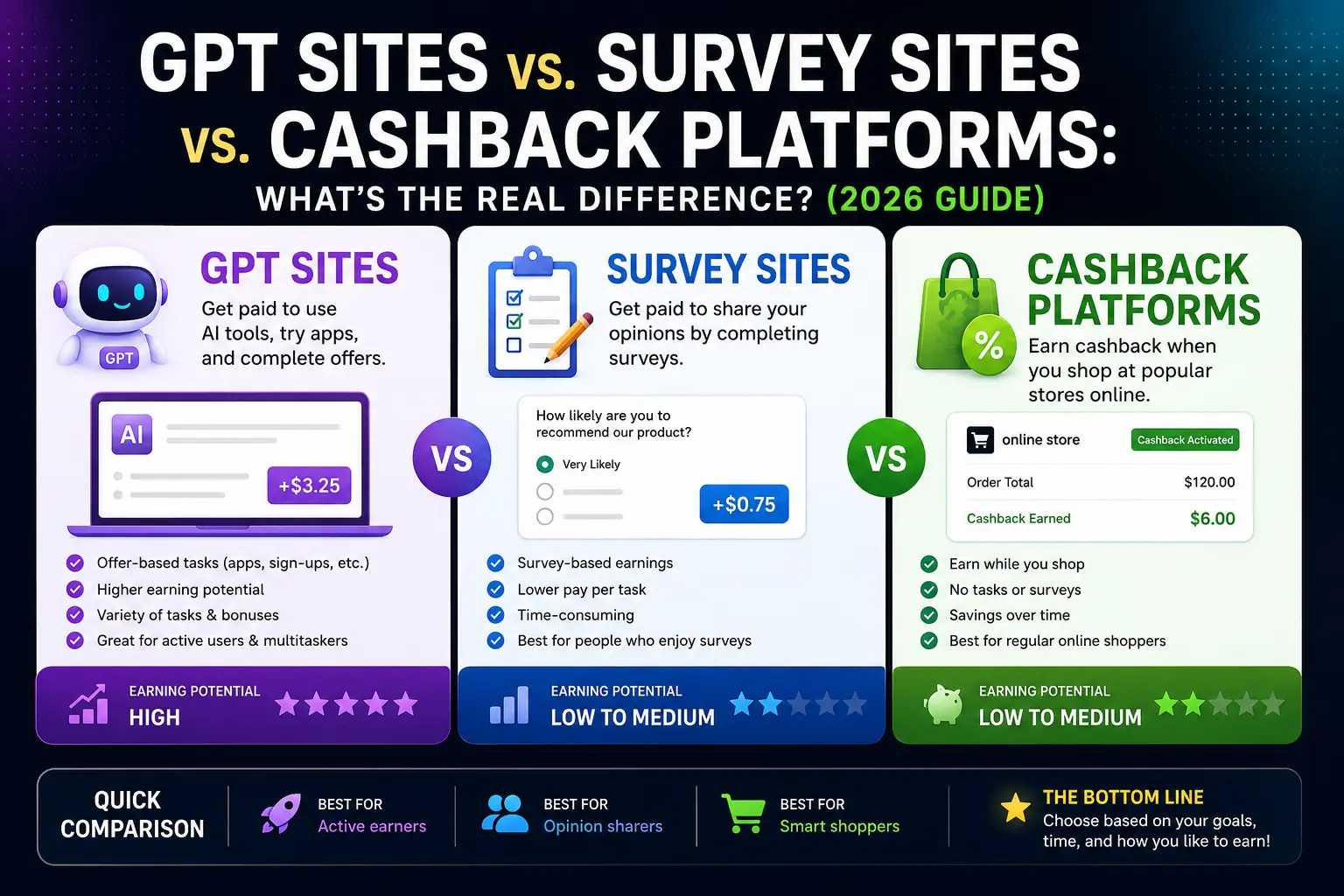
The generalist reward hub. Platforms like Swagbucks and InboxDollars run every revenue stream at once — offers, surveys, cashback, video, search — deliberately spreading risk across as many advertiser relationships as possible. This is the most resilient model, but it's also the most expensive to build and operate, since it requires integrating and maintaining dozens of separate network relationships simultaneously.
The offer-and-survey specialist. Platforms like Freecash and TimeBucks lean heavily on aggregating the deepest possible catalog of offers and survey routers from third-party networks, competing primarily on payout speed, low minimum cashouts, and interface quality rather than owning a proprietary revenue stream of their own. Their margins are thinner per user, so they compete on volume and retention instead — which is exactly why review-site reputation and Trustpilot scores matter so much to platforms in this category specifically.
The gaming-and-in-app rewards layer. Platforms such as Idle Empire lean into gift cards for gaming currencies and app-install offers aimed at a younger, mobile-first audience, monetizing largely through CPI (cost-per-install) deals rather than higher-value financial or subscription offers. The tradeoff is a lower average payout per action, offset by a much larger volume of casual, low-friction completions.
The passive-resource model. Platforms like Honeygain sidestep the task-completion economy almost entirely, instead monetizing a user's unused internet bandwidth by reselling it to data-collection and web-intelligence clients, then sharing a portion of that resale revenue back with the user. This is architecturally a completely different business — closer to a data marketplace than an advertising network — but it gets grouped with GPT sites because the user experience (sign up, do very little, get paid a small recurring amount) feels identical from the outside.
Recognizing which archetype a platform belongs to tells you almost everything about what to expect from it: how volatile its payouts will be if one network relationship sours, how much your specific country and device matter to your earnings, and whether the platform's revenue is tied to your active effort or simply to your presence.
A Real Example: Why Swagbucks Has Survived Almost Two Decades
It's worth sitting with one long-running example rather than only abstractions. Swagbucks launched in 2008, weathered the 2008 financial crisis, the rise and fall of dozens of imitators, and multiple shifts in payment rails and advertiser behavior, and it's still standing in 2026 having paid out over $450 million cumulatively. What separates it from the graveyard of dead GPT apps isn't a secret algorithm — it's diversification across every revenue stream described above, all at once: offer walls, survey routers, shopping cashback, video ad views, and even its own search engine, which shares a slice of ad revenue every time a user searches instead of using Google directly. No single stream has to carry the whole business, and no single advertiser relationship going stale can sink the platform.
Compare that to the long tail of GPT apps that launch on one offerwall integration and one acquisition campaign. When that single network cuts its payouts, or the ad campaign stops being profitable, there's no second engine to fall back on, and the platform quietly stops paying out — or, less charitably, stops paying out on purpose once acquisition slows and the operators decide breakage plus remaining ad revenue outweighs continued payout obligations. This is exactly why review sites and forums matter so much in this space, and why any credible guide to GPT sites spends real time on trust signals: years in operation, transparent minimum payouts, responsive support, and verifiable independent review history, rather than headline earning claims alone.
What Separates a Sustainable GPT Platform From a Short-Lived One
Having looked at the mechanics, here's the pattern that shows up consistently across the platforms that last versus the ones that don't.
Diversified revenue, not a single offerwall. The strongest platforms blend CPA offers, survey routing, affiliate cashback, and often a passive-income layer (like selling unused bandwidth, the way Honeygain does) so that no single advertiser relationship or network policy change can sink the business overnight.
Realistic payout expectations set publicly. Honest industry writing acknowledges that headline "$200 a month" figures usually require several hours a day of activity in a high-inventory country, and that the real difference between someone earning $20 a month and someone earning $100 has more to do with task selection than platform choice, per EarnLab's analysis. Platforms that oversell earning potential burn through new users fast, spike their acquisition cost, and end up with an unsustainable CAC relative to the tiny margins each user generates.
Low, achievable minimum payouts paired with fast processing. Sites with the lowest minimum cashouts and the most reliable payment histories consistently earn the strongest independent trust scores — trust, in this business, compounds the same way it does anywhere else, and a platform's review-site reputation is effectively a leading indicator of its retention economics, as reflected in Freecash's own comparison of leading GPT sites.
A referral engine instead of pure paid acquisition. Because margins per transaction are thin, platforms that convert satisfied users into referrers reduce blended acquisition cost dramatically compared with competitors relying solely on paid install campaigns.
Fraud infrastructure that doesn't punish real users. Overly aggressive fraud flags erode trust and retention just as fast as under-enforcement invites the abuse that gets a platform blacklisted by its own advertiser networks. This is a genuinely difficult balance to strike, and it's a big part of why building this kind of platform is a real operations business, not a weekend side project.
The User Side of the Ledger: What This Means If You're Earning, Not Building
If you're reading this as someone who actually uses these platforms rather than someone building one, the economics above translate into a few very practical takeaways.
You are, functionally, an extension of someone else's marketing department, compensated at a discount. That's not a criticism — it's just an accurate description that helps calibrate expectations. The advertiser calculated that your attention and a bit of your data were worth roughly $X, the network took a cut, the platform took a cut, and you received what was left. Understanding that chain explains a few recurring patterns:
- Higher-payout offers (financial apps, trading platforms, gambling apps) almost always come from higher-lifetime-value verticals and often carry real financial risk or recurring subscription terms — the payout is high precisely because the advertiser expects to earn much more back from you than it's paying the platform.
- Survey disqualification isn't a glitch; it's a routing mechanism working exactly as designed, and it happens to everyone, not just you.
- Cashback shopping is the one category with genuinely no catch — you were going to buy the item anyway, and the commission comes out of the retailer's existing marketing budget, not your pocket.
- Diversifying across a handful of established, well-reviewed platforms — rather than concentrating all your time on one unproven site — mirrors exactly the diversification logic that keeps the platforms themselves alive, and it reduces your exposure if any single site changes its terms or slows its payouts.
Regulatory and Trust Considerations
Because real money and real advertiser relationships are involved, GPT platforms operate under the same general advertising-disclosure and consumer-protection expectations as any performance-marketing business. Advertisers vetted through legitimate CPA networks are subject to standard truth-in-advertising rules, and reputable platforms disclose minimum payout terms, verification requirements, and, where relevant, the affiliate nature of shopping links. If you're evaluating a platform's legitimacy, the U.S. Federal Trade Commission's general guidance on endorsements, online advertising, and consumer reviews — available at ftc.gov — is a useful baseline for the kind of disclosure a trustworthy site should be providing, even though it wasn't written specifically about the GPT category.
The Adjacent, Frequently Confused Economy: AI "GPT" Monetization
Because the acronym overlaps, it's worth briefly separating this from a genuinely different 2026 trend: monetizing OpenAI's Custom GPTs through the GPT Store. That economy runs on entirely different mechanics — usage-based revenue share from a single AI company, rather than advertiser CPA spread across many networks — and, candidly, the numbers there are far less generous for individual creators than the Get-Paid-To model discussed throughout this article. Most individual creators reportedly hit a soft ceiling of a few hundred dollars a month from GPT Store revenue share, which has pushed serious builders toward direct B2B consulting instead of relying on marketplace payouts, according to Digital Applied's 2026 guide to the GPT Store. If you landed here searching for that topic instead, it's a genuinely different business model wearing the same three letters — but it illustrates a truism that applies to both: platforms dependent entirely on one company's revenue-share terms are inherently fragile, while platforms built on multiple, diversified income streams tend to last.
Where This Is Heading
A few shifts are worth watching if you care about where GPT platform economics go from here. Offerwall networks are increasingly investing in real-time fraud and quality segmentation — sorting traffic into tiers so higher-value users see higher-paying offers — which should, over time, make payouts feel less arbitrary and more personalized. Cashback and affiliate integrations are deepening as retail media budgets grow, which likely means the shopping-commission slice of GPT revenue keeps expanding relative to old-fashioned survey and offer-wall income. And as advertiser CPA benchmarks keep climbing in high-lifetime-value verticals like fintech and iGaming, expect the payout gap between "watch this ad for a nickel" and "complete this trading app deposit for forty dollars" to keep widening rather than narrowing — which is exactly what you'd predict once you understand that every payout on a GPT platform is just a visible fragment of someone else's customer-acquisition budget.
Final Thought
The thing that stuck with me most, once I understood how this industry actually works, wasn't cynicism about it — it's a strange kind of respect for how efficiently the whole chain operates. An advertiser somewhere needs new trial users for a budgeting app. A network matches that need to available inventory. A platform in your browser presents it as "earn $2." And you, doing something you'd probably have scrolled past anyway, get paid a sliver of a marketing budget that would otherwise have gone entirely to Meta or Google. It's not a way to get rich. It was never designed to be. But as a small, transparent slice of a much larger advertising economy, it's a surprisingly honest business once you can see the whole chain — which, now, you can.
Frequently Asked Questions
How do GPT sites make money if they're paying users cash? They keep a margin between what advertisers and CPA networks pay per completed action and what they pass along to users as rewards — typically retaining a meaningful percentage of every offer, survey, or cashback transaction before it reaches your balance.
Are GPT sites a scam? Established platforms with long track records, transparent payout minimums, and verifiable payment histories are legitimate businesses operating within the same performance-marketing infrastructure used by mainstream advertisers. That said, the category also attracts short-lived copycat apps that inflate earning claims and quietly stop paying — track record and independent reviews matter enormously.
Why do survey sites disqualify me so often? Survey routers match respondent profiles to specific research studies in real time. If you don't fit the demographic quota a client needs, you're routed out, and the platform earns nothing for that attempt either — which is why most sites pay a small consolation bonus for disqualifications.
What's the difference between a GPT site and a CPA network? A CPA network sits upstream, aggregating offers from advertisers and paying out publishers (including GPT sites) for verified actions. A GPT site is the consumer-facing publisher that displays those offers to individual users and shares a portion of the network payout with them.
Can you actually make good money on GPT sites? Realistically, most users earn modest supplemental income — a few dollars to a couple hundred dollars a month, depending on time invested and country of residence, since offer inventory and payouts vary significantly by geography. It's a legitimate side-income stream, not a replacement for employment.
Sources
- RevBoost — What Is an Offerwall?
- RevBoost — How to Start an Offerwall or Rewards Site
- Shopify — CPA Marketing: What It Is and How It Works
- Wikipedia — Cost per Action
- PropellerAds — CPA Marketing Model 2026
- Pubscale — 14 Best Offerwall Ad Networks
- EarnLab — Best GPT Sites: Honest Earnings, Real Rankings
- Freecash Academy — Best Get-Paid-To Sites
- SwiftSalary — 25 Best GPT Sites, Get Paid To Sites, Apps, Tips and FAQs
- IBISWorld — Market Research & Public Opinion Polling in the UK
- Digital Applied — GPT Store & Custom GPTs Business Guide 2026
- Federal Trade Commission

Comments (0)
No comments yet. Be the first to share your thoughts!