
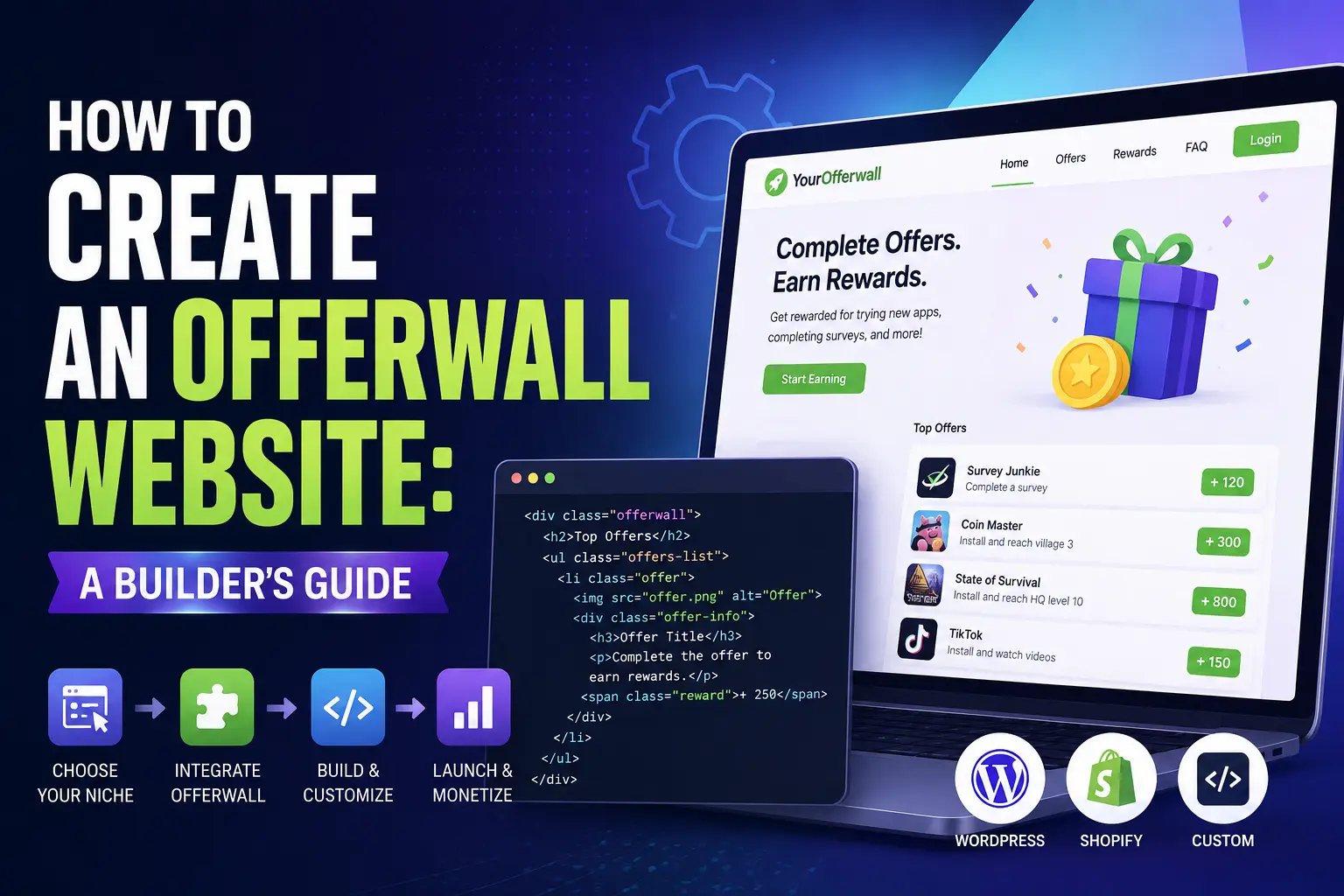
Building an offerwall website looks simple from the outside: show offers, let users complete them, and add rewards to their balances.
The difficult part starts after the first conversion.
A production-ready offerwall website has to connect user attribution, offer tracking, server-to-server postbacks, wallet accounting, fraud controls, reversals, withdrawals, and provider reporting. One duplicated callback can create an incorrect balance; one unverified request can turn into a direct financial loss.
This guide focuses on the parts that usually need the most engineering attention. It covers the architecture, database design, S2S security, provider integrations, testing, withdrawals, and the decisions that make an offerwall easier to maintain as traffic grows.
For mobile products, the same backend can support Android and iOS applications. See our guide on How to Add an Offerwall SDK to Android & iOS Apps for the mobile SDK side of the architecture.
Table of Contents
- 1. Plan the Offerwall Architecture
- 2. Build the Data and Reward Layer
- 3. Secure Postbacks and Provider Integrations
- 4. Test the Conversion and Withdrawal Pipeline
- 5. Scale, Monitor, and Maintain the Platform
<a id="architecture"></a>
1. Plan the Offerwall Architecture
What an offerwall website actually does
An offerwall sits between users and one or more offer providers.
The user starts on your platform, clicks an offer, completes the advertiser's requirement, and the provider reports the conversion back to your infrastructure. Your backend then decides whether the event is valid and whether a reward should be added.
The basic flow is:
The browser starts the process, but the browser should not be the authority that confirms the reward.
Start with one working conversion path
A common mistake is trying to integrate every offer provider before the first provider has been tested end to end.
For an MVP, build this path first:
Once that pipeline is reliable, additional networks become adapters rather than entirely new systems.
Choose a stack that makes transactions easy
A Laravel application is a practical choice for this type of project because it gives you routing, database access, queues, caching, authentication, validation, and transactions without having to assemble those pieces yourself.
A typical stack might be:
Laravel's database layer supports transactions for operations that need to succeed or roll back as one unit. Its queue system is useful for background work such as analytics and notifications. See the Laravel database documentation and Laravel queue documentation.
Keep provider-specific logic out of your wallet code
This becomes important as soon as you add the second network.
One provider might call the user identifier sub_id; another might call it uid. One might sign a callback with HMAC-SHA256; another may use a token or a different signature scheme.
Your application should normalize those differences.
A simple internal object can look like:
Then each provider has its own adapter.
That separation saves a lot of cleanup later.
Recommended architecture
<a id="data-reward"></a>
2. Build the Data and Reward Layer
Do not store the wallet as a single number
A field such as:
is useful as a cached balance, but it should not be your complete accounting system.
A better design keeps a wallet ledger.
Now a conversion has a history:
If that conversion is later reversed:
The original record stays intact.
Why the transaction ID matters
Offer networks often retry callbacks.
Imagine your server receives:
Then the same request arrives again because the provider did not receive a successful response quickly enough.
Without idempotency:
With a unique transaction key:
This is not an optional optimization. It is one of the basic protections for a reward system.
Use a postback log as well as a reward ledger
Keep a separate table for incoming provider requests.
This gives your support team something concrete to investigate.
When a user says "the offer completed but my balance did not change," you can trace:
Separate provider reward from platform reward
Do not hard-code the assumption that one provider credit equals one platform point.
For example:
Keep the conversion rule configurable:
The exact multiplier is a business decision, not a technical constant.
It is also useful to preserve the original provider amount in transaction metadata so revenue and payout reports can be reconciled later.
Keep an immutable history
Do not rewrite old wallet transactions when something changes.
For example, avoid:
Prefer:
That gives you an audit trail and makes balance disputes much easier to resolve.
<a id="postbacks-security"></a>
3. Secure Postbacks and Provider Integrations
Build the postback endpoint explicitly
For a Laravel application:
Your actual HTTP method and parameters should match the provider specification.
Do not place a normal logged-in-user middleware in front of a webhook endpoint unless the provider actually supports that authentication model.
Validate before crediting anything
A postback should not go directly from:
to:
Validate:
An example controller structure:
Those field names are examples. Never force a provider into a format it does not use.
Verify signatures instead of trusting the request
If a provider specifies HMAC-SHA256, the verification pattern is similar to:
hash_equals() is preferable to a normal string comparison for secret-derived values.
Not every offer network uses HMAC-SHA256, though. Some use a token, a parameter hash, a shared secret, or another signing method. The provider's current documentation must define the actual verification algorithm.
Do not rely on IP allowlisting alone
IP allowlisting can be an additional layer when the provider publishes supported source addresses, but it should not replace request authentication.
A more useful security stack is:
That gives you multiple independent checks.
Never put server secrets in the client
Your Android or iOS application can contain credentials that the provider explicitly documents as public.
It should not contain:
Those belong on your backend.
This is especially important when the same reward system supports both a web offerwall and the Android/iOS SDK integration.
Process rewards inside a database transaction
A race condition can happen when two requests for the same conversion arrive nearly simultaneously.
The reward operation should be atomic.
The application-level existence check is useful, but the database uniqueness constraint is still important. The database should enforce the rule even when concurrent requests reach the application at the same time.
Track a stable user identifier
The user ID has to survive the complete attribution journey.
For example:
The provider might call the parameter:
The name changes; the purpose does not.
Prefer an opaque internal identifier rather than sending a user's email address through tracking URLs when the provider does not require it.
Add provider adapters
A provider interface keeps the wallet system independent:
A provider implementation can then handle its own signature and parameter names:
This design is much easier to extend when a third provider arrives.
Use the flowchart as the visual explanation
The diagram above belongs directly beside the S2S explanation. It communicates the trust boundary much faster than another paragraph of terminology.
<a id="testing-operations"></a>
4. Test the Conversion and Withdrawal Pipeline
Test the complete conversion journey
Do not stop after confirming that an offer loads.
Create a test account and follow the entire path:
If one step fails, log that specific stage instead of treating the conversion as a generic "offerwall issue."
Test duplicate callbacks
Send the same transaction twice:
Expected result:
The second request should be recognized as a duplicate.
Test invalid signatures
Change the signature by one character.
The expected behavior is:
Do not accidentally create a fallback branch that credits the user when verification fails.
Test invalid users
Try a postback containing:
The server should not create a new user automatically just because a provider referenced an unknown identifier.
Log the event and follow your chosen provider retry policy.
Test impossible reward values
A reward endpoint should reject data such as:
The exact limits depend on your business model, but the backend should never blindly trust external numerical values.
Test reversals
Simulate:
Then:
The wallet should return to the correct state while keeping both events visible in history.
Test account and device changes
Also test:
Offerwall bugs often appear in lifecycle transitions rather than the happy path.
Design the withdrawal workflow carefully
An early-stage platform should not necessarily pay every withdrawal immediately.
A safer workflow is:
Typical withdrawal states are:
A simple schema:
Delay automation until you understand your fraud profile
Instant payouts can look attractive from a marketing perspective, but offerwall revenue can later be reversed.
That creates an unpleasant situation:
A practical approach is to combine a minimum withdrawal threshold with risk rules and manual review for new or unusual accounts.
<a id="scale-maintain"></a>
5. Scale, Monitor, and Maintain the Platform
Add fraud signals gradually
You do not need a machine-learning fraud engine on day one.
Start with signals that are easy to explain:
A simple risk score can route accounts into different workflows:
This does not need to block every flagged user. It can simply determine whether the withdrawal should be reviewed.
Rate-limit sensitive endpoints
Authentication, withdrawals, password reset, and public API endpoints all deserve protection.
Laravel provides route and rate-limiter facilities that can be tuned per endpoint. See the Laravel rate limiting documentation.
For example:
Use different policies for different routes rather than forcing one global limit onto the whole application.
Move non-critical work into queues
The postback request should not spend several seconds generating reports, sending emails, and recalculating dashboards.
Keep the critical path short:
Then queue secondary work:
This also makes it easier to recover from temporary failures.
Monitor the events that actually affect revenue
A useful monitoring dashboard should show:
A sudden drop in conversions could mean a provider problem.
A sudden increase in rejected signatures could indicate a configuration issue or an attack.
A sudden increase in duplicate callbacks could simply mean the provider is retrying aggressively because your endpoint is responding too slowly.
Those are very different incidents, and good logging lets you tell them apart.
Keep a clear audit trail for admin actions
If an administrator manually changes a user's balance, record:
Avoid silently editing balances from a database console.
A reward platform eventually becomes an accounting system. Once that happens, "who changed this?" becomes an operational question, not a theoretical one.
Decide when to use a ready-made platform
Building everything yourself gives you complete control, but it also means owning:
A ready-made GPT or offerwall platform can shorten the time to launch when its existing architecture matches your requirements.
For example, Hansal Dev's VibeCash currently describes multi-offerwall support, transaction history, withdrawals, referrals, analytics, and centralized postback management. Preads is another offerwall and monetization product listed by Hansal Dev. These are useful reference points when comparing a custom build against a ready-made starting point.
The important comparison is not simply "custom versus script." Check:
Keep documentation next to the integration
Every provider adapter should document:
This prevents the integration from becoming tribal knowledge that only one developer understands.
Think about the system as a financial pipeline
The most useful mental model is not:
It is:
Every stage has a different failure mode.
That is why a good offerwall backend is closer to a small financial-processing system than a simple affiliate landing page.
Frequently Asked Questions
How much does it cost to build an offerwall website?
The cost depends on whether you are using an existing platform or building the entire system yourself. A custom build requires development time for the user system, wallet ledger, provider integrations, fraud controls, admin tools, withdrawals, and maintenance.
Can I build an offerwall website with Laravel?
Yes. Laravel is well suited to the backend because it provides routing, validation, database access, transactions, queues, caching, and authentication. The important part is designing the reward and postback systems correctly rather than relying on the framework to solve business logic automatically.
What is an S2S postback?
An S2S, or server-to-server, postback is a notification sent by the offer provider directly to your backend after a conversion event. Your server can then verify the request and record the reward without trusting the user's browser.
Why shouldn't JavaScript credit the user's balance?
Because JavaScript runs in the user's environment. A malicious user can manipulate client-side requests. The backend should determine whether a conversion is valid and whether the corresponding reward can be added.
How do I prevent duplicate rewards?
Use the provider's unique transaction ID, store it in a wallet ledger, and enforce uniqueness at the database level. Also process the ledger update and balance change inside a database transaction.
Should I integrate multiple offerwall providers?
Usually, yes — but only after the first provider works reliably. Multiple providers can improve offer availability and revenue diversification, but they also increase reconciliation and support work.
Should withdrawals be automatic?
They can be, but automatic payouts are safer after you have enough data to understand fraud and reversal patterns. New or high-risk accounts can be routed through manual review first.
Do I need IP whitelisting?
It can be a useful additional control when the provider supports it, but it should not replace provider-specific authentication such as signatures or secrets.
Can the same backend power an Android or iOS app?
Yes. The web frontend, mobile application, and offerwall can all use the same user identity, reward ledger, postback endpoint, and withdrawal system. The mobile client becomes another interface to the same backend rather than a second rewards engine.
What should I build first?
Build one complete conversion path:
Once that path is stable, add providers, referrals, leaderboards, advanced fraud scoring, and other features.
Final Takeaway
Creating an offerwall website is less about displaying offers and more about building a trustworthy conversion pipeline.
The core architecture should answer five questions for every reward:
If your system can answer those questions from stored records, you have a strong foundation.
The practical architecture is straightforward:
The most expensive bugs in this space are rarely visual bugs. They are duplicate credits, incorrect attribution, unverified callbacks, reversals that were never accounted for, and withdrawals made before the underlying revenue was trustworthy.
Build those parts carefully first. Everything else becomes easier to improve later.
- For developers working on the mobile side, continue with How to Add an Offerwall SDK to Android & iOS Apps. For broader Hansal Dev resources, visit the blog and projects.



Comments (0)
No comments yet. Be the first to share your thoughts!