
I spent three years running a small GPT site — nothing huge, never more than about 40,000 registered members at its peak — and the question I got asked more than any other, by far, wasn't "how do I withdraw my money" or "why was my survey rejected." It was some version of: "Wait, if you're paying ME cash, how are you making anything?"
It's a fair question. On the surface, a GPT ("Get-Paid-To") site looks like it's giving money away. You watch a video, you get 2 cents. You download a game and hit level 10, you get $1.50. You fill out a 20-minute survey about your grocery habits, you get $3. From where the user sits, it genuinely feels like free money.
It isn't free. It was never free. Someone paid for that video view, that game install, and that survey response — and they paid a lot more than what landed in your account. This article is the explanation I wish someone had handed me before I built my first offerwall integration, written from the site-owner side of the desk, with real numbers, real terminology, and the parts nobody puts in the "10 Best GPT Sites of 2026" listicles.
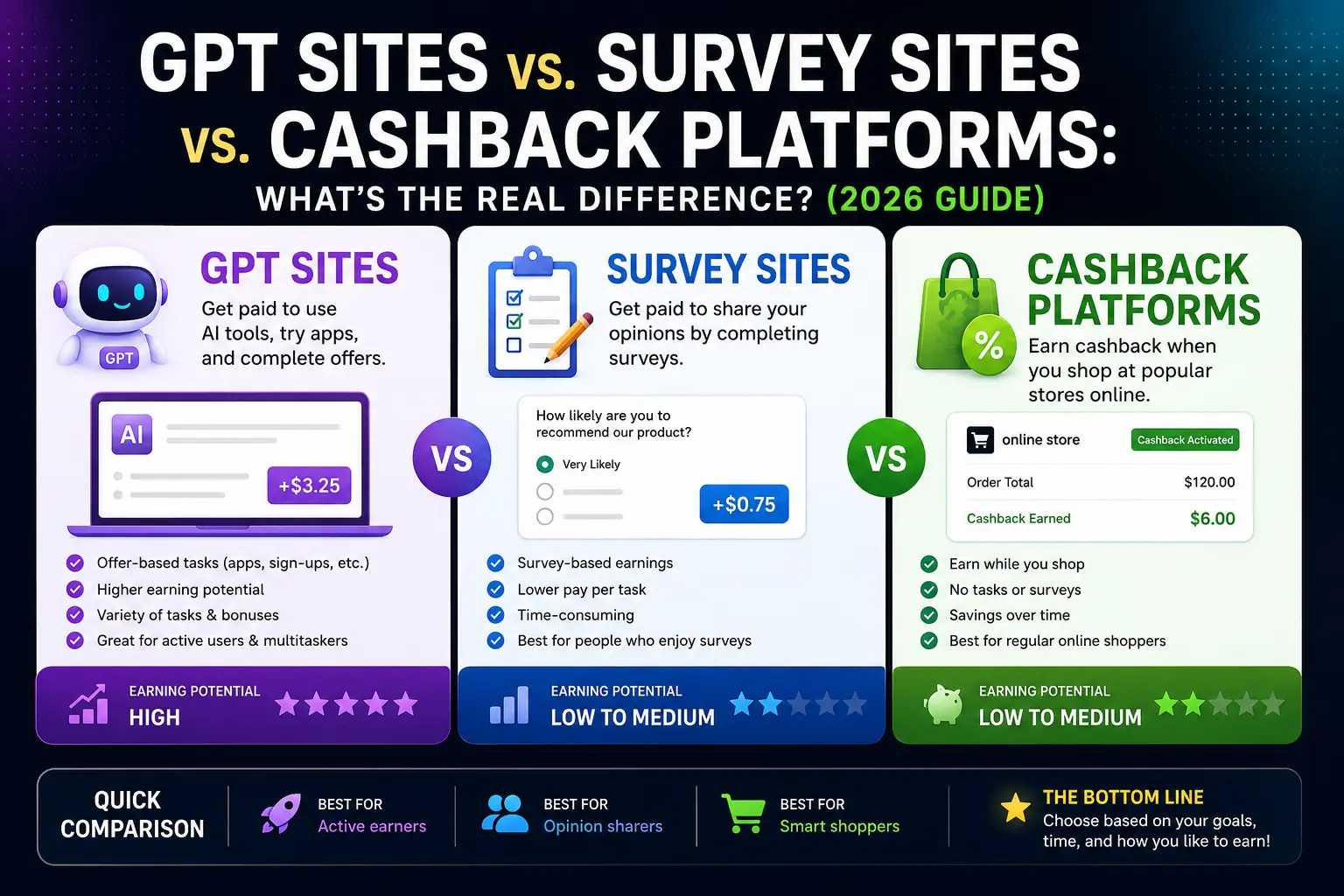
A GPT — Get-Paid-To — site is a website (or app) where members complete small online tasks in exchange for money, points, or gift cards. The tasks usually fall into a handful of buckets: surveys, offers (sign-ups, free trials, purchases), app or game installs, video views, paid-to-click ads, and shopping cashback.
The names you'll recognize if you've spent any time in this space — Swagbucks, InboxDollars, Freecash, PrizeRebel, ySense — have been around, in some cases, for close to two decades. Swagbucks has been running since 2008 and has paid out over $450 million total, which is usually the first data point people reach for when they're trying to figure out whether this whole category is legitimate or a scam dressed up in friendly branding.
It's legitimate. That's actually the more interesting part of the story, because "legitimate" and "the site profits far more than you do" are not contradictory statements — they're basically the same statement, viewed from two different chairs.
GPT sites get paid by offering advertising space; companies and individuals pay them to run banner and text ads and to display offers for members to complete, and the more traffic a site gets, the more it can charge for that advertising space. That single sentence, from a fairly old but still accurate HubPages explainer, is the whole business model in miniature. Everything else in this article is detail on top of that sentence.
The Core Idea: GPT Sites Are Not Charities, They're Middlemen
Here's the mental model that finally made it click for me when I was setting up my own site's first offerwall integration back in 2018, sitting in a chat with an account manager from a mid-size CPA network who was, frankly, a little too honest with me about the margins involved.
GPT websites are like the middlemen — they don't own any of the activities that pass through their platforms, but they can moderate them depending on their terms and conditions. A GPT site doesn't manufacture surveys. It doesn't build the mobile games you install. It doesn't run the streaming service that gives you a free trial. It sits in the middle of a supply chain that already existed — advertisers who need users, and users who have time and attention to sell — and it takes a cut for connecting the two sides and handling the plumbing: tracking, fraud checks, and payouts.
The concept behind GPT sites is simple: advertisers offer trials, surveys, and videos to watch that GPT sites then offer to their members through the platform, and when members participate, they earn a portion of the revenue the GPT website earns. Notice the phrasing there — "a portion." Not "the revenue." A portion of it. That word is doing a lot of quiet work, and it's the entire subject of this article.
Think of a GPT site less like a bank handing out free money and more like a talent agency. The agency doesn't pay the actor out of its own pocket — it books the gig, takes its commission off the top, and passes the rest along. The advertiser is the studio. You're the actor. The GPT site is the agent. Nobody in that arrangement is doing you a favor; everyone is doing a job, and the agent's job happens to be the one where the margin lives.
Revenue Stream #1: Offerwalls and CPA Networks
If you've ever clicked into the "Offers" tab on a GPT site and seen a scrolling wall of app icons, streaming trials, credit card sign-ups, and "complete these 3 steps for $8" boxes, you were looking at an offerwall. This is, in almost every case I've seen, the single biggest revenue driver for a GPT site, and it runs on something called CPA marketing.
CPA stands for Cost Per Action. A Cost-Per-Action network is, in the words of one industry explainer, a marketing model where affiliates get paid for user actions rather than just clicks, which lets publishers earn commissions from parts of the sales funnel beyond a full purchase, such as a registration. A GPT site is functionally an affiliate — it's just an affiliate that shares the commission with the end user instead of pocketing all of it, which is what makes the whole model recognizable as "get paid to."
Here's how the chain actually works, step by step, because the listicle sites tend to skip this part entirely:
- An advertiser — say, a mobile game studio, a meal-kit company, or a credit card issuer — wants new users and is willing to pay for each one. Advertisers start by defining the type of actions they want to encourage and how much they're willing to pay affiliates to promote them — for example, offering affiliates a percentage of every sale generated.
- The advertiser lists that offer with a CPA network (or several) rather than negotiating with every website individually. Advertisers often partner with affiliate networks to list their offers and source affiliates, because it would be impossibly slow to strike a private deal with every GPT site, blog, and app on earth one at a time.
- The CPA network makes that offer available to publishers — and a GPT site is a publisher in this relationship, exactly like a blogger running Amazon affiliate links, just at a different scale and with a different audience-facing wrapper.
- The GPT site plugs offers into its offerwall, usually through a widget provided by an "offerwall aggregator" that blends offers from several CPA networks at once so members always see something to do.
- A member completes the offer — installs the game, reaches level 15, or signs up for the trial.
- The advertiser pays the CPA network an agreed amount for that action — could be $0.50 for a simple email sign-up, could be $40+ for a funded trading account or an insurance quote, depending on how valuable that user is to the advertiser.
- The CPA network keeps a cut and pays the GPT site the rest.
- The GPT site keeps a cut and pays the member what's left.
Three layers of margin, and you as the member are standing at the very end of the line.
The reason this model is so durable is the one Shopify's guide puts plainly: CPA marketing is a low-risk, high-reward model because it's the only marketing model that guarantees a business only pays when it achieves a real result, such as a completed action. Advertisers love it because there's no wasted ad spend on people who never do anything. That reliability is exactly why they're willing to pay a premium per action — a premium that gets split three ways before you ever see it.
And the categories of "action" are broader than most users realize. CPA programs can pay per lead, per click, per sale, per install, or even per view, and businesses can run a recurring revenue share every time a referred customer purchases, or a one-time cost-per-acquisition payment for the first conversion. A GPT site owner is often mixing all five of these inside a single offerwall without the user ever noticing the difference — from your seat, it's all just "an offer."
A concrete example, close to what I actually saw running my own wall: a fintech app offering a signup bonus might pay a CPA network $25 for every user who links a bank account and completes one transaction. The network takes roughly 20-30% as its own margin, passing $17-20 down to the GPT site. The GPT site then displays that as a $10-14 reward to the member, keeping the remaining $6-10 as its gross margin on that single completed action — before subtracting fraud losses, chargebacks, payment processing fees, and the advertising cost of acquiring the member in the first place.
Multiply that across thousands of completed offers a day, and you can see why offerwalls — not surveys, not ads — are usually the backbone of a GPT site's income.
Revenue Stream #2: Survey Routers and Panel Aggregators
Surveys work on a similar but distinct model, and they're worth separating out because the economics — and the frustration users feel — are different.
Business owners commission surveys to gather information on what customers want, and each time you fill out that form you may be helping an organization decide which business line to pursue, or helping someone complete their research. Market research firms need a constant supply of specific demographics — women aged 25-34 who've bought skincare in the last month, men who own a truck and live in a particular state, parents with kids under five. Recruiting that exact mix of people from scratch, for every single study, would be prohibitively expensive. So research firms buy access to "panels" — big pools of pre-registered people willing to answer questions for money — through survey routers, which are the survey equivalent of an offerwall.
Here's the part that explains a huge amount of user frustration on GPT sites: the router doesn't know in advance whether you match what any given study needs. It asks a handful of screening questions first, and only pays you the full amount if you qualify and complete the whole thing. If you get filtered out three questions in — after ten minutes of typing — some sites throw you a tiny consolation payment, and plenty pay nothing at all. That isn't a glitch. It's baked into how panel aggregation is priced: the GPT site (and the router behind it) is only compensated for delivered, qualified, complete responses, so a partial or disqualified one often generates little or no revenue for anyone in the chain, including you.
The money that does flow follows the same three-layer pattern as offerwalls: research firm pays the panel/router — router takes its cut and pays the GPT site — GPT site takes its cut and pays the member. It's the exact same middleman economics as CPA marketing, just wearing a clipboard instead of an app icon.
Revenue Stream #3: Paid-to-Click (PTC) and Display Advertising
PTC — Paid to Click — is the oldest and simplest GPT mechanic, and honestly the one with the thinnest margins for everyone involved these days. Paid to click is an online business model that draws traffic from people aiming to earn money from home; PTC websites act as intermediaries between advertisers and consumers, where the advertiser pays for displaying ads and a part of that payment goes to the viewer when they view the advertisement. You click a listed ad, a timer runs for 20-30 seconds while the advertiser's page loads in a new tab, and you get a fraction of a cent.
One of the easiest routes to start earning on a GPT site is paid to click — you click adverts provided to you, watch them for roughly 20 to 30 seconds, and get paid. The advertiser here is typically buying cheap traffic or brand impressions, similar to old-school CPM (cost per thousand impressions) or CPC (cost per click) display advertising, and the GPT site is essentially operating an in-house ad network layered on top of member eyeballs.
It's worth flagging honestly, and this comes straight from the Wikipedia entry on the model, that PTC has a rougher reputation than the rest of the GPT category: the viability of the PTC business model has been questioned, as fraudulent clicks have ramped up expenses for advertisers, and a criticism leveled at the model is that a Ponzi scheme could potentially market itself as a legitimate PTC advertising business — the U.S. Securities and Exchange Commission brought exactly this kind of complaint against one notable case. That's not me being alarmist — that's the documented history of the sub-category. It's why, if I were vetting a GPT site today, a business model that's mostly PTC with almost no offerwall, survey, or cashback component would be the first thing that made me raise an eyebrow.
On top of PTC specifically, most GPT sites also run standard programmatic display ads on their site — the banner and sidebar ads you scroll past on the way to the offer list. That's ordinary web publishing revenue, no different from any content site: advertisers (through ad exchanges like Google AdSense or similar networks) pay per thousand impressions or per click, and the GPT site collects it without sharing a cent of it with members, because it isn't tied to any task you completed.
Revenue Stream #4: Cashback and Shopping Portals
Some of the biggest GPT brands blend in a shopping cashback layer, and it's worth understanding because it runs on the cleanest version of the affiliate model — no offerwall, no survey router, just a straightforward retail affiliate link.
Clicking through a shopping portal before buying from a major retailer earns a percentage back without any additional effort, and for anyone who already does regular online shopping, that passive layer adds up without requiring extra task time. The mechanic: the GPT site has an affiliate relationship with the retailer (often through a traditional affiliate network like the ones described earlier), earns a commission on your purchase — typically anywhere from 1% to 10%+ depending on the retailer and category — and shares a slice of that commission with you as "cashback." The retailer is happy because affiliate-driven traffic converts well and costs nothing unless a sale actually happens; the GPT site is happy because cashback is one of the stickiest features in the whole category, since it rewards behavior people were already going to do anyway.
Revenue Stream #5: Referral Programs and Network Effects
Referral programs look, from the user side, like the GPT site being generous — "invite a friend, get a bonus!" From the site owner's side, referrals are simply the cheapest, highest-quality user-acquisition channel that exists.
Get Paid To sites love it when you introduce your friends to them, and nearly every GPT site has a referrals program, meaning every time you bring in a friend who signs up, you become entitled to a commission on their points earnings — paid separately, not deducted from your friend's own earnings. That last clarification matters and is worth repeating, because it's a common misconception: on a legitimate GPT site, your referral commission comes out of the site's own margin, not out of your friend's payout. It's the site choosing to spend part of its cut on acquiring you as a long-term, engaged, unpaid marketer instead of spending that same money on a Facebook or Google ad campaign.
And it genuinely is cheaper. Paid digital advertising for a "make money online" audience is notoriously expensive and full of ad-fraud risk. A member who refers five friends who then stay active for a year is often worth more to the site than $50 of paid ad spend would have generated, and the site knows it — which is why referral commissions on GPT sites tend to be structured to run for months or years off a single referred user's ongoing activity, not just a one-time signup bonus.
Revenue Stream #6: App and Game Install Monetization
Game and app install offers deserve their own section because the economics are unusually generous compared to most other offer types, and it's worth explaining why.
Mobile game and app publishers spend enormous amounts on user acquisition (UA) — the industry term for paying to get someone to install and, more importantly, keep playing an app. A single install with no ongoing engagement is nearly worthless to a game studio; what they're actually paying for is a player who reaches a certain level, makes an in-app purchase, or watches enough ads inside the game to justify the acquisition cost. That's why you'll often see GPT offers structured as "install and reach level 25" rather than just "install," and why those offers can pay several dollars — sometimes tens of dollars — for what looks like a few minutes of tapping through tutorial screens.
Under the hood, this still runs through the same CPA/CPI (cost-per-install) machinery described earlier: game studio — mobile ad network or CPA network — GPT site — member, with a cut taken at each stage. The reason the payouts feel bigger than a typical survey is that game studios have historically had large marketing budgets and a strong incentive to pay well for players who'll actually stick around and spend money inside the app — which is also exactly why milestone-gated offers ("reach level 25," not just "install") are so common; the studio is paying for retained players, not downloads.
The Math: What a GPT Site Actually Keeps
Nobody publishes their exact margins — I never did, and I wouldn't expect a competitor to either — but based on running one and comparing notes with a few other small operators over the years, a rough, honest range looks like this:
| Revenue Stream Typical Site Owner Margin | |
| CPA offers (app installs, sign-ups, trials) | 20% — 50% of what the CPA network pays out |
| Surveys (via router) | 20% — 40% of the router payout |
| Paid-to-click | Thin, often 30%+, but on very small absolute dollar amounts |
| Shopping cashback | 20% — 60% of the affiliate commission earned |
| Display advertising | 100% (not shared with members at all) |
| Referral-driven users | Effectively a marketing cost, not a "margin," but far cheaper than paid ads |
These ranges swing a lot based on the site's negotiating power. A GPT site pushing tens of millions of dollars of offer volume a year through a network gets meaningfully better rates than a small operator like I was — the same way a big-box retailer gets better wholesale terms from a supplier than a corner shop does. Scale is the whole game here, which is also why the same five or six GPT brands keep showing up at the top of every "best GPT sites" list year after year: they've had a decade or more to build the volume that earns them better rates, which lets them pay members more competitively, which attracts more members, which earns them even better rates. It compounds.
Where the Money Really Comes From (Follow the Chain)
Zoom out far enough and every dollar in a GPT ecosystem traces back to one of three ultimate sources:
1. Marketing budgets. The vast majority of the money is simply corporate marketing spend rerouted through an unusual channel. A subscription box company, a mobile game studio, a bank offering a new credit card — all of them have a customer-acquisition-cost budget they'd otherwise spend on Instagram ads, TV spots, or Google Ads. GPT offers are just another line item competing for that same budget, and often a more efficient one, because the advertiser only pays for a completed action, not a maybe.
2. Market research budgets. Whatever the survey is for, filling it out adds pieces of crucial information to a database, and researchers or business owners pay to gather that much-needed information because good consumer data drives product decisions worth far more than the cost of collecting it. A company deciding whether to launch a new flavor, price point, or feature genuinely will pay real money to reduce the risk of getting that decision wrong.
3. Retail margins. In the shopping/cashback stream, the money is simply a slice of a retailer's existing marketing budget or gross margin on the sale, redirected through an affiliate link instead of a billboard.
There isn't a fourth, mysterious source. There's no venture capital fairy dust subsidizing your $0.15 survey reward forever (though early-stage GPT sites absolutely do use investor capital to cover losses while they build an audience, same as most tech startups). It's marketing, research, and retail money, laundered — in the completely legal, mundane sense of that word — through three or four layers of intermediaries before it reaches your PayPal balance.
Costs a GPT Site Owner Has to Cover
The margin numbers above are gross margin, not profit. What actually eats into that:
- Payment processing fees. PayPal, Payoneer, and gift-card fulfillment providers all take a cut, and international payouts especially get expensive fast.
- Fraud prevention tooling. Bot detection, device fingerprinting, VPN/proxy detection, and manual review staff to catch multi-accounting — this is a genuinely large line item, and I underestimated it badly in my first year.
- Customer support. "Where's my payout," "why was my offer rejected," "my survey didn't credit" — these tickets never stop, and answering them badly is how a GPT site earns a wave of one-star Trustpilot reviews that then hurts its ability to attract new members.
- Development and hosting. Offerwall integrations, tracking pixels, anti-fraud systems, and mobile apps all require ongoing engineering.
- Compliance. Depending on jurisdiction, this can include GDPR/CCPA data-handling obligations, gambling-adjacent regulation if the site touches sweepstakes mechanics, and tax reporting obligations for members who cross reporting thresholds.
- User acquisition. Paid ads, SEO content, app store optimization, influencer and affiliate deals to bring in the next wave of members — all necessary because a GPT site's whole value proposition to advertisers depends on having a large, active audience to sell attention from.
Run those numbers and the "GPT sites are basically printing money" narrative gets a lot less dramatic. It's a real business with real overhead, competitive margins by online-advertising standards, and — like most affiliate-driven businesses — a model that only becomes genuinely profitable at meaningful scale.
Why "Breakage" Is the Quiet Profit Center
There's one mechanism that almost never gets discussed openly, and it's worth pulling into the light: breakage. In loyalty and rewards program economics generally (gift cards are the classic example), breakage refers to the value of points, balances, or rewards that members earn but never redeem — accounts that go dormant right below a cashout threshold, points that expire, balances abandoned when someone stops using the site.
Every points-based GPT site benefits from breakage to some degree. If a minimum cashout is $5 and a meaningful share of accounts sit at $2-4 forever because the person got bored, moved on, or forgot the account existed, that unclaimed balance is revenue the site collected from advertisers but never has to pay out. This is precisely why a payout threshold and payout speed genuinely matter when judging whether a GPT site is member-friendly — one industry voice put it plainly when explaining what they personally look for: what's also important is being able to get your money quickly and not being blocked by more than a minimum of a small amount collected before you can get paid. A site with a low, fast cashout threshold is voluntarily giving up some breakage revenue in exchange for member trust and retention — which tells you something real about how it prioritizes its business.
Fraud, Leakage, and the War Nobody Talks About
I want to be straightforward about something that ate more of my time than any other single issue: fraud runs in both directions in this industry, and it shapes almost every design decision a GPT site makes, including ones that frustrate legitimate users.
On one side, advertisers get defrauded by bad actors gaming offers — bots completing surveys, click farms hammering PTC ads, multi-accounting to farm referral bonuses, or automated scripts "completing" app-install offers without a real human ever opening the app. Fraudulent clicks have ramped up expenses for advertisers, with the burden placed on advertisers to determine valid clicks from fraudulent ones and request reimbursement. When fraud rates on a network get too high, advertisers pull their offers or demand lower payouts, which directly reduces what a GPT site can pass along to legitimate members — this is the actual reason strict verification, ID checks on large cashouts, and aggressive survey disqualification exist. It isn't the site trying to cheat you; it's the site protecting the advertiser relationships that fund the whole platform.
On the other side, some GPT and PTC sites are themselves the fraud — sites that never intend to pay, that exist purely to harvest personal data or ad-click revenue and vanish. A criticism leveled at the PTC model is that a Ponzi scheme could market itself as a legitimate internet-advertising company under that guise, and the most notable such case drew a complaint from the U.S. Securities and Exchange Commission. This is exactly why reputation, payout history, and third-party review volume (Trustpilot counts, longevity, community forums like SurveyPolice) matter so much when evaluating a GPT site — a platform that's been running since 2008 and has verifiably paid out hundreds of millions of dollars has settled the legitimacy question before it even comes up, in a way a six-month-old site with no track record simply cannot.
Is the GPT Business Model Sustainable in 2026?
Broadly, yes — with a caveat. Digital advertising and market-research spending aren't going anywhere; if anything, the appetite for first-party behavioral data and verified human engagement has grown as platforms fight bot traffic and ad fraud elsewhere online. GPT sites don't require special skills or experience, and the model of watching videos, training AI, or completing micro-tasks for pay has, if anything, expanded as AI companies themselves have entered the market for human-labeled data and human feedback — training data collection and AI feedback tasks are one of the newer categories showing up on offerwalls, running on the exact same CPA logic as everything else in this article, just with a different kind of buyer at the top of the chain.
The caveat is realism about earnings, and it's worth being blunt about this because so much content in this space oversells it. One of the more clear-eyed recent breakdowns of the category makes the point well: the headline "$200 a month" numbers get attention, while the fact that hitting them requires several hours a day in a high-inventory country tends to get quietly left out — for most consistent users, realistic earnings run closer to $30-100 a month. That's not nothing, and for the right person filling genuinely idle time, it's worthwhile. But it's also exactly consistent with everything explained above: three layers of margin between the advertiser's budget and your payout means the majority of the money was always going to stay upstream of you, structurally, by design — not because any single site is cheating you.
What This Means If You're a User
Understanding the business model actually makes you a smarter GPT user, not a more disillusioned one. A few practical takeaways from having sat on the other side of the wall:
- Milestone-gated offers (games, apps) tend to pay proportionally better than simple sign-ups, because the advertiser is paying for a retained user, and more of that value gets passed down the chain.
- Survey disqualification isn't personal or random malice — it's baked into how panel routers price completed vs. incomplete responses. Sites with better "profile pre-screening" waste less of your time, and that's a real, checkable quality signal.
- A low, fast cashout threshold is a meaningful trust signal, not just a convenience feature — it tells you the site isn't relying heavily on breakage to pad its margins.
- Longevity and payout volume matter more than app-store star ratings, which are easy to inflate. Long-running platforms with large, independently verified total payouts have a lot more to lose by not paying you than a brand-new site does.
- Treat referral bonuses as a bonus, not a strategy — they're the site sharing part of its own acquisition budget with you, which is genuinely fine and fair, but building your entire earning plan around recruiting friends puts you in the position of being the site's unpaid marketing department.
What This Means If You're Thinking of Building One
If this article has you thinking about launching a GPT site of your own rather than just using one, the realistic starting point is almost never building your own offers — it's plugging into existing infrastructure. Offerwall aggregators (which blend several CPA networks into a single embeddable widget) and survey router providers exist specifically so that a new site doesn't need to negotiate individually with hundreds of advertisers on day one. The margin you'll realistically get as a small new entrant will be thinner than what an established brand commands, and your first real product isn't the offerwall at all — it's fraud prevention, because a site with a high fraud rate gets its offer inventory throttled or pulled fast, and inventory is everything in this business. Budget for that from the very first spreadsheet, not as an afterthought once problems start.
Frequently Asked Questions
Are GPT sites a scam? The category as a whole is not a scam — it's a real, well-established branch of affiliate and CPA marketing with platforms that have paid out hundreds of millions of dollars over nearly two decades. Individual bad actors do exist within the space, particularly in the older PTC sub-category, which is why checking payout history and independent reviews before joining any specific site matters.
How do GPT sites make money if they're paying users cash? They keep a percentage of what advertisers, CPA networks, and survey research firms pay them for each completed action — offer, survey, click, install, or purchase — and pass the remainder to the member who completed it. Display advertising and unredeemed "breakage" balances add additional revenue that isn't shared with members at all.
Why do surveys disqualify me so often? Survey routers only get paid for delivering fully qualified, completed responses that match a specific demographic a research firm requested. If your answers don't match what that particular study needs, the router — and by extension the GPT site — often earns little or nothing for your partial attempt, so many sites pay a small consolation reward at best.
Do referral bonuses come out of my friend's earnings? No, on legitimate platforms. The site pays referral commissions out of its own marketing budget as the cost of acquiring a new user cheaply, not by deducting anything from the person you referred.
Which pays better: surveys, offers, or PTC? Generally, milestone-based app/game offers and CPA sign-up offers pay the most per minute of effort, because advertiser budgets in those categories tend to be larger. Paid-to-click typically pays the least, since advertisers are usually only buying cheap impressions or traffic, not a real conversion.
Sources and Further Reading
- SurveyPolice — Ultimate Guide to GPT Sites
- GetPaidTo — How GPT Websites Work
- Wikipedia — Paid to Click
- Wikipedia — Affiliate Network
- Shopify — What Is CPA Marketing?
- Semrush — CPA Marketing Explained
- EarnLab — Best GPT Sites 2026: Honest Earnings and Real Rankings
This article reflects publicly available industry information plus firsthand experience operating a small GPT platform. It is written for informational purposes and is not financial advice. Individual platform terms, payout rates, and eligibility requirements change frequently — always check a site's current terms before joining.

Comments (0)
No comments yet. Be the first to share your thoughts!