
How Users Earn Money on GPT (Get-Paid-To) Platforms
A grounded look at what GPT sites actually pay, how the business model works, and how to avoid wasting your time on the ones that don't.
I signed up for my first "get-paid-to" site back when a lot of these platforms still looked like they'd been designed in 2006 — clunky point systems, banner ads everywhere, and a payout page that took three clicks too many to find. Somewhere along the way, out of curiosity more than need, I kept an account running for months just to see what a realistic month of GPT earnings actually looked like. Spoiler: it wasn't life-changing, but it also wasn't nothing, and it taught me more about how this corner of the internet works than any "top 10 sites" roundup ever did.
That's really the point of this article. Not another recycled list of platform names, but an honest explanation of how GPT sites make their money, how that money trickles down to you, what a realistic monthly total looks like, and how to tell a legitimate platform from one that's going to waste your evenings.
What Is a GPT (Get-Paid-To) Platform, Exactly?
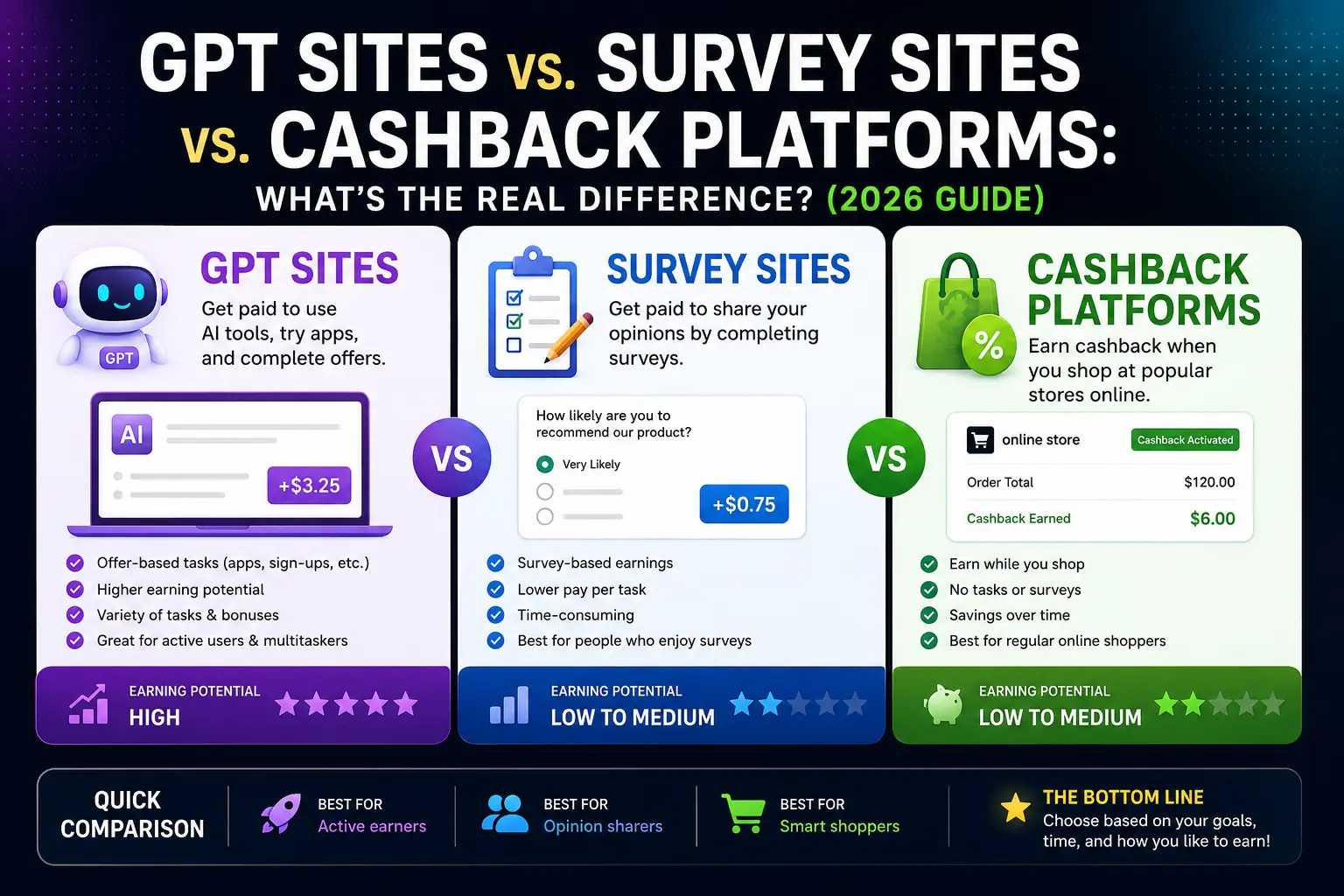
GPT stands for Get-Paid-To. It's an umbrella term for websites and apps that pay ordinary users — in cash, PayPal balance, gift cards, or occasionally crypto — for completing small online activities. Take a survey, install a game and reach level 10, watch a sponsored video, sign up for a free trial, click through a shopping link before buying something you were going to buy anyway. Each action earns you points or cents, and once your balance crosses a minimum threshold, you cash out.
The concept isn't new. Sites like Swagbucks have been running since 2008, and PrizeRebel has been operating continuously since 2007. What's changed is the variety: modern GPT platforms have folded in mobile game offers, app-testing gigs, cashback shopping, and crypto payouts alongside the classic paid survey.
It helps to be precise about what these platforms are not. They are not a replacement for a job. They are not a passive-income machine. And despite what some landing pages imply, nobody is making a stable full-time living clicking through offer walls. What they are is a legitimate, low-barrier way to convert spare attention — time you'd otherwise spend scrolling — into a few dollars a week, and occasionally quite a bit more if you're strategic about it.
The Business Model: Why Do These Sites Actually Pay You?
This is the part most explainers skip, and it's the part that actually tells you whether a platform is trustworthy.
GPT sites don't pay you out of goodwill. They're the consumer-facing layer of a much bigger advertising and market-research economy. Three main revenue streams fund almost every payout you'll ever receive:
1. Market research firms need opinions. Companies like Toluna, YouGov, and the survey panels behind Survey Junkie sell aggregated consumer data and opinion trends to brands. A shampoo company wants to know what packaging color tests better — that data has to come from somewhere, and market research firms pay a fee per completed response. A slice of that fee becomes your $0.75 for a 10-minute survey.
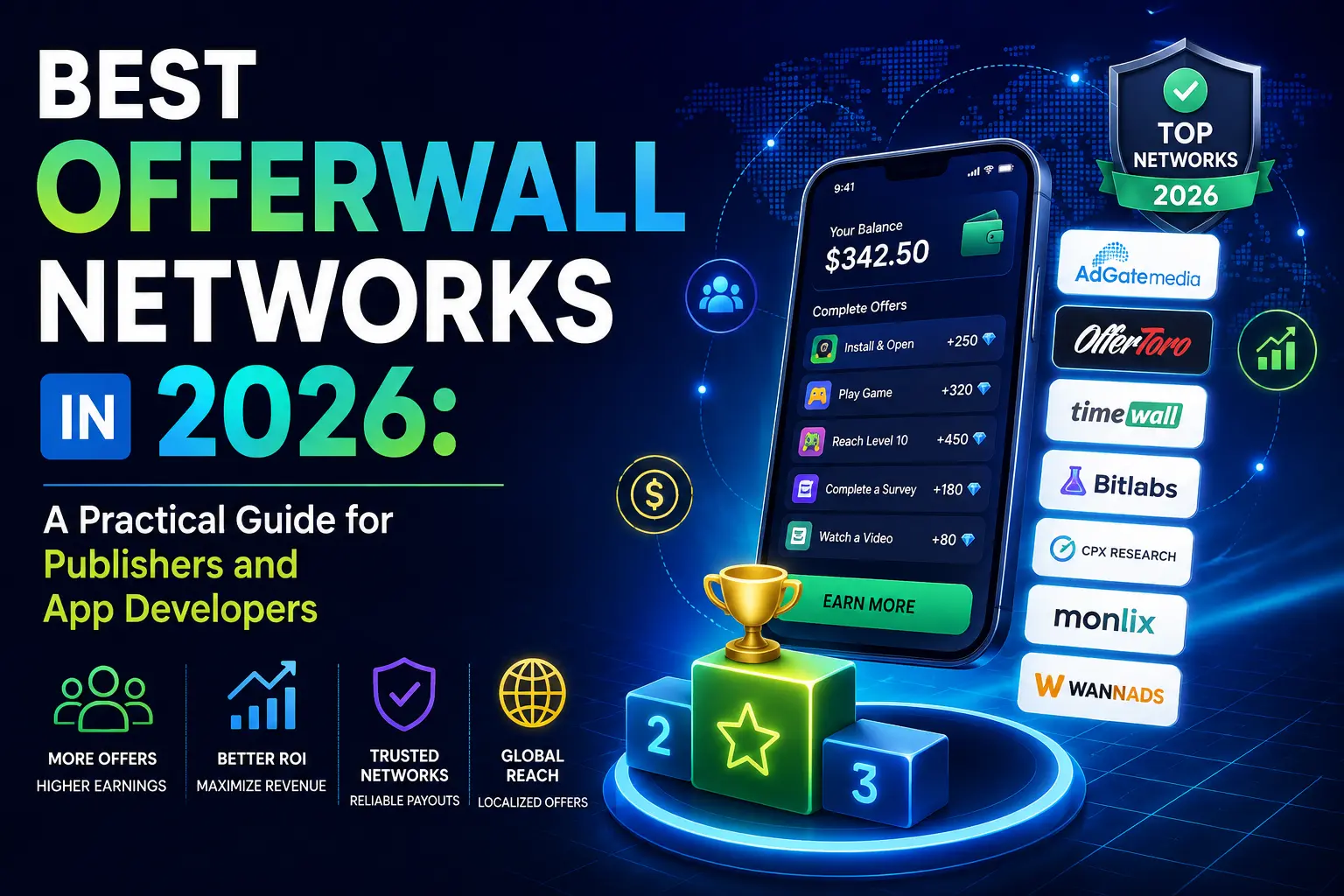
2. Advertisers pay for user acquisition. Mobile game studios and app developers pay "cost per install" or "cost per action" fees to advertising networks — often tens of cents to several dollars per install, and considerably more if a user has to reach a certain level or make an in-app purchase. GPT platforms plug into these ad networks (commonly called offerwalls, with names like AdGem, Revlum, or BitLabs showing up behind the scenes on many sites) and pass a cut of that acquisition fee to you for completing the install.
3. Affiliate and cashback shopping. When you click through a GPT site to buy something on Amazon or Walmart, the platform earns an affiliate commission on the sale, and shares part of it back with you as cashback.
Understanding this matters because it explains the earning ceiling. You're being paid a fraction of what an advertiser or research firm is already paying for your attention or your data. That's a completely normal transaction — you're being compensated for something of real value — but it also means the payouts are, by design, going to be modest per task. Anyone promising you can "get rich" this way is either exaggerating or running something that isn't a real GPT platform at all.
The Main Ways Users Actually Earn on GPT Sites
Every platform mixes and matches these categories differently, but almost all GPT earning falls into one of the following buckets.
1. Paid Surveys
The oldest and still most common task type. You answer demographic screening questions, and if you match what a research firm is looking for, you're routed into a full survey. Typical payouts run from about $0.25 for a short screener-style survey up to $3 — 5 for a longer 20-minute study, occasionally more for specialized medical or B2B panels.
The honest downside: disqualification rates are high. You can spend five minutes answering screening questions only to be told you don't match the target demographic, and you get little or nothing for the attempt. This is the single biggest source of frustration new users report, and it's worth knowing going in rather than being surprised by it.
2. Offerwalls: App Installs, Free Trials, and Sign-Ups
This is where the real money tends to be, hour for hour. Offerwalls are essentially catalogs of third-party promotions — install this game and reach level 15, sign up for a free trial of this streaming service, register for a finance app. Payouts range from a couple of dollars for a simple install to $20 — 50 for a game that requires several days of active play to reach a deep level milestone.
The trade-off is time and, sometimes, hidden commitment. A "free trial" offer might auto-renew into a paid subscription if you don't cancel in time, so reading the fine print on each offer before you click "join" is non-negotiable. This is also the task type most likely to fail to track — meaning you complete the requirement but the platform's system doesn't register it, which is why reputable platforms all have a "missing offer" support ticket process.
3. Playing Games for Rewards
A specific subset of the offerwall model, focused entirely on mobile and casual games. Apps like Mistplay pay you in points redeemable for gift cards just for playing games you choose based on your own genre preferences, with bonus multipliers for trying new titles. It's genuinely one of the more enjoyable ways to earn, if you already play mobile games recreationally — you're just getting paid for something you'd likely do anyway.
4. Watching Videos and Clicking Ads
Lower-effort, lower-pay. You watch short ad-supported video content or click paid-to-click (PTC) ads for fractions of a cent each. On their own these tasks rarely add up to meaningful money, but they're useful filler between higher-value tasks and require zero skill or attention beyond keeping a tab open.
5. Cashback Shopping
You shop through the platform's affiliate links at retailers you were already going to use, and earn a percentage back. Swagbucks, Rakuten-style cashback tools, and several GPT hybrids build this in. It's genuinely close to "free money" in the sense that it doesn't cost you extra time — just a browser extension or a habit of clicking through before checkout.
6. Referral Programs
Nearly every GPT platform offers a referral bonus, usually a percentage of whatever your referred friends earn, for a limited time or indefinitely. This is where the more aggressive "make $500 a month" claims usually come from — they're describing referral income from a large downline, not typical solo task earnings, and it's worth reading between the lines whenever a platform leads with this number.
7. Passive/Background Earning Apps
A newer category — apps like Honeygain that pay you for sharing unused internet bandwidth, running in the background without any active task completion. Earnings here are genuinely passive but also genuinely small, typically a few dollars a month.
What Do the Best-Known GPT Platforms Actually Offer?
Rather than another arbitrary "top 10," here's an honest snapshot of the platforms that come up again and again in independent reviews and comparison sites, along with what actually distinguishes them.
Swagbucks is the platform most people have heard of, running since 2008. Its catalog covers surveys, cashback shopping, search rewards, and game offers under one roof. Its scale is its main advantage — a huge offer library and broad availability — though several independent comparison guides now note that per-hour earning rates have slipped as the platform has grown and matured, with newer challengers offering faster payouts per task.
Freecash has become one of the most consistently recommended platforms in 2026 comparisons, largely on the strength of a low minimum cashout, fast PayPal processing, and a support team that reviewers describe as unusually responsive to tracking issues. It pulls offers from multiple third-party offerwalls (AdGem, BitLabs, and others), which means a wide and frequently refreshed task list.
PrizeRebel has been operating since 2007 and has one of the lowest minimum cashout thresholds in the industry — as low as $1 on some reward options — which makes it a low-risk way to test whether a platform actually pays before you invest real time.
Survey Junkie focuses specifically on surveys rather than a mixed offer catalog, and is frequently cited by financial publications like FinanceBuzz as one of the more reliable dedicated survey panels for U.S. users.
InboxDollars displays your balance in actual dollars rather than points, which some users find easier to track, and mixes surveys with paid emails, games, and video-watching tasks.
Toluna and YouGov lean into the market-research side more heavily than the "microtask" side. YouGov in particular has built its reputation over roughly 25 years as a political and consumer-opinion research company, which gives it a different trust profile than newer offerwall-style platforms — though payouts accumulate more slowly.
Mistplay is worth calling out separately because it's mobile-gaming-only. If your idea of a relaxing evening already includes a game on your phone, it's one of the few GPT-adjacent apps where the "task" and the "leisure activity" are the same thing.
A general pattern across nearly every current review site — JumpTask, Honeygain's blog, FinanceBuzz, and SurveyPolice among them — is that no single platform dominates every category. The realistic strategy, and the one independent reviewers converge on, is running two or three platforms at once rather than relying on one: it keeps you from running dry on tasks and lets you cherry-pick the highest-paying option for each task type.
How Much Can You Realistically Earn?
This is the question that matters most, and it's also the one most GPT-adjacent content quietly dodges because platforms benefit from you believing the number is higher than it is.
Based on multiple independent comparisons published in 2026, casual users spending roughly 15 — 30 minutes a day land somewhere between $30 and $75 a month. Users who treat it more like a genuine side hustle — a couple of hours a day, strategically choosing higher-paying offerwall tasks over low-value surveys — report $150 to $300 a month, though that figure depends heavily on which country you're in, since offer inventory and per-task rates are noticeably richer in the U.S., U.K., Canada, and Australia than elsewhere.
For broader context: a 2024 Pew Research Center survey found that roughly 16% of U.S. adults have earned money through some form of online gig platform, of which GPT-style microtask sites are one of the more accessible entry points precisely because they require no special skill and no application process. Separately, Bankrate's side-hustle research has put average monthly side-hustle income (across all forms, not just GPT sites) at several hundred dollars for people who treat it consistently — useful context for where GPT earnings sit relative to other side-income options, generally toward the lower, more casual end of that range.
The most useful mental model: GPT platforms convert idle attention into modest cash, not spare hours into a paycheck. If you're comparing hourly rates, offerwall app-install and game tasks generally pay three to five times more per hour of effective effort than pure survey-taking, so if your goal is maximizing dollars per hour, that's where to focus.
Getting Started: A Realistic Walkthrough
Here's roughly the process I'd recommend to someone starting from zero, based on what actually worked and what was a waste of time when I tried it myself.
Pick one platform and commit to a week before judging it. Don't spread yourself across ten sites on day one — you won't build a fair impression of any of them, and account verification on some platforms takes a day or two. Choose based on your country's offer availability and a platform with a track record of at least a few years.
Fill out your profile completely. This is the step almost everyone skips, and it's the one that determines how many surveys you actually qualify for. Survey platforms match you to studies based on your demographic profile — age, location, household composition, income bracket, shopping habits. A thin profile means constant disqualifications; a complete one means the platform can route you into surveys you're actually likely to finish and get paid for.
Set a daily or weekly time box. Fifteen to thirty minutes, done consistently, tends to outperform sporadic hour-long binges, mostly because daily bonuses, streak rewards, and fresh survey inventory reset on a daily cycle on most platforms.
Diversify your task types. Mix a couple of surveys with one offerwall task and some background video-watching. This hedges against the days when survey inventory in your country runs dry.
Track your cashouts, not your points balance. Points look bigger than they are. The number that matters is what you've actually withdrawn to PayPal, your bank, or a gift card — that's your real earning rate, and it's the only number worth comparing month to month.
Add a second platform once you trust the first. Once you've confirmed a platform pays reliably — meaning you've successfully cashed out at least once — adding a second site to fill in the gaps on days when the first one is quiet is where most experienced users land.
Payment Methods and Cashout Thresholds
Payout structures vary a fair amount, and they're worth checking before you sink time into a platform, since a $50 minimum threshold on a slow-earning site can mean waiting months for your first payment.
Most platforms offer some combination of:
- PayPal — the most universal option, usually processed within a few days
- Bank transfer / direct deposit — slower, sometimes with a higher minimum
- Gift cards (Amazon, Visa prepaid, and hundreds of retail and gaming options) — often the fastest to redeem and sometimes available at a lower threshold than cash
- Cryptocurrency — a growing option on newer platforms, appealing mainly to users who already hold or want exposure to crypto
Minimum cashout thresholds range widely, from $1 — 5 on platforms like PrizeRebel and Freecash up to $15 — 50 on some of the more research-heavy panels like YouGov. If you're testing a new platform for the first time, deliberately choosing one with a low minimum threshold is a smart way to verify it actually pays before committing more time — treat your first small cashout as a trust test, not a real earning milestone.
Is It Actually Safe? How to Vet a GPT Platform
Here's where I'd ask you to slow down, because this is the part where people get burned — not usually through some dramatic hack, but through slowly wasted time on a platform that was never going to pay out, or worse, through handing over information they shouldn't have.
The Federal Trade Commission has published consistent, plain guidance on this general category of opportunity for years, and the core principle applies directly to GPT sites: legitimate earning opportunities never require you to pay money upfront. If a "GPT platform" asks for a membership fee, a "verification deposit," or payment to unlock withdrawals, that's not a fee — it's the scam.
A practical vetting checklist, based on what independent reviewers and consumer-protection resources consistently flag:
Is it free to join? Every legitimate GPT platform costs nothing to sign up for. Full stop.
Does it have a real payout history you can verify? Check Trustpilot reviews specifically for mentions of successful withdrawals, not just star ratings — a platform with thousands of reviews mentioning actual PayPal payments received is a very different signal than one with vague five-star praise and no payment specifics. Freecash, for instance, has accumulated well over 200,000 Trustpilot reviews, the large majority positive, which is the kind of payout-history depth worth looking for.
How much personal information does it actually need? Basic demographic info for survey matching is normal. Being asked for your Social Security number, bank login credentials (rather than just an account number for a transfer), or a copy of your ID for a task that has nothing to do with identity verification is not.
Does it have transparent contact and support channels? A working support ticket system, a real company address, and visible response times in reviews are good signs. If support is unreachable or reviewers consistently report being ignored after requesting a withdrawal, walk away.
Is the payout threshold and timeline disclosed clearly? Reputable platforms state their minimum cashout and average processing time upfront. Vague or shifting terms are a warning sign.
Does it avoid guaranteeing specific high earnings? "Earn $500 this week guaranteed" is not how legitimate market research or advertising payouts work, because your earnings depend on offer availability and your qualification rate — no platform can guarantee that in advance.
The Better Business Bureau and Consumer Reports both maintain general fraud-alert resources that apply here too, particularly around lottery and prize-style scams that sometimes masquerade as reward platforms — the common thread across all of their guidance is the same one the FTC uses: real winnings and real earnings never require you to pay to receive them.
Red Flags: Signs a "GPT Site" Isn't Legitimate
Beyond the upfront-payment rule, a few other patterns are worth watching for:
- Unrealistic per-task payouts. If a five-minute survey claims to pay $50, it's not a real market-research rate, and it's a strong sign the site is either fake or a lead-generation scheme for something else entirely.
- No visible company information. Legitimate platforms disclose who runs them, often with a corporate address and a privacy policy that explains exactly how your data is used and sold to research partners.
- Pressure to recruit others as the primary earning method. A referral bonus on top of real task-based earning is normal. A platform where the only real way to earn is by recruiting new members underneath you is a pyramid structure, not a GPT site.
- Requests to deposit and forward a check. This exact scam shows up in the FTC's mystery-shopping warnings and it maps directly onto some fake "product testing" GPT offers — you're sent a check, asked to deposit it and wire part of the money elsewhere, and the original check later bounces, leaving you liable for the full amount.
- Apps that only exist as a sign-up page with no reviews anywhere. If you can't find independent mentions of the platform outside of its own marketing, treat that as a reason to wait, not a reason to be an early adopter.
Tips to Maximize What You Actually Earn
A few things that make a measurable difference, based on patterns that show up consistently across experienced users' accounts and my own time testing a few of these platforms:
Claim daily bonuses first, every time. Most platforms front-load a small guaranteed bonus for logging in or completing a daily streak. It costs nothing and adds up over a month more than you'd expect.
Prioritize offerwall tasks over surveys when your time is limited. Per-hour, they consistently outperform surveys, sometimes by three to five times, according to multiple comparison sites.
Be honest on survey screeners. Trying to guess "profitable" demographic answers to qualify for more surveys backfires — mismatched answers get you disqualified mid-survey after you've already spent the time, and repeated inconsistency can get flagged by the platform's quality-control systems, hurting your ability to qualify for anything going forward.
Read offer terms before clicking join, especially on free trials. Set a calendar reminder to cancel before a trial converts to paid — otherwise a "free" offer costs you real money and erases whatever you earned completing it.
Use a dedicated email address. Keeps survey-related correspondence and offer confirmations out of your main inbox and makes it much easier to track which offers you've completed if something needs a support ticket later.
File a support ticket immediately if a completed offer doesn't track. Tracking failures are common on offerwalls because of ad-network delays, not usually because you did something wrong. Reputable platforms resolve these; the speed and fairness of that resolution is itself a good signal of whether a platform is worth staying on.
Treat referral income as a bonus, not a plan. It's real, but it depends on convincing other people to also spend time on the platform, and building it up sustainably takes months, not days.
Pros and Cons, Honestly
What's genuinely good about GPT platforms:
- Zero cost and no application process to start
- Flexible — no schedule, no minimum commitment
- A legitimate way to convert idle phone time into a small but real amount of money
- Good entry point for students, stay-at-home parents, or anyone testing out the broader side-hustle world before committing to something with a steeper learning curve
- Multiple well-established platforms with genuine, verifiable payout histories going back over a decade
What's genuinely limiting:
- Hourly rates are low compared to almost any other form of paid work, skilled or unskilled
- High survey disqualification rates waste time
- Offer tracking failures happen and require follow-up
- Earnings are heavily dependent on your country — U.S., U.K., Canadian, and Australian users consistently report better inventory and payouts than users elsewhere
- It will not replace a job, and treating it as anything more than supplemental income sets you up for disappointment
A Quick Word on Taxes
If you're earning through GPT platforms in the U.S. and your total income from any single platform crosses certain reporting thresholds, that platform may issue a tax form, and regardless of whether you receive one, that income is generally considered taxable and reportable. This isn't tax advice — for anything beyond casual pocket-money amounts, it's worth checking current guidance directly on the IRS website or with a tax professional, since thresholds and reporting rules for gig and platform income have shifted in recent years and vary by country if you're outside the U.S.
How GPT Earnings Differ by Country
One thing that rarely gets said plainly enough in platform marketing: where you live changes the math more than almost any other factor. Offer inventory — the actual surveys and offerwall tasks available to you — is driven by which advertisers and research firms are buying attention in your market, and that's heavily concentrated in a handful of countries.
Users in the United States, United Kingdom, Canada, and Australia consistently report the deepest task inventory and the highest per-task rates, because that's where the advertising and market-research dollars are thickest. A survey that pays $2 for a U.S. respondent might pay a fraction of that, or simply not exist at all, for a user in a smaller ad market. Some platforms — Freecash and TimeBucks among them — have made a deliberate effort to build out inventory for a wider set of countries, including parts of Southeast Asia and Latin America, which is worth checking specifically if you're outside the traditional "big four" markets. Before committing real time to any platform, it's worth spending ten minutes just browsing the available tasks in your country rather than assuming the advertised earning ranges apply everywhere equally.
This also explains why so many "how much can you earn" claims online feel inconsistent with each other. A U.S.-based reviewer spending two hours a day on high-value offerwall tasks and a user in a market with thin inventory are going to report wildly different numbers from the same platform, and neither is lying — they're just describing two different local economies layered on top of the same site.
GPT Sites vs. Other Side Hustles: Where They Actually Fit
It's worth placing GPT platforms next to the other common ways people earn a bit of extra money online, because the comparison clarifies what they're good for and what they're not.
Compared to freelance work on platforms like Upwork or Fiverr, GPT sites require zero skill-building and zero portfolio, but they also pay a fraction of what even entry-level freelance gigs command per hour, because you're not selling a skill — you're selling attention and demographic data, which is a much lower-value commodity.
Compared to gig-economy driving or delivery work, GPT platforms need no vehicle, no background check, and no minimum hours, but they also can't approach the per-hour earnings of active gig work during a decent shift, because there's no equivalent to surge pricing or tips.
Compared to reselling, flipping, or e-commerce side hustles, GPT platforms require no upfront capital and no inventory risk, but they also have a hard ceiling on earnings that reselling doesn't, since a skilled reseller's income scales with effort and market knowledge in a way that a fixed per-survey payout never will.
The honest way to think about where GPT platforms fit: they're the lowest-barrier, lowest-risk, lowest-ceiling option on the side-hustle spectrum. That makes them a genuinely good starting point — especially for someone who wants to dip a toe into earning online without any setup cost or learning curve — but a poor long-term strategy if your goal is meaningfully growing your income over time. Most people who stick with the broader side-hustle world end up treating GPT platforms as a background layer, running quietly in spare moments, while they build something else with a higher ceiling alongside it.
Building a Simple Weekly Routine
If you decide to give this a real trial run rather than a one-off signup, a lightweight weekly structure tends to outperform sporadic effort, based on the patterns experienced users describe:
Monday — Friday, ten to fifteen minutes each morning: Check for new daily bonuses and any surveys that showed up overnight — survey inventory refreshes are often timed to daytime hours in your platform's core market, so checking once in the morning and once in the evening catches more opportunities than checking only once a day.
One evening a week, thirty minutes: Work through a longer offerwall task — a game that needs sustained play to hit a milestone, or a longer research study — since these pay disproportionately well relative to the five-minute tasks and are easier to knock out in one sitting than in fragments.
Monthly: Review your actual cashout total against the time you estimate you spent, and decide honestly whether the hourly rate is worth continuing at your current pace, scaling up, or treating as a low-effort background habit. This single step — actually doing the math rather than going on a vague sense of "it adds up" — is the one most people skip, and it's the one that turns GPT platforms from a mildly interesting habit into either a genuinely useful supplemental income stream or something you consciously decide isn't worth your time.
Frequently Asked Questions
Are GPT sites actually legit, or is this all a scam? The category as a whole is legitimate — it's a real, if modest, slice of the online advertising and market-research economy. Individual platforms vary, which is exactly why the vetting checklist above matters more than any specific "best of" list.
How fast can I get my first payout? On platforms with low minimum thresholds like PrizeRebel or Freecash, some users cash out within their first hour or two of activity. On research-heavy panels with higher thresholds, it can take a few weeks of casual use.
Do I need to give my bank details to sign up? No. You only need to provide payment information (like a PayPal email) when you're ready to withdraw, and even then, a legitimate platform never needs your full banking login credentials — only the account details necessary to process a transfer.
Can GPT earnings become a full-time income? Realistically, no, for the vast majority of users. The task-based, per-offer nature of the model caps how much any one person can earn in a day, no matter how efficient they get. It's genuinely useful supplemental income, not a career.
What's the single best platform to start with? There isn't a universal answer — it depends on your country, how much time you have, and which task type you find least tedious. Starting with a well-reviewed platform that has a low cashout threshold, so you can verify it pays quickly, is a more useful strategy than chasing whichever site currently tops a "best of" list.
The Bottom Line
GPT platforms are exactly what they say on the label — a way to get paid for small chunks of time and attention, funded by the same advertising and market-research dollars that already follow you around the internet in less transparent ways. Used with realistic expectations, a handful of trusted platforms, and a habit of checking terms before you click "join," they're a genuinely useful way to turn idle scrolling into a modest but real amount of extra cash. Used with the expectation that they'll replace a paycheck, they'll mostly just teach you how much your spare time is actually worth on the open market — which, it turns out, is a useful thing to know either way.

Comments (0)
No comments yet. Be the first to share your thoughts!