
What Is the Get-Paid-To Business Model, Really?
At its core, a Get-Paid-To (GPT) platform is a three-sided marketplace. On one side, you have everyday users — people like you and me — who are willing to trade time and attention for small cash rewards, gift cards, or digital currency. On the second side, you have advertisers, app developers, and market research firms who need something very specific: qualified leads, app installs, survey completions, or consumer data. And in the middle sits the GPT platform, acting as the matchmaker, the traffic broker, and the payment processor.
The model is sometimes called — rewarded engagement — or — rewarded user acquisition — (RUA) in industry parlance, but the mechanics are the same. The platform aggregates demand from hundreds or thousands of advertisers, breaks those demands down into bite-sized tasks that users can complete, and distributes a fraction of the advertiser's payment back to the user who performed the action.
What makes this model powerful is that it aligns incentives across all three parties. The advertiser gets a measurable action — an app install, a free trial signup, a completed survey — at a predictable cost. The user gets compensated for something they were already capable of doing in their spare time. And the platform takes a margin on every transaction without ever needing to manufacture a product, hold inventory, or deliver a service itself.
The Revenue Engine: How GPT Platforms Actually Make Money
If you want to understand how GPT sites work, you need to understand their revenue streams. No single platform relies on just one method. The most successful ones — think Swagbucks, InboxDollars, PrizeRebel — operate what industry analysts call a multifaceted revenue model that combines multiple performance-based income sources.
1. CPA Arbitrage: The Core Profit Mechanism
The single largest revenue driver for most GPT platforms is CPA (Cost Per Action) arbitrage. Here's how the economics work in practice:
An advertiser — let's say a fintech app like a budgeting tool — wants new user signups. They go to a CPA network and set a payout of, for example, $5.00 per qualified free trial signup. The CPA network (like RevBoost, MaxBounty, or Clickbooth) takes its cut and passes roughly $4.00 to the GPT platform that will promote the offer. The GPT platform then lists that offer on its site: — Sign up for BudgetPro and earn 400 points. —
Those 400 points might be worth roughly $2.80 to the user. The platform keeps the remaining $1.20 as gross profit. Multiply that across thousands of daily conversions, and the math becomes extremely compelling.
This is pure arbitrage. The platform is buying user actions at one price (the reward cost) and selling them to advertisers at a higher price (the CPA payout). The spread is where the business lives or dies.
2. Affiliate Commissions from E-Commerce
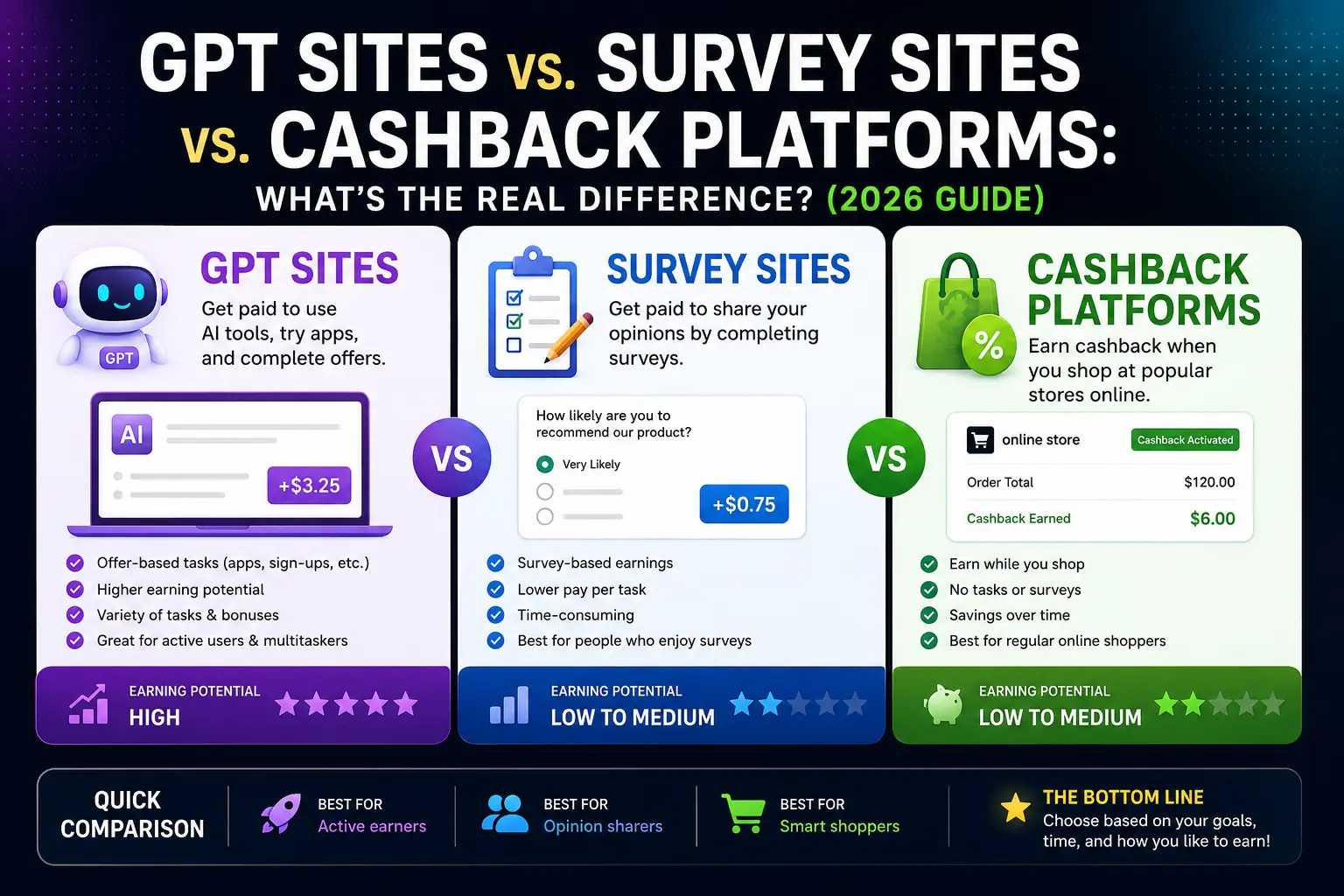
When you shop through a GPT portal and earn — cashback, — you're not actually getting a rebate from the retailer directly. You're participating in an affiliate marketing program. The GPT platform has affiliate agreements with thousands of online retailers. When you click through their portal to Walmart, Target, or Expedia and make a purchase, the retailer pays the platform a commission — often between 1% and 10% of the sale value. The platform then shares a portion of that commission with you as — cashback — or points.
This is why the cashback percentages on GPT sites are almost always lower than what you'd get from a pure cashback site like Rakuten. The platform needs to keep a margin. If Walmart pays 5%, the GPT site might give you 2% and pocket the 3% difference.
3. Market Research and Survey Revenue
Surveys are the most visible part of the GPT experience, but they're also the most misunderstood. When you spend 15 minutes answering questions about your car insurance preferences, you're not just earning $0.50. You're generating data that market research firms sell to Fortune 500 companies for product development, ad targeting, and competitive intelligence.
The GPT platform partners with survey routers — companies like Cint, Lucid, TheoremReach, and Pollfish — that aggregate demand from research firms. The research firm pays the router, the router pays the platform, and the platform pays you. Payouts per survey typically range from $0.25 to $2.00, with occasional high-value surveys reaching $5.00 or more for specialized demographics like IT decision-makers or medical professionals.
4. Rewarded Video Advertising
Those — watch a video, earn 1 point — offers? They're monetized through rewarded video ad networks. Advertisers pay on a CPM (cost per thousand impressions) basis, and the platform shares a microscopic fraction of that revenue with users. A single video watch might generate $0.001 to $0.01 in platform revenue. It's not meaningful per user, but at scale — millions of video views per day — it becomes a real revenue line.
5. Display Advertising and Sponsored Placements
High-traffic GPT sites also monetize their pageviews directly through display ad networks like Google AdSense, Mediavine, or Ezoic. Every time you visit the dashboard, browse the offerwall, or check your points balance, you're generating ad impressions. For a platform with 500,000 monthly active users, this can add thousands of dollars in essentially passive revenue.
6. Data Monetization (The Controversial One)
This is where the GPT model gets murky. Platforms collect enormous amounts of behavioral data: what you click, what you buy, what surveys you qualify for, what offers you complete, what demographics you belong to. Some platforms aggregate and anonymize this data, then sell insights to brands and research firms. This isn't universal — legitimate platforms are increasingly transparent about data usage — but it remains a material revenue stream for some operators.
The Offerwall: Where the Magic Happens
If you've ever used a GPT site, you've interacted with an offerwall, even if you didn't know the term. An offerwall is essentially a curated marketplace of CPA offers displayed in a grid or list format. Each offer shows what you need to do ( — Download Coin Master and reach level 10 — ) and what you'll earn ( — Earn 2,500 points — ).
From a technical perspective, the offerwall is powered by APIs that pull offers from multiple CPA networks and survey providers in real-time. The platform operator sets the — exchange rate — how many points equal a dollar — and determines what percentage of the CPA payout to share with users.
The economics of the offerwall are where platform operators exercise the most control. A savvy operator can adjust point values, feature high-converting offers prominently, and A/B test which offers generate the best user engagement. The best platforms use machine learning to personalize the offerwall — showing gaming offers to users who complete gaming offers, and financial services offers to users who shop for credit cards.
The Major Players: Who's Actually Running This Industry
The GPT space isn't a collection of sketchy fly-by-night operations. The largest players are backed by serious private equity and generate hundreds of millions in annual revenue.
Swagbucks (Prodege, LLC)
Swagbucks is the undisputed king of the GPT world. Founded in 2008 and headquartered in El Segundo, California, Swagbucks is a subsidiary of Prodege, LLC, a marketing and consumer insights conglomerate founded in 2005. Prodege reported generating over $300 million in revenue in 2021 alone, reflecting 32% year-over-year growth. The company has paid out over $832 million to members cumulatively and maintains BBB accreditation.
Swagbucks — revenue model combines affiliate commissions from 1,500+ retail partners, advertising fees, survey revenue, sponsored offers, and its Swagbucks Plus subscription tier. The platform uses a points system where 100 SB = $1.00, making the valuation transparent.
InboxDollars (Also Prodege)
InboxDollars operates under the same Prodege umbrella but uses a cash-based system rather than points. Founded around 2000 and based in St. Paul, Minnesota, InboxDollars connects users with advertisers and market research companies. It differentiates itself by showing earnings in actual U.S. dollars rather than abstract points, which reduces user confusion. The platform offers a $5 sign-up bonus but maintains a higher initial payout threshold of $15.
PrizeRebel
PrizeRebel has been operating for over 15 years and functions similarly, partnering with major market research companies to offer tailored consumer opinion surveys. The platform allows redemptions via PayPal, Bitcoin, and hundreds of gift cards, with a low $5 minimum threshold for PayPal cashouts.
The User Side: What You Actually Earn and Why
Here's where I need to be brutally honest with you, because this is the part most — make money online — articles gloss over.
The effective hourly rate on most GPT tasks is low. Professional reviewers estimate standard survey work at approximately $1.00 to $3.00 per hour. Video watching and ad clicking pay even less. The only activities that approach minimum wage equivalence are high-value mobile game offers — where studios pay bounties of $50 to $100+ for users who reach complex in-game milestones within a time limit — and strategic cashback shopping on items you were already planning to buy.
So why do millions of people use these platforms?
Because flexibility has value. A stay-at-home parent can complete a survey while their child naps. A college student can grind a mobile game offer during a boring lecture. Someone waiting at the DMV can watch a few videos and earn enough for a coffee. The GPT model succeeds not because it replaces employment, but because it monetizes fragmented attention that would otherwise go unmonetized entirely.
The platforms know this. Their entire UX is designed around micro-commitments: daily login bonuses, streak rewards, progress bars, and gamified achievements. They borrow mechanics from mobile games because those mechanics are proven to drive retention. A user who logs in for 10 days straight is exponentially more likely to hit their first cashout threshold — and once someone cashes out once, they're psychologically hooked.
The Fraud Problem: Why GPT Sites Are Fortresses
If you think the GPT business model sounds easy to exploit, you're right — and platform operators know it better than anyone. Fraud is the number one operational risk in this industry. The same incentives that attract legitimate users also attract bad actors.
Common fraud tactics include:
- Multi-accounting: One person creates dozens of accounts to multiply earnings
- VPN/proxy abuse: Users mask their location to access higher-paying geo-restricted offers
- Incentive abuse: Completing offers with fabricated information just to get credited
- Bot traffic: Automated scripts completing offers at scale
- Referral fraud: Users referring their own fake accounts to earn referral bonuses
This is why legitimate GPT sites have become increasingly strict. Phone verification, government ID uploads for large cashouts, device fingerprinting, IP monitoring, and 24-72 hour earning hold periods are now standard. If you've ever had your account locked or been asked for ID before cashing out, this is why. The platform isn't trying to scam you — they're trying to prevent chargebacks from advertisers that would literally destroy their business.
The scrub rate on offerwall conversions runs 10% to 25% in tier-1 geos like the US, UK, and Canada, meaning a significant portion of completed offers get reversed by advertisers due to quality concerns or fraud flags.
The Economics at Scale: What the Numbers Actually Look Like
If you're curious about the business potential of running a GPT site, the economics are surprisingly transparent. According to industry benchmarks:
- ARPU (Average Revenue Per User): $1.00 — $5.00 per month
- Gross Margin: 20% — 40% after paying user rewards
- Offer Completion Rate: 15% — 35% of users complete at least one offer per session
- User Retention (D30): 15% — 30% still active after 30 days
- Redemption Rate: 60% — 85% of earned points actually get redeemed
A GPT site with 5,000 daily active users can generate roughly $1,000 to $5,000 per month in gross revenue. At 50,000+ DAU, that scales to $10,000 to $50,000 per month. The largest platforms with hundreds of thousands of active users can clear $100,000+ per month.
The loyalty management market overall — of which GPT platforms are a significant segment — was valued at approximately $16.44 billion in 2026 and continues growing steadily.
Regulation and Compliance: The FTC Is Watching
One aspect of the GPT model that doesn't get enough attention is regulatory compliance. Because these platforms operate at the intersection of advertising, market research, and financial rewards, they fall under the scrutiny of multiple regulatory bodies.
The Federal Trade Commission (FTC) has specific guidelines about endorsements and material connections. If a GPT user posts a glowing review of a product they discovered through an offer, and they're being compensated by the platform, that constitutes a material connection that must be disclosed. The FTC requires — clear and conspicuous — disclosure using simple language like — Ad, — — Sponsored, — or — Paid Partnership. —
Additionally, platforms must comply with data privacy regulations (GDPR in Europe, CCPA in California), anti-money laundering (AML) rules for large cash transfers, and advertising standards set by the Interactive Advertising Bureau (IAB). The legitimate platforms invest heavily in legal compliance because a single FTC enforcement action or advertiser network ban can be existential.
The Future of GPT: Where This Model Is Heading in 2026 and Beyond
The GPT business model is evolving rapidly. Several trends are reshaping the industry:
1. Mobile-First Shift
Desktop GPT sites are becoming legacy products. The future is mobile apps with push notifications, geotargeted offers, and integrated wallet systems. Apps have higher retention rates and enable access to mobile-only offers like app installs and in-app event completions.
2. AI-Powered Personalization
Platforms are increasingly using AI to match users with offers they're actually likely to complete. Instead of showing everyone the same offerwall, machine learning models analyze user behavior, demographics, and completion history to surface high-converting, high-payout offers to the right users.
3. Crypto and Alternative Payouts
While PayPal and Amazon gift cards remain the standard, platforms are increasingly offering cryptocurrency payouts (Bitcoin, Ethereum) and even prepaid debit cards to appeal to younger, more digitally native demographics.
4. Integration into Larger Ecosystems
Standalone GPT sites may eventually become less common as their functionality gets embedded into super-apps, mobile games, and loyalty programs. The — offerwall as a service — model — where any app can embed a rewarded task system via API — is already massive in mobile gaming.
5. Higher Quality, Lower Volume
Advertisers are getting pickier. They don't just want installs; they want engaged users who actually use the product. This is pushing GPT platforms toward higher-value, higher-barrier offers (like subscription trials that require a credit card) and away from low-quality — click and earn — activities.
My Honest Take: Is the GPT Model Sustainable?
After years of watching this industry from both sides of the transaction, I believe the GPT model is not only sustainable — it's structurally durable. It solves a real problem for advertisers (expensive customer acquisition) and a real problem for users (monetizing spare time). As long as brands need consumers to try their products, fill out their surveys, and install their apps, there will be a market for intermediaries who can aggregate and incentivize those actions at scale.
But the model is also brutally competitive. User acquisition costs are rising. Advertiser quality standards are tightening. Fraud is an arms race. The platforms that survive will be the ones that invest in technology, maintain strict advertiser relationships, and treat their users with enough respect to keep them coming back.
If you're a user, my advice is simple: treat GPT sites as a side hustle for spare change, not a career. Use them strategically. Stack cashback with coupon codes. Target high-value game offers if you actually enjoy mobile games. Never pay to join a platform. And always, always cash out as soon as you hit the minimum threshold — because in this business, a bird in the hand is worth two in the bush.
If you're an entrepreneur considering building a GPT platform, know that the barrier to entry is lower than ever thanks to white-label solutions and offerwall APIs, but the barrier to sustainability is higher than ever. You need fraud prevention from day one, reliable CPA network partnerships, and a user acquisition strategy that can compete with the incumbents who have already spent hundreds of millions building their brands.
Key Takeaways
- GPT platforms are arbitrage businesses. They buy user actions cheap and sell them to advertisers at a markup.
- Revenue comes from multiple streams: CPA offers, affiliate commissions, survey fees, video ads, display ads, and data insights.
- The offerwall is the core product. It's a curated marketplace of tasks powered by real-time API connections to CPA networks.
- Fraud is the biggest risk. Legitimate platforms invest heavily in verification, device fingerprinting, and chargeback prevention.
- User earnings are modest but real. Expect $1 — $3/hour for surveys, with higher payouts for strategic activities like game offers and cashback shopping.
- The industry is massive and growing. Backed by billion-dollar loyalty markets and sustained advertiser demand.
Trusted Resources and Further Reading
- FTC Endorsement Guides — Official guidance on disclosure requirements for paid partnerships and affiliate relationships.
- Better Business Bureau: Prodege, LLC — Check accreditation status and complaint resolution for Swagbucks — parent company.
- Business of Apps: Rewards and Offerwall Market — Industry data on mobile monetization and rewarded engagement trends.
- IAB Ad Fraud Standards — Technical standards for invalid traffic detection and prevention.
- RevBoost GPT Site Economics Guide — Detailed breakdown of CPA arbitrage, margins, and scaling strategies for platform operators.

Comments (0)
No comments yet. Be the first to share your thoughts!