
What Is a GPT Website?
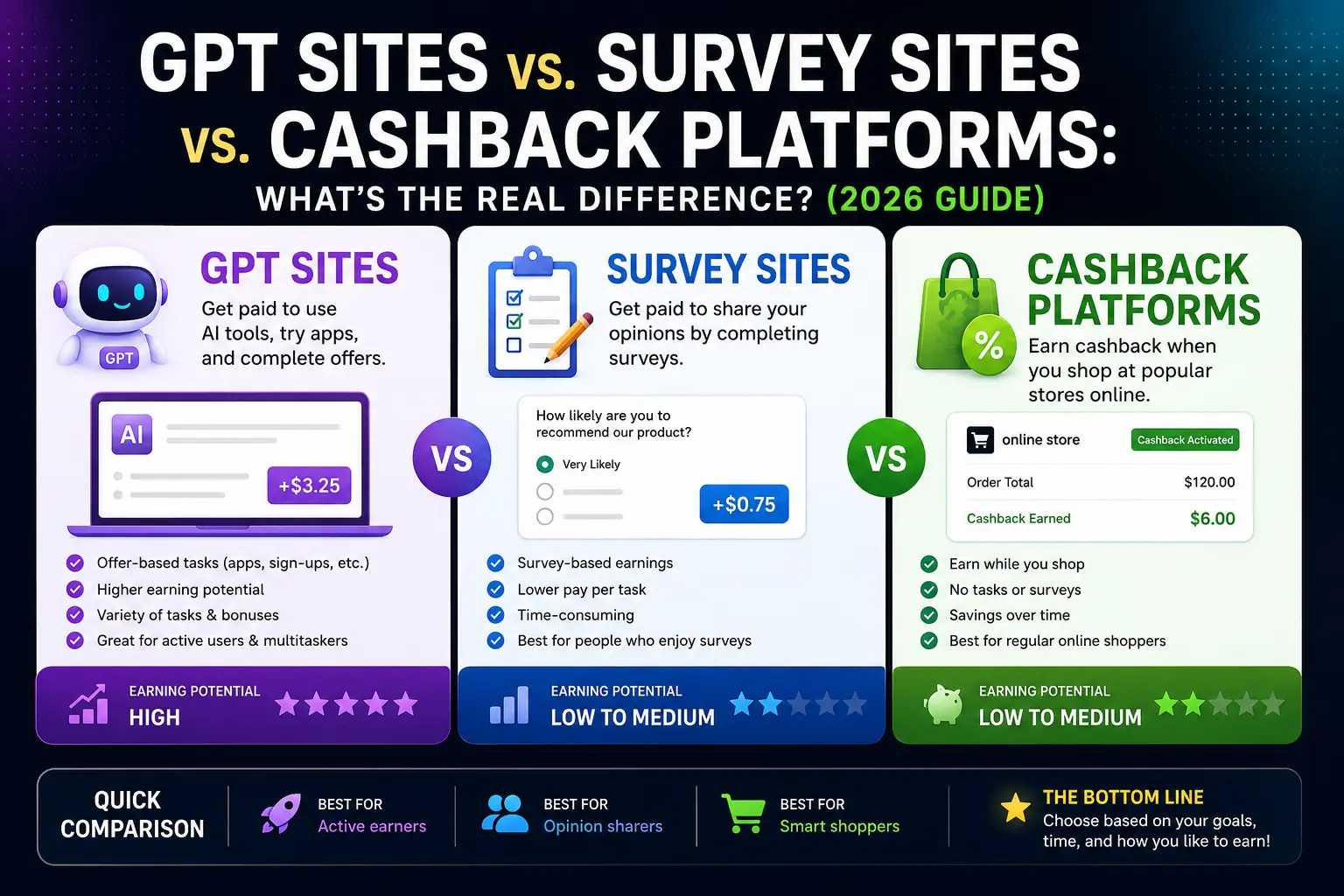
A GPT (Get-Paid-To) website is an online platform that pays users for completing simple tasks. The acronym is literal: you get paid to do something. That — something — can range from answering market research surveys and watching promotional videos to downloading apps, signing up for free trials, shopping through affiliate links, or even playing games.
GPT sites are also commonly called rewards sites, offerwall platforms, or micro-task sites. They sit at the intersection of three massive industries: affiliate marketing, market research, and consumer incentives.
The concept isn't new. InboxDollars, one of the earliest mainstream platforms, launched in 2000 — before Facebook, before the iPhone, before the term — side hustle — entered the cultural lexicon. Swagbucks followed in 2008 and quickly became the category leader. Today, the space has exploded into a multi-billion-dollar ecosystem with hundreds of platforms, millions of active users, and sophisticated backend infrastructure that most participants never see.
According to Precedence Research, the global cash back and rewards app market alone was valued at approximately $4.14 billion in 2025 and is projected to reach $7.73 billion by 2034, expanding at a compound annual growth rate (CAGR) of 7.20%. That figure doesn't even capture the full breadth of web-based GPT platforms, offerwall integrations inside mobile games, and the broader digital loyalty economy — which Fact.MR estimates at $51.5 billion in 2024 and growing.
In short: this is not a fringe industry. It is a legitimate, scalable, and increasingly competitive business model.
How GPT Websites Work: The Engine Under the Hood
The user experience of a GPT site is deceptively simple. You log in, see a dashboard of tasks, complete one, and watch your balance tick up. But beneath that clean interface is a complex orchestration of advertisers, CPA networks, tracking pixels, postback URLs, and virtual economies.
The Three-Party Ecosystem
Every GPT transaction involves three parties:
- The Advertiser (the company paying for an action)
- The GPT Platform (the website you use)
- The User (you)
Here's the flow: A mobile game developer wants new installs. They go to a CPA (Cost Per Action) network and say, — I'll pay $4.00 for every user who downloads my game and reaches Level 5. — The CPA network lists this offer. The GPT platform pulls that offer into its interface and tells you, — Download this game and reach Level 5 — earn $2.50. — You complete the task. The advertiser pays the CPA network $4.00. The CPA network pays the GPT platform (let's say $3.50). The GPT platform pays you $2.50. Everyone keeps a slice.
This is CPA arbitrage, and it is the foundational revenue model of nearly every GPT site on the internet.
The Role of Offer Walls
Most GPT sites don't source offers directly from advertisers. Instead, they integrate offer walls — aggregated feeds of hundreds or thousands of CPA offers served through specialized networks.
An offer wall is essentially an embedded marketplace. When you click on a task, you're redirected through a tracking link that cookies your device. If you complete the required action, the advertiser's system fires a postback (a server-to-server notification) to the offer wall, which then credits the GPT platform, which finally credits your account.
Major offer wall providers include:
- AdGate Media
- Adscend Media
- OfferToro
- Revenue Universe
- Peanut Labs
- Persona.ly
Platforms like PrizeRebel integrate with eight or more of these providers simultaneously to maximize task variety.
Surveys: The Market Research Pipeline
Not all GPT tasks are CPA offers. Surveys operate on a different but related model. Market research firms need consumer opinions. They pay survey routers (like YourSurveys or SaySo Rewards) to find respondents. The router pays the GPT site for every completed survey. The GPT site passes a portion to you.
This is why survey qualification exists. The research firm only wants responses from specific demographics — say, women aged 25-34 who own a hybrid vehicle. If you don't fit the profile, you get disqualified. The GPT site doesn't get paid, so you don't get paid. It's frustrating, but it's structurally necessary.
The Business Model: How GPT Sites Make Money
Understanding the revenue streams is critical whether you're a user trying to gauge legitimacy or an entrepreneur considering entry.
1. CPA Arbitrage Margin
This is the core. The platform keeps the spread between what the advertiser pays and what the user receives. Typical margins range from 20% to 50%.
If an advertiser pays $10.00 for a subscription signup, the GPT site might pay the user $7.00 and pocket $3.00. The exact split depends on competition, user retention goals, and the platform's operating costs.
2. Affiliate Commissions (Cashback Shopping)
When you click a retailer's link through Swagbucks or InboxDollars and make a purchase, the platform earns an affiliate commission — often 1% to 10% of the sale. They share a portion with you as — cashback. — Prodege, Swagbucks — parent company, reportedly takes around 5% from each purchase made across its platforms.
3. Data Monetization
This is the quiet revenue stream most users ignore. When you complete your profile, answer surveys, and browse offers, you generate valuable behavioral data. Aggregated and anonymized, this data is sold to market research firms, advertisers, and brands who want to understand consumer trends. Prodege, for instance, operates as a — consumer marketing and insights platform, — selling information about shopper habits back to clients like Walmart and Clorox.
4. Advertising and Sponsored Placements
High-traffic GPT sites sell premium placement to advertisers who want their offers featured at the top of the wall. This is pure advertising revenue, separate from the CPA model.
5. Breakage (Unredeemed Points)
Not every user cashes out. Some abandon accounts with small balances. Some forget about minimum thresholds. The platform keeps the revenue from those unredeemed earnings. It's a small but real contributor to profitability.
The Giants of the Industry: Who Actually Owns What?
The GPT space looks fragmented, but it's surprisingly consolidated.
Prodege, LLC: The Undisputed King
Prodege is the parent company behind Swagbucks, InboxDollars, MyPoints, ySense, Tada, Upromise, and MyGiftCardsPlus. Founded in 2005 and headquartered in El Segundo, California, Prodege has grown into a powerhouse without traditional venture capital — bootstrapping to over $50 million in revenue by 2013 before taking a major investment from Great Hill Partners in 2021 that valued the company at over $1 billion (unicorn status).
By 2025, Prodege's estimated annual revenue reached $71.6 million, with a valuation of $214.8 million and approximately 651 employees. The company has paid out more than $2.35 billion in total rewards to its members.
In 2024, Prodege reported a 305% year-over-year increase in Monthly Active Users (MAUs) and was forecasting a tenfold increase in gaming-specific user acquisition spend.
Swagbucks vs. InboxDollars: Sister Sites, Different Flavors
Because Prodege owns both, the underlying offer inventory is similar. But the positioning differs:
| Feature Swagbucks InboxDollars | ||
| Launch Year | 2008 | 2000 |
| Currency | Points (SB) | Real dollars |
| Total Paid Out | $650+ million | $80+ million |
| Min. Cashout | $3 (gift cards) | $15 first, $10 after |
| Availability | Multiple countries | US only |
| Sign-up Bonus | $10 | $5 |
Swagbucks uses a points system where 100 SB = $1.00. InboxDollars displays earnings in actual dollars, which some users find more intuitive. Swagbucks generally offers more task variety and faster payouts, while InboxDollars has unique features like paid email reading ($0.02 — $0.05 per email).
Other Notable Players
- PrizeRebel: Operating since 2007, with over ??19 million paid out. Known for low $5 minimum payouts and a referral program paying up to 30% of lifetime earnings.
- Freecash: Gained traction for high-paying game trial offers and a $0.10 minimum payout.
- EarnLab: Known for fast cashouts with a $2.50 minimum and instant PayPal processing.
- ySense: Prodege's global platform, active in over 180 countries, focusing on surveys and micro-tasks.
- Prolific: Academic research-focused, with a minimum hourly rate of $6.50. Higher quality, higher pay, but fewer opportunities.
Realistic Earnings: The Truth Nobody Puts in Ads
Here's where we need to get honest. GPT sites are not a replacement for a job. They are not passive income. They are time-for-money exchanges at the lower end of the hourly wage spectrum.
What the Data Says
According to platform comparisons and user reports:
- Casual users (15 — 30 minutes/day): $20 — $50/month
- Active users (1 — 2 hours/day): $50 — $100/month
- Power users (2+ hours/day with strategy): $100 — $200+/month
On a per-hour basis, most survey work pays between $1 and $5 per hour, with rare outliers reaching $10. Game offers and high-value CPA tasks can spike that average temporarily, but they require focused effort.
The Reddit Beermoney Reality Check
The r/beermoney subreddit is the most honest forum on the internet for this topic. One long-time member who tracked earnings meticulously reported making approximately $30,000 in a year through a diversified strategy of UX testing, field work, surveys, and GPT sites — treating it essentially as a second job after a layoff. Another veteran of the community reported earning roughly $140,000 over 9+ years before transitioning to other income streams.
These are outliers. The typical user doing surveys in spare time earns enough for a nice dinner out, not a mortgage payment.
The Hidden Costs
- Disqualifications: You can spend 5 minutes on a survey only to be kicked out with $0. Disqualification rates of 30 — 50% are standard.
- Opportunity Cost: Every hour on a GPT site is an hour not spent on higher-paying skills.
- Taxes: In most jurisdictions, GPT earnings are taxable income. Platforms like Swagbucks and InboxDollars issue 1099 forms in the US once you cross $600 in a year.
Legitimacy, Scams, and Red Flags
Not every platform that promises — free money — is legitimate. The GPT space has its share of scams, and knowing how to distinguish a real operation from a trap is essential.
Signs of a Legitimate GPT Site
- Transparent ownership: Real companies have real addresses, leadership teams, and press coverage. Prodege is a documented business with hundreds of employees. Swagbucks is BBB-accredited.
- Reasonable promises: Legitimate sites tell you earnings are modest. They do not promise — $500/day for 10 minutes of work. —
- Established payout history: Swagbucks has paid out over $650 million. InboxDollars has a 20+ year track record.
- Clear terms of service: They explain disqualifications, account bans, and payment timeframes upfront.
- Active community presence: Legit platforms engage with users on Reddit, Trustpilot, and social media.
Common Scam Patterns
- Fake GPT apps and browser extensions: Malicious extensions claiming to enhance GPT functionality but actually harvesting data or injecting ads.
- Phishing clones: Websites mimicking popular GPT platforms to steal login credentials. Always verify URLs.
- Upfront payment requirements: No legitimate GPT site asks you to pay to join. If they do, run.
- Impossible minimums: A $500 minimum payout on a survey site is a retention trap designed to make you quit before cashing out.
- Vague — terms violations — : Some platforms deactivate accounts near withdrawal thresholds without clear explanation — a pattern reported by some InboxDollars users.
Verification Checklist
Before investing time in any GPT site:
- Search — [Site Name] + Reddit — and read recent threads on r/beermoney
- Check Trustpilot ratings
- Verify BBB accreditation if US-based
- Look for a physical business address and contact information
- Start with the minimum payout threshold to test reliability
How to Start Your Own GPT Website: The Entrepreneur's Playbook
If you're reading this as a business opportunity, the barriers to entry have never been lower — but the competition has never been higher.
Step 1: Choose Your Model
Option A: General GPT Site
Broad appeal, multiple earning methods (surveys, offers, videos, cashback). High technical complexity but largest addressable market. Examples: Swagbucks, PrizeRebel.
Option B: Niche Rewards Platform
Target a specific community — gamers, students, fitness enthusiasts, crypto users. Lower traffic but higher engagement and better ad rates.
Option C: Mobile-First Offerwall
Integrate directly into games or apps where users complete offers for virtual currency. This is where Prodege is aggressively expanding, with gaming user acquisition spend forecasted to increase tenfold.
Step 2: Build or Buy the Tech Stack
You have three paths:
| Approach Timeline Cost Control | |||
| White-Label Platform | 1 — 2 weeks | $500 — $2,000/month | Low |
| CMS + Custom Plugins | 1 — 2 months | $2,000 — $10,000 | Medium |
| Custom Development | 3 — 6 months | $15,000 — $50,000+ | High |
Essential features include: user registration, points/balance tracking, offer wall display, postback handling for conversion tracking, redemption system (gift cards, PayPal, crypto), admin dashboard, anti-fraud detection, and referral program infrastructure.
Step 3: Secure Offer Inventory
Apply to CPA networks that specialize in incent-allowed offers — meaning advertisers permit you to reward users for completions. Networks like RevBoost, AdGate Media, and Adscend Media cater specifically to rewards site operators.
You need server-to-server (S2S) postback tracking. When a user completes an offer, the network sends a secure notification to your server, automatically crediting the user's account. Without reliable postbacks, you'll drown in support tickets.
Step 4: Design Your Virtual Economy
This is where platforms live or die. Your exchange rate and margin structure determine both profitability and user retention.
Common point systems:
- 100 points = $1.00 (simple, transparent)
- 1,000 points = $1.00 (makes earnings feel larger)
Start by giving users 70 — 80% of the CPA payout. A stingy platform loses users to competitors. A generous platform builds the trust necessary for organic growth.
Step 5: Launch and Acquire Users
- SEO and content marketing: Target keywords like — earn money online, — — free gift cards, — and — best rewards apps 2026. —
- YouTube proof-of-earnings: — I earned $X on [Your Site] — content performs exceptionally well.
- Referral programs: Swagbucks grew primarily through referrals. Offer 10 — 25% of referral lifetime earnings.
- Reddit engagement: The r/beermoney community is where power users discover new platforms. Participate genuinely.
Step 6: Manage Fraud
This is the operational nightmare every GPT site owner faces. Users will attempt to:
- Complete offers multiple times using VPNs
- Use fake credentials on signups
- Abuse referral programs with bot accounts
AI-powered fraud detection is becoming standard. Machine learning models analyze completion patterns, device fingerprints, and behavioral anomalies to flag suspicious activity before it costs you money.
The Future of GPT Sites: Where the Industry Is Heading
The GPT model is evolving. Several trends are reshaping the landscape in 2026:
1. Shift Toward Real-World Actions
Consumers are increasingly rejecting low-paying digital tasks in favor of apps that reward physical engagement — scanning QR codes at stores, verifying retail visits, or completing location-based challenges. Industry observers note that the average survey app pays only 3 — 10 cents per minute, driving frustration and churn.
2. AI-Driven Personalization
Platforms are using AI to match users with higher-converting, better-paying offers based on their behavioral profiles. This increases user satisfaction and platform revenue simultaneously.
3. Crypto and Instant Payouts
The next generation of GPT users expects near-instant gratification. Platforms offering crypto withdrawals (Bitcoin, Ethereum) and sub-$3 minimum payouts are gaining market share against legacy players with $15+ thresholds.
4. Mobile-First and In-App Offerwalls
The growth is in mobile. Prodege's 305% MAU growth was driven largely by mobile gaming integrations. If you're starting a platform today, mobile responsiveness isn't optional — it's existential.
5. Data Privacy as a Differentiator
With increasing regulation (GDPR, CCPA) and consumer awareness, platforms that transparently explain how user data is used — and give users control — will win trust. Prodege's entire model is built on explicit permission: — We get the member to give us their permission to have a quid pro quo. —
My Honest Take After Years in This Space
I've used GPT sites on and off for nearly a decade. I've cashed out from Swagbucks, PrizeRebel, Prolific, and a half-dozen smaller platforms. I've also studied the business model from the operator side, interviewing site owners and CPA network account managers.
Here's what I know for sure:
For users: GPT sites are legitimate, but they are not efficient. If you need $500 fast, get a side gig with a guaranteed hourly rate. If you want to monetize idle time — waiting in line, watching TV, sitting in a boring meeting (camera off) — GPT sites are a perfectly reasonable way to convert dead time into gift cards or PayPal cash. The key is diversification. No single platform has enough high-paying tasks to keep you busy full-time. Use three to five sites simultaneously.
For entrepreneurs: The rewards site model is proven, but it's not a get-rich-quick scheme. Your success depends on offer inventory quality, fraud prevention, and user acquisition costs. The big players have decade-long head starts, massive data advantages, and direct advertiser relationships. Your edge will be speed, niche focus, or superior user experience.
The industry is growing — $4.14 billion today, $7.73 billion by 2034 — but the spoils go to operators who treat it as a real business, not a passive income hack.
Frequently Asked Questions
Are GPT sites legal?
Yes. Legitimate GPT sites are legal businesses that operate transparently. They generate revenue through advertising, affiliate commissions, and market research partnerships.
How much can I realistically earn?
Most casual users earn $20 — $50 per month. Dedicated power users can reach $100 — $200+ per month. It is not a substitute for full-time employment.
Do I have to pay taxes on GPT earnings?
In the United States, yes. If you earn $600 or more from a single platform in a calendar year, they are required to issue a 1099 form. Report all income, even below the threshold.
Can I use a VPN on GPT sites?
No. Using a VPN to bypass geographic restrictions is a violation of terms of service on virtually every platform and will result in account termination and forfeiture of earnings.
What's the best GPT site for beginners?
Swagbucks is the most beginner-friendly due to task variety, a $10 sign-up bonus, and a low $3 minimum cashout. InboxDollars is excellent for US users who prefer seeing earnings in real dollars. Prolific is best for users who want higher-paying academic research studies.
How do GPT sites avoid going bankrupt?
They maintain margins on every transaction, benefit from users who never cash out (breakage), and monetize aggregated data. The model is cash-flow positive when managed correctly.
Conclusion
A GPT website is, at its core, a marketplace. It connects people with time to spare and opinions to share with companies willing to pay for attention, installs, and data. The model has existed in various forms for over two decades, survived economic downturns, adapted to mobile, and is now integrating AI to become more efficient.
Whether you're a user looking to fund your coffee habit or an entrepreneur evaluating a business model with $7.73 billion in projected market value, understanding how GPT sites actually work — the economics, the technology, the risks — puts you ahead of 99% of participants.
The money is real. The work is real. The business model is real. Just keep your expectations grounded, your fraud radar active, and your time valued appropriately.
External Resources & Further Reading:
- Swagbucks Official Site
- InboxDollars Official Site
- Prodege Corporate Overview
- r/beermoney Community
- Precedence Research: Cash Back and Rewards App Market
- Better Business Bureau (for verifying platform legitimacy)
- Trustpilot (for user reviews)

Comments (0)
No comments yet. Be the first to share your thoughts!