
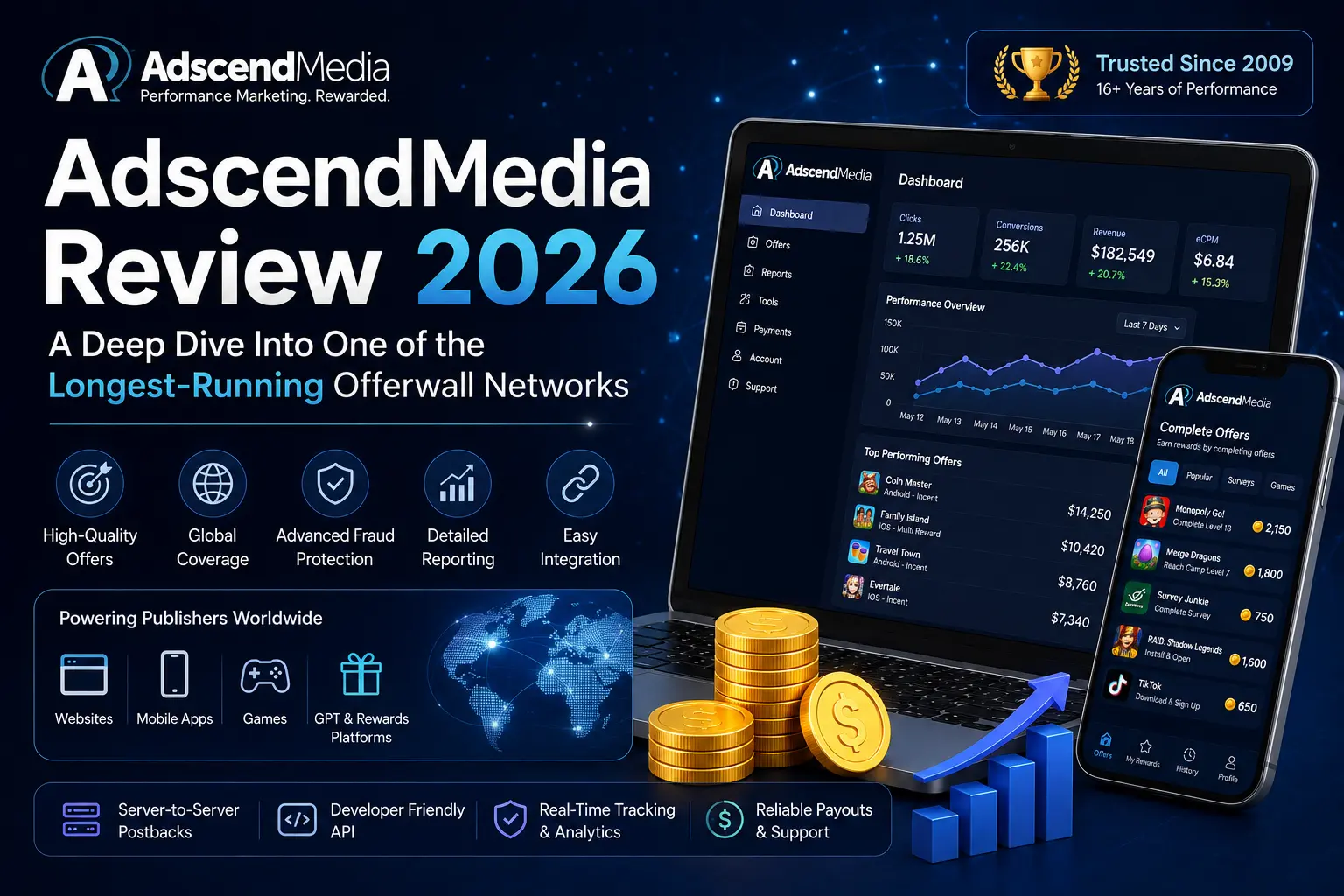
1. Overview
AdscendMedia has been around since 2009. In an industry where most networks disappear within three years, that longevity alone makes them worth a serious look. They position themselves as a performance-based advertising network specializing in rewarded inventory — offer walls, surveys, videos, and app-install campaigns. Their flagship product is AdWall, an offerwall solution that lets users complete tasks in exchange for in-app currency, virtual goods, or cash rewards.
The company claims over 12,000 publishers, operations in 180+ countries, and more than $21 million in all-time payouts with zero missed payments since inception. Those are bold claims, and after spending considerable time inside their publisher portal and reading through hundreds of third-party reviews, I can tell you the reality is more nuanced than the marketing page suggests.
AdscendMedia sits in a crowded space alongside AdGate Media, OfferToro (now Torox), CPX Research, and a wave of newer entrants. What separates them is their hybrid model: they serve both sides of the market — publishers who need to monetize traffic, and advertisers who need verified user actions. If you are building a GPT site, a mobile game, or a rewards app, understanding how AdscendMedia fits into your stack is critical. For context on how the broader GPT economy works, see our deep dive into the $5 billion Get-Paid-To economy.
2. Who Is It For?
AdscendMedia is built for three primary audiences:
Mobile app and game developers who want to monetize non-paying users through rewarded offer walls. If your freemium game has a currency system, AdWall lets users earn that currency by completing offers instead of pulling out a credit card.
Website publishers and GPT platform operators who run get-paid-to sites, reward portals, or content-locking pages. The network provides a stream of CPA, CPI, and survey offers that can be embedded via WebView, iFrame, or API.
Advertisers and user acquisition teams looking for incentivized traffic. If you are launching a fintech app, mobile game, or subscription service and need installs or sign-ups at a predictable cost, AdscendMedia delivers performance-based campaigns.
If you are an individual looking to earn pocket money by completing offers yourself, AdscendMedia is not a direct consumer platform. You access their offers through partner sites like Swagbucks, Freecash, or independent GPT platforms. For a breakdown of how consumer-facing GPT sites differ from backend networks like AdscendMedia, read our guide on GPT sites vs. survey sites vs. cashback platforms.
3. Supported Platforms
AdscendMedia supports a wide range of platforms:
- Web/Desktop: Full support via WebView and API integration. Works on any modern browser.
- Android: Native SDK and WebView integration.
- iOS: Native SDK and WebView integration.
- Unity: Dedicated Unity SDK for game developers.
- Mobile Web: Responsive offerwall design that works on mobile browsers without an app.
This cross-platform coverage is one of their stronger selling points. Whether you are running a Laravel-based offerwall website or a Unity mobile game, you can plug into the same offer inventory. If you are technically inclined and want to build your own offerwall from scratch, our complete builder's guide covers the architecture, postback security, and fraud controls you will need.
4. Website Support
For website publishers, AdscendMedia offers two main integration paths:
WebView Integration: This is the fastest route. You load the offerwall inside an iframe or WebView using a URL structured like https://www.adscendmedia.com/adwall/publisher/{publisherID}/profile/{OfferWallID}/preview?subid1={userID}. It requires minimal development work and can be live within hours.
API Integration: For publishers who want full control over the UI, the API lets you fetch offer data directly and render it in your own design. This requires more engineering effort but delivers a native, seamless user experience. The API returns offer names, descriptions, icons, payout amounts, tracking URLs, and geographic targeting data.
Both methods support custom sub-ID tracking so you can attribute conversions back to individual users. The WebView approach is ideal for publishers who want speed; the API approach is for those who want brand consistency.
5. App Support
AdscendMedia has invested heavily in mobile app monetization. Their AdWall product is specifically designed for apps that use virtual currency or reward systems. Users see a list of offers inside the app, complete an action (install an app, take a survey, watch a video), and receive their reward without ever leaving your ecosystem.
The app experience is smooth. Offers are sortable and filterable by category, and the SDK handles session management so users can navigate back and forth without losing their place. For developers building Android or iOS apps, we have a dedicated guide on how to add an offerwall SDK to Android and iOS apps that covers the technical integration patterns in detail.
6. Game Support
Game developers get special attention from AdscendMedia. The Unity SDK is a clear signal that they understand the gaming vertical. Offer walls in games work best when the reward currency is something players already value — gems, coins, lives, or premium unlocks.
AdscendMedia reports eCPMs of up to $90 in the United States for gaming inventory, which is competitive with industry standards. The network includes game-specific offers where users install a new game and reach a certain level, which aligns perfectly with the motivations of a gaming audience. These "milestone" offers tend to pay significantly more than simple app installs because the advertiser is getting a genuinely engaged user.
7. Integration Methods
AdscendMedia gives publishers three integration options, ranked by complexity:
- WebView/iFrame: Load the pre-built offerwall in a browser frame. Fastest to implement, least customizable.
- SDK (Android, iOS, Unity): Native integration with pre-built UI components. Best for apps and games that want a polished out-of-the-box experience.
- API: Full server-to-server integration where you build your own frontend. Maximum flexibility, maximum development time.
Most small-to-medium publishers start with WebView and graduate to API once their volume justifies the engineering investment. The SDK route is the sweet spot for mobile developers who want native performance without building a custom UI.
8. API Availability
Yes, AdscendMedia offers a full REST API for publishers who want programmatic access to their offer inventory. The API allows you to:
- Fetch available offers filtered by country, platform, and offer type
- Retrieve tracking URLs with custom sub-ID parameters
- Access real-time reporting data
- Manage offerwall profiles programmatically
API access requires publisher approval and proper authentication credentials. The documentation is available through their developer portal, and in my experience, it is thorough enough that a competent backend developer can have a test integration running within a day. If you want to understand how API-based offerwalls fit into a broader monetization strategy, our article on the real economics behind GPT platforms breaks down the unit economics from the operator's perspective.
9. iFrame Availability
Yes. The iFrame integration is the simplest way to embed AdscendMedia's offerwall on a website. You generate an offerwall profile in your publisher dashboard, copy the iFrame code, and paste it into your page. The offerwall auto-resizes and handles mobile responsiveness.
The downside is limited customization. You are essentially displaying AdscendMedia's branded interface inside your site. For publishers who care deeply about brand consistency, the API is the better long-term choice. But for a quick launch or an MVP, iFrame gets you revenue on day one.
10. SDK Availability
AdscendMedia provides native SDKs for:
- Android (Gradle-based, Android Studio compatible)
- iOS (iOS 8+)
- Unity (for cross-platform game development)
The SDKs handle offer loading, user session tracking, reward callbacks, and error states. They can be integrated in minutes according to AdscendMedia's own documentation, and they include sample projects to accelerate development.
One practical note: the SDKs have been around since 2015, so they are mature and stable. However, always test the latest version against your target OS versions, as mobile platform requirements change frequently.
11. Postback System
AdscendMedia uses server-to-server (S2S) postbacks to notify your backend when a user completes an offer. This is the industry standard and is far more secure than client-side JavaScript callbacks, which can be spoofed.
The postback system sends a real-time HTTP request to your designated endpoint with details like the transaction ID, user ID, offer ID, and reward amount. Your server verifies the request, checks for duplicates, and credits the user's balance. This is the exact architecture we recommend in our offerwall builder's guide, where we explain why S2S postbacks are non-negotiable for any production reward system.
AdscendMedia's postbacks support custom sub-IDs (sub1 through sub5), which lets you pass additional tracking data through the conversion funnel.
12. Tracking
Tracking is handled through a combination of unique tracking URLs, sub-ID parameters, and server-side postbacks. When a user clicks an offer, they are redirected through AdscendMedia's tracking domain with your publisher ID and sub-IDs appended. The advertiser's platform records the click, and when the conversion happens, the postback fires.
The tracking is generally reliable, though like all CPA networks, there can be delays or discrepancies between AdscendMedia's reporting and the advertiser's final numbers. AdscendMedia's terms explicitly note that tracking detail may not be available in real time for all advertisers and that reporting delays can occur. This is standard across the industry, not unique to AdscendMedia.
13. Attribution Window
AdscendMedia does not publicly specify a single global attribution window because it varies by advertiser and offer type. However, industry standards for incentivized offer walls typically range from 24 hours to 30 days depending on the action:
- App installs (CPI): Usually 24 hours to 7 days
- Registrations/sign-ups (CPA): Typically 30 days
- Survey completions: Usually instant to 24 hours
- Game milestones (reach level 10, etc.): Often 7 to 30 days
Always check the specific offer terms in your dashboard, as attribution windows are set by the advertiser, not the network. If you are running your own platform, it is wise to communicate these windows clearly to your users to avoid support tickets about "missing" credits.
14. Offer Types
AdscendMedia's inventory covers the full spectrum of incentivized actions:
- CPI (Cost Per Install): Users install and open a mobile app
- CPA (Cost Per Action): Users complete a specific action like registration or form submission
- CPL (Cost Per Lead): Users submit lead information
- CPC (Cost Per Click): Users click through to an advertiser's landing page
- CPE (Cost Per Engagement): Users engage with content, such as watching a video
- Surveys: Market research surveys from router partners
- Video Offers: Rewarded video content through their video partners
- Game Offers: Milestone-based offers where users progress to a specific level in a game
- Sweepstakes and Trials: Sign-up offers for subscription services
The variety is solid. US and UK publishers will see the deepest inventory, while smaller GEOs may have fewer high-paying options. This geographic disparity is standard across all offerwall networks.
15. GEO Coverage
AdscendMedia operates in 180+ countries with 25,000 publishers globally. That said, the quality and quantity of offers vary dramatically by region.
Tier 1 (US, UK, Canada, Australia, Western Europe): Dense inventory, high payouts, strong advertiser demand. eCPMs can reach $80 — $90 in the US.
Tier 2 (Eastern Europe, Latin America, parts of Asia): Moderate inventory, lower payouts, but still viable for volume-based publishers.
Tier 3 (Africa, Southeast Asia, smaller markets): Limited inventory. Users in these regions may see sparse offer lists and lower-value tasks.
This is not AdscendMedia being stingy — it is simply how advertiser budgets flow. A fintech app will pay $40 for a US user who links a bank account and $2 for the same action in a market with lower customer lifetime value. If you run a global platform, plan to supplement AdscendMedia with region-specific networks.
16. Survey Inventory
AdscendMedia includes market research surveys as a core part of their offerwall. Surveys are sourced through router partnerships and are typically the highest-fill-rate offer type because research firms constantly need fresh respondents.
Survey payouts range from $0.50 to $5.00+ depending on length and targeting criteria. The downside is qualification rates — users frequently get disqualified partway through a survey, which creates friction. AdscendMedia's survey integration includes profiling questions that help match users to relevant surveys, which improves completion rates slightly.
For publishers, surveys are reliable revenue because they do not require app installs or credit card trials. For users, they are often the most accessible but also the most frustrating offer type.
17. Gaming Inventory
Gaming is one of AdscendMedia's strongest verticals. Their offerwall includes "play-to-earn" style offers where users install a game and reach specific milestones (e.g., reach level 10, complete the tutorial, win three matches). These offers pay significantly more than standard CPI because the advertiser is getting a proven-engaged user.
Gaming offers can pay anywhere from $2 to $50+ per completion depending on the game's monetization model and the difficulty of the milestone. For publishers with gaming audiences, this is where the real money is. AdscendMedia also supports rewarded video ads for gaming inventory, which provides a passive revenue stream alongside interactive offers.
18. Fraud Prevention
AdscendMedia markets its fraud prevention as "Total Fraud Defense," and they are not shy about the layers they employ:
- Manual vetting: Less than 5% of partner applications are accepted. Every new publisher is reviewed by a human.
- IP and device filtering: Known VPNs, proxies, and bot IPs are blocked in real time. Thousands of IPs are added to their blacklist daily.
- Behavioral analysis: They analyze click patterns, conversion timing, and engagement signals to flag abnormal behavior.
- Third-party tools: They partner with external fraud detection services to close gaps.
- Facial recognition: In high-risk cases, they deploy facial recognition checks to verify human users.
- Human compliance team: An in-house team reviews traffic manually to catch what automation misses.
This multi-layered approach is provided free to all advertisers. From a publisher perspective, the strict fraud controls mean you need to drive clean, legitimate traffic. Any hint of incentivized manipulation, proxy use, or bot activity will result in account suspension and forfeited earnings.
For a broader look at how fraud impacts the performance marketing industry — where global ad fraud is projected to exceed $100 billion in 2026 — see this ad fraud detection and prevention guide.
19. Reporting
AdscendMedia provides a publisher dashboard with tracking and reporting tools. You can view:
- Clicks, conversions, and earnings by offer
- Geographic breakdown of traffic
- Sub-ID performance for user-level attribution
- Payment history and pending balances
The reporting is functional but not cutting-edge. Some publishers note that real-time data is not always available for every advertiser, and there can be delays in final numbers as advertisers reconcile their own tracking. If you need deeply customized analytics, you may want to pull data via API into your own BI tools.
20. Reward Flexibility
AdscendMedia offers flexible reward structures. As a publisher, you decide what your users receive — virtual currency, points, gift cards, or cash. The network passes you the monetary value of each conversion, and your platform handles the reward distribution.
This flexibility is essential for different business models. A mobile game might reward gems. A GPT site might reward points convertible to PayPal. A content-locking site might unlock premium content. AdscendMedia does not dictate your reward structure; they simply provide the monetization layer.
21. Payout Model
AdscendMedia operates on a performance-based payout model. Publishers earn a commission for every verified action their users complete. The exact payout varies by offer, country, and advertiser.
Network-wide, they report eCPMs up to $90 in the US and up to $70 internationally for offerwall inventory. These are ceiling figures, not averages. Your actual eCPM depends on your user demographics, traffic quality, and offer mix.
Payment terms are Net 30 for standard campaigns and Net 60 for video earnings. You can expedite video payments to Net 30 for a 7% fee, which is useful if you need cash flow acceleration.
22. Payment Methods
AdscendMedia supports multiple payment methods with varying minimum thresholds:
Table
| Payment Method Minimum Payout | |
| PayPal | $50 |
| Payoneer | $50 |
| ACH (US bank transfer) | $100 |
| Checks (US only) | $100 |
| Wire Transfer | $500 |
Wire transfers under $1,000 incur a $15 fee. All publishers must complete a W-9 tax form, even if located outside the US, because AdscendMedia is a US-based company. Payments are processed on the 10th of the month following the invoice deadline, provided your balance exceeds the minimum threshold and you have submitted any required invoices.
For comparison, competitor AdGate Media has a $25 minimum for some methods, while Torox requires $200. AdscendMedia sits in the middle — accessible for small publishers via PayPal, but with higher thresholds for bank transfers.
23. Approval Requirements
Getting approved as an AdscendMedia publisher is more rigorous than some competitors. Their terms state that less than 5% of applications meet their standards. They manually review every application and look for:
- A legitimate website, app, or game with real traffic
- Compliance with content policies (no prohibited content)
- A clear monetization model
- Evidence of quality traffic sources
They do not accept everyone. If you are running a brand-new site with no traffic history, or if your content falls into gray areas, expect rejection. This strict gatekeeping is part of their fraud prevention strategy, but it can be frustrating for new publishers.
24. Minimum Traffic
AdscendMedia does not publish a hard minimum traffic number, but the approval process suggests they favor established publishers with demonstrable volume. If you are just starting out, you may want to build traffic on easier-to-join networks first and apply to AdscendMedia once you have consistent monthly conversions.
For context, networks like CPX Research and AdGate Media have lower barriers to entry, making them better options for publishers who are still building an audience. If you are serious about scaling, however, AdscendMedia's stricter standards often correlate with higher-quality offers and better advertiser relationships.
25. Publisher Support
AdscendMedia assigns dedicated account managers to approved publishers. This is a significant advantage over self-serve networks where you are just a ticket number. Account managers help with:
- Campaign optimization recommendations
- Monetization strategy
- Technical integration support
- Offer selection and placement
They also provide direct email support with a claimed 24-hour response time. The quality of support varies by account manager — some publishers rave about their responsiveness, while others report slow replies during high-volume periods.
On the consumer side (users completing offers through partner sites), Trustpilot reviews paint a much bleaker picture. AdscendMedia holds a 1.5 out of 5 rating on Trustpilot, with numerous complaints about non-payment, unresponsive support, and offers that fail to credit. It is important to distinguish between publisher support (which is generally rated higher) and end-user support (which appears to struggle with volume).
26. Strengths
- Longevity and stability: 15+ years in business with claimed zero missed publisher payments
- High eCPM potential: Up to $90 in the US for offerwall inventory
- Multiple integration options: WebView, SDK, and API cover nearly every use case
- Strong fraud prevention: Multi-layered Total Fraud Defense with manual review
- Dedicated account managers: Personalized support for approved publishers
- Global reach: 180+ countries with diverse offer inventory
- Flexible reward structures: Publishers control what users earn
- Gaming vertical expertise: Strong milestone offers and Unity SDK support
27. Weaknesses
- Strict approval process: Less than 5% of applications are accepted
- Poor consumer-side reputation: 1.5/5 on Trustpilot with frequent non-payment complaints from end users
- Payment delays for video: Net 60 for video earnings unless you pay a 7% expedite fee
- Geographic inequality: Tier 3 countries see significantly fewer and lower-paying offers
- Higher minimums for bank transfers: $100 — $500 thresholds exclude very small publishers
- W-9 requirement for all: Even non-US publishers must submit US tax forms
- Reporting delays: Not all advertiser data is real-time
28. Best Use Case
AdscendMedia shines when you are a mid-sized to large publisher with established traffic and you want a reliable, high-paying offerwall partner. If you run a mobile game with 50,000+ monthly active users, a GPT site with consistent US/UK traffic, or a rewards app with engaged users, AdscendMedia can become a primary revenue driver.
The combination of high eCPMs, dedicated account management, and flexible integration makes them ideal for publishers who have outgrown smaller networks and need a partner that can scale with them. If you are building this type of platform from scratch, our guide on whether GPT websites are still profitable in 2026 offers a reality check on the economics.
29. Who Should Avoid It
You should probably look elsewhere if:
- You are a brand-new publisher with no traffic history
- You need instant payments or very low minimum thresholds
- Your audience is primarily in Tier 3 countries with limited advertiser demand
- You are an end user trying to complete offers directly (AdscendMedia is not a consumer platform)
- You cannot tolerate Net 30/Net 60 payment cycles
- You need a self-serve platform with instant approval
For new publishers, networks like CPALead or CPX Research offer lower barriers to entry. For consumers looking to earn, stick to established GPT platforms like Swagbucks or Freecash.
30. Alternatives
The offerwall space is competitive. Here are the main alternatives to consider:
AdGate Media: One of the oldest offerwalls (founded 2011), now part of Prodege. Strong advertiser relationships, no minimum traffic requirements, and a $25 minimum payout. A solid premium alternative. Learn more about AdGate Media.
Torox (formerly OfferToro): Global leader with offices in Israel, the US, Europe, and Asia. Known for user-friendly integration and strong customer support. Higher minimum payout ($200) but excellent reputation for payment reliability.
CPX Research: Specializes in survey-based monetization. Great for publishers whose audiences prefer surveys over app installs. Lower entry barriers and strong support.
CPALead: Known for instant payouts and low minimum thresholds. Good for publishers who need fast cash flow. Less premium inventory than AdscendMedia but easier to join.
AdGem: A newer entrant with strong mobile focus and competitive gaming offers. Growing quickly in the rewarded video space.
Klink Labs: Emphasizes global reach (140+ countries), real-time reporting, and crypto payouts. A viable alternative if you need faster campaign launches and multi-vertical depth.
For a technical comparison of how these networks fit into a custom platform, refer back to our offerwall builder's guide.
31. Final Rating
After weeks of research, dashboard exploration, and review analysis, here is my honest assessment:
Table
| Category Rating Notes | ||
| Integration Ease | 8/10 | WebView and SDK are simple; API requires dev resources |
| Offer Quality & Variety | 8/10 | Strong in US/UK; weaker in smaller markets |
| Payout Rates | 8/10 | eCPMs up to $90; competitive with top networks |
| Payment Reliability | 7/10 | Net 30/60 is standard; video delays are annoying |
| Publisher Support | 7/10 | Good account managers; consumer support is poor |
| Fraud Prevention | 9/10 | Total Fraud Defense is industry-leading |
| Approval Process | 6/10 | Too restrictive for new publishers |
| Consumer Reputation | 4/10 | Trustpilot scores are concerning |
| Overall | 7.1/10 | Solid for established publishers; avoid if you are new |
AdscendMedia is not a scam. It is a legitimate, long-standing network that pays publishers and provides real advertiser value. But it is not perfect. The strict approval process, payment delays for video, and troubling consumer-side reviews are real drawbacks that you need to weigh against the high eCPMs and strong account management.
If you are an established publisher with clean traffic and you want a premium offerwall partner, AdscendMedia deserves a spot in your monetization stack. If you are just starting out, build your traffic elsewhere first and come back when you have the volume to meet their standards.
The rewarded advertising industry is evolving fast. Networks that do not invest in fraud prevention, mobile UX, and publisher transparency will not survive the next five years. AdscendMedia has shown it can adapt — but whether it remains a top choice in 2027 and beyond depends on how well it addresses the support and payment friction that end users are loudly complaining about.
Have you worked with AdscendMedia? Share your experience in the comments. And if you are building your own monetization platform, do not miss our technical guides on the Hansal Dev blog.

Comments (0)
No comments yet. Be the first to share your thoughts!