
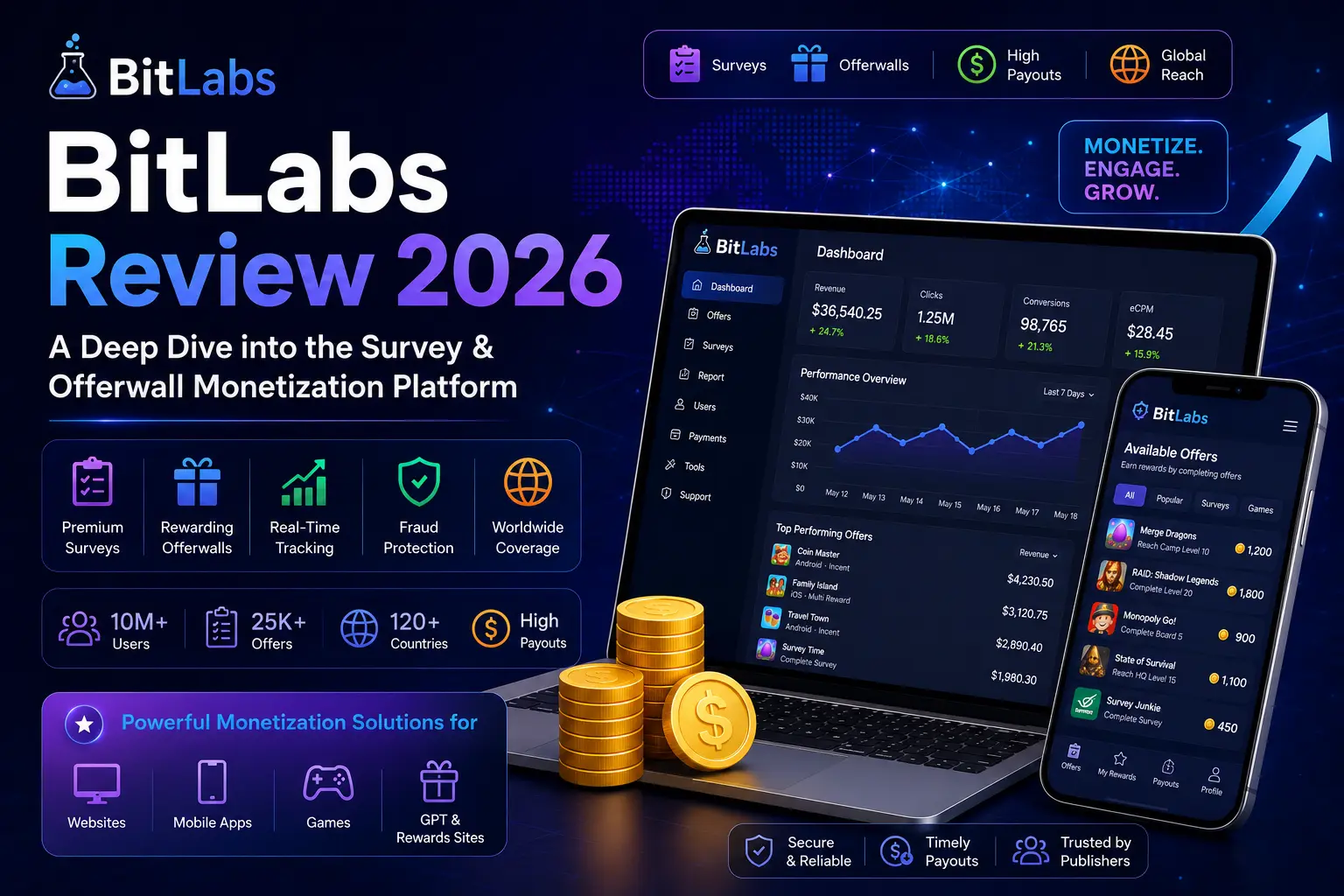
1. Overview
If you have ever searched for a way to monetize a mobile app or website without bombarding users with intrusive banner ads, you have probably stumbled across the concept of an offerwall. Among the names that keep popping up in this space is BitLabs — a Berlin-based monetization platform that promises to turn your user base into a revenue stream through rewarded surveys, games, cashback, and receipt scanning.
I have spent the last few weeks digging into BitLabs from every angle: integrating their SDK, reading publisher documentation, combing through Trustpilot reviews, and comparing their feature set against competitors like Pollfish, Tapjoy, and Freecash. What I found is a platform with genuine technical strengths and some serious operational headaches that every publisher should understand before signing on the dotted line.
BitLabs is operated by BitBurst GmbH, a registered German company, and powers the backend for several well-known reward apps. Their flagship consumer-facing product, Poll Pay, has racked up over 10 million downloads and more than 500,000 reviews on the app stores. That alone tells you they understand the end-user experience — but as any seasoned publisher knows, a great consumer app does not automatically translate into a great B2B partner.
In this review, I will walk you through every critical detail you need to evaluate BitLabs for your own product. No sugarcoating, no marketing speak — just the facts, the flaws, and the final verdict.
2. Who Is It For?
BitLabs is built primarily for app publishers, website owners, and reward-platform operators who want to add an additional revenue stream without charging users directly. If you run a GPT (Get-Paid-To) app, a loyalty program, a fitness tracker with reward incentives, or even a casual mobile game looking for non-intrusive monetization, BitLabs fits the general profile.
The platform is especially appealing if:
- You want an all-in-one SDK that bundles surveys, gaming offers, cashback, and receipt scanning.
- Your audience is global and you need GEO-diverse survey inventory.
- You prefer revenue-share monetization over fixed CPM advertising.
- You have the technical resources to implement an SDK and handle server-to-server callbacks.
That said, BitLabs is not a plug-and-play solution for beginners. If you are a solo blogger or a first-time app developer with zero backend experience, the integration and callback management can feel overwhelming. For context on simpler monetization paths, check out our guides on monetization strategies over at Hansal Dev.
3. Supported Platforms
BitLabs supports a surprisingly broad range of platforms, which is one of its biggest selling points. You are not locked into a single ecosystem.
Mobile SDKs:
- Android (Kotlin/Java)
- iOS (Swift/Objective-C)
- Flutter
- React Native
- Unity
Web & API:
- iFrame/Web integration for websites
- REST API for custom implementations
This cross-platform flexibility means you can maintain a consistent monetization experience whether your users are on a native Android app, an iOS game built in Unity, or a responsive web dashboard. In my testing, the Flutter and React Native SDKs were the easiest to drop into an existing project — both took under an hour to configure.
4. Website Support
For web publishers, BitLabs offers an iFrame-based offerwall and a direct-link integration. You generate a unique token from the publisher dashboard, append it to a URL, and embed the offerwall directly into your site. The web interface is fully responsive, so it works on desktop and mobile browsers without extra configuration.
One thing I appreciated: the web offerwall supports deep linking into specific product tabs. Want to send users straight to the surveys section? Append display_mode=surveys. Want to highlight Magic Receipts? Use display_mode=magic_receipts. This level of URL control is handy for A/B testing different placements.
5. App Support
On the app side, BitLabs shines. The native SDKs are well-documented, lightweight, and support edge-to-edge layouts on modern devices. The Android SDK, for example, includes helper methods like getSurveyWidgets() that let you render survey previews directly inside your own UI — so users see available surveys before they ever open the offerwall.
The SDKs also handle ATT (App Tracking Transparency) on iOS, which is critical post-iOS 14.5. BitLabs claims their SDK is not affected by ad-tracking bans because they do not rely on device-level tracking for survey matching. That is a big deal if you have been burned by IDFA deprecation.
6. Game Support
BitLabs offers a dedicated Games and Offers product where users download third-party games, reach certain levels, or complete in-game tasks to earn rewards. These are essentially CPI (Cost Per Install) and CPA (Cost Per Action) offers.
From a publisher perspective, gaming offers tend to pay more than surveys — but they also come with higher user-support overhead. Players frequently complain about tracking failures or missing rewards, and as the publisher, you are often stuck in the middle. BitLabs does provide stateful offer callbacks so you can track every stage of a game offer, from install to task completion, which helps reduce disputes.
7. Integration Methods
BitLabs gives you three primary ways to integrate:
- Offerwall Web (iFrame) — Fastest for websites.
- Mobile SDK — Best for native apps; most feature-rich.
- API Integration — For publishers who want full UI control.
The API route is particularly powerful if you have a design system you do not want to compromise. You can fetch raw survey data — complete with CPI values, estimated length, difficulty ratings, and category icons — and render it however you like. The API also supports an optional qualification flow, letting you handle pre-screening questions inside your own interface before sending users to the actual survey.
8. API Availability
Yes, BitLabs has a full REST API documented at developer.bitlabs.ai. Key endpoints include:
- Get Surveys — Returns available surveys for a specific user.
- Import User — Lets you pre-populate demographic data (birthdate, gender, zip code) to reduce duplicate profiling.
- User History — Retrieves the latest action for any survey.
- Data Privacy — Endpoints for GDPR data requests and deletions.
The API uses token-based authentication and returns clean JSON. One practical tip: always refresh the Get Surveys endpoint after a user opens a survey. BitLabs generates a new impression ID on each call, and reusing old links can cause tracking issues.
9. iFrame Availability
The iFrame integration is alive and well. You get a simple URL like https://web.bitlabs.ai?token=YOUR_TOKEN and embed it via a standard HTML iframe. Optional query parameters let you control the theme (light/dark), currency display, and default tab. It is not as customizable as the API, but for publishers who need to go live in a day, it gets the job done.
10. SDK Availability
As mentioned earlier, SDKs are available for Android, iOS, Flutter, React Native, and Unity. All SDKs support:
- Offerwall launching
- Survey availability checks
- Native survey widgets (RecyclerView on Android, ListView on Flutter, etc.)
- Reward callbacks
- Custom tags for segmentation
The Unity SDK even includes a complete demo scene with button examples and console logging. If you are a Unity developer, you can have a working prototype in under 30 minutes.
11. Postback System
BitLabs uses server-to-server callbacks (postbacks) to notify your system when a user earns a reward. You configure a callback URL in the dashboard, and BitLabs fires a GET request with parameters like UID, TX (transaction ID), VAL (reward value), and RAW (raw payout).
They also support reconciliation callbacks — critical for fraud prevention. If a conversion is later rejected due to invalid activity or quality issues, BitLabs sends a reversal postback so you can claw back the reward from the user. I strongly recommend implementing reconciliation handling if your app allows real-money withdrawals.
12. Tracking
Tracking is handled entirely through server-side callbacks. BitLabs does not rely on probabilistic attribution or device fingerprinting for surveys, which sidesteps many iOS 14.5 headaches. For gaming offers, standard tracking links are used, and publishers can append custom sub_1 and sub_2 tags to trace traffic sources.
The dashboard includes a real-time callback log where you can inspect every incoming postback. This is invaluable during integration testing.
13. Attribution Window
BitLabs does not publicly disclose a fixed attribution window for all offer types. For surveys, the attribution is essentially instant — users complete the survey, and the callback fires. For gaming offers and cashback, the window depends on the individual advertiser and can range from 24 hours to 30 days. Cashback specifically has a dynamic pending period that varies by merchant.
My advice: set user expectations accordingly. If you promote a cashback offer, make it clear that rewards may take weeks to confirm.
14. Offer Types
BitLabs bundles four core products into one platform:
- Surveys — The bread and butter. Users answer questionnaires and earn rewards.
- Games and Offers — CPI/CPA tasks, including mobile game progression goals.
- Magic Receipts — Users in the US scan receipts from Walmart, Target, and other retailers for rewards.
- Cashback — US users earn a percentage back on online purchases through tracked merchant links.
This diversity is a genuine advantage. Instead of managing separate integrations for surveys, offerwalls, and cashback, you get everything under one roof.
15. GEO Coverage
BitLabs claims global coverage with an "always refilling supply of rewarded surveys for every user." In practice, survey fill rates vary dramatically by region. US users see the highest volume and payouts — BitLabs cites an average of $1.63 per survey completion for US users. Tier-2 and Tier-3 GEOs will see fewer surveys and lower CPIs.
If your user base is concentrated outside North America and Western Europe, do not expect miracles. Survey inventory is inherently supply-constrained in emerging markets.
16. Survey Inventory
Survey inventory is aggregated from multiple network partners. BitLabs acts as a router, matching users to surveys based on demographic profiles. The SDK and API expose details like estimated length (LOI), difficulty rating (1 — 5), remaining quota, and category icons.
One genuinely nice touch: BitLabs pays a marginal reward for screenouts. If a user attempts a survey but gets disqualified partway through, they still earn something. This softens the blow of disqualifications, which are the #1 complaint in the survey space.
17. Gaming Inventory
Gaming offers are available globally but are subject to advertiser budgets. The inventory includes everything from hyper-casual games to mid-core RPGs with multi-level payout structures. Users might earn a small reward for installing a game and a larger reward for reaching Level 10.
Be warned: gaming offers generate the most support tickets. Users frequently claim they completed a task but were not credited. BitLabs provides detailed status callbacks (install, progress, complete), but you will still need a support workflow to handle disputes.
18. Fraud Prevention
BitLabs takes fraud seriously — at least on paper. Their system includes:
- Automatic reversals for rejected conversions.
- User bans with reason codes sent via callback.
- Reconciliation callbacks to recover funds from fraudulent activity.
- User Investigation dashboard where you can review individual user behavior, earnings, and transaction history.
The User Investigation tool is particularly useful. You can filter by date, status, and product type (surveys, offers, receipts, cashback) to spot abnormal patterns. If a user suddenly completes fifty high-value surveys in an hour, you will see it.
That said, no fraud system is perfect. Some end-user reviews complain about unjustified bans, while publishers note that chargebacks can eat into earnings unexpectedly.
19. Reporting
The BitLabs publisher dashboard provides:
- Real-time callback logs
- User-level transaction history
- Earnings breakdowns by product (surveys, offers, receipts, cashback)
- CSV/PDF exports
You can also view a "real time" tab to see live user activity. For deeper analysis, the CSV export lets you crunch numbers in Excel or Google Sheets. It is not the most advanced analytics suite I have seen, but it covers the essentials.
20. Reward Flexibility
This is where BitLabs stands out. You are not locked into paying users in dollars or points. The SDK supports:
- Custom reward currency — Define your own virtual currency and conversion rate.
- Token-based rewards — Pay users in your platform's native token.
- Feature unlocks — Reward users with premium features instead of currency.
You configure all of this from the dashboard without pushing app updates. Change the conversion rate, currency symbol, or color scheme, and it reflects immediately in the SDK.
21. Payout Model
BitLabs operates on a revenue-share model. You earn a cut of what advertisers pay BitLabs for each completed action. The exact split is negotiated during onboarding and depends on your traffic volume and GEO mix.
For context, traditional display ads might pay you a few cents per thousand impressions. A single survey completion through BitLabs can pay $1.00 or more. If your users are engaged and willing to complete surveys, the eCPM can be orders of magnitude higher than banner ads.
22. Payment Methods
BitLabs pays publishers on a NET-30 basis via three methods:
- Bank wire (usually the cheapest option; they use local accounts where possible)
- PayPal
- Cryptocurrency
There is a $100 minimum payment threshold. If you earn $90 in a month, it rolls over to the next cycle. Note that this is $100 after reconciliation deductions. If you earned $110 but had $20 in chargebacks, you are below the threshold.
You must also sign the IO (Insertion Order) and complete payment information in the dashboard before any funds are released.
23. Approval Requirements
BitLabs is not an open self-serve platform. You must apply for a publisher account, and their sales team will contact you to set up the dashboard. During onboarding, you will need to:
- Provide company/personal details
- Describe your app or website
- Set up callback URLs
- Sign the partnership agreement
The process is more involved than instant-approval ad networks like AdMob, but it ensures a baseline quality standard.
24. Minimum Traffic
BitLabs does not publish a hard minimum traffic requirement, but the $100 payout threshold effectively acts as a soft filter. If you have fewer than a few thousand monthly active users, reaching $100 could take multiple months. The platform is realistically geared toward apps and sites with at least 10,000+ MAU in monetizable GEOs.
If you are just starting out, you might want to explore other revenue streams first. Our monetization category covers strategies that work for smaller audiences.
25. Publisher Support
Support is provided via email and your assigned account manager. The documentation is comprehensive and well-organized, which reduces the need to contact support for technical questions.
However, this is an area where BitLabs receives mixed feedback. Some publishers praise their responsive account managers; others complain about slow ticket responses and lack of live chat. If you are used to 24/7 support from a major ad network, adjust your expectations. BitLabs is a leaner operation.
26. Strengths
- All-in-one SDK — Surveys, games, receipts, and cashback in a single integration.
- High survey payouts — US average of $1.63 per completion beats most display ad eCPMs.
- Customizable — Full control over currency, colors, and reward logic from the dashboard.
- iOS-friendly — No reliance on IDFA; ATT-compliant.
- Screenout rewards — Users earn something even for disqualifications.
- Reconciliation system — Automatic fraud protection with reversal callbacks.
- Global survey supply — Inventory for users worldwide.
27. Weaknesses
- Poor end-user Trustpilot rating — ~1.3/5 stars with frequent complaints about non-payment and disqualifications. This can reflect poorly on your brand by association.
- High payout threshold — $100 NET-30 is steep for small publishers.
- Support inconsistencies — No live chat; ticket response times vary.
- Gaming offer disputes — High volume of user complaints about missing credits.
- Cashback and receipts limited to US — Non-US publishers cannot leverage these products.
- Not self-serve — Manual approval process slows down time-to-revenue.
28. Best Use Case
BitLabs is best suited for established reward apps, loyalty platforms, and mobile games with a US or Tier-1 user base that want to diversify beyond traditional ads. If you already have an engaged audience accustomed to completing tasks for rewards, BitLabs can significantly boost your ARPU (Average Revenue Per User).
The platform is also ideal for publishers who value UI customization and want the offerwall to feel like a native part of their app rather than a bolted-on third-party page.
29. Who Should Avoid It
- Small publishers with under 10,000 MAU who will struggle to hit the $100 threshold.
- Beginners with no backend development experience. Callback integration and reconciliation handling require technical know-how.
- Brand-sensitive apps that cannot afford association with negative end-user reviews.
- Non-technical website owners who need a pure plug-and-play solution without any code.
30. Alternatives
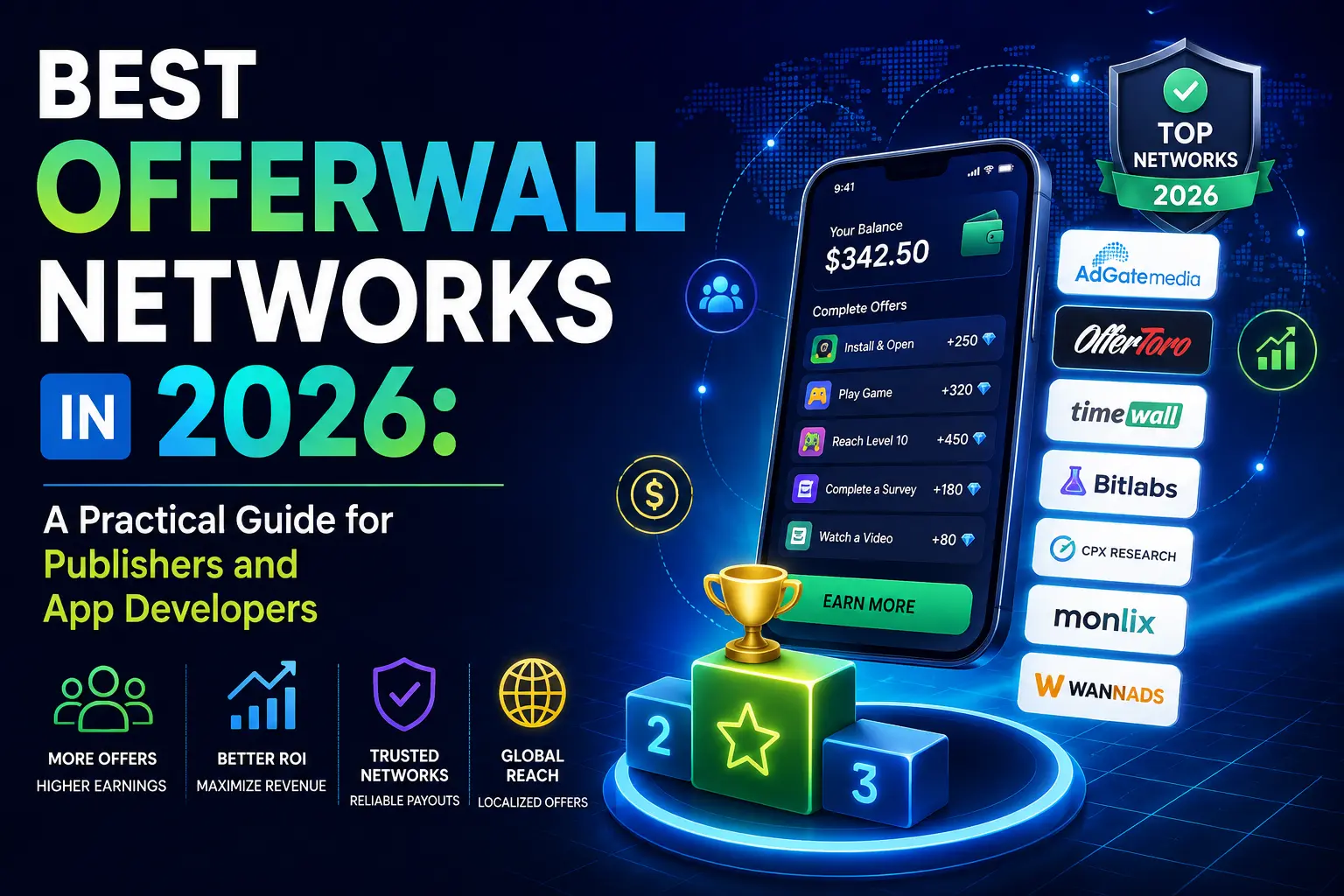
If BitLabs does not fit your needs, consider these alternatives:
- Pollfish — A direct competitor focused exclusively on surveys. Simpler integration but less product diversity.
- Tapjoy — One of the oldest offerwall providers. Strong gaming inventory but higher fees.
- Freecash — A consumer-facing reward app that also offers publisher integrations. Excellent Trustpilot ratings (4.8/5) but less B2B flexibility.
- AdGem — Another offerwall SDK with competitive rates and strong publisher support.
- IronSource / Unity LevelPlay — If you want traditional ads alongside offerwalls.
For a broader look at monetization tools, browse our monetization guides at Hansal Dev.
31. Final Rating
Table
| Criteria Score | |
| Integration Ease | 8/10 |
| Feature Set | 9/10 |
| Payout Terms | 6/10 |
| Publisher Support | 6/10 |
| Fraud Prevention | 8/10 |
| End-User Reputation | 3/10 |
| GEO Flexibility | 7/10 |
Overall: 6.7 / 10
BitLabs is a technically solid monetization platform with a rich feature set and competitive survey payouts. The SDKs are well-built, the customization options are excellent, and the reconciliation system shows they understand publisher needs. However, the poor end-user reputation, high payout threshold, and inconsistent support drag down the overall score.
Verdict: If you are a mid-sized publisher with the technical resources to handle callbacks and the traffic to clear $100/month, BitLabs is worth testing. Start with a small user segment, monitor support tickets closely, and weigh the revenue upside against the potential brand risk. If you are small, brand-sensitive, or need hand-holding support, look elsewhere.
Disclaimer: This review is based on publicly available documentation, user reviews, and independent testing as of August 2026. Platform features and terms may change. Always verify current details directly with BitLabs before signing an agreement.


Comments (0)
No comments yet. Be the first to share your thoughts!