
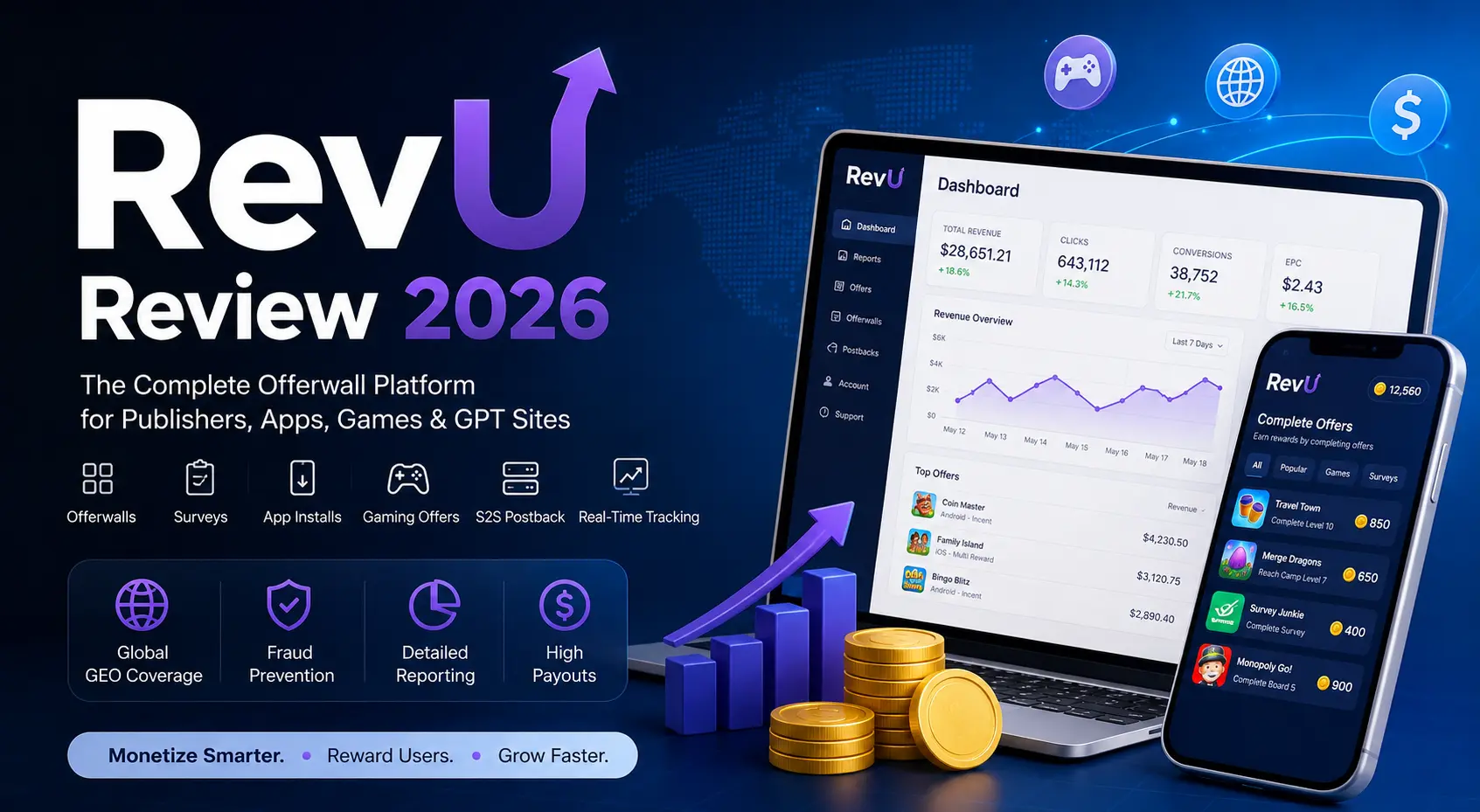
RevU Review: Is This Offerwall Worth Using in 2026?
RevU is one of the more established names in the rewarded-offerwall market, but the interesting thing about the platform is not simply the size of its offer catalog.
For publishers, the real question is much more practical:
Can RevU be integrated without creating unnecessary technical work, does it provide enough quality inventory for users in different GEOs, and can the reward flow be trusted enough to run on a real website, app, game, or GPT platform?
After going through RevU's current publisher documentation, integration documentation, support material, and terms, my impression is that RevU is strongest when the publisher wants a relatively lightweight implementation with the option to move toward a more customized API-based experience later.
RevU officially supports web, mobile and game environments and describes its architecture as SDK-free. Its current publisher material advertises more than 6 million active users and 2,500+ live campaigns, although these figures should be treated as RevU's own marketing claims rather than independently audited numbers.
The most important distinction is that RevU is not primarily an affiliate dashboard where a publisher manually selects individual CPA offers and promotes them. It is a monetization infrastructure designed to put a marketplace of rewarded actions inside another product.
That makes it particularly relevant to GPT sites, rewards platforms, mobile applications, games, loyalty products, and communities where users already have an internal points or virtual-currency economy.
1. Overview
RevU, operated by Revenue Universe LLC, is a performance-based offerwall and monetization platform founded in 2015. RevU positions itself as a bridge between advertisers and digital publishers, allowing users to complete activities such as surveys, app installs, registrations, subscriptions and gaming-related tasks in exchange for rewards.
For a publisher, the basic flow is straightforward:
User — RevU Offerwall — Offer Completion — RevU Validation — S2S Postback — Publisher Credits User
That last step matters.
A serious offerwall integration should not trust a browser redirect or a mobile client to determine whether a user deserves money or virtual currency. RevU's own architecture uses server-to-server postbacks after conversion validation, which is the correct general architecture for reward systems.
RevU also provides an API layer for publishers that want something beyond the hosted offerwall.
That gives the platform a useful progression:
Hosted implementation — iFrame/web experience — API/custom UI
This is one of the strongest aspects of RevU.
2. Who Is It For?
RevU is most suitable for companies and developers that already have an audience and want to introduce another monetization layer.
Typical users include:
- GPT and rewards websites
- Loyalty platforms
- Gaming websites
- Mobile applications
- Unity games
- Communities with virtual currencies
- Subscription or engagement platforms
- Consumer apps looking for rewarded monetization
It is especially attractive when the product already has something like:
Coins — Points — Credits — Tokens — Gems — XP — Loyalty balance
The publisher does not necessarily need to create a separate payment system for RevU users. Instead, RevU can notify the publisher's server when an offer has been validated, and the publisher decides how much internal currency to award.
This is fundamentally different from simply placing banner ads on a website. The user actively chooses to participate in an offer, making offerwalls particularly suitable for products where engagement and retention matter.
For developers building a GPT platform from scratch, the reward ledger, postback handler and fraud controls are more important than the visual offerwall itself. That architecture is covered in our guide on [How to Create an Offerwall Website: A Builder's Guide].
3. Supported Platforms
RevU's current documentation explicitly discusses support for:
- Web
- Android
- iOS
- Unity
- Desktop environments
RevU describes its offerwall as suitable for mobile and desktop products, while emphasizing that the integration does not require a native SDK.
This is important because the same monetization concept can therefore be used across a website, mobile application and game without forcing the publisher to maintain completely different commercial infrastructure.
4. Website Support
Website integration is one of RevU's most attractive use cases.
The basic deployment can be as simple as sending the user to a RevU-hosted offerwall URL containing the publisher's Offerwall ID and user identifier. RevU's documentation provides the URL-based integration pattern and recommends opening offer flows in the user's external browser for reliable tracking.
This means a traditional PHP, Laravel, WordPress, Node.js or custom web application can potentially integrate RevU without adding a complicated JavaScript advertising framework.
For a website owner, that simplicity is valuable.
The important part is not the technology used to render the page. The important part is ensuring that the same internal user ID is consistently passed into the RevU flow and later returned through the postback.
5. App Support
RevU supports app environments and specifically documents mobile integration for iOS and Android.
One significant advantage is that publishers do not need to install a native RevU advertising SDK. RevU describes its architecture as SDK-free and recommends web-based or hosted integration methods.
That reduces several common mobile development problems:
- App binary size
- SDK dependency management
- SDK version conflicts
- Additional release cycles
- Store-review delays caused by SDK changes
For a startup, that can be a meaningful advantage.
6. Game Support
Games are one of the most natural environments for RevU because the value exchange is easy to understand:
Complete an offer — receive virtual currency — spend it inside the game.
RevU explicitly supports gaming environments and Unity, and its offer data can include multi-step reward events. Those events can represent milestones inside an offer, making the system appropriate for campaigns where a user needs to reach several stages rather than complete one action.
RevU also has a strong existing footprint among gaming and digital entertainment properties. Its help center references partners such as RuneScape, Covet Fashion, Top Eleven and Game of Thrones: Conquest, although this should not be interpreted as a guarantee of availability for every publisher.
7. Integration Methods
RevU currently provides several integration paths.
Hosted offerwall
The simplest approach is to send users to a RevU-hosted offerwall.
iFrame
A website can embed the experience, subject to the technical recommendations in RevU's documentation.
API
Developers can retrieve offers and build a custom front end.
Personalized API
RevU also provides an endpoint designed to return offers personalized for an individual user.
This range is a major strength because a small publisher can start with the hosted implementation and later build a completely custom experience.
8. API Availability
Yes. RevU has a documented publisher API.
The current documentation includes a Get Offers API, which returns the eligible catalog for a publisher's wall, including information such as payouts, reward events, targeting restrictions, capping state, creatives and performance metrics.
RevU also provides a Get Personalized API, allowing an application to retrieve offers for a specific user.
There is also a Publisher Reporting API for retrieving revenue statistics.
From a developer's perspective, this is considerably more useful than a network that only gives you a static hosted wall.
9. iFrame Availability
Yes.
RevU's publisher documentation discusses iFrame-based embedding for desktop websites. It recommends a responsive configuration and notes that an embedded wall should be large enough to provide users with a practical offer-browsing experience.
There is an important technical caveat for mobile apps.
RevU recommends opening offer clicks in the device's external browser rather than assuming that every part of the offer flow should remain inside a WebView or iFrame. This is intended to improve tracking reliability for browser-based offers.
So, yes, iFrame support exists — but I would not build a mobile product around the assumption that an embedded WebView should contain the entire conversion journey.
10. SDK Availability
This is where RevU differs from several competitors.
RevU does not require a native SDK.
In fact, RevU actively markets the absence of an SDK as one of its advantages. Its current publisher page says publishers can use an iFrame, hosted page or white-label API instead.
This can be a significant benefit for teams that do not want advertising dependencies inside their Android or iOS projects.
The trade-off is equally important: if your product is specifically designed around a deeply native rewarded-ad SDK experience, RevU's SDK-free architecture may feel less integrated than an SDK-first competitor.
11. Postback System
This is one of RevU's strongest technical areas.
RevU supports server-to-server postbacks, allowing the provider to notify the publisher's server after an offer conversion has been validated.
The documentation supports dynamic values such as user identifiers and offer information.
This allows the publisher to implement:
- User opens offerwall.
- User clicks an offer.
- RevU records the click.
- Advertiser confirms completion.
- RevU validates the event.
- RevU sends the postback.
- Publisher validates the callback.
- Publisher credits the user's wallet.
RevU's preflight documentation also recommends IP allowlisting and explains that failed postbacks can be retried.
For a GPT site, this is exactly the type of server-side architecture I would want.
12. Tracking
RevU uses a click-based tracking architecture.
When a user enters an offer and clicks through, RevU generates an internal Click ID. The advertiser's eventual conversion notification references that click, allowing RevU to connect the conversion with the original user journey.
The publisher also passes a unique user identifier into the system.
That gives you two important layers:
RevU tracking identity: Click ID
Publisher identity: User ID / SID2/UID
That separation is useful when debugging missing conversions.
RevU's documentation also supports custom tracking values through SID parameters, which can be useful for publisher-side attribution and reconciliation.
13. Attribution Window
This is an area where publishers should be careful.
RevU's public documentation exposes campaign-level reward expiration data and event-level reward windows, but I did not find a single universal attribution-window number that applies to every RevU campaign. Offer requirements and campaign timing can vary by advertiser.
That is not necessarily a weakness.
It simply means the publisher should not advertise something like:
— Every RevU offer has a 30-day attribution window. —
That would be too broad.
Instead, the practical rule is to treat attribution and completion timing as offer-specific and inspect the campaign information returned by RevU.
14. Offer Types
RevU's offer inventory can include several common performance-marketing actions:
- App installs
- Registrations
- Surveys
- Subscriptions
- Purchases
- Game milestones
- Multi-step campaigns
- Other rewarded engagement actions
RevU describes its marketplace as containing surveys, app installs, sign-ups and other reward-based activities.
The API structure also supports different payment models such as CPC, CPI, CPE, MRCPE and CPI with a multi-reward funnel.
For a publisher, that variety matters because different users respond to different offer types.
15. GEO Coverage
RevU operates internationally and its offer APIs provide geographic targeting and filtering.
The Get Offers API supports filtering by country and other targeting dimensions, while the reporting API can break data down by country and platform.
That makes RevU suitable for international products rather than only U.S.-focused publishers.
However, this should not be confused with equal inventory quality everywhere.
A network can support a large number of countries while still having much stronger inventory in Tier-1 GEOs.
For an international GPT site, I would therefore evaluate RevU using your actual country mix rather than relying on a general statement such as — worldwide coverage. —
16. Survey Inventory
Surveys are part of RevU's offerwall ecosystem.
RevU's own materials explicitly describe surveys as one of the major ways users can earn rewards.
Survey inventory is useful because it provides a non-gaming earning option.
This matters for a mixed audience.
A user who does not want to install ten mobile games may still complete surveys. Likewise, a user who dislikes surveys may prefer gaming campaigns.
The practical limitation with survey inventory, as with almost every offerwall, is qualification.
A survey user can be screened out after answering demographic questions, so publishers should never assume that the number of visible survey opportunities equals the number of conversions.
17. Gaming Inventory
Gaming is another important component of RevU.
The platform supports game-based reward campaigns and multi-step offers. RevU's API can return multiple reward events for a campaign, allowing publishers to represent progression-based rewards.
This is particularly useful for:
- Mobile games
- GPT sites
- Gaming communities
- Loyalty apps
- Reward platforms
Gaming offers can also create stronger engagement than simple one-step installs because the user has an incentive to continue returning to the platform.
The downside is that gaming offers frequently come with more complicated eligibility requirements, progression deadlines and verification conditions.
18. Fraud Prevention
Fraud prevention is another area where RevU appears technically mature.
RevU says that conversion events pass through matching and fraud-prevention rules before rewards are processed. Its publisher documentation also recommends securing the postback endpoint with IP allowlisting.
RevU's publisher terms are also quite explicit about invalid activity. They cover fraudulent or artificially generated traffic, abnormal engagement behavior, manual interaction, prohibited content and other activities that can inflate publisher earnings improperly.
This is important for GPT operators.
An offerwall is not just a revenue source. It is a liability if users exploit it.
Your own platform should therefore add additional controls:
- Device/IP monitoring
- Duplicate transaction protection
- Withdrawal review
- Velocity checks
- VPN/proxy detection where appropriate
- Account-age restrictions
- Manual investigation for unusual earnings
RevU can validate conversions, but it cannot replace your own platform-level anti-fraud system.
19. Reporting
RevU has strong reporting capabilities relative to what I expect from an established offerwall provider.
The publisher reporting API can expose:
- Impressions
- Clicks
- Conversions
- Revenue
- Awarded currency
- Country
- Platform
- Offerwall
- App
- EPC
- CVR
- eCPM
- Daily engaged users
- Revenue per engaged user
- Revenue per converter
The API supports reporting by day, country, wall and other dimensions.
The documented reporting API currently provides up to 90 days of data per query.
For a serious publisher, these metrics are much more valuable than simply knowing the total revenue.
You want to understand:
Which GEOs convert?
Which platforms perform?
Which wall produces the best EPC?
Are users actually engaging?
Is revenue growing because of traffic or because of better conversion quality?
RevU gives you data to answer those questions.
20. Reward Flexibility
RevU is flexible in how the publisher distributes rewards.
The offerwall itself does not dictate that you must pay users in cash.
The typical architecture is that RevU reports a verified conversion and the publisher awards its own virtual currency.
That currency could be:
- Coins
- Points
- Credits
- Gems
- Loyalty units
- Game currency
The RevU API also exposes user reward amounts and tiered event information, which is particularly useful for multi-stage offers.
For GPT operators, this is an important distinction: RevU monetizes the action; your platform controls the user economy.
21. Payout Model
For publishers, RevU's payment model is not presented as one universal percentage or one fixed public rate.
Its current publisher materials state that payment terms are agreed with the publisher during onboarding and can vary by publisher.
Its published affiliate terms state that RevU pays publishers a percentage of net revenue attributable to advertising activity, with the applicable revenue share potentially varying. The terms also state that certain applications may be subject to different payment terms.
This means publishers should not rely on an old blog post claiming a fixed RevU revenue share.
Ask for the current commercial terms attached to your account.
22. Payment Methods
Payment methods are one of the areas where RevU is less transparent publicly than some competitors.
The current publisher material explains that payment terms are agreed during onboarding but does not present a universal public list of supported publisher payment rails.
RevU's terms do establish several important financial rules, including:
- Manual invoices may be paid within 30 days of the later of month-end or receipt of a proper invoice.
- Self-billing may be available.
- Amounts below $100 USD may be held until the payable balance exceeds $100 or a final payment becomes due.
- Tax and remittance information may be required.
So the correct answer is not — RevU always pays via X. —
The payment method and commercial arrangement should be confirmed during onboarding.
23. Approval Requirements
RevU is not presented as a completely anonymous, instant self-service network where anyone can plug in a URL and immediately begin receiving commercial inventory.
Publisher onboarding and account setup are part of the process, and RevU's current publisher site encourages prospective publishers to speak with its business team.
The documentation does not publish a simple universal checklist such as — you need exactly 10,000 daily users. —
The terms instead make clear that RevU can request information and impose requirements associated with its services.
For that reason, approval should be treated as case-by-case rather than assuming automatic acceptance.
24. Minimum Traffic
I could not find an official public RevU page stating a universal minimum traffic number for every publisher.
That is important.
Many older offerwall comparison articles repeat minimum-traffic figures that may have applied to a particular period, product, or manual onboarding policy.
I would not publish a fixed number as fact without confirmation from RevU.
The better approach is to present your actual product during onboarding:
What is the site/app?
How many active users do you have?
Which countries do users come from?
What is your monthly traffic?
What kind of engagement does your audience have?
A smaller but highly engaged gaming audience can be commercially more attractive than a large site with poor-quality traffic.
25. Publisher Support
Support is a strong point in RevU's current positioning.
RevU advertises dedicated publisher support, and its business contact process explicitly separates publisher/business inquiries from consumer support.
The developer documentation is also unusually detailed compared with networks that provide little more than an iframe URL.
There is documentation for:
- Integration
- APIs
- Postbacks
- Reporting
- Testing
- Troubleshooting
That is valuable for technical teams.
The consumer support system is also structured around missing rewards and offer issues, which suggests RevU has a formal process for investigating conversion disputes.
26. Strengths
1. SDK-free architecture
This is probably RevU's most attractive technical feature.
You can integrate a serious offerwall without putting another native advertising SDK inside the application.
2. Good API depth
The current API documentation is significantly more capable than a basic — get offers — endpoint. RevU provides catalog, personalized and reporting APIs.
3. Strong S2S architecture
The postback-based conversion flow is appropriate for platforms where real money or virtual currency is involved.
4. Broad platform coverage
Web, mobile and Unity support make RevU relevant to several types of publishers.
5. Good fit for custom reward systems
You can integrate RevU into your own wallet and points economy rather than forcing a particular user-reward model.
6. Established ecosystem
RevU has been operating since 2015 and maintains a large publisher/consumer ecosystem.
27. Weaknesses
RevU is not perfect.
1. Commercial terms are not very transparent publicly
Revenue share, payment terms and some onboarding details are dependent on the publisher relationship.
2. No native SDK
The lack of an SDK is an advantage for some publishers, but a disadvantage for developers who specifically want deeply native offerwall functionality.
3. Attribution is offer-specific
There is no simple universal public attribution-window number that can be applied to every offer.
4. Mobile WebView requires care
RevU recommends external browser behavior for offer clicks because tracking reliability can suffer when browser-based offers are trapped inside an embedded environment.
5. No guarantee of equal GEO inventory
Global reach does not mean identical offer density or conversion quality in every country.
6. Fraud remains a publisher responsibility
RevU provides fraud-prevention infrastructure, but the publisher still needs its own wallet security and abuse controls.
28. Best Use Case
The strongest RevU use case is a real product with a real user base and a virtual reward economy.
For example:
GPT website
A user earns points by completing RevU offers and later exchanges those points for the site's payout options.
Mobile game
A player completes a sponsored task and receives premium currency.
Loyalty application
A user completes surveys or installs an application and receives loyalty points.
Gaming community
Users earn credits through optional sponsored activities.
SaaS or consumer app
An app uses rewarded offers as an additional monetization stream instead of relying completely on subscriptions or display advertising.
The common denominator is this:
The offerwall should be an additional value-exchange layer, not the entire business model.
29. Who Should Avoid It?
I would be cautious about RevU if:
- You have no real audience yet.
- Your traffic quality is questionable.
- Your site relies heavily on incentivized traffic without appropriate compliance controls.
- You need a guaranteed public revenue-share percentage before applying.
- You specifically require a native SDK.
- Your business cannot implement a secure server-side reward system.
- Your primary audience is in GEOs where RevU inventory performs poorly for your particular niche.
- You expect every offer to convert immediately.
For a brand-new GPT site with almost no users, adding ten offerwall networks is usually the wrong first move.
Build the product, acquire legitimate users, establish a secure wallet system, and then optimize monetization.
30. Alternatives
RevU should not be evaluated in isolation.
AdGem
AdGem is a strong alternative for publishers wanting multiple integration approaches, including iOS, Android, Unity, web, REST Offer API and GraphQL-based integrations. It also supports iFrame/WebView deployments.
AdGem may be more attractive if native SDK support is a major requirement.
Adscend Media
Adscend Media is another established offerwall provider with an Offers API and server-to-server postback support. Its API also supports geographic, language, device and OS targeting.
This can be an interesting option for publishers that want a more traditional API/postback model.
Tapjoy
Tapjoy is particularly relevant to mobile gaming and app monetization. Its publisher platform provides offerwall-related content and reporting infrastructure.
The right choice between these networks depends heavily on your audience GEOs, platform, offer density, payment terms and actual conversion performance.
There is no universal — best offerwall. —
31. Final Rating
RevU Rating: 8.7/10
| CategoryRating | |
| Platform Coverage | 9/10 |
| Website Integration | 9/10 |
| Mobile Support | 8.5/10 |
| Game Support | 9/10 |
| API | 9.5/10 |
| iFrame / Hosted Wall | 9/10 |
| SDK Flexibility | 9/10 |
| Postbacks | 9.5/10 |
| Tracking | 9/10 |
| Reporting | 9/10 |
| Survey Inventory | 8.5/10 |
| Gaming Inventory | 9/10 |
| Fraud Prevention | 9/10 |
| Reward Flexibility | 9/10 |
| Publisher Support | 9/10 |
| Payment Transparency | 7/10 |
| Public Approval Requirements | 7/10 |
| Overall | 8.7/10 |
Final Verdict
RevU is a serious option for publishers that want to add offerwall monetization without committing to a native SDK.
Its biggest advantage is not simply its offer inventory. It is the combination of a lightweight integration model, S2S postbacks, APIs, personalized offer retrieval, reporting, multi-step rewards and broad platform support.
For a developer building a GPT site, rewards platform or custom Laravel application, that combination makes RevU particularly interesting.
The SDK-free architecture is also a practical advantage. You can start with a hosted wall or iFrame and avoid turning monetization into another large mobile dependency.
The main area where I would want more transparency is commercial: publishers will not find one simple public page telling everyone exactly what revenue share, payment route and traffic threshold they will receive. RevU's own terms make clear that payment conditions and revenue-share arrangements can vary.
That means the final decision should not be based on the brand name alone.
The right way to evaluate RevU is to run a controlled test and compare:
EPC — Conversion Rate — Revenue/User — Reward Cost — Chargebacks — GEO performance — User retention
That is especially important for GPT platforms.
An offerwall that shows thousands of offers but produces poor-quality conversions is not necessarily better than a smaller network with higher EPC and better retention.
My Bottom Line
For websites: Very good
For GPT/reward platforms: Excellent
For mobile apps: Very good
For games: Excellent
For custom API integrations: Excellent
For developers who want a native SDK: Not ideal
For publishers demanding completely public payment terms: Average
For serious long-term monetization: Strong candidate
I would place RevU on the shortlist for any serious offerwall comparison in 2026, especially alongside AdGem and Adscend Media.
The important part is to treat RevU as monetization infrastructure — not as a magic revenue button. Your traffic quality, reward economy, fraud controls, user experience and GEO mix will ultimately determine whether the integration is profitable.







Comments (0)
No comments yet. Be the first to share your thoughts!