
1. Overview
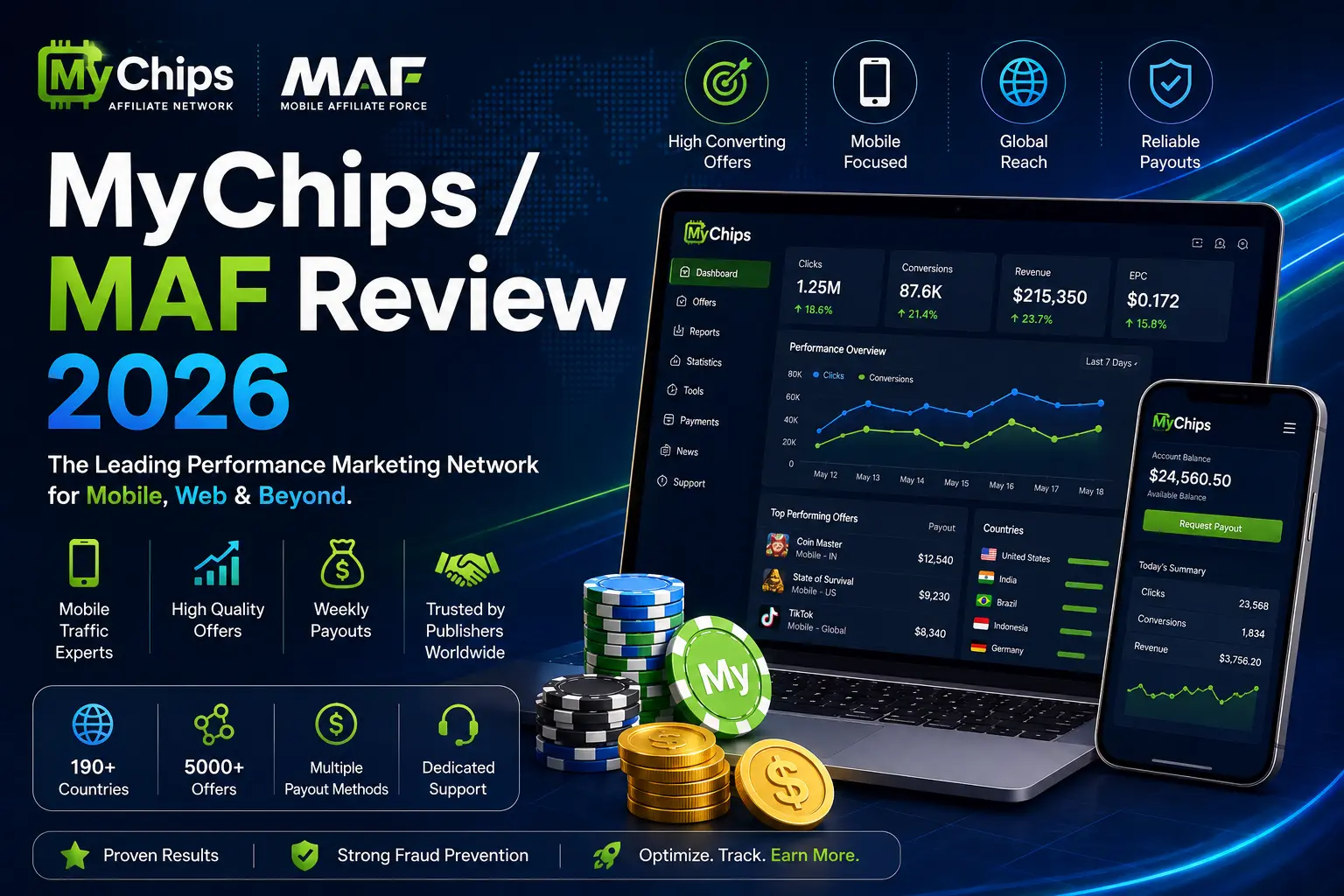
MyChips was one of MAF's better-known products for rewarded advertising and app monetization. The basic proposition was straightforward: publishers integrate an offerwall into their app, website, game, or rewards product; users complete advertiser-sponsored activities; advertisers pay for validated actions; and the publisher keeps an agreed share of the resulting revenue.
The important update for 2026 is that MyChips is no longer an independent MAF product in the same sense it was before. Mistplay announced the acquisition of MyChips from MAF on May 4, 2026. Mistplay later stated that the acquired MyChips technology is now part of LoyaltyPlay for publishers and the Mistplay Audience Network for advertisers. MAF's own website also says the MAF brand is being retired and that MyChips will continue under the LoyaltyPlay name.
That matters when researching old MyChips reviews. Much of the historical documentation still uses the MyChips and MAF names, while the commercial direction in 2026 is moving toward Mistplay and LoyaltyPlay.
From a technical perspective, however, the underlying product is still interesting. MyChips supports native mobile SDKs, cross-platform integrations, web/iFrame deployment, WebView/direct-link implementations, server-to-server postbacks, and revenue reporting APIs.
My overall view is that MyChips was particularly well positioned for gaming-heavy reward products and apps that want a second monetization loop, rather than for publishers looking for a survey-first network.
2. Who is it for?
MyChips was primarily designed for publishers that already have an audience and want to monetize additional user activity.
The strongest candidates include:
- Mobile game developers
- Reward and loyalty apps
- GPT platforms
- Cashback products
- Survey/reward apps
- Fintech and consumer apps with reward sections
- Social or community apps using gamification
- Websites that want a browser-accessible offerwall
- Existing publishers that want to add another offerwall alongside their current providers
The product does not have to be the application's entire monetization strategy. In fact, one of the more practical applications is using MyChips as a supplementary offerwall alongside existing monetization channels. MAF itself has published examples of publishers adding MyChips beside other offerwalls to increase offer variety and revenue.
For a publisher with a small site and almost no active users, the economics are much less attractive. Offerwalls work best when there is already meaningful user engagement.
3. Supported platforms
Historically, MyChips supported a broad range of environments.
The current documentation identifies integration paths for:
- Android
- iOS
- Unity
- Flutter
- React Native
- Expo/React Native
- Web/iFrame
- WebView
- Direct-link implementations
The official documentation has separate integration areas for Android, iOS, Unity, Flutter, React Native, and iFrame deployment.
That is one of MyChips' strongest technical characteristics. You are not forced into a single SDK architecture.
4. Website support
Yes. MyChips supports web-based deployment.
The clearest option is the iFrame integration, which allows a publisher to embed the offerwall inside an existing webpage. MyChips also documents a WebView/direct-link method that can be used where the publisher controls the presentation layer.
For a traditional GPT or rewards website, this is considerably easier than building a native mobile integration from scratch.
The website implementation can pass parameters such as:
- User ID
- Advertising ID where applicable
- Click ID
- Gender
- Age
- Custom affiliate parameters
The iFrame documentation specifically supports aff_sub1 through aff_sub5, which can be passed through and returned in the postback.
5. App support
Mobile apps are where MyChips makes the most sense.
The native SDK documentation covers both Android and iOS, while cross-platform developers can use React Native, Expo, Flutter, or Unity integrations.
The SDK architecture is also designed around a publisher-defined user ID. If you already have your own account system, you can pass your internal user identifier instead of relying entirely on an automatically generated identifier.
This is important for reward systems because the offerwall conversion ultimately has to map back to a real account in your database.
6. Game support
Gaming is arguably MyChips' strongest area.
The network's product positioning has historically focused heavily on mobile games, and its offer formats include traditional multi-step game missions as well as Play2Earn-style rewarded gameplay.
MAF documented Play2Earn for iOS as a major product development, using a proprietary system to estimate gameplay time without relying on invasive direct device tracking. MAF said the solution could estimate playtime with 98% accuracy and was designed around Apple's privacy framework.
The acquisition by Mistplay makes the gaming specialization even more relevant. Mistplay says MyChips added an established rewarded advertising network active across hundreds of apps in North America, APAC, and Europe.
For publishers with a gaming-oriented audience, this is a meaningful advantage.
7. Integration methods
MyChips offers several implementation paths instead of one monolithic integration.
The main approaches are:
Native SDK:
Android and iOS SDKs give developers direct control over the offerwall experience.
Cross-platform SDKs:
React Native, Expo, Flutter, and Unity integrations reduce the amount of native code required.
iFrame:
Useful for websites and browser-oriented products.
WebView/direct link:
Useful when you want to retain more control over the host application's UI while still loading the hosted offerwall environment.
Server-to-server postback:
The preferred architecture when your reward ledger is server-controlled.
From a development standpoint, this flexibility is one of MyChips' better features.
8. API availability
Yes, but the terminology requires some care.
MyChips provides API functionality, including a RevenueMetrics API that exposes performance information such as impressions, clicks, revenue, eCPM, ARPDAU, and DAU. The API uses an API key supplied through the Universal Developer Portal.
The publisher terms also refer to MyChips' platform API and require publishers to keep the API information about campaign availability and conditions up to date, with the terms specifying a five-minute verification interval.
The important distinction is that the publicly documented API surface should not automatically be interpreted as a completely open, generic offer-feed API comparable to every competing offerwall platform. Some functionality is tied to the publisher account, platform, campaigns, and commercial configuration.
9. iFrame availability
Yes — fully documented.
The iFrame integration is one of the easiest ways to deploy MyChips on a website.
The official guide provides an SDK initialization process, an iFrame URL, platform-specific examples, and optional parameters such as age, gender, advertising identifiers, click ID, and custom sub-parameters.
One important limitation is that the iFrame documentation states that the available reward mechanism for this integration is Webhook/S2S Postback.
That is actually preferable for a serious reward platform because the publisher can maintain reward logic on its own backend rather than trusting browser-side events.
10. SDK availability
SDK support is excellent.
Official documentation covers:
- Android
- iOS
- Unity
- Flutter
- React Native
- React Native/Expo
The SDK repository components are also distributed under the MIT License, and the documentation lists separate SDK packages for React, React Native, Android, iOS, Flutter, and Unity.
The SDK integrations expose functionality for showing the offerwall and handling rewards. They also support custom user IDs and parameters.
For Android and iOS, advertising identifiers are treated as important inputs for reward tracking and eCPM optimization.
11. Postback system
This is one of MyChips' strongest technical areas.
MyChips provides a Webhook/S2S Postback system that notifies the publisher's backend after conversions.
The documentation states that the system sends postbacks using HTTP GET and supports configurable parameters/macros. Publishers are also instructed to whitelist MAF postback IP addresses and correctly parse incoming parameters.
The system supports information such as:
- User ID
- Payout
- User payout
- Custom sub-parameters
- Conversion-related information
There is an important implementation detail: MyChips explicitly advises publishers to calculate rewards using user_payout or, preferably, payout, rather than using the virtual-currency value as the basis for reward calculation.
That is good advice because reward conversion should remain under your own accounting logic.
12. Tracking
Tracking is central to the platform.
MyChips uses user identifiers, click IDs, advertising IDs, and campaign-level tracking mechanisms to attribute actions. The publisher terms state that the company monitors campaign performance through its own tracking solution and that the resulting tracking data is the basis for determining transactions.
The platform also supports custom parameters, including aff_sub1 through aff_sub5, which can be useful for connecting a conversion to a particular internal user, placement, campaign group, or other publisher-side identifier.
For production systems, I would strongly recommend maintaining your own internal transaction ID and immutable reward ledger rather than depending entirely on front-end tracking.
13. Attribution window
This is an area where MyChips is less transparent publicly.
I could not verify a single universal attribution window published for every MyChips offer. That is not necessarily a technical defect because attribution conditions can depend on the individual advertiser campaign.
MAF's terms explicitly state that campaign conditions and restrictions may vary and may be changed or updated.
Therefore, I would not publish a generic claim such as — MyChips uses a 30-day attribution window — unless that exact window appears in the campaign documentation for your account.
For publishers, the practical conclusion is simple: treat attribution as campaign-specific, not as a universal MyChips setting.
14. Offer types
MyChips has historically provided a fairly broad performance-offer mix.
Documented and publicly described action types include:
- App installs
- Clicks
- Registrations
- Leads
- Sales
- Multi-step conversions
- Game progression
- Play2Earn gameplay
- Single-action offers
MAF describes MyChips as combining single-action ads, multi-reward ads, and special Play2Earn offers.
The result is a much more engaging offerwall than one based exclusively on short surveys.
For users, the difference matters. A user who dislikes surveys may still spend significant time completing game milestones.
15. GEO coverage
MyChips has international reach rather than being limited to one country.
Mistplay reported after the acquisition that the MyChips network was active across hundreds of apps in North America, APAC, and Europe, with proven performance across 19 markets.
This supports the argument that MyChips was built for international publishers rather than only U.S.-focused products.
However, GEO coverage should not be confused with equal inventory everywhere. Offerwalls are inherently dependent on advertiser demand, user demographics, device type, and campaign availability.
A publisher in the United States, Japan, Germany, or another high-spend market can naturally see a different offer catalog from a publisher serving lower-ad-spend GEOs.
16. Survey inventory
This is where I would be careful before positioning MyChips as a survey network.
MyChips has appeared in survey and rewards applications, but its strongest public positioning has historically been rewarded advertising and gaming rather than being a survey-specialist provider.
For example, MAF documented how PollFlow used MyChips gaming offers to supplement a survey-focused product. The goal was not to turn MyChips into a survey engine; instead, the gaming offerwall gave users something to do when surveys were unavailable or repetitive. PollFlow reported a 100% monthly revenue increase and more than 35% higher retention in the cited case study.
This is an important distinction.
If your product is primarily a survey wall, I would treat MyChips as a complementary gaming/offerwall source, not automatically as your main survey supplier.
17. Gaming inventory
Gaming is the real selling point.
MyChips has supported traditional game milestone offers and more advanced Play2Earn mechanics.
MAF described Play2Earn as a time-based model that rewards users according to gameplay duration rather than only completed milestones. MAF also stated that MyChips could provide Play2Earn, multi-reward offers, or both.
This is exactly the type of inventory that can work well with:
- GPT websites
- Reward apps
- Loyalty platforms
- Gaming communities
- Cashback applications
- Survey apps looking to diversify
- Apps with highly engaged users
Recent MAF case studies also show MyChips being used by companies outside pure gaming, including social commerce and survey products.
18. Fraud prevention
MyChips has explicit anti-fraud and traffic-quality rules.
Publisher terms prohibit:
- Click spamming
- Click stuffing
- Impression-pixel tracking abuse
- Pre-caching clicks
- Ad stacking
- Excessive targeting
- Adult traffic
- Unauthorized push/discovery traffic
- Incent traffic on non-incent campaigns
MAF also states that transactions can be reduced or adjusted for invalid actions, duplicate transactions from the same person, device or IP address, technical errors, tracking discrepancies, and other invalid activity.
The platform's own guidance also emphasizes tracking controls and the importance of fraud detection in offerwall ecosystems.
From a publisher perspective, this means quality traffic matters. You should not treat an offerwall as a place to dump arbitraged or suspicious traffic.
19. Reporting
Reporting is available through the publisher account.
The MyChips Revenue API can retrieve performance metrics including:
- Revenue
- Impressions
- Clicks
- eCPM
- ARPDAU
- DAU
These metrics can be retrieved over a specified date range through the API.
MAF's publisher terms also explicitly state that publishers have access to reporting tools inside their account.
For developers building their own analytics stack, the API is particularly useful because it allows you to reconcile revenue data with your internal user and reward records.
20. Reward flexibility
MyChips gives publishers a reasonable amount of flexibility over how rewards are handled.
There are two major approaches:
Publisher-managed rewards:
Your system receives information about the conversion and decides how many points, coins, credits, or other internal units to give the user.
Client-side/SDK reward handling:
The SDK can expose reward information to the application for selected configurations.
For serious GPT and loyalty platforms, I prefer the first model because it keeps the reward ledger under your control.
The documentation also makes it clear that publisher-side calculations should be based on the payout parameters rather than treating virtual currency values as authoritative accounting data.
That architecture scales much better once your platform has multiple reward providers.
21. Payout model
According to the publisher terms, MyChips uses a revenue-share model.
The publisher receives an agreed share of actual revenue generated by the products/campaigns, while the company retains the remaining amount as its compensation.
The exact commercial share is not presented as a universal public percentage. It can therefore be different depending on the agreement, campaign configuration, and publisher relationship.
This is preferable to publishing a misleading universal — publisher gets X% — claim that cannot be independently verified.
22. Payment methods
This is one of the areas where public information is limited.
The publisher terms clearly describe the payment process and invoice requirement, but they do not provide a universal public list of all payment methods.
The terms state that:
- Payments are generally due within 30 days after the end of each calendar month.
- The balance must exceed $100.
- A valid publisher invoice is required.
- Payment can be withheld until the relevant advertiser settles its obligations.
The practical conclusion is that the payment process is structured and contractual, but publishers should confirm the actual supported payment method during onboarding rather than assuming PayPal, bank transfer, or another method is universally available.
23. Approval requirements
Approval is part of the onboarding process.
The MyChips documentation states that newly created AdUnits initially enter Sandbox mode and require manual approval. Once the first AdUnit has been approved, additional AdUnits can be created outside Sandbox without requiring the same additional approval process.
That is a sensible approach because publishers can test the technical implementation before live monetization.
For production deployment, I would plan for a manual review rather than expecting instant self-service activation.
24. Minimum traffic
I could not verify a fixed public minimum traffic threshold for MyChips.
This is worth emphasizing because many offerwall articles casually publish traffic requirements without a source.
The publicly available publisher documentation describes registration, sites, AdUnits, Sandbox testing, approval, and campaign restrictions, but I did not find a verified universal requirement such as — 10,000 daily users — or — 50,000 monthly visitors. —
In practice, acceptance can depend on:
- Traffic quality
- Application/site type
- GEO
- User engagement
- Existing monetization model
- Compliance
- Advertiser suitability
For a new publisher, it is better to present the actual audience and product honestly than to artificially inflate traffic numbers.
25. Publisher support
Support appears to be more account-management-oriented than a purely self-service affiliate platform.
MAF has publicly emphasized dedicated account management and client support, including data-driven optimization recommendations.
That is also reflected in publisher case studies.
For example, KAUCHE reported that the MyChips team supplied data-driven recommendations and insights based on performance in Japan and international markets.
This is useful when an offerwall becomes large enough that merely installing an SDK is no longer the hard part. The real work becomes:
- Offer placement
- Reward economics
- GEO optimization
- Offer overlap
- User retention
- Campaign quality
- Conversion performance
26. Strengths
Strong gaming inventory
This is the clearest advantage. MyChips has a much stronger identity around gaming and rewarded gameplay than a typical survey wall.
Multiple integration options
Native SDKs, cross-platform SDKs, iFrame, WebView, direct links, and S2S postbacks make the platform technically flexible.
Good backend architecture
The S2S postback approach allows publishers to retain control over reward calculations and user balances.
International reach
The platform has operated across North America, APAC, and Europe, with Mistplay describing activity across 19 markets.
Suitable as a second offerwall
The platform can complement existing providers rather than requiring publishers to replace them.
Strong fit for reward ecosystems
GPT, loyalty, survey, cashback, and gaming products can all make use of the same core model.
27. Weaknesses
The brand transition creates uncertainty
This is the biggest 2026 issue.
MyChips was acquired by Mistplay and is now being folded into LoyaltyPlay. Publishers researching old documentation need to understand that the commercial product is moving under a new corporate and product structure.
Public pricing is limited
There is no universal publisher revenue-share rate published for everyone.
Payment methods are not clearly documented publicly
The commercial terms explain payment timing and minimum balance but do not provide a universal public payment-method list.
Attribution windows are not universally published
Publishers must review campaign-specific conditions instead of relying on a single network-wide number.
Surveys are not the main reason to choose it
Publishers looking for deep, survey-first inventory may get better results from dedicated survey providers.
Offer tracking can still become operationally difficult
No tracking system is perfect. Users may encounter missing attribution, delayed validation, or advertiser-side rejection. That means your support and reconciliation systems still matter.
28. Best use case
The best MyChips use case is a reward platform with an existing active audience that wants to add gaming-based earning opportunities without building an advertising marketplace from scratch.
A strong example would be a GPT website that already has:
- User accounts
- Internal points
- A withdrawal system
- Several existing offerwalls
- A reward ledger
- S2S postback support
- A meaningful mobile audience
MyChips can then become the gaming-heavy component of the monetization stack.
It is also a natural fit for a survey application that wants a second earning category. PollFlow's case study is a good example of this model, where gaming offers were used to diversify beyond surveys.
The new LoyaltyPlay direction makes this even more interesting for loyalty products and broader consumer apps.
29. Who should avoid it
I would avoid making MyChips your first choice in the following situations.
A brand-new website with almost no traffic:
There is little economic value in integrating a sophisticated offerwall before you have users.
A survey-only business:
MyChips can supplement surveys, but it should not automatically be treated as a dedicated survey specialist.
A publisher looking for completely public pricing:
Commercial terms are not published as a single universal package.
A traffic arbitrage operation:
The publisher terms are explicit about prohibited traffic and attribution fraud.
A publisher unwilling to manage postback/reward reconciliation:
For a serious rewards product, you should have your own backend handling the transaction lifecycle.
30. Alternatives
MyChips should not be evaluated in isolation.
For a publisher building a serious rewards ecosystem, the better approach is often to combine different providers according to their strengths.
RevU
RevU is a natural alternative for publishers looking for broader offerwall and performance marketing inventory, particularly where a mix of offers beyond gaming is important.
Internal resource: RevU Review on HansalDev
AdGate Media
AdGate Media is another established option for publishers that want a large selection of reward-based campaigns and multiple monetization categories.
Internal resource: Offerwall and Ad Network Reviews on HansalDev
Dedicated survey providers
For products where surveys are the primary activity, dedicated survey providers can make more sense than forcing a gaming-focused offerwall into the center of the experience.
Multiple-offerwall strategy
In many cases, the most effective solution is not choosing one provider.
MAF itself has discussed the benefits of using multiple offerwalls in the same application and reported publishers achieving additional revenue after adding MyChips beside existing providers.
For a mature GPT platform, I generally prefer this architecture:
Survey Provider + Gaming Offerwall + CPA Offerwall + Internal Reward Ledger
That reduces dependence on any single advertiser pool and gives users more earning choices.
31. Final rating
MyChips / MAF Rating: 8.7/10
| CategoryRating | |
| Offerwall quality | 9/10 |
| Gaming inventory | 9.5/10 |
| Survey inventory | 6.5/10 |
| SDK support | 9/10 |
| API availability | 8.5/10 |
| iFrame/Web support | 9/10 |
| S2S postbacks | 9.5/10 |
| Tracking | 9/10 |
| Reporting | 8.5/10 |
| GEO coverage | 9/10 |
| Fraud controls | 8.5/10 |
| Reward flexibility | 9/10 |
| Payment transparency | 7/10 |
| Publisher requirements transparency | 7/10 |
| Publisher support | 9/10 |
| Overall | 8.7/10 |
Final verdict
MyChips was a technically capable offerwall with a particularly strong position in rewarded gaming, app monetization, and engagement-driven products.
The most important 2026 development is not a new SDK feature or another offer format. It is the acquisition by Mistplay.
MyChips is now becoming part of Mistplay's broader LoyaltyPlay ecosystem, and MAF's website explicitly says the MAF brand is being retired. The underlying technology and publisher relationships remain relevant, but anyone evaluating the service today should think in terms of MyChips — LoyaltyPlay, rather than treating MAF as an independent long-term destination.
Technically, I consider the platform strong because it checks most of the boxes a professional rewards publisher needs: SDKs, cross-platform support, web integration, iFrame, S2S postbacks, custom parameters, reporting APIs, gaming inventory, and international reach.
Where I would be more cautious is commercial transparency. Public information does not establish a universal attribution window, minimum traffic requirement, publisher revenue share, or payment-method list. Those details need to be confirmed during onboarding rather than copied from outdated third-party reviews.
For a GPT platform, loyalty app, gaming community, cashback site, or reward application, MyChips remains a compelling option — especially when used as a gaming-focused complement to other offer providers.
For a survey-first platform, I would use it as a secondary monetization source rather than the primary survey engine.
The acquisition actually makes the long-term opportunity more interesting. Mistplay has a strong background in rewarded gameplay, and integrating MyChips' established publisher network into LoyaltyPlay gives the technology a broader strategic home than it had as a standalone MAF product.
Recommended for
GPT platforms: Yes
Reward apps: Yes
Gaming apps: Excellent fit
Loyalty platforms: Excellent fit
Survey apps: Yes, as a complementary channel
Cashback platforms: Potentially
Tiny/new publishers: Not a priority
Survey-only businesses: Consider specialist survey providers first
Useful resources
Official MyChips documentation: MyChips Developer Documentation
MyChips S2S Postback documentation: MyChips Webhook / S2S Postback
MyChips iFrame documentation: MyChips iFrame Integration
MyChips Revenue API: MyChips Revenue API
Mistplay LoyaltyPlay: LoyaltyPlay for App Publishers
Mistplay announcement regarding MyChips: Mistplay Audience Network and MyChips acquisition
Apple tracking/privacy documentation: Apple App Tracking Transparency
Google Android Advertising ID guidance: Android Advertising ID and identifier best practices
Related HansalDev guide: What Is an Offerwall? Meaning, Mechanics, and Earning Potential




Comments (0)
No comments yet. Be the first to share your thoughts!