
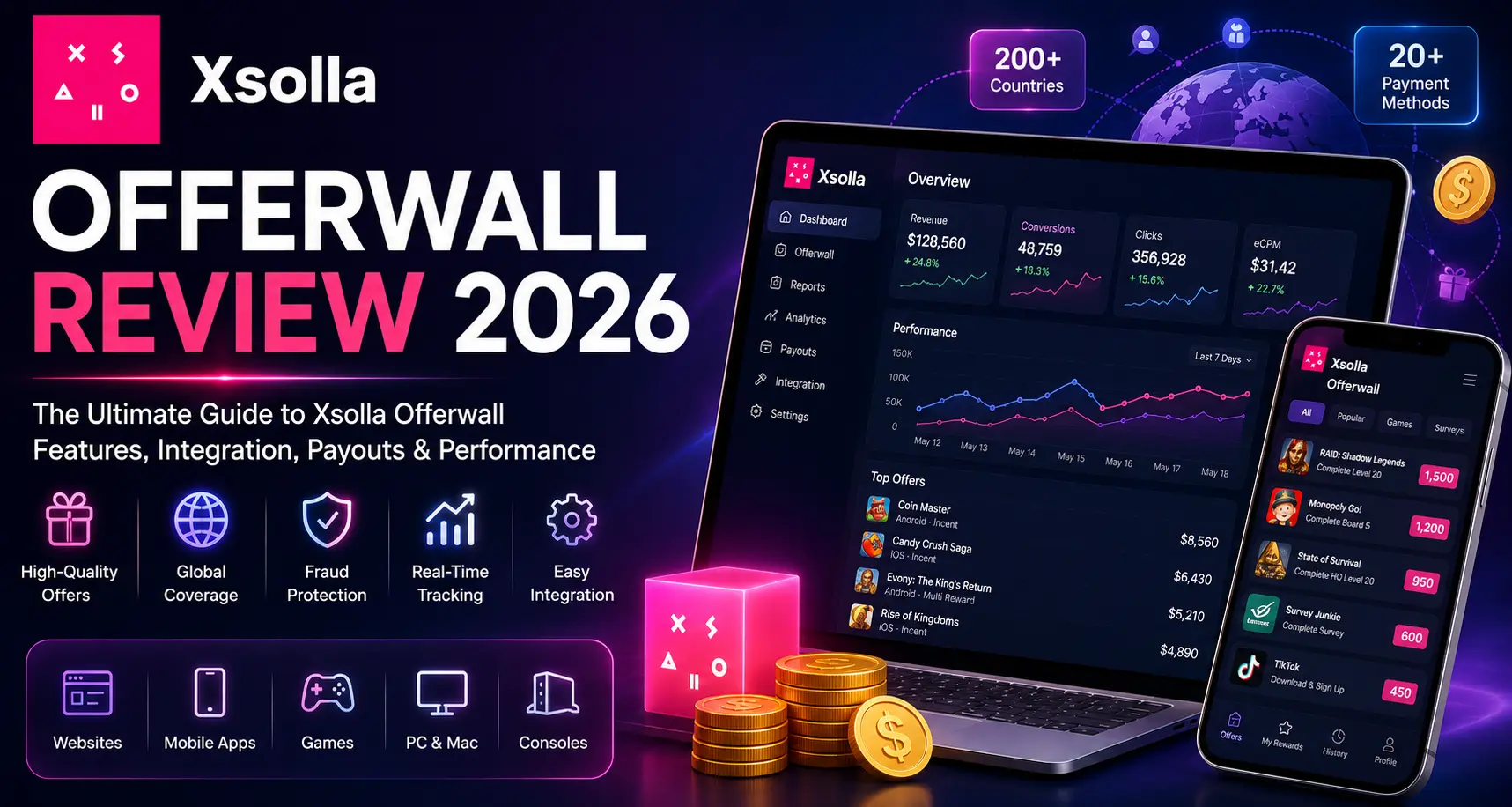
Offerwalls are no longer limited to GPT websites and reward apps. In gaming, they have become a serious monetization layer for players who are unlikely to purchase premium currency directly.
That is where Xsolla Offerwall takes an interesting position.
Xsolla is already deeply embedded in the game commerce ecosystem, and its Offerwall is designed primarily around game developers and publishers rather than around generic GPT publishers. Players complete advertiser quests — such as installing an app, reaching a game milestone, registering for a service, completing a survey, or engaging with an offer — and receive virtual rewards supplied by the publisher.
According to Xsolla's current documentation, the Offerwall connects advertisers, game publishers, and users, while completed offers are tracked through Xsolla's ad server and supported mobile measurement partners such as Adjust, AppsFlyer, and Singular.
The interesting part is the economics. Xsolla promotes up to 90% revenue share for developers, which is considerably more aggressive than many traditional offerwall models. The company has also positioned higher player rewards as a differentiator, with its developer materials claiming that players can receive substantially more reward value per offer than with leading competitors.
But there is a catch.
Xsolla Offerwall is still more tightly controlled and gaming-oriented than many independent offerwall networks. Some of the technical features developers normally expect — particularly a public standalone API, public iframe documentation, and generally available SDK binaries — are not fully exposed in the public documentation at the time of this review. The current Offerwall SDK page explicitly describes the SDK binaries, API reference, and integration guides as — Coming Soon. —
So, is Xsolla Offerwall worth considering in 2026?
For a game developer, potentially very much so.
For a traditional GPT site owner looking for a plug-and-play offerwall, the answer is less straightforward.
1. Overview
Xsolla Offerwall is a rewarded advertising and game monetization product designed to turn non-paying game users into a source of incremental revenue.
The basic model is simple:
- A player opens an Offerwall.
- Xsolla displays available advertiser quests.
- The player chooses an offer.
- The player completes the required action.
- The advertiser confirms the conversion.
- Xsolla processes the transaction.
- The publisher receives the agreed revenue share.
- The player receives the game's virtual reward.
The current Xsolla documentation describes offers from both gaming and non-gaming advertisers. Gaming advertisers can use quests to acquire new players, while non-gaming advertisers can promote actions such as app downloads, registrations, subscriptions, and purchases.
The product launched publicly in March 2025 and was expanded into Xsolla Web Shop later that year, making the Offerwall part of a broader direct-to-consumer gaming monetization stack.
My practical assessment: Xsolla Offerwall feels less like — another offerwall network — and more like a monetization component inside the Xsolla gaming ecosystem.
That distinction matters when comparing it with AdGem, Lootably, Tapjoy, or offerwalls traditionally used by GPT platforms.
2. Who is it for?
Xsolla Offerwall is primarily designed for:
- Game developers
- Game publishers
- Free-to-play games
- Mobile games
- Developers using Xsolla Web Shop
- Developers looking to monetize non-paying players
- Studios wanting rewarded acquisition campaigns inside a gaming environment
It is particularly attractive for games with a large percentage of players who do not purchase virtual currency.
Xsolla itself frames the product around the idea that only a small percentage of players typically monetize through direct purchases, while Offerwall provides a way to monetize the rest. The company says Offerwall users show higher retention and conversion metrics, although these performance figures should be treated as Xsolla-reported marketing claims rather than independently verified benchmarks.
It is less naturally suited to:
- Generic GPT websites
- Cashback websites
- Survey-only platforms
- Arbitrage publishers
- Publishers wanting unrestricted offerwall customization
- Businesses seeking a fully public API-first offerwall infrastructure
3. Supported platforms
Xsolla Offerwall currently sits mainly within the gaming and web-commerce ecosystem.
The publicly documented environments include:
- Mobile applications
- Games
- Xsolla Web Shop
- Websites using Xsolla's Site Builder
- In-game entry points that redirect users to the Offerwall
- Future native SDK integrations
Xsolla documentation specifically shows Offerwall functionality working either in-app or through a Web Shop, with direct Offerwall URLs carrying both a placement ID and gamer ID.
The important limitation is that Xsolla does not currently present Offerwall as an ordinary generic publisher widget that can simply be dropped into any website with a universal JavaScript snippet.
That makes the product stronger for gaming businesses but less flexible for traditional web publishers.
4. Website support
Website support is available, but it is closely tied to the Xsolla Web Shop ecosystem.
Xsolla's Web Shop is designed to operate through desktop browsers, mobile browsers, and Progressive Web Apps. The Offerwall can be added as a Web Shop block, allowing developers to display calls to action and direct users toward available quests.
This is one of the strongest parts of the current product.
If a game already uses Xsolla Web Shop, the integration becomes much more attractive because Offerwall is not operating as an isolated advertising component. It becomes part of the same player-facing storefront and monetization environment.
There is also support for providing an Offerwall link from a website or application.
However, Xsolla states that publishers wanting to use the Offerwall independently of an Xsolla Site Builder website should contact the Offerwall team.
Verdict: Website support — Yes, but ecosystem-oriented rather than fully open-ended.
5. App support
App support is central to Xsolla Offerwall.
The current end-user agreement explicitly describes the Offerwall as a service presented within mobile applications and games. Offers can include app downloads, engagement actions, subscriptions, registrations, purchases, surveys, and game progression requirements.
Xsolla also documents links that can be placed inside an application, including:
- In-app shop banners
- Main-menu messages
- App feed promotions
- Push notifications, with appropriate user consent
This means the Offerwall can be surfaced as part of the normal monetization journey rather than hidden behind a separate website.
For developers building native experiences, the longer-term story is the Xsolla Offerwall SDK.
6. Game support
This is where Xsolla Offerwall performs best.
The entire product is strongly oriented toward games.
The reward model revolves around virtual currency, virtual items, game content, game keys, and other digital rewards, while quests can be configured around actions such as reaching levels or completing gameplay milestones.
Examples include:
- Reach level 10
- Complete a tutorial
- Install and open another game
- Register for a service
- Complete a purchase
- Watch or interact with an advertisement
- Complete a survey
- Achieve an in-game milestone
Gaming advertisers can use these actions for user acquisition while non-gaming advertisers can use the same infrastructure for performance advertising.
This gaming orientation is arguably the biggest reason to consider Xsolla over a generic offerwall.
7. Integration methods
There are several documented integration routes, but they are not equally mature.
Current practical options
Xsolla Web Shop integration
This is the easiest route if the game already uses Xsolla Web Shop.
The Offerwall can be added as a Web Shop block without creating an entirely separate offerwall frontend. Xsolla announced the Web Shop integration as a zero-code addition for supported setups.
Direct Offerwall URL
Xsolla provides a direct URL structure containing:
- Placement ID
- Gamer ID
This makes it possible to open the Offerwall from an app, website, menu, banner, or other supported entry point.
Webhook-based reward integration
The publisher uses Xsolla webhooks to validate the player and process rewards.
SDK
Native Offerwall SDK support is being developed, but public binaries and documentation are currently marked as coming soon.
8. API availability
This is one of the areas where I would be careful with terminology.
Xsolla's Offerwall terms explicitly recognize APIs as part of the technical materials that may be supplied for Offerwall integration.
However, that is not the same thing as having a fully documented public Offerwall API equivalent to the APIs exposed by some independent offerwall networks.
The current public Offerwall documentation focuses much more heavily on:
- Web Shop configuration
- Direct Offerwall URL
- User validation webhook
- Reward/payment webhook
- Publisher integration
- Tracking through Xsolla's infrastructure and MMPs
There is currently no clearly documented public standalone Offerwall Offers API in the same style as some competing networks.
That is a meaningful weakness for developers who want complete control over offer presentation.
API rating: 6/10 for public developer accessibility.
9. iFrame availability
This is another area where Xsolla differs from many dedicated offerwall networks.
I could not find current public Xsolla documentation that presents a standard, general-purpose iframe integration method for Offerwall.
Xsolla does provide a direct Offerwall URL and a Web Shop block, which solve similar usability problems, but they should not be described as an official generic iframe integration.
That distinction matters.
A developer should not build an architecture around an assumed Xsolla iframe endpoint unless Xsolla specifically provides that method for the project.
iFrame availability: Not publicly documented as a standard integration method.
For comparison, dedicated offerwall providers such as Lootably explicitly document iframe integration, while AdGem documents both direct-link and iframe/WebView integrations.
10. SDK availability
The current state here is unusually important.
The public Xsolla Offerwall SDK page says:
— Coming Soon —
and identifies the SDK binaries, API reference, and integration guides as being under development.
Xsolla says the future SDK will allow the Offerwall to appear directly inside a game, handle advertiser tasks, grant rewards, and track completions without forcing the player to leave the app.
This could become one of the strongest features of the platform.
For now, however, developers should distinguish between Xsolla's general SDK ecosystem and the specific Offerwall SDK, which is not yet presented as a fully public, production-ready package.
Current Offerwall SDK rating: 5/10.
Potential: 9/10 if the public SDK becomes mature and broadly available.
11. Postback system
The postback/webhook system is one of the more convincing technical parts of the platform.
Xsolla documents webhooks for:
- User validation
- Successful offer/payment events
- Reward processing
The validation system allows Xsolla to verify that a gamer exists in the publisher's system before rewarding the user.
When an offer is completed, Xsolla sends the relevant event and the publisher can grant the corresponding virtual currency or item.
Xsolla also specifically recommends verifying the webhook's authenticity by generating a signature from the request body and comparing it with the authorization signature provided by Xsolla.
That is exactly the kind of server-side verification I would want in a production reward system.
Do not award valuable currency purely from a client-side success screen.
The reliable architecture is:
Offer completed — Xsolla server — verified webhook — publisher backend — idempotent reward transaction — player wallet/game balance
That architecture also makes fraud investigations and reconciliation much easier.
12. Tracking
Xsolla tracks conversions through its own advertising infrastructure and integrations with third-party MMPs.
The current documentation specifically names:
- Adjust
- AppsFlyer
- Singular
These systems provide additional attribution and campaign measurement capabilities.
Xsolla also uses a placement ID to identify the source application or placement, while the gamer ID identifies the user receiving the reward.
This is a solid foundation, particularly for gaming publishers already using an MMP.
The weak point is not the existence of tracking; it is the amount of publicly exposed Offerwall tracking customization available to independent developers.
13. Attribution window
This is one of the details where the responsible answer is:
Xsolla does not publicly document a universal Offerwall attribution window in the current publisher-facing Offerwall documentation.
I would not publish a claim such as — 7 days, — — 30 days, — or — 90 days — as a standard Xsolla Offerwall rule without a project-specific agreement or documentation confirming it.
That is important because offer attribution windows can differ by advertiser, campaign, mobile measurement setup, and conversion event.
Xsolla's own end-user documentation also confirms that offer completion depends on advertiser-specific requirements and confirmation from the advertiser.
Attribution window: Not publicly specified as one universal value.
14. Offer types
The available offer model is broader than simply — install an app. —
Current Xsolla materials document:
- CPI — Cost Per Install
- CPE — Cost Per Engagement
- CPA — Cost Per Acquisition
- CPC — Cost Per Click
Examples include installing and opening an app, reaching game milestones, registering for services, subscribing, making purchases, watching or interacting with content, and completing promotional activities.
That makes the inventory useful for both gaming acquisition and broader performance advertising.
The current system also emphasizes quest-style campaigns rather than treating offers as simple affiliate links.
15. GEO coverage
Xsolla positions Offerwall as a global product.
Its marketing materials describe advertiser demand across multiple regions and global audiences, while Xsolla's wider game commerce infrastructure operates across more than 200 regions.
However, it is important not to confuse:
Xsolla's global payments coverage
with
Offerwall offer availability in every country.
Offerwall inventory is naturally determined by:
- Advertiser demand
- Campaign targeting
- Device
- Country
- User eligibility
- Offer requirements
- Regulatory restrictions
So a country being supported by Xsolla does not guarantee strong Offerwall fill in that country.
For publishers targeting premium advertising GEOs such as the United States, Canada, United Kingdom, Australia, and Western Europe, the model is potentially much more attractive than for low-demand GEOs.
16. Survey inventory
Survey inventory exists, but Xsolla is not primarily marketed as a survey network.
The Offerwall terms explicitly include surveys as an eligible quest type.
That means users may encounter survey-based offers alongside app, game, registration, or purchase opportunities.
However, I would not choose Xsolla primarily because I wanted the largest possible survey inventory.
If surveys are the core monetization model, a specialized research/survey provider or a network with deep survey aggregation may offer more flexibility.
Xsolla's strength is the combination of gaming + app + brand + performance inventory, not survey specialization.
17. Gaming inventory
Gaming inventory is arguably the strongest reason to use Xsolla.
The company specifically describes a mix of gaming and brand advertisers and positions Offerwall as a gaming-focused monetization solution.
Gaming tasks can be built around actual engagement:
- Install a game
- Open the game
- Complete onboarding
- Reach a level
- Finish a tutorial
- Complete milestones
- Continue playing
- Make a purchase
This creates a better connection between the advertiser's desired outcome and the player's reward.
It is also one of the places where Xsolla's game-commerce positioning makes more sense than a traditional generic CPA network.
18. Fraud prevention
Fraud prevention is a strong area.
Xsolla publicly highlights SMS-based user authentication as a method for improving traffic quality and reducing fraudulent completions.
The user agreement also prohibits activities including:
- Device ID manipulation
- Spoofing
- Misrepresented eligibility
- VPN/proxy location manipulation
- Bots
- Automated tools
- Other fraudulent behavior
From a publisher's perspective, that matters because rewarded advertising is highly vulnerable to:
- Fake installs
- Emulator abuse
- Multi-accounting
- Location spoofing
- Incentive abuse
- Automated completion
- Device farms
Xsolla's approach is not simply — trust the conversion. — It incorporates verification and anti-fraud controls into the ecosystem.
That is a meaningful advantage.
19. Reporting
Xsolla provides reporting and analytics through its publisher ecosystem.
Its Offerwall materials describe advertiser and publisher dashboards for tracking earnings and campaign performance, while Xsolla's Web Shop ecosystem includes analytics integrations and MMP connections.
The main strength is ecosystem-level visibility.
The main limitation is that the publicly available Offerwall documentation does not expose every reporting field, API endpoint, retention rule, or export feature that a large independent offerwall operator might want.
For enterprise-level analytics requirements, I would verify the exact dashboard and export capabilities during onboarding.
20. Reward flexibility
Reward flexibility is one of Xsolla's better features.
The Offerwall model supports rewards such as:
- Virtual currencies
- Virtual items
- Game content
- Game keys
- Gift cards or digital goods in qualifying configurations
- Xsolla Points
Xsolla's legal terms explicitly recognize several categories of rewards, while its current product materials promote Xsolla Points as an additional reward mechanism.
However, publishers remain responsible for fulfilling the promised reward after Xsolla confirms the completed quest.
For a game publisher, this is a very natural model because the reward is usually something the developer already controls.
21. Payout model
The headline figure is impressive:
Up to 90% revenue share for developers.
Xsolla has repeatedly marketed this as one of the platform's primary differentiators.
But there is an important qualification.
The legally binding Offerwall terms state that revenue calculations and payment terms are governed by the applicable supplemental agreement, exhibit, and/or pricing terms shown in the publisher's Xsolla account.
Therefore, the correct way to interpret — 90% — is:
up to 90%, depending on applicable commercial terms, region, and volume — not a universal guaranteed rate for every publisher and every conversion.
This is still a highly competitive headline payout.
22. Payment methods
This is another area where Xsolla does not publicly publish a simple Offerwall-specific payout table.
Do not confuse:
payment methods offered to gamers
with:
publisher settlement methods.
Xsolla's wider commerce infrastructure supports a large number of consumer payment methods, but Offerwall publisher revenue settlement is governed by the publisher's commercial agreement and account configuration.
The current public Offerwall terms do not provide one universal list saying every publisher will receive earnings through PayPal, Payoneer, bank transfer, or another specific method.
Therefore:
Publisher payout method: Account/agreement dependent.
This should be confirmed with Xsolla before committing to the platform financially.
23. Approval requirements
Xsolla does not present the Offerwall like an instant anonymous affiliate network where anyone can register and immediately send traffic.
The platform is connected to Xsolla's publisher ecosystem, and technical documentation refers to working with Xsolla's team or Customer Success/Offerwall representatives for certain configurations.
The publisher must also:
- Provide accurate registration information
- Comply with applicable laws
- Follow industry standards
- Provide valid publisher content
- Properly deliver advertised rewards
- Maintain technical reliability
- Implement required security measures
Xsolla's Offerwall terms make those responsibilities explicit.
24. Minimum traffic
I could not find a current official Xsolla source publishing a universal minimum traffic requirement such as:
- 10,000 DAU
- 50,000 MAU
- 100,000 page views
- 1 million monthly impressions
Therefore, claims online that Xsolla — requires exactly X traffic — should be treated cautiously unless they come directly from Xsolla.
The more accurate position is:
No universal public minimum traffic threshold was found in the current official Offerwall documentation.
Approval is likely to depend on the publisher, application/game, audience quality, compliance, commercial potential, and technical setup.
For a serious publisher, this is preferable to attempting to optimize around an unofficial traffic number.
25. Publisher support
Xsolla has a significant advantage here because Offerwall exists inside a broader game commerce company.
The publisher ecosystem includes partner support, Customer Success resources, documentation, account management, and Offerwall-specific contact channels.
This is different from many smaller offerwall providers where most integration and debugging responsibility falls directly on the developer.
The downside is that support can be more account-driven.
In other words, Xsolla offers a more enterprise-oriented relationship, but that can also mean fewer self-service controls than a developer expects from a modern API-first network.
26. Strengths
Gaming-first design
This is the biggest advantage.
Xsolla understands the economics of games, virtual currencies, player retention, Web Shops, and direct-to-consumer monetization.
Up to 90% revenue share
The headline revenue share is highly competitive and potentially one of the strongest reasons to test the product.
Strong reward model
Virtual currency and digital rewards fit naturally into game economies.
Good fraud controls
SMS verification, server-side processing, user validation, and policy enforcement provide a much stronger anti-abuse framework than a basic client-side reward system.
MMP support
Adjust, AppsFlyer, and Singular support gives larger gaming teams access to familiar attribution infrastructure.
Xsolla Web Shop integration
For developers already using Xsolla Web Shop, adding Offerwall can be considerably simpler than integrating a separate monetization vendor.
Global orientation
The platform is clearly designed for international game publishers and advertiser demand across multiple markets.
27. Weaknesses
The public API story is not strong enough yet
Compared with dedicated offerwall companies, public API documentation is limited.
No clearly documented standard iframe integration
Developers looking for the simplest — copy this iframe — implementation may find the current model restrictive.
Offerwall SDK is still developing
As of the current public documentation, Offerwall SDK binaries and reference material are listed as coming soon.
Commercial details are not fully public
Revenue share, payment calculations, and related commercial details may depend on contracts and publisher-account terms.
Not ideal for generic GPT websites
The product's strongest positioning is games and game-adjacent experiences, not independent GPT publishers.
Less self-service than some competitors
The more customized your integration becomes, the more likely you are to interact with Xsolla's account or Offerwall team.
Attribution window is not publicly standardized
This creates uncertainty for publishers who want to model delayed conversion behavior before signing a commercial agreement.
28. Best use case
The best use case for Xsolla Offerwall is:
A free-to-play game with a meaningful non-paying audience that already uses, or is willing to use, Xsolla's commerce ecosystem.
For example:
Imagine a mobile strategy game with 500,000 monthly active users.
Only a fraction buys premium currency.
Instead of leaving the rest of the audience completely unmonetized, the developer introduces:
— Earn 5,000 Gems —
Players can then complete a game quest, install another application, reach a gaming milestone, complete a survey, or perform another qualifying task.
The player receives something valuable.
The advertiser receives a performance action.
The publisher receives revenue.
That is the economic loop Xsolla is trying to build.
This becomes particularly interesting when Offerwall is combined with Web Shop, loyalty systems, events, and other LiveOps mechanics rather than presented as a random advertising tab.
29. Who should avoid it
I would avoid Xsolla Offerwall as the primary choice if your business is mainly:
- A generic GPT website
- A survey-only website
- A cashback business
- A small content site
- A non-gaming rewards portal
- A business demanding a fully public Offers API
- A developer requiring a public iframe implementation immediately
- A company that needs fixed, publicly documented payout terms
- A publisher that wants complete control over the offerwall UI and offer-selection logic
For these use cases, independent offerwall networks may provide a simpler and more transparent integration model.
30. Alternatives
AdGem
AdGem is a strong option when the priority is technical control.
Its current documentation exposes:
- Web Offerwall
- iOS SDK
- Android SDK
- Unity SDK
- REST Offer API
- GraphQL-based Prism
- Server-to-server postbacks
That is considerably broader from a developer-integration perspective.
Best for: developers wanting API and SDK flexibility.
Lootably
Lootably is particularly interesting for web and app publishers that want straightforward offerwall implementation.
Its documentation explicitly supports:
- iFrame
- Direct link
- Offers API
- Android SDK
- Postbacks
Best for: flexible websites, apps, and custom offerwall implementations.
Tapjoy
Tapjoy remains an important option in the mobile advertising and rewarded monetization space. Its current API infrastructure includes Offerwall-related content types, publisher analytics, and SDK/API concepts.
Best for: established mobile game monetization and a broader mobile advertising ecosystem.
Independent survey/offerwall networks
For GPT publishers, survey-heavy businesses, and reward platforms, specialized networks may be more appropriate than Xsolla.
The right choice depends heavily on whether your business is a game publisher or a general rewards publisher.
For broader research on offerwall economics, integration architecture, and GPT monetization, the Hansal Dev blog is also useful as an internal reference hub. Hansal Dev Blog
31. Final rating
Xsolla Offerwall Rating: 8.4/10
| CategoryRating | |
| Game monetization | 9.5/10 |
| Gaming inventory | 9.0/10 |
| Revenue share | 9.5/10 |
| Reward flexibility | 9.0/10 |
| Fraud prevention | 9.0/10 |
| Tracking | 8.5/10 |
| Web Shop integration | 9.0/10 |
| Website flexibility | 7.0/10 |
| Public API | 6.0/10 |
| iFrame support | 5.0/10 |
| SDK availability | 5.0/10 |
| Reporting | 8.0/10 |
| Global reach | 9.0/10 |
| Publisher support | 8.5/10 |
| Transparency of commercial terms | 6.5/10 |
Final verdict
Xsolla Offerwall is one of the more interesting offerwall products to watch in 2026, but it should not be judged using exactly the same criteria as a traditional GPT offerwall network.
Its biggest advantage is also its biggest limitation:
Xsolla is building a gaming monetization ecosystem, not simply selling an offerwall widget.
For game developers, this is a major advantage. The Offerwall fits naturally with virtual currencies, Web Shops, player retention, game advertising, MMP attribution, rewards, and direct-to-consumer commerce.
The up to 90% revenue share, gaming-focused inventory, server-side reward processing, fraud controls, and Xsolla Web Shop integration make the product genuinely compelling.
At the same time, developers coming from networks such as AdGem or Lootably may immediately notice the missing level of public technical openness. A public, mature Offerwall API, universal iframe option, and fully released Offerwall SDK would make the product much easier to evaluate and integrate independently.
There is also a practical issue with researching Xsolla Offerwall commercially: some of the most important details are account-specific. The public documentation does not provide a universal publisher payout schedule, one fixed attribution window, or a universal minimum traffic number. Xsolla's own terms state that revenue and payment details can be established through supplemental agreements and publisher-account terms.
That is why I would not choose Xsolla solely because of the — 90% revenue share — headline.
The real question is whether the combination of revenue share + game inventory + fraud controls + Xsolla ecosystem + Web Shop integration produces better net revenue for your audience than competing offerwalls.
For a serious game publisher, it is absolutely worth testing.
For a GPT or generic rewards website, I would start with networks that expose a broader range of APIs, SDKs, iframes, and self-service publisher tools.
Overall: 8.4/10 — Excellent for game developers, but not yet the most developer-open offerwall on the market.
Trusted resources
- Xsolla Offerwall official product page
- Xsolla Offerwall developer documentation
- Xsolla Offerwall Terms and Conditions
- Xsolla Offerwall End-User Agreement
- Xsolla Offerwall SDK documentation
- Xsolla Legal Agreements
- Hansal Dev Blog — Offerwalls & GPT Resources
Research note: This review reflects publicly available Xsolla documentation and product information available in August 2026. Where Xsolla does not publicly disclose a fixed value — such as minimum traffic, universal attribution window, or publisher payout method — the review explicitly identifies it as undisclosed rather than presenting an unverified number as fact.



Comments (0)
No comments yet. Be the first to share your thoughts!