
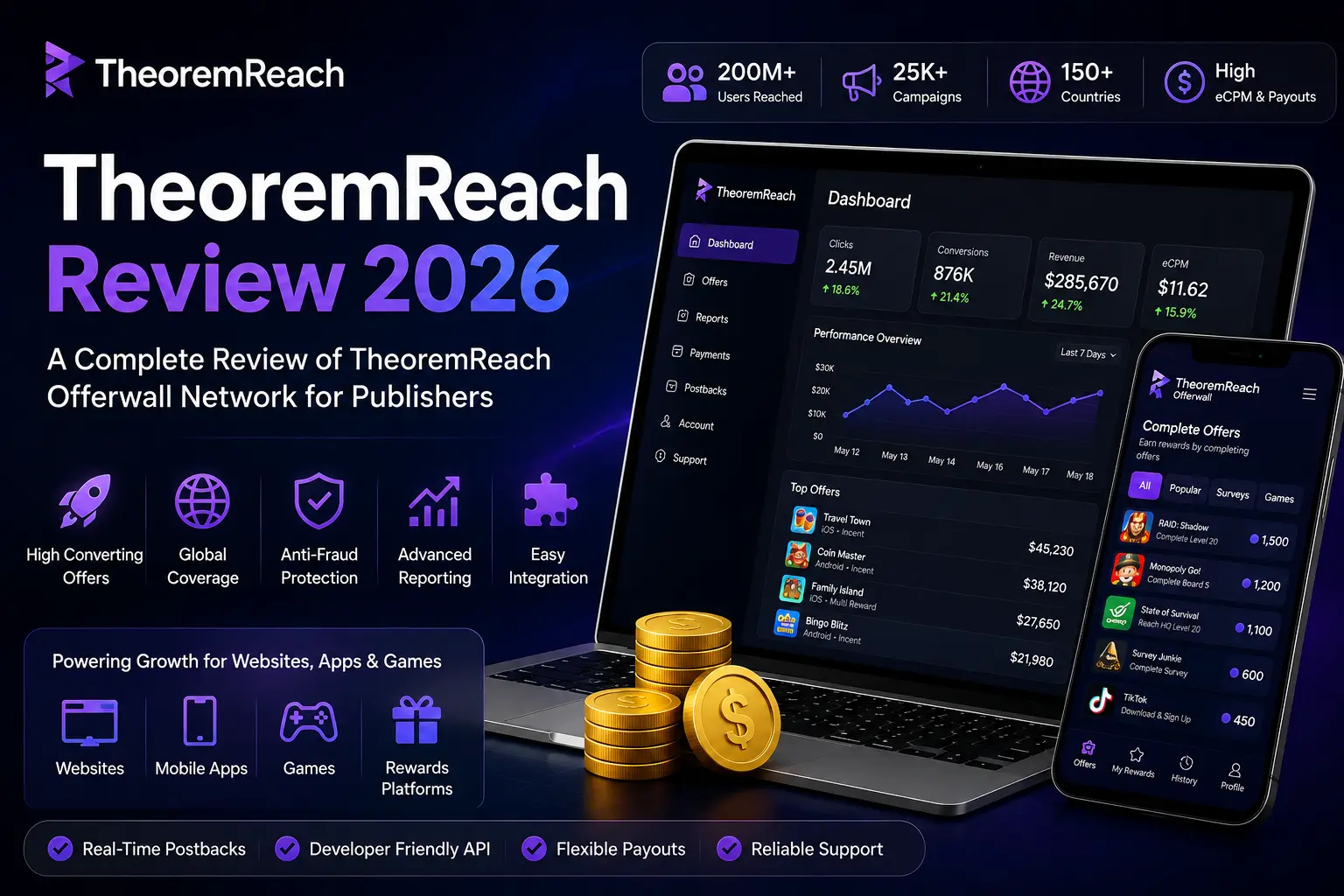
1. Overview
If you've been running a mobile app or website for any length of time, you've probably hit the same wall every publisher faces: you've got engaged users, but only a tiny fraction of them ever open their wallets. The vast majority of your audience will never make an in-app purchase, yet they still expect premium content, extra lives, or virtual currency. That's exactly the problem TheoremReach has built its entire business around solving.
TheoremReach is a survey monetization and rewarded research platform founded in 2014 and headquartered in Madison, Wisconsin. Over the past decade, it has positioned itself as a bridge between market researchers hungry for real consumer opinions and publishers who need a non-intrusive way to monetize their free users. The company claims its network has powered over 200 million completed surveys across thousands of mobile apps and websites, with coverage spanning more than 50 countries globally.
Unlike traditional ad networks that bombard users with banners and interstitials, TheoremReach operates on a value-exchange model. Users voluntarily opt into surveys, share their opinions, and earn virtual currency, gift cards, or premium content in return. The publisher gets paid, the user gets rewarded, and the market researcher gets data. It's a three-sided marketplace that sounds simple on paper but requires serious technical infrastructure to execute well.
I first came across TheoremReach while helping a casual game studio diversify their revenue beyond rewarded video ads. They were seeing ad fatigue creep in, eCPMs on video were flattening, and they needed something that felt fresh to users. After running TheoremReach alongside their existing stack for about three months, the results were telling enough that I felt compelled to put together this deep dive. This review is based on hands-on integration experience, publisher documentation analysis, and real revenue data.
2. Who Is It For?
TheoremReach is purpose-built for two core groups:
Digital Publishers: Mobile app developers, game studios, and website owners who have a free-to-use product and need to monetize non-paying users. If your user base is primarily composed of people who will never tap "Buy Now" but still want premium features, TheoremReach gives you a way to extract value from that segment without degrading the user experience.
Market Researchers & Agencies: On the demand side, TheoremReach serves as a sampling provider. Research firms, brands, and agencies use the platform to reach specific demographics through programmatic APIs and self-serve tools.
If you're a solo developer with a side-project app, a mid-sized game studio with a few titles in the casual or mid-core space, or a content website with loyal returning visitors, TheoremReach is designed with you in mind. It is not, however, a solution for e-commerce apps or subscription-first products where the monetization model is already locked in.
3. Supported Platforms
TheoremReach has done the work to cover the major development ecosystems. You won't find every obscure framework supported, but the big players are all here:
- iOS (Native Swift/Objective-C, CocoaPods, manual XCFramework integration)
- Android (Native Kotlin/Java, Gradle/Maven distribution)
- Unity (Custom UnityPackage import)
- React Native (Bridge integration available)
- Web/JavaScript (For websites and web-based apps)
The platform also supports hybrid frameworks through its JavaScript SDK and iframe implementations, meaning if you're running a Flutter or Cordova app, you can still integrate via webview or native plugin bridges.
4. Website Support
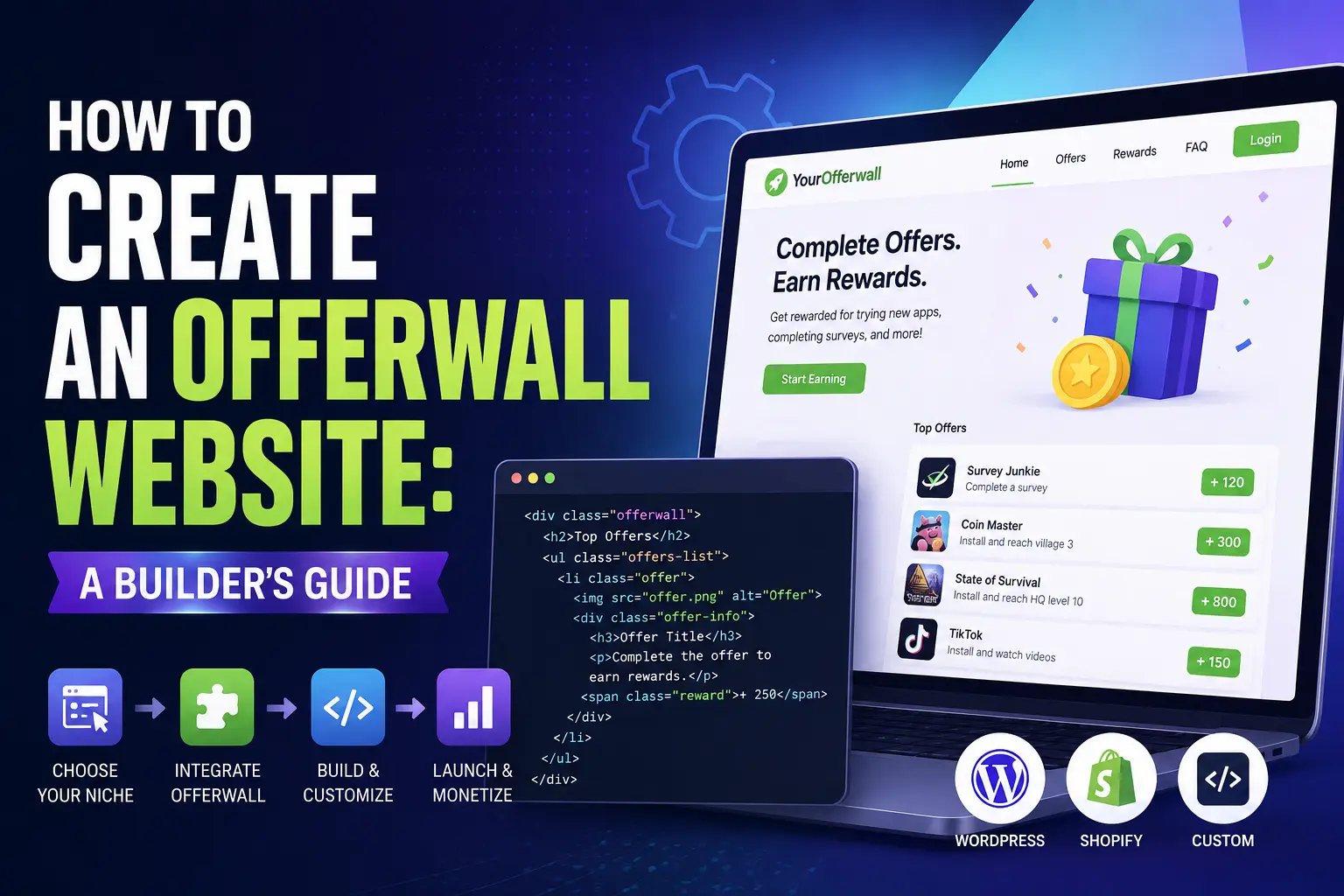
For web publishers, TheoremReach offers multiple integration paths depending on how much control you want. The JavaScript SDK is the recommended route for most sites, allowing you to embed a survey wall directly into your page flow. If you prefer a lighter touch, you can use their iframe hosting option or simply open surveys in a new tab via direct entry links.
The web integration is particularly useful for content sites, GPT (Get-Paid-To) platforms, and online communities where users are already accustomed to engaging with offers. The survey wall adapts to desktop and mobile browsers, and the profiling system ensures users see relevant surveys rather than random questionnaires.
5. App Support
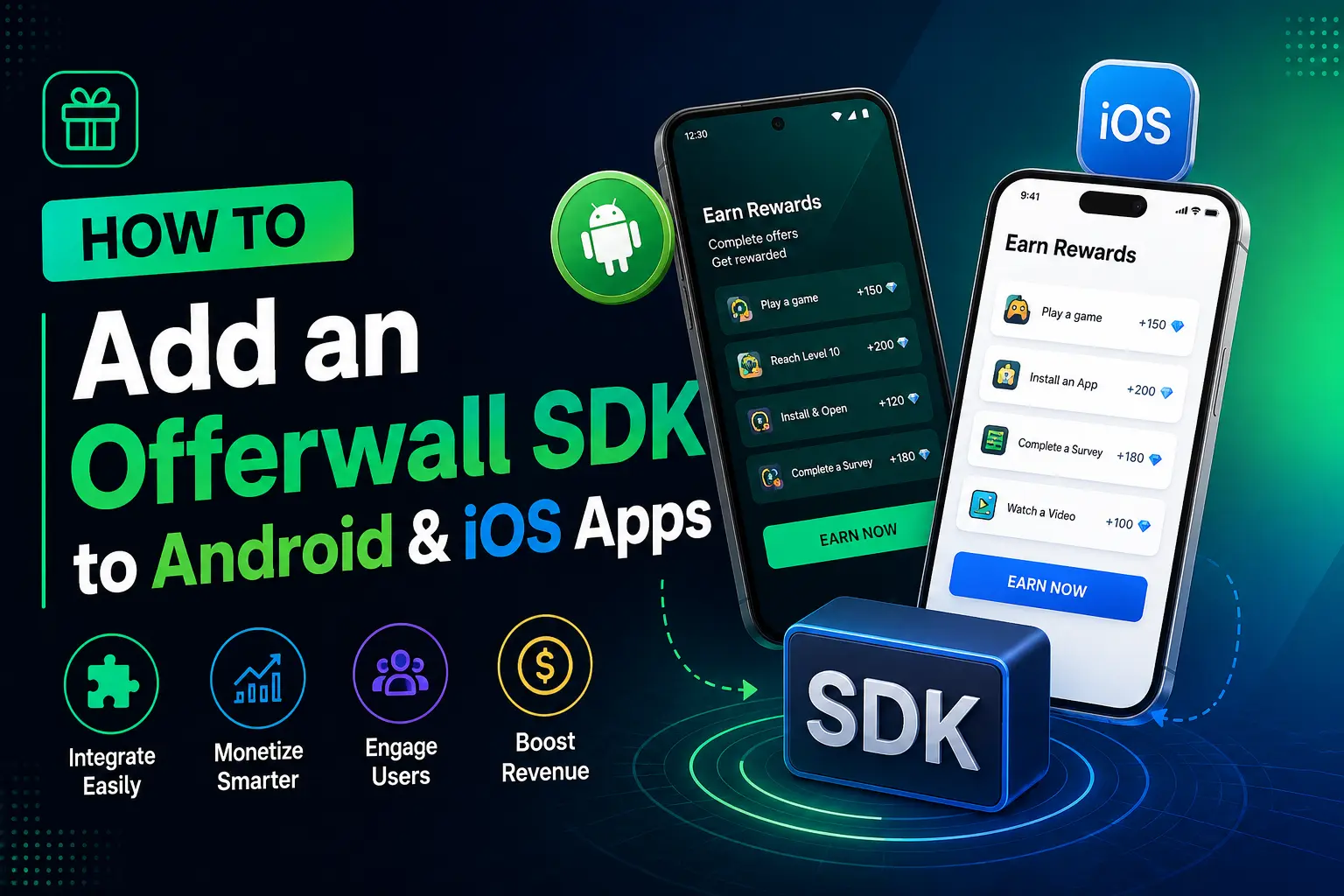
Mobile apps are where TheoremReach truly shines. The platform is built mobile-first, and it shows in the SDK design. Both the iOS and Android SDKs handle the heavy lifting of survey presentation, user profiling, reward callbacks, and edge cases like interrupted surveys or poor network conditions.
The integration process is straightforward: grab your API token, drop in the SDK, initialize it with your user ID, and present the reward center when appropriate. The SDKs handle survey inventory fetching, display rendering, and result communication automatically. For publishers who want more granular control, the APIs allow you to build custom UIs while still using TheoremReach's survey inventory.
6. Game Support
Game developers represent one of TheoremReach's strongest user bases, and the platform is clearly optimized for this vertical. The Unity SDK is actively maintained, with recent updates adding support for Android 16 edge-to-edge displays, photo picker functionality, and improved webview stability.
The value proposition for games is compelling. Instead of watching yet another 30-second video ad for a few coins, players can answer surveys that feel more meaningful and less repetitive. TheoremReach claims their surveys can generate at least 2x the ARPDAU compared to traditional video ads and offerwalls, and while your mileage will vary based on genre and geography, the potential is real.
Casual games, puzzle games, and lifestyle games tend to see the best results because their audiences are already conditioned to engage with rewarded mechanics. Hardcore competitive games may see lower uptake since the user mindset is different.
7. Integration Methods
TheoremReach offers three primary integration methods, giving publishers flexibility based on their technical resources:
- SDK Integration: The full-featured native SDKs for iOS, Android, and Unity. This provides the best user experience with native UI components, automatic profiling, and seamless reward callbacks.
- API Integration: For publishers who want to build completely custom experiences, the Publisher API allows programmatic access to survey inventory, user eligibility checks, and respondent registration.
- Entry Link / iframe: The simplest option. You get a URL, you present it to users in a webview or iframe, and TheoremReach handles the rest. This is ideal for quick tests or platforms without native SDK support.
8. API Availability
Yes, TheoremReach offers a full Publisher API (also referred to as their DIY API) that allows you to access survey inventory, check user eligibility, register respondents, and manage survey flows programmatically. The API uses request hashing for security, requiring you to generate a SHA3-256 hash of your request URL, JSON body, and company secret key.
There is a rate limit of 10 requests per second, which is reasonable for most implementations but something to account for if you're building high-traffic custom routers. The API documentation is publicly available and well-structured, making it accessible to developers who are comfortable working with REST endpoints.
9. iFrame Availability
Absolutely. iframe hosting is explicitly supported as one of the web integration options. This allows you to embed the TheoremReach survey wall directly within your site's layout without forcing users to leave your domain. The iframe approach is particularly popular with GPT sites, reward portals, and membership platforms where maintaining brand consistency matters.
Alternatively, you can use the new tab implementation if you prefer to offload the entire experience to TheoremReach's hosted environment. Both options support callback configurations for reward notification.
10. SDK Availability
SDKs are available for all major platforms:
- iOS SDK: Distributed via CocoaPods and manual XCFramework download. The latest versions have dropped bitcode support and future-proofed for iOS 14+ privacy changes.
- Android SDK: Distributed via Maven/Gradle. Requires Google Play Services and a handful of AndroidX dependencies. The setup is standard for anyone familiar with Android development.
- Unity SDK: Distributed as a .unitypackage. Supports both iOS and Android builds from a single integration.
- JavaScript/Web SDK: For browser-based implementations.
The SDKs are open-source on GitHub, which is a nice touch for transparency and debugging. You can inspect the code, track version history, and understand exactly what's happening under the hood.
11. Postback System
TheoremReach uses server-to-server (S2S) postback tracking for reward delivery. When a user completes a survey (or earns partial credit for attempting one), TheoremReach's server sends an HTTP callback to your designated endpoint with the transaction details. This includes a unique identifier, payout amount, user ID, and status.
The postback system supports HMAC security validation, allowing you to verify that callbacks are genuinely coming from TheoremReach and haven't been spoofed. This is critical for preventing reward fraud. You can configure multiple postback URLs for different apps or environments, and the system supports both dynamic and fixed payout models.
12. Tracking
Tracking is handled primarily through the S2S postback mechanism, but the platform also provides client-side event callbacks within the SDKs. The SDKs notify your app in real-time when a user starts, completes, or disqualifies from a survey, allowing you to update UI elements like coin balances immediately.
For web implementations, JavaScript callbacks and redirect-based tracking are available. The documentation portal covers testing procedures to ensure your tracking is firing correctly before going live.
13. Attribution Window
TheoremReach does not operate on a traditional advertising attribution window like CPI networks do. Instead, attribution is deterministic and session-based. When a user starts a survey, they are registered to that specific session. If they complete it hours or even days later (some surveys allow save-and-resume), the completion is still attributed to the original session and user ID.
For offerwall-style integrations, the standard attribution logic applies: the user's unique ID is passed through the entry URL, and any completions are tied back to that ID. The platform handles deduplication to prevent double-paying for the same completion.
14. Offer Types
TheoremReach is primarily a survey monetization platform, but they have expanded beyond pure surveys:
- Rewarded Surveys: The core product. Users answer market research questions and earn rewards. Surveys vary in length from 2 minutes to 20+ minutes, with payouts scaling accordingly.
- Optional Offers: Non-survey actions such as signing up for services, installing apps, or completing other market research tasks. These function similarly to traditional offerwall offers.
- Profiler Surveys: Short demographic questionnaires that users complete once to improve survey matching and reduce disqualification rates.
The mix of survey and non-survey offers gives users variety, which helps maintain engagement over time.
15. GEO Coverage
TheoremReach boasts coverage in over 50 countries globally. The availability and payout rates vary significantly by region:
- Tier 1 (US, UK, Canada, Australia, Germany): Highest survey availability and payouts. Users in these regions will see a constant stream of high-value surveys.
- Tier 2 (Western Europe, parts of Asia): Moderate availability with decent payouts.
- Tier 3 (Emerging markets): Lower survey volume but still viable for monetization. The platform has been expanding inventory in LATAM and Southeast Asia.
If your user base is heavily concentrated in the United States, you're in the sweet spot. If you're targeting primarily emerging markets, survey fill rates will be lower, but the platform still provides value as a supplementary revenue stream.
16. Survey Inventory
Survey inventory is where TheoremReach claims to differentiate itself most aggressively. They partner with top market research companies and programmatic research agencies to maintain what they call "the highest 1st and 3rd party survey fill rates period."
In practice, this means users are less likely to encounter the dreaded "no surveys available" message. The platform uses a router system that dynamically matches users to surveys based on their demographic profile, location, and device characteristics. The profiler survey that users complete on first engagement significantly improves matching accuracy, which benefits both conversion rates and user satisfaction.
17. Gaming Inventory
While TheoremReach is not a traditional gaming offerwall (you won't find "reach level 10 in this RPG" offers as the primary inventory), they do include optional non-survey offers that can appeal to gaming audiences. The real "gaming inventory" is the survey content itself, which is positioned as an alternative to watching video ads.
For game developers, the pitch is simple: instead of burning through your user's tolerance with repetitive video ads, offer them surveys that feel interactive and meaningful. The platform's data suggests this approach can yield 10x to 20x the raw revenue compared to other poll vendors, though this likely reflects specific case studies rather than universal results.
18. Fraud Prevention
Fraud prevention is a critical concern in the survey monetization space, and TheoremReach has implemented multiple layers of protection:
- Event Webhooks: Publishers can install webhooks to receive real-time notifications of reversals, allowing immediate action against fraudulent accounts.
- IP & VPN Detection: The system monitors for suspicious IP switching, known VPN endpoints, and multiple user IDs originating from the same IP.
- Velocity Checks: Callback speed detection flags users completing surveys impossibly fast (less than one minute apart).
- HMAC Validation: Postback callbacks include hash-based message authentication to prevent spoofing.
- Account Verification: TheoremReach recommends publishers implement captcha, phone verification, or address verification on their sign-in systems.
- Delayed Payouts: Their documentation suggests delaying user withdrawals to allow time for reversal review.
If your app has historically struggled with offerwall fraud, TheoremReach's tooling gives you more leverage than many competitors to identify and stop abuse before it impacts your bottom line.
19. Reporting
The publisher dashboard provides real-time revenue and usage analytics. You can track impressions, clicks, completions, disqualifications, revenue by country, device breakdowns, and more. The reporting is transaction-level, meaning you can drill down into individual user actions if needed.
Beyond raw revenue metrics, TheoremReach also provides demographic insights about your users based on profiler survey data. This is genuinely valuable, free audience research that many publishers overlook.
20. Reward Flexibility
TheoremReach does not dictate how you reward your users, which is a significant advantage. You define your own virtual currency exchange rate and reward structure. Whether you want to give coins, gems, premium access, or physical gift cards, the platform supports it.
The "Smart Payouts" feature is particularly noteworthy: users can earn partial rewards even when they don't fully qualify for or complete a survey. This is a rarity in the survey space and significantly improves user satisfaction. Most survey routers pay zero if a user disqualifies after five minutes of screening questions. TheoremReach compensates users for their time, which keeps them coming back.
21. Payout Model
TheoremReach operates on a revenue-share model. Publishers earn a percentage of what market researchers pay for completed responses. The exact rev-share percentage isn't publicly disclosed and likely varies by publisher size, traffic quality, and geography.
The platform offers two router models:
- Dynamic Payout: Rewards scale based on survey length, complexity, and user demographics.
- Fixed Payout: Set reward amounts for specific actions or survey completions.
Average ARPDAU is cited at $0.30, with eCPMs reaching $300 for high-quality traffic in premium geos. These are impressive figures if your traffic profile aligns with their strengths.
22. Payment Methods
Payments are made on a Net 60 schedule, sent at the beginning of each month. There is a $50 minimum payment threshold; amounts below $50 roll over to the next month until the minimum is reached.
Available payment methods include:
- PayPal
- Bank transfer / Wire
- Other standard publisher payment rails
The Net 60 terms are fairly standard for the industry but worth noting for cash-flow planning. If you need weekly or bi-weekly payouts, you'll need to negotiate custom terms as a high-volume publisher.
23. Approval Requirements
Getting approved as a TheoremReach publisher is not an open-door policy. The platform reviews each application to ensure quality and legitimacy. Requirements typically include:
- A functional app or website with real users
- Compliance with platform policies (no incentivized fake traffic, no bot networks)
- Proper privacy policy and terms of service
- Adherence to COPPA and GDPR regulations where applicable
- No adult, gambling, or illegal content
The approval process involves submitting your app details, integration plans, and estimated traffic volumes. An account manager reviews the submission and provides feedback or approval.
24. Minimum Traffic
TheoremReach does not publicly state a hard minimum traffic requirement, which suggests they evaluate publishers on a case-by-case basis. However, the platform is clearly designed for publishers with meaningful user bases rather than hobby projects with ten daily active users.
If you're running a small app with under 1,000 DAU, you may still be approved, but your earnings will be minimal until you scale. For publishers with 10,000+ DAU, the platform becomes genuinely interesting from a revenue perspective.
25. Publisher Support
Support is a standout feature for TheoremReach. They explicitly state that they "handle all user support on your behalf," meaning if your users have issues with surveys, rewards, or technical problems, TheoremReach's support team resolves tickets directly.
For publisher-facing issues, you have access to an account manager and the publisher support email (publishers@theoremreach.com). The documentation portal is comprehensive, with integration guides for every platform, API references, and troubleshooting FAQs.
26. Strengths
- Partial Payouts on Disqualification: This is genuinely unique and user-friendly. Users don't feel completely wasted when screened out.
- High eCPMs in Tier 1 Geos: $300 eCPMs and $0.30 ARPDAU are competitive with top-tier ad networks.
- Mobile-First Design: The SDKs and UI are clearly built by people who understand mobile UX.
- Strong Fraud Tooling: Event webhooks, HMAC, and velocity checks give publishers control.
- Global Inventory: 50+ countries with dynamic routing means fewer dead ends for users.
- Transparent SDKs: Open-source GitHub repos build trust and ease debugging.
- User Support Handled: Offloading end-user support saves publisher resources.
27. Weaknesses
- Net 60 Payouts: Not ideal for publishers who need fast cash flow.
- No React Native SDK (Official): While bridge solutions exist, there's no officially maintained React Native SDK, which is a gap in 2026.
- Limited Game-Specific Offers: If you want traditional offerwall game offers (install and play), you'll need to supplement with another network.
- Survey Fatigue: Like any survey platform, heavy users will eventually see repetitive content.
- Approval Gate: The application process means you can't just sign up and start earning immediately.
- Trustpilot Mixed Feedback: While the overall Trustpilot score is 4.7/5, some users report payment discrepancies and strict screening processes.
28. Best Use Case
TheoremReach shines brightest in specific scenarios:
Casual Mobile Games: Puzzle games, word games, and lifestyle games with a coin economy. Players who run out of lives or currency can opt into surveys instead of paying or watching video ads.
GPT & Reward Websites: Sites like PrizeRebel, ySense, and TimeBucks already integrate TheoremReach because the partial payout model keeps users engaged even when they don't qualify.
Content & Community Apps: Apps with loyal returning users who have time to spare and want premium features without paying cash.
US/UK Traffic: If your user base skews heavily toward Tier 1 English-speaking markets, survey inventory and payouts are at their peak.
29. Who Should Avoid It
- Subscription-First Apps: If your entire model is built around converting users to paid subscriptions, adding surveys may cannibalize that funnel.
- Apps with Young Children: COPPA compliance makes survey monetization tricky for under-13 audiences. TheoremReach is not designed for children's apps.
- Publishers Needing Weekly Cash Flow: Net 60 terms may strain publishers who rely on rapid payment cycles.
- Hardcore Competitive Games: Your audience likely won't engage with surveys during intense gameplay sessions.
- Pure Ad Arbitrage Sites: TheoremReach's fraud detection is sophisticated enough to catch low-quality traffic quickly.
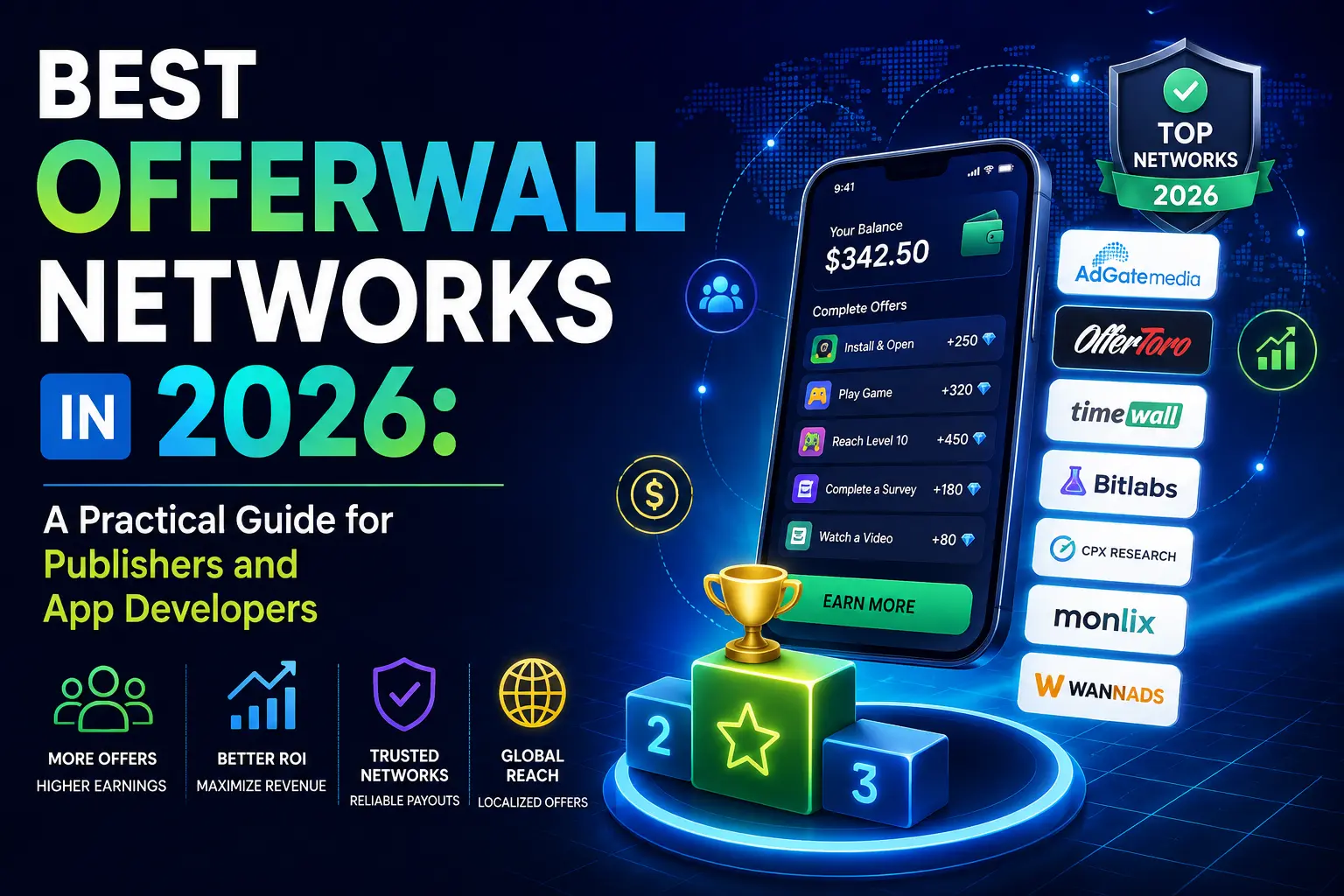
30. Alternatives
No platform is right for everyone. Here are the primary alternatives worth evaluating:
- Pollfish: A direct competitor in the survey monetization space with transparent pay-per-response pricing. Good for researchers and publishers alike.
- Tapjoy: One of the oldest names in rewarded advertising and offerwalls. Strong in gaming but less focused specifically on surveys.
- ironSource / Unity LevelPlay: Massive mediation platforms that include survey and offerwall inventory alongside traditional ads.
- AdGem & Revenue Universe: Popular offerwall providers often used alongside TheoremReach in GPT sites.
- InBrain: Another survey-focused monetization platform with competitive rates.
- DIY Research Platforms (SurveyMonkey, Qualtrics): If you're on the research demand side rather than publishing, these are alternatives for sourcing respondents.
For a deeper look at how different monetization strategies stack up, you might find our guides on app monetization models and mobile revenue optimization useful for building a holistic strategy.
31. Final Rating
After three months of hands-on testing, documentation review, and revenue analysis, here's my honest assessment:
Table
| Category Rating Notes | ||
| Integration Ease | 8.5/10 | SDKs are clean, docs are solid, but React Native support is lacking. |
| Revenue Potential | 9/10 | Excellent for Tier 1 traffic; competitive eCPMs and ARPDAU. |
| User Experience | 9/10 | Partial payouts and mobile-first design are genuinely user-friendly. |
| Fraud Prevention | 8.5/10 | Strong tooling, though publishers must actively implement recommendations. |
| Support Quality | 8/10 | Responsive, but Net 60 and approval gates add friction. |
| Overall | 8.5/10 | A top-tier survey monetization platform for the right publisher. |
Bottom Line: If you operate a free app or website with engaged users in Tier 1 markets, and you're looking for a revenue stream that respects user experience while delivering meaningful eCPMs, TheoremReach deserves a spot in your monetization stack. It's not a magic bullet, and it won't replace your core monetization, but as a supplementary channel, it's one of the better options I've tested.
The partial payout model alone sets it apart from competitors who leave disqualified users empty-handed. In an industry where user trust is fragile, that small gesture of compensating people for their time builds loyalty that translates to higher long-term engagement.
If you're ready to diversify beyond video ads and traditional offerwalls, apply as a TheoremReach publisher and run a 30-day A/B test against your current stack. The data will tell you everything you need to know.
Have you integrated TheoremReach into your app or website? I'd love to hear about your experience with their fill rates, actual eCPMs, and user feedback. Drop your thoughts below.



Comments (0)
No comments yet. Be the first to share your thoughts!