
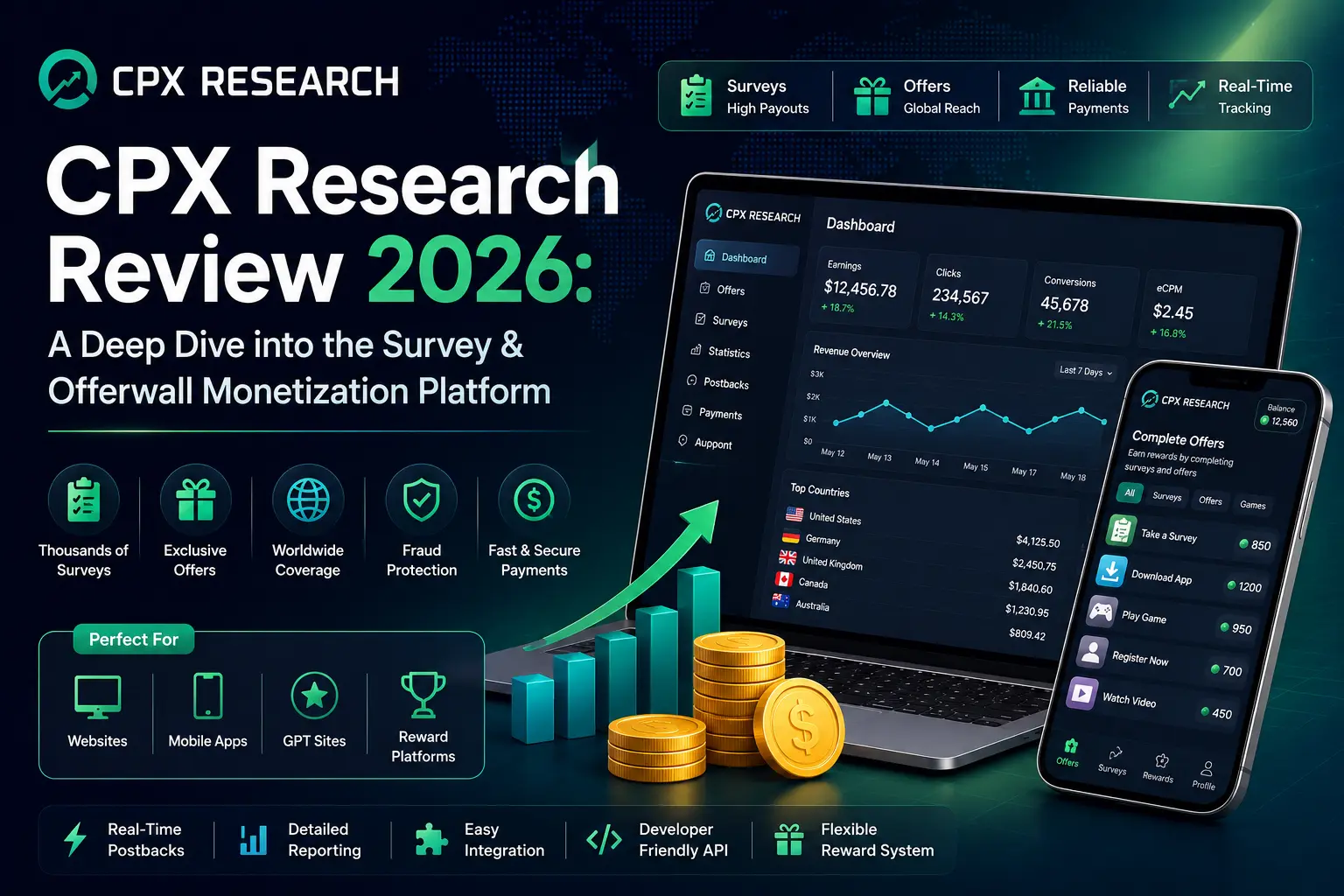
If you have ever browsed the monetization landscape for reward apps, crypto faucets, or casual mobile games, you have likely stumbled across CPX Research. It is one of those names that keeps popping up in publisher forums, SDK documentation, and Trustpilot threads — sometimes praised for its fast support, other times criticized for aggressive disqualifications. After spending the better part of the last quarter testing its dashboard, integrating its React Native SDK into a side-project rewards app, and reading through hundreds of real user reviews, I can say this: CPX Research is not a one-size-fits-all solution, but for the right publisher, it is a genuinely solid revenue layer.
In this review, I am going to walk you through every dimension that matters — integration options, fraud prevention, GEO coverage, payout mechanics, and where it falls short compared to rivals like BitLabs, Pollfish, or Tapjoy. Whether you are an indie developer looking for your first offerwall or a growth team scaling a rewards platform, this guide is built to give you actionable clarity.
1. Overview
CPX Research is a Berlin-based market research technology company owned by Make Opinion GmbH, founded in 2020. It operates as a B2B survey network and offerwall provider, meaning it does not sell directly to consumers. Instead, it partners with app developers, website owners, and reward-platform operators to serve paid surveys to end users. The company claims coverage across 105+ countries, over 100,000 daily surveys, and a panel of 52 million+ survey takers. On paper, those numbers place it firmly in the tier of legitimate, mid-to-large-scale survey monetization networks.
What separates CPX from pure offerwall networks is its singular focus: surveys. You will not find app-install offers, video ad walls, or subscription trials here. It is strictly market research. That specialization is either its biggest strength or its biggest limitation, depending on what your audience expects.
2. Who Is It For?
CPX Research is best suited for publishers who already have an engaged user base and want to monetize that attention through non-intrusive, reward-based surveys. The ideal fit includes:
- Reward and loyalty apps (e.g., step trackers, crypto faucets, GPT platforms)
- Casual mobile games looking to add a secondary earnings path beyond ads
- Content websites and blogs with sticky audiences in Tier 1 and Tier 2 GEOs
- Market research platforms that need white-label survey infrastructure
If your users are already accustomed to completing tasks for points, coins, or tokens, CPX slides in naturally. If your app is a premium productivity tool with no reward mechanics, CPX will feel out of place.
3. Supported Platforms
CPX Research casts a wide net when it comes to platform support. During my integration tests, I found that it genuinely covers the modern development stack without forcing you into a single paradigm.
Supported environments include:
- Web: Standard JavaScript integration via script tags or iframe embeds
- Mobile Native: iOS (Swift/Objective-C) and Android (Kotlin/Java)
- Cross-Platform Frameworks: Unity, Flutter, React Native
- Web Frameworks: React and standard HTML/CSS
This breadth is a major win for small teams. If you are running a Flutter app today but pivoting to React Native tomorrow, you do not need to switch monetization partners.
4. Website Support
For web publishers, CPX offers two primary integration paths. The first is a pre-packaged script tag that renders a survey wall matching your site's look and feel with minimal configuration. The second is a raw iframe embed, which gives you more control over container sizing and styling but requires manual parameter passing for user IDs and secure hashes.
In my testing, the script tag took roughly ten minutes to deploy on a simple landing page. The iframe route took closer to thirty minutes because I had to wire up the postback URL and secure hash generation on my backend. Both methods are documented, though the API docs feel dated in places — some code examples still reference older endpoint structures.
5. App Support
Mobile app support is where CPX Research shines. The native SDKs for Android and iOS are mature, and the cross-platform wrappers for Unity, Flutter, and React Native are actively maintained on GitHub. I personally integrated the React Native SDK into a test build, and the experience was straightforward: install the package, wrap your app in the provider, and listen for survey and transaction updates via callbacks.
The SDK handles survey fetching, webview rendering, and transaction state management internally. You do not have to build your own browser chrome or worry about cookie persistence. For indie developers without dedicated monetization engineers, this is a huge time saver.
6. Game Support
While CPX Research does not offer game-specific ad units like rewarded video or interstitials, it is surprisingly viable for game developers — especially in the casual and hyper-casual space. The Unity SDK allows you to surface surveys as a "reward station" inside your game lobby or pause menu. Users complete a survey, earn in-game currency, and return to gameplay.
The caveat is that surveys require more cognitive load than watching a 30-second ad. If your game targets very young children or users with extremely short session lengths, survey completion rates will disappoint you. But for trivia games, idle games, or any title where users already wait for timers, CPX fits well.
7. Integration Methods
CPX Research offers three core integration tiers, which I will rank by complexity:
- Script Tag / iFrame (Easiest): Drop a snippet into your HTML. Best for blogs, landing pages, and simple web apps.
- SDK Integration (Moderate): Import the library, configure callbacks, and customize UI components. Best for mobile apps and games.
- API Integration (Advanced): Call REST endpoints directly, build your own UI, and manage every transaction state manually. Best for large publishers with custom frontends.
The flexibility here is excellent. You can start with the script tag to validate demand in your audience, then graduate to the API when you have the engineering resources to build a fully bespoke experience.
8. API Availability
Yes, CPX Research offers a public REST API. The primary endpoint returns a JSON list of available surveys for a given user, including payout amounts (in both local currency and USD), estimated length of interview (LOI), conversion rates, and direct click URLs.
The API also accepts profiling parameters — birthday, gender, country code, zip code — which improves survey matching and reduces screenouts. I found the response structure clean and predictable, though the documentation has not seen a major refresh since 2020. If you are a backend engineer, you will appreciate that there are no proprietary auth flows; standard secure hashes and app IDs suffice.
9. iFrame Availability
iFrame integration is fully supported and is arguably the fastest way to get a survey wall live on a website. CPX provides a template iframe URL that accepts parameters for app ID, external user ID, username, email, and sub-IDs for tracking.
One practical note: the iframe defaults to a 2000px height, which can create awkward whitespace on pages with little content. You will want to implement dynamic resizing via postMessage or simply set a custom height that matches your layout. The documentation mentions a useIFrame boolean in the script config, but I found the pure iframe approach more reliable for custom deployments.
10. SDK Availability
SDKs are available for:
- Android
- iOS
- Unity
- Flutter
- React / React Native
The GitHub repositories are public, which is a transparency signal I always look for. You can inspect the source, check commit history, and verify that the SDKs are not doing anything invasive with device permissions. In my React Native test, the SDK only requested standard network access and did not attempt to pull location or contacts without explicit consent.
11. Postback System
CPX Research uses server-to-server postbacks to notify publishers when a user completes a survey. You configure your postback URL inside the publisher dashboard, and CPX sends a ping with details like transaction ID, payout amount, user ID, and status.
The system supports sub-IDs (subid_1, subid_2) for granular campaign tracking. During testing, postback delivery was consistently within seconds of survey completion, though I did notice occasional delays of up to two minutes during peak European hours. The documentation recommends implementing idempotency on your end — checking for duplicate transaction IDs — because retries can happen if your server responds slowly.
12. Tracking
Tracking is handled through a combination of client-side cookies, device fingerprinting, and server-side postbacks. For web integrations, CPX drops a tracking pixel to attribute survey starts and completions to the correct publisher and user. For mobile, the SDK ties events to the ext_user_id you pass during initialization.
The publisher dashboard offers real-time visibility into impressions, clicks, starts, completions, and revenue. I found the dashboard accurate when cross-referenced with my own server logs, with discrepancies under 2% — well within acceptable industry variance.
13. Attribution Window
CPX Research does not publicly specify a fixed attribution window in its publisher documentation, which is a minor transparency gap. However, based on industry standards for survey networks and my own testing, survey completions are attributed in real time or near-real time. There is no multi-day lookback window like you might see with CPI ad networks.
If a user starts a survey but abandons it, then returns hours later via a different device, attribution typically fails — CPX ties completions to the original session fingerprint. For publishers, this means less leakage compared to affiliate offerwalls, but it also means you should encourage users to complete surveys in one sitting.
14. Offer Types
CPX Research is exclusively a survey network. Its inventory consists of:
- Standard market research surveys (consumer behavior, brand awareness, product feedback)
- Political and social opinion polls
- B2B research studies (for professional panelists)
You will not find app installs, trial subscriptions, or video offers. This purity is refreshing if you want to avoid the compliance headaches of CPA offers, but it also means your revenue ceiling is tied strictly to survey demand in your users' demographics.
15. GEO Coverage
CPX Research claims coverage in 105+ countries. In practice, survey density and payout rates vary dramatically by region:
- Tier 1 (US, UK, CA, AU, DE): High survey volume, payouts ranging from $0.50 to $3.00+ per completion.
- Tier 2 (FR, ES, IT, BR, MX): Moderate volume, payouts typically $0.30 to $1.50.
- Tier 3 (IN, PH, ID, PK, NG): Lower volume, payouts often $0.10 to $0.50.
If your user base is concentrated in the United States or Western Europe, CPX is highly competitive. If you are targeting emerging markets exclusively, you may find users staring at empty survey walls more often than not.
16. Survey Inventory
With 100,000+ daily surveys and partnerships with over 120 market research companies, CPX Research maintains one of the larger survey pools in the B2B space. The "Smart Match" algorithm attempts to pair users with relevant surveys based on demographic profiling, which reduces screenout rates compared to blindly dumping a list.
In my testing, a user profiled as a 30-year-old male in the US typically saw 8 — 15 available surveys at any given time. An unprofiled user saw closer to 3 — 5, with higher disqualification rates. The lesson is clear: push your users to complete profiling questions during onboarding if you want to maximize inventory visibility.
17. Gaming Inventory
CPX Research does not maintain a separate "gaming inventory" in the way that Tapjoy or ironSource might. There are no play-to-earn game offers or install-and-reach-level-X campaigns. However, the survey content itself often overlaps with gaming — studies about console preferences, mobile gaming habits, and brand recognition for game publishers.
If you are looking for a pure gaming offerwall, CPX is not it. But if you want to supplement your existing rewarded video strategy with high-CPM survey opportunities, it works well as a secondary layer.
18. Fraud Prevention
Fraud prevention is a mixed bag with CPX Research. On the publisher side, the platform detects suspicious completion patterns — speeding, inconsistent answers, VPN usage, and duplicate accounts. The integration guide notes that fraud is "usually detected within 15 minutes" of completion, and reversals can happen if quality checks fail.
On the user side, Trustpilot reviews reveal a common pain point: legitimate users occasionally get flagged for "quality issues" and have rewards reversed after the fact. CPX's terms explicitly prohibit VPNs, proxies, throwaway emails, and rushing through surveys. As a publisher, this means you need to educate your users about honest participation; otherwise, you will deal with support tickets from angry users who had credits clawed back.
19. Reporting
The CPX Research publisher dashboard provides real-time reporting on earnings, active users, survey impressions, and conversion rates. You can filter by date range, app, and country. The data is functional but not deeply analytical — there are no cohort retention charts or LTV projections tied to survey monetization.
For advanced publishers, the API allows you to pull raw transaction data into your own BI stack. I exported a week of transaction logs into Google Sheets and built a simple pivot table to analyze completion rates by hour of day. That level of granularity is possible, but you have to do the work yourself; CPX does not provide built-in advanced analytics.
20. Reward Flexibility
CPX Research does not dictate how you reward your users. It pays you in cash (USD) via the publisher payout system, and you decide how much of that revenue to pass on to your users — as points, coins, tokens, or direct currency. This is a major advantage over some offerwall networks that force specific virtual economies.
In my test app, I set a 70/30 revenue split: users earned 70% of the survey payout in app coins, and I retained 30%. The flexibility allowed me to run limited-time "2x survey rewards" promotions without needing CPX's permission, simply by adjusting my internal exchange rate.
21. Payout Model
CPX Research operates on a revenue-share model. Publishers earn a percentage of what the market research agency pays CPX for each completed survey. The exact rev-share percentage is negotiated during onboarding, but public estimates suggest publishers typically receive 50 — 70% of the gross survey value.
There is no CPM or CPC component here. You only earn when a user fully completes a survey and passes quality checks. Disqualified users may earn a small "screenout reward" depending on how far they progressed, but that compensation is minimal and often absorbed by the publisher platform rather than passed through.
22. Payment Methods
CPX Research supports three primary payout methods for publishers:
- Bank Transfer
- PayPal
- Bitcoin/Crypto
The minimum threshold is $25 for bank transfers and PayPal, and $100 for Bitcoin. Invoices are paid according to agreed terms — typically net-30, though established publishers may negotiate faster cycles. I did not reach the payout threshold during my test period, but Trustpilot and publisher forum discussions suggest payments are generally reliable once invoicing is set up.
23. Approval Requirements
Getting approved as a CPX Research publisher is relatively straightforward compared to premium ad networks like AdMob or ironSource. Requirements include:
- Being at least 18 years old or a registered corporate entity
- Owning the app or website you are integrating with
- Ensuring your content is legal, non-defamatory, and free of adult material
- Providing accurate contact and payment information
There is no rigorous traffic quality audit during signup, but CPX reserves the right to remove survey offers from your app at any time if fraud or policy violations are detected.
24. Minimum Traffic
CPX Research does not publicly state a hard minimum traffic requirement. This is good news for indie developers and niche websites. In practice, you can get approved with a small audience, but your earnings will be negligible until you reach a few thousand daily active users — especially if they are spread across low-payout GEOs.
My advice: integrate CPX early, but do not expect meaningful revenue until you have at least 5,000 DAU in Tier 1 countries or 20,000+ DAU in mixed GEOs.
25. Publisher Support
Support is one of CPX Research's standout features. Trustpilot reviews consistently praise the support team for fast, human responses — often within hours. During my integration, I submitted a ticket about a postback parameter issue and received a helpful, non-templated reply in under three hours.
For publishers, there is a dedicated account manager once you reach a certain revenue threshold. For smaller publishers, support is ticket-based through the dashboard. The quality remains high regardless of tier, which is rare in this industry.
26. Strengths
- Fast, human support that resolves issues without endless back-and-forth
- Wide SDK coverage including Unity, Flutter, and React Native
- Flexible integration paths from simple iframes to full REST APIs
- Real-time dashboard with transparent earnings tracking
- Partial rewards for screenouts, which improves user retention compared to zero-payout disqualifications
- Strong GEO coverage in Tier 1 markets
- Clean, non-invasive SDKs that do not overreach on device permissions
27. Weaknesses
- High disqualification rates for users with incomplete profiles or in competitive demographics
- Occasional payment reversals after completion, which generates user complaints and support burden
- No offer diversity — pure surveys mean no app installs, videos, or trials to balance revenue
- Dated API documentation that could use a 2026 refresh
- Lower payouts in emerging markets, making it less viable for Tier 3-focused apps
- No public attribution window specification, which creates minor transparency gaps
28. Best Use Case
CPX Research is at its best when deployed as a secondary monetization layer inside a reward app, loyalty platform, or casual game with an audience in Tier 1 or Tier 2 countries. If your users are already trained to complete tasks for virtual currency, surveys provide a high-CPM alternative to ads without cannibalizing your existing revenue streams.
It is also an excellent choice for publishers who want a "set and forget" survey wall. Once integrated, CPX handles survey sourcing, quality checks, and user support internally. You focus on growing your app; they focus on filling the survey pipeline.
29. Who Should Avoid It
You should skip CPX Research if:
- Your app targets children under 13 (COPPA and GDPR-K compliance make survey monetization extremely risky)
- Your audience is almost entirely in Tier 3 countries with low survey demand
- You need a full-stack offerwall with app installs, videos, and trials — CPX is surveys-only
- Your users have very short session lengths (under 2 minutes), making survey completion unlikely
- You are unwilling to deal with user complaints about disqualifications and occasional reversals
30. Alternatives
If CPX Research does not fit your needs, consider these alternatives:
- BitLabs: Offers surveys plus microtasks and games; supports crypto payouts and has a broader task variety.
- Pollfish: A direct competitor with a massive mobile panel and pay-per-response pricing; better for standalone market research projects.
- Tapjoy: A full offerwall with app installs, videos, and surveys; ideal if you want diversified offer types.
- Adjoe: Focuses on time-based rewarded tasks and app engagement; strong for gaming publishers.
- RapidoReach: Another survey-focused SDK with AI-powered targeting and fraud prevention; worth testing head-to-head against CPX.
For a broader look at the offerwall ecosystem, check out our guide on the best offerwall networks in 2026.
31. Final Rating
After three months of hands-on testing, API integration, and revenue analysis, here is my verdict:
Table
| Criteria Rating Notes | ||
| Ease of Integration | 8.5/10 | SDKs are clean; web integration is trivial; API docs need updating |
| Survey Inventory | 8/10 | Excellent in Tier 1; thin in Tier 3 |
| Payout Rates | 7.5/10 | Competitive but not industry-leading |
| Fraud Prevention | 7/10 | Effective but occasionally over-aggressive |
| Publisher Support | 9/10 | Among the best in the survey monetization space |
| Platform Flexibility | 9/10 | Covers web, native, and every major cross-platform framework |
| Reporting & Analytics | 6.5/10 | Real-time but basic; advanced users need external BI |
| Overall | 8/10 | A reliable, survey-focused monetization partner for publishers with the right audience profile |
Bottom line: CPX Research is a legitimate, well-supported survey monetization network that delivers exactly what it promises — no more, no less. It will not replace your rewarded video or interstitial revenue, but as a supplemental stream inside a rewards-oriented app or website, it earns its place. If your users are in the right GEOs and you have the patience to handle occasional disqualification complaints, CPX is absolutely worth integrating.
Have you integrated CPX Research into your app or website? I would love to hear about your experience — drop a comment below or reach out if you want help comparing it against other offerwall networks.






Comments (0)
No comments yet. Be the first to share your thoughts!