
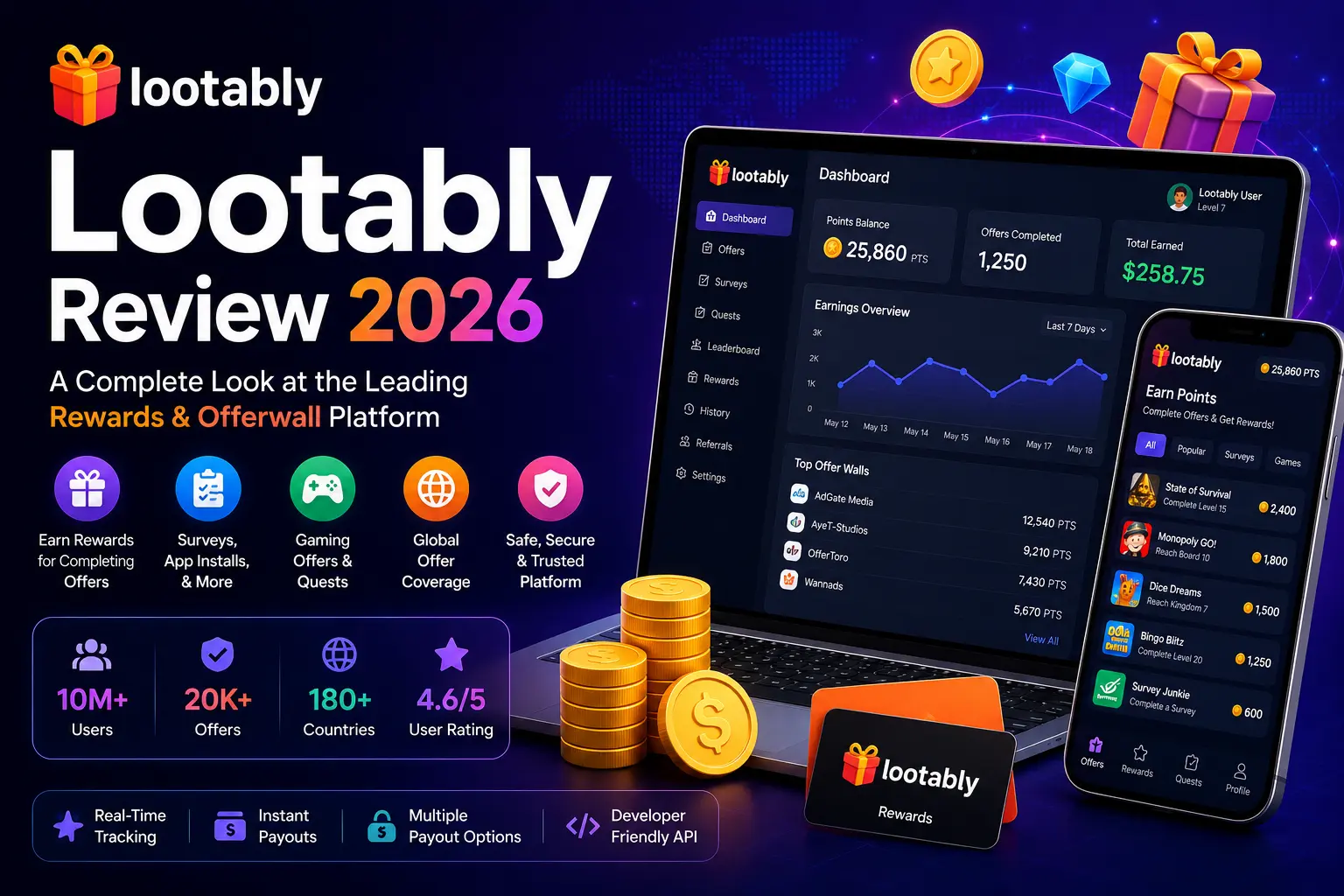
1. Overview
Lootably is a rewards-based monetization platform built around the offerwall model. It allows website, app, and game publishers to give users virtual currency for completing advertiser actions such as app installs, game milestones, surveys, sign-ups, quizzes, videos, shopping actions, and other performance-based tasks.
The company currently positions itself as a large rewards ecosystem and, at the time of this review, its website reports more than 30.9 million conversions, 1.49 million monthly active users, 2,286 active campaigns, and more than $13.2 million paid to publishers. Those numbers are company-reported rather than independently audited, so they are useful for understanding scale but should not be treated as third-party verification.
What makes Lootably interesting for publishers is not simply the offerwall itself. The stronger part of the platform is the range of integration methods available. A publisher can start with a simple iFrame or direct link, move to the Offers API for a completely custom interface, and use server-side postbacks or newer conversion webhooks to control reward processing and reconciliation.
That flexibility matters.
A small GPT website does not need to build an elaborate offer system from scratch. At the same time, a developer running a larger rewards application is not forced to use a generic embedded wall.
My overall impression is that Lootably makes the most sense as a developer-friendly, flexible offerwall rather than a complete rewards business in a box. It gives you the infrastructure to monetize actions, track conversions, and distribute virtual currency, but the quality of your own platform still determines how useful the network becomes.
For context, publishers building their own GPT platform should also understand the economics behind offerwalls, reward margins, and postback architecture. The Hansal Dev. blog covers these broader GPT and offerwall topics, including practical guides for building offerwall-based websites.
2. Who is it for?
Lootably is primarily useful for businesses that already have an audience and want to monetize user engagement.
The strongest audience segments include:
- GPT and rewards websites
- Loyalty platforms
- Mobile applications
- Casual and mobile games
- Gaming communities
- Web applications with virtual currencies
- Rewards and engagement platforms
- Startups building their first offerwall product
The key distinction is between having traffic and merely having a website.
Lootably's model is performance-based. You make money when users perform advertiser-defined actions. That means a beautifully designed website with no active users is worth very little, while a simple rewards site with a highly engaged user base can potentially generate meaningful revenue.
For a founder launching a new GPT platform, this is particularly important. You should think of Lootably as a monetization layer, not as the core product.
3. Supported platforms
Lootably publicly documents support for websites, applications, and games. Its standard integration documentation specifically describes installing the offerwall into a website, app, or game.
The underlying Offers API also exposes device targeting for:
- macOS
- Windows
- Android
- iPhone
- iPad
and offer categories including mobile and desktop games.
This makes Lootably considerably more flexible than a platform designed exclusively for mobile apps.
4. Website support
Website integration is one of Lootably's strongest areas.
The simplest option is an iFrame. You place the Lootably Offerwall inside your site and pass your own user ID. Lootably also offers a direct integration link for publishers who prefer opening the wall in a separate page or tab.
For a typical GPT website, this can reduce development time dramatically.
You do not need to recreate every offer card, tracking flow, and targeting rule yourself. Lootably handles the underlying offer experience while your site manages the user account, wallet, and final reward economics.
For developers who want a custom design, the Offers API is the more interesting option.
5. App support
Lootably supports mobile apps through its offerwall integration and provides a dedicated Android SDK for a native offerwall experience. The documented Android SDK is distributed as an AAR package and can initialize a placement using a publisher-defined user ID.
The SDK also exposes a conversion listener for apps that need client-side reward notifications.
However, this is where I would be careful with implementation choices.
Lootably itself recommends server-side postbacks where possible because they are safer than relying entirely on client-side reward events.
That is the right architecture for serious reward platforms: the client should display state, while the server remains authoritative.
6. Game support
Lootably is well suited to games because its offer catalog explicitly supports:
gamedesktopgamemobilegame
and devices such as Windows, macOS, Android, iPhone, and iPad.
This creates a useful combination for gaming platforms.
A game can offer rewards for actions outside the core game, such as installing another application or reaching a specified milestone, and then award the user in-game currency.
For publishers running gaming communities or reward-based game portals, this is one of Lootably's more natural use cases.
7. Integration methods
Lootably currently gives publishers several integration paths:
- iFrame
- Direct link
- Offers API
- Android SDK
The iFrame is the fastest route to launch.
The direct link is useful when you want the offerwall separated from your main interface.
The API is the choice for a custom-built offer UI.
The Android SDK is aimed at native Android applications.
This is a good progression because it lets a publisher start simple and increase technical control as the business grows.
8. API availability
Yes. Lootably has a documented Offers API.
The API provides both a User API and a Catalogue API.
The User API is designed for real-time, user-specific offers and lets Lootably handle country, device, and OS targeting.
The Catalogue API is designed for publishers who want to retrieve offers and maintain their own internal catalog. Lootably recommends refreshing cached catalog data approximately every 10 — 20 minutes.
This is a meaningful difference.
If you are building a serious marketplace-style reward interface, the Catalogue API gives you more control over ranking, filtering, caching, and presentation.
The API documentation also provides TypeScript types through an NPM package, which is a nice touch for modern JavaScript/TypeScript teams.
9. iFrame availability
Yes.
Lootably explicitly documents iFrame integration as the simplest way to embed the offerwall into a website, application, or game. The integration uses the publisher's placement and the user's ID.
For beginners, this is probably the best place to start.
You can validate demand, study completion rates, and understand your economics before investing engineering time in a custom API implementation.
10. SDK availability
Lootably has a documented Android SDK.
The public documentation currently describes the SDK as a lightweight native Android offerwall implementation. The example uses Kotlin and supports a currency-earned callback.
I would not describe Lootably as having a broad cross-platform SDK ecosystem based on the public documentation currently available. In particular, I did not find equivalent official public documentation for an iOS SDK.
For iOS, a publisher should therefore evaluate the iFrame, direct-link, or API routes rather than assuming an Apple-native SDK is available.
That distinction matters when choosing a stack.
11. Postback system
Postbacks are one of Lootably's strongest technical features.
A Lootably postback sends an HTTPS GET request to an endpoint controlled by the publisher when a user completes an offer or goal. The request can include values such as:
- User ID
- Revenue
- Currency reward
- Status
- Custom sub-IDs
- Hash
- Offer information
Lootably also supports postback retries, with a configurable retry count from 0 to 5.
The platform provides SHA-256 validation logic using the user ID, IP, revenue, currency reward, and a postback secret.
That is important because reward systems are a security-sensitive environment. You should never blindly trust a browser callback and immediately credit a user account.
12. Tracking
Tracking is built around placement IDs, user IDs, tracking links, and server-side conversion notifications.
The Offers API allows publishers to associate offers with users and retrieve user-specific inventory. Offer objects also include tracking links.
For a custom rewards platform, I would pass an internal immutable user identifier and, where appropriate, additional sub-ID values so that every conversion can be tied back to the correct account.
Lootably supports sid2 through sid5 as customizable parameters that can travel through supported offerwall or API integrations and return through the postback system.
That makes troubleshooting much easier when multiple pages, placements, campaigns, or traffic sources are involved.
13. Attribution window
This is one area where publishers should avoid assumptions.
Lootably's public documentation does not clearly publish one universal attribution window that applies to every offer.
Instead, individual offer data can include information such as minutesUntilExpiration, which tells the user how long they have to complete certain offers after clicking.
In practice, attribution and completion rules can vary by campaign.
That is normal for offerwall businesses, because advertisers determine their own qualification rules.
My recommendation is simple: never promise your users that every offer has a fixed attribution period. Treat each offer's displayed conditions as authoritative.
14. Offer types
Lootably's API documents a relatively broad range of categories:
- Apps
- Games
- Desktop games
- Mobile games
- One-click offers
- Surveys
- Sign-ups
- Videos
- Quizzes
- Chrome extensions
- Credit card offers
- Deposits
- Free trials
- Shopping
This diversity is a major selling point.
The biggest mistake a publisher can make is judging an offerwall purely by the number of offers displayed. What matters more is whether the inventory matches your users.
A gaming-heavy audience needs games.
A general GPT audience may respond better to a mix of surveys, apps, sign-ups, and shopping.
15. GEO coverage
Lootably supports country targeting through ISO 3166 country codes in the API. Publishers can request offers by country and device, while the User API can automatically apply country, device, and OS restrictions for the user.
That suggests broad international coverage, but it does not mean that every country has equal inventory.
This is an important distinction.
United States, United Kingdom, Canada, Australia, and Western European traffic may have very different inventory from lower-monetization GEOs.
Therefore, a publisher should judge Lootably by the GEO composition of its own audience, not by screenshots of offers seen in another country.
16. Survey inventory
Surveys are explicitly supported as an offer category.
The important limitation is that Lootably does not publicly present a fixed universal number of surveys available at all times. Inventory is dynamic and depends on GEO, device, user profile, and campaign availability.
For publishers, this means Lootably should be treated as a dynamic survey source, not a guaranteed survey inventory.
That is actually the safer way to design your platform.
Build the interface to handle inventory shrinking, changing, or disappearing instead of assuming a fixed number of surveys every day.
17. Gaming inventory
Gaming is another strong part of Lootably's catalog.
The API distinguishes between standard games, desktop games, and mobile games. Multistep offers can also contain individual goals, each with its own revenue and description.
This structure is particularly useful for game offers.
Instead of rewarding the user only when an entire campaign is finished, a publisher can process individual milestones as users move through the offer.
Gaming inventory is also one area where offerwalls can produce much higher-value conversions than basic microtasks, but the trade-off is greater complexity and more qualification requirements.
18. Fraud prevention
Fraud is not an optional feature in the offerwall business.
Lootably's newer Conversion Webhooks provide three distinct conversion states:
- Pending
- Approved
- Rejected
The documentation states that an approved conversion has passed Lootably's fraud protection rules, while rejected conversions are flagged as fraudulent and will not be paid out.
This is a significant improvement over a simplistic "conversion happened, immediately credit the user" workflow.
Lootably also provides:
- Webhook secrets
- Webhook IDs
- SHA-256 postback validation
- IP data
- Transaction IDs
- Retry handling
However, publishers still need their own fraud controls.
I would add rate limiting, duplicate protection, wallet reconciliation, suspicious-account review, and withdrawal controls on your own platform.
19. Reporting
Lootably offers a dedicated Reporting API.
The documented report types include:
- Conversions
- Daily revenue
- Monthly revenue
- Country revenue
Reports can be generated for a date range and optionally filtered by placement.
This is particularly useful for publishers who do not want to depend entirely on the dashboard.
An API-driven reporting pipeline lets you combine Lootably data with:
- User activity
- GEO
- Device
- Retention
- Withdrawal behavior
- Lifetime value
- Your own fraud signals
That is where offerwall monetization becomes much more interesting from a business perspective.
20. Reward flexibility
Lootably gives publishers control over their virtual currency economics.
Its placement configuration allows you to define the currency name and conversion rate, then specify what percentage of each offer's revenue is given to users.
Lootably's own example describes a model where the user receives 80% and the publisher retains 20% as profit.
This is valuable because it separates advertiser revenue from user-facing reward economics.
You can build your own points economy without exposing raw advertiser payouts directly.
You can also create temporary promotions that increase the currency users earn.
21. Payout model
Lootably's publisher model is based on revenue generated from completed offers.
The publisher controls the user-facing currency conversion and reward split. Lootably's placement documentation explicitly demonstrates configuring how much of each offer's revenue goes to the user versus the publisher.
One important warning: do not confuse this publisher revenue model with the cashout system offered by your own GPT platform.
Lootably supplies the monetization revenue.
Your platform is normally responsible for deciding how users redeem their earned balance.
That distinction becomes extremely important when calculating profit margins.
22. Payment methods
This is one of the areas where the public information is less transparent than the integration documentation.
Third-party network directories currently list PayPal, wire transfer, and cryptocurrency among Lootably publisher payment options, and one directory currently lists a $10 minimum payment figure.
However, I would not present those figures as universal current Lootably terms because Lootably's own publicly accessible documentation does not clearly publish one universal payout threshold and payment schedule.
For a serious business, verify the exact payout terms inside the publisher account or directly with Lootably before building your financial model around a specific threshold or payment cadence.
That is much safer than copying a third-party directory's numbers.
23. Approval requirements
Lootably is not presented as a completely automatic, instant-access publisher network.
Its official getting-started documentation tells applicants to submit an application and then alert their Lootably contact for approval before creating placements.
That means publishers should expect some level of review.
Quality matters more than simply owning a domain.
A legitimate business model, clean traffic sources, useful content, and clear reward mechanics are much better signals than a website built primarily to push incentivized traffic with little real value.
24. Minimum traffic
I could not find a clearly published official universal minimum traffic requirement in Lootably's public documentation.
That is important because many reviews casually publish a number without proving where it came from.
I would therefore not claim that Lootably requires a specific number of monthly visitors.
The practical reality is straightforward: traffic volume helps, but traffic quality and the type of traffic are also critical in performance marketing.
A smaller platform with genuine, engaged users can be more valuable than a large site sending low-quality or suspicious traffic.
25. Publisher support
Lootably provides publisher-facing documentation covering integration, APIs, postbacks, SDK usage, placement configuration, reporting, and webhooks.
The documentation also directs publishers to contact Lootably when they need guidance on integration or configuration.
From a developer perspective, the documentation is one of the better parts of the platform.
The important test, however, is not whether documentation exists.
It is whether support is responsive when a high-value conversion fails, a postback breaks, or an advertiser disputes a completion.
Public user reviews show mixed experiences around individual offer credits and support, including complaints involving uncredited or disputed offers. These are user-level experiences rather than definitive evidence about publisher support quality, so they should be treated as signals rather than proof of systemic failure.
That distinction matters.
26. Strengths
Strong technical flexibility
Lootably gives publishers several ways to integrate, from a simple iFrame to a custom API-driven experience.
Good developer documentation
The API documentation is detailed and includes request structures, response objects, TypeScript examples, and integration guidance.
Strong postback architecture
SHA-256 validation, retry support, transaction data, custom sub-IDs, and webhooks give developers enough control to build a reliable reward ledger.
Broad offer categories
The catalog covers surveys, games, apps, sign-ups, shopping, video, quizzes, extensions, and financial actions.
Useful reporting layer
The Reporting API provides conversion and revenue reporting by several dimensions.
Good fit for custom GPT platforms
Lootably works particularly well when you want to control your own frontend, wallet, user experience, and payout rules.
27. Weaknesses
Publisher payment terms are not very transparent publicly
This makes financial planning more difficult until you have an approved account and confirmed terms.
Inventory can vary significantly
An impressive offer catalog does not mean every user will see the same volume or payout level.
Public review sentiment is mixed
Some end users report delayed or missing credits, especially around individual higher-value offers. Those reports should not automatically be interpreted as proof that Lootably is fraudulent, but they are still worth taking seriously when designing support workflows.
Limited publicly documented native SDK coverage
The official documentation I found clearly covers Android, but does not present an equivalent public iOS SDK.
Offerwall dependence
Your earnings are still dependent on third-party campaigns.
If advertisers reduce budgets or remove campaigns, your inventory can change without warning.
28. Best use case
The best Lootably use case is a real rewards platform with an existing user base, particularly:
- GPT websites
- Reward apps
- Gaming communities
- Loyalty platforms
- Mobile applications
- User-engagement platforms
It is particularly attractive when the publisher wants to start with an embedded wall and eventually move toward a custom API implementation.
For a startup, I would not over-engineer the first version.
Start with the iFrame.
Measure:
- Offer impressions
- Click-through rate
- Conversion rate
- Revenue per active user
- User reward cost
- Chargebacks or rejected conversions
- Withdrawal behavior
Once the economics make sense, move to the API.
That sequence prevents developers from spending weeks building a beautiful offer marketplace that users barely touch.
29. Who should avoid it
Lootably is probably not the best choice for:
- Websites with no meaningful traffic
- Businesses without a real user-account system
- Publishers looking for guaranteed fixed monthly revenue
- Projects that cannot implement secure server-side reward processing
- Websites built mainly around low-quality incentivized traffic
- Teams expecting the offerwall provider to handle their entire rewards business
It is also a poor fit if your entire business depends on one offerwall.
A healthy rewards platform should usually diversify its inventory.
For example, a GPT site can combine multiple offerwalls and specialist survey providers rather than forcing every user through one provider.
That approach gives you redundancy when campaigns disappear or one network has tracking problems.
30. Alternatives
Lootably should be evaluated alongside several other offerwall and survey providers rather than in isolation.
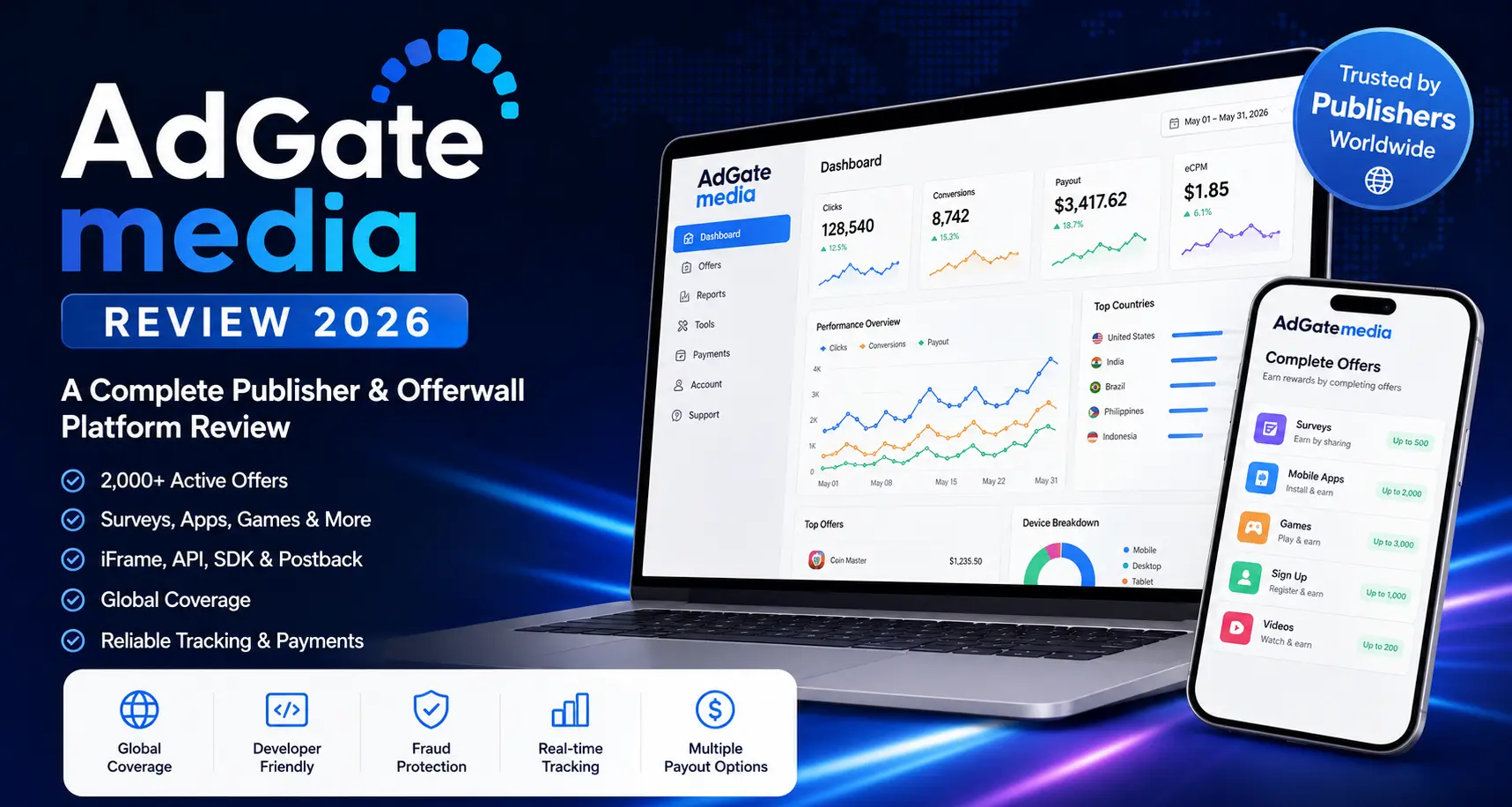
AdGate Media is one of the obvious alternatives for GPT and rewards platforms. You can compare the two in the AdGate Media Review 2026.
Torox is another relevant alternative, especially for publishers focused heavily on gaming and performance offers. Hansal Dev. is also publishing a dedicated Torox Review 2026.
For survey-heavy businesses, providers such as CPX Research, BitLabs, and TheoremReach deserve separate evaluation because survey specialization can produce a different inventory mix from a general-purpose offerwall. Those reviews are also part of the current Hansal Dev. offerwall research section.
The important strategy is not necessarily finding one "best" provider.
For a serious GPT platform, the better architecture is usually:
Multiple offerwalls + specialist survey providers + your own wallet + centralized fraud controls + unified reporting.
That creates competition between networks and gives your users more opportunities to earn.
31. Final rating
Lootably Rating: 8.2/10
| CategoryRating | |
| Offer variety | 8.5/10 |
| API | 9/10 |
| iFrame integration | 9/10 |
| Postbacks & tracking | 9/10 |
| SDK support | 7/10 |
| Gaming inventory | 8.5/10 |
| Survey inventory | 8/10 |
| GEO flexibility | 8.5/10 |
| Reporting | 8.5/10 |
| Fraud controls | 8.5/10 |
| Publisher flexibility | 9/10 |
| Payment transparency | 6.5/10 |
| Publisher support | 7.5/10 |
Lootably is not a perfect network, but it is a technically capable offerwall that deserves consideration from publishers building rewards, GPT, loyalty, and gaming platforms.
The biggest advantage is flexibility.
You can start with a simple embedded offerwall, collect real data, and eventually build a much more customized experience through the API. The postback and webhook infrastructure is strong enough for a professional reward ledger, while the catalog supports a useful mixture of games, apps, surveys, sign-ups, videos, quizzes, shopping, and other performance actions.
The biggest weakness is transparency around commercial terms.
Important questions such as the exact payment threshold, payment schedule, and account-specific publisher conditions are not presented as clearly in the public documentation as the technical integration details. Third-party directories provide some numbers, but publishers should verify those terms directly before forecasting cash flow.
I also would not build a business around Lootably alone.
Use it as one component of a broader monetization strategy. Compare its conversion rate, revenue per active user, GEO coverage, and support performance against other networks. On a real GPT platform, the "best" offerwall is not necessarily the one with the highest headline payout. It is the provider that consistently produces good inventory, reliable tracking, acceptable approval rates, predictable revenue, and enough user satisfaction to keep people completing offers.
That is where Lootably is strongest: it gives developers enough technical control to build around the network rather than simply placing a box on a page.
Bottom line
Lootably is a strong choice for publishers who want a flexible offerwall with API access, iFrame integration, Android support, server-side postbacks, conversion webhooks, and a broad mix of gaming, survey, app, and performance offers.
For a small GPT website, the iFrame is probably enough.
For a growing platform, use the API and server-side reward processing.
For a serious business, integrate Lootably alongside competing offerwalls rather than depending on it as your only monetization source.
Overall verdict: Recommended for GPT, rewards, loyalty, gaming, and app publishers — particularly developers who value integration flexibility and control.


Comments (0)
No comments yet. Be the first to share your thoughts!