
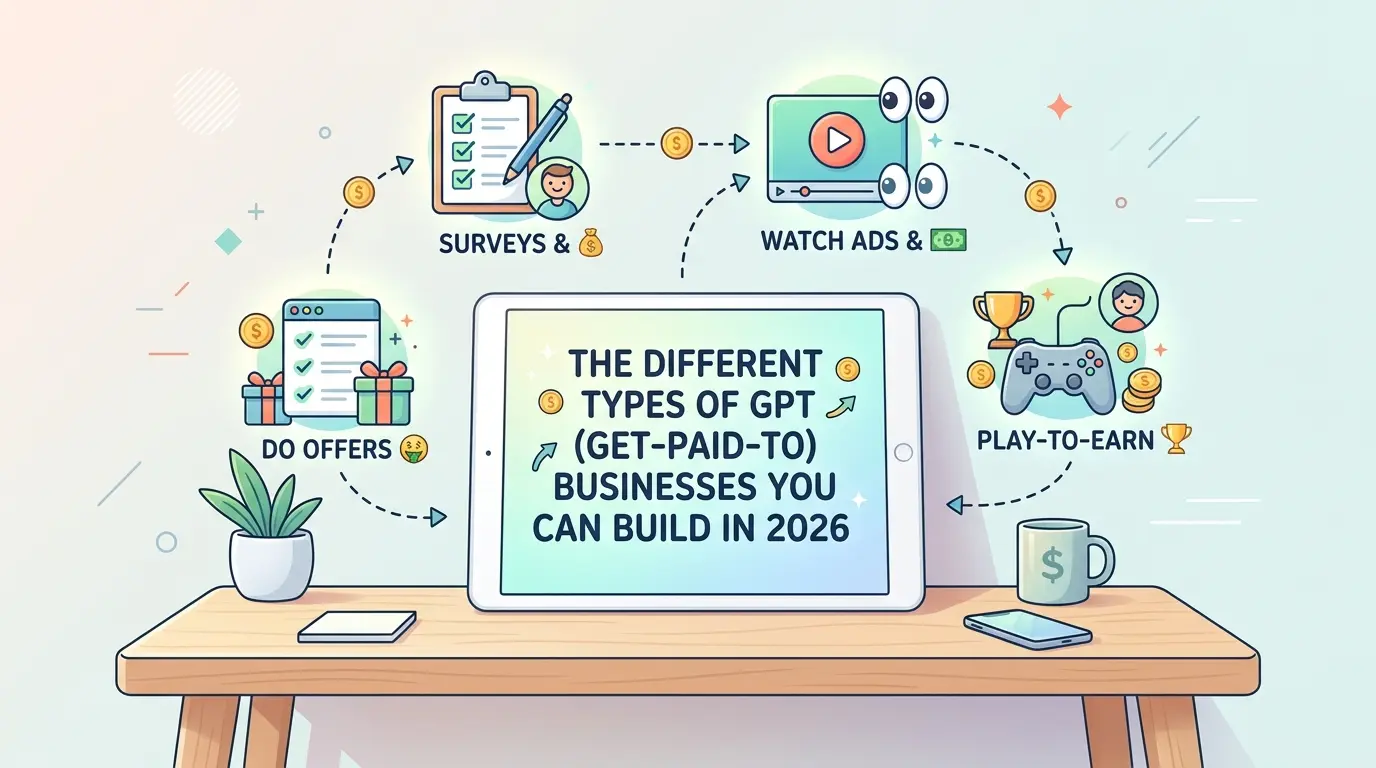
Introduction: Why the GPT Economy Is Bigger Than You Think
Let me be straight with you. Three years ago, I thought GPT sites were just a side hustle for bored teenagers clicking surveys between classes. Then I dug into the actual numbers, spoke with platform operators, and realized something that completely shifted my perspective: the Get-Paid-To economy is a $5+ billion industry growing at 14% annually — and most of that money flows to the business owners, not the users clicking tasks.
If you've been searching for a business model with low barrier to entry, multiple monetization streams, and the ability to scale globally from day one, building a GPT platform deserves your attention. But here's the catch: not all GPT businesses are created equal. The difference between a platform that generates $500 a month and one that clears six figures often comes down to which type of GPT business you choose to build and how well you understand the ecosystem behind it.
In this guide, I'm breaking down every viable GPT business model I've researched, tested, or watched succeed in 2026. Whether you're a developer looking to build the next Swagbucks, a marketer who understands CPA networks, or an entrepreneur hunting for a proven digital business model, this is the most comprehensive breakdown you'll find.
Before we dive in, if you're new to the GPT world, I'd recommend reading our deep-dive on how the GPT market actually works — it gives you the foundational economics that make everything below make sense.
What Exactly Is a GPT Business?
GPT stands for Get-Paid-To. At its core, every GPT business operates on the same fundamental principle: you act as the middleman between advertisers who need actions completed and users willing to complete those actions for rewards.
The advertiser pays you when a user installs their app, completes a survey, signs up for a trial, or makes a purchase. You keep a percentage of that payment and pass the rest to the user as cash, points, gift cards, or crypto. The magic is in the spread — and in your ability to attract users who are motivated to complete these tasks at scale.
According to EarnLab's 2026 analysis, realistic monthly earnings for active users land between $30 and $150, with offer walls and app trials paying 3 — 5x more per hour than surveys. But as the platform owner? You're earning on every single transaction across thousands of users. That's where the real money lives.
If you want to understand the unit economics behind this model in granular detail, check out our post on the real economics behind a successful GPT platform.
The 10 Types of GPT Businesses You Can Build
1. The Classic Survey & Market Research Platform
This is where most people's minds go when they hear — GPT site. — Think Survey Junkie, Toluna, or Ipsos iSay. You partner with market research companies that need consumer opinions, and you pay users a small fraction of what the research firm pays you.
How the money flows: Market research firms typically pay $1 — $5 per completed survey depending on length and demographic targeting. You pay the user $0.50 — $2.50, pocketing the difference. The key is volume and targeting — high-value demographics (US/UK, 25 — 45, high income) get more surveys and better rates.
Startup requirements:
- Survey router integration (Cint, Lucid, Dynata, or Peanut Labs)
- User management system with demographic profiling
- Fraud detection (speeders, straight-liners, duplicate accounts)
- Payment processing (PayPal, gift cards, crypto)
Reality check: Survey-only platforms have the lowest margins in the GPT space. Disqualification rates frustrate users, inventory is unpredictable, and you're competing with established players with 15+ years of advertiser relationships. I don't recommend building a survey-only site unless you have a very specific niche or audience.
Realistic revenue potential: $2,000 — $15,000/month at scale, but margins are thin.
External resources:
- FinanceBuzz's GPT site comparison for understanding user expectations
- SideHustles.com's GPT directory for competitive analysis
2. The Offerwall & CPA Network Platform
This is where the real money is in GPT. Offerwall platforms like Freecash, EarnLab, and PrizeRebel don't primarily make money from surveys — they make it from Cost-Per-Action (CPA) offers.
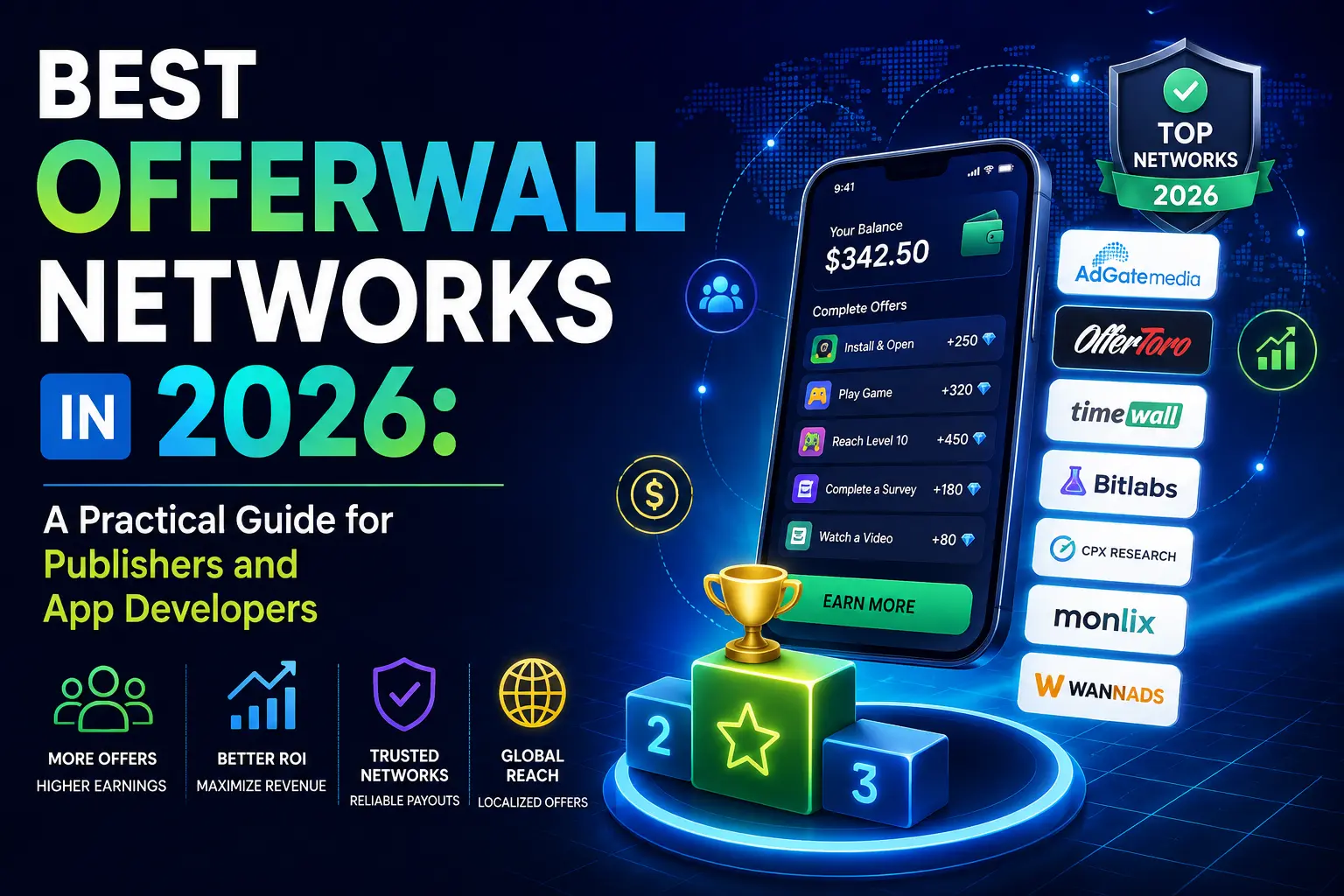
An offerwall is essentially a curated marketplace of tasks: install this game and reach level 10, sign up for this streaming trial, download this fitness app. When a user completes the action, the advertiser pays the offerwall network (like AdGem, Ayet, or OfferToro), who pays you, and you pay the user a portion.
How the money flows: A mobile game advertiser might pay $8 — $25 per user who installs their game and reaches a specific milestone. You pay the user $4 — $12, keeping 40 — 50%. On high-value offers like subscription trials or fintech app signups, payouts can hit $50 — $200 per conversion.
The business model advantages:
- Higher margins than surveys (typically 40 — 60% vs. 20 — 30%)
- Better user retention (users want to complete game offers because they're fun)
- Scalable inventory (offer walls auto-populate based on user location)
- Multiple offer wall providers mean you're never dependent on one source
Startup requirements:
- Integration with 3 — 5 offer wall providers (AdGem, Ayet Studios, OfferToro, RevU)
- Server-to-server (S2S) postback system for conversion tracking
- Anti-fraud systems (VPN detection, emulator blocking, duplicate device ID checks)
- Wallet/ledger system for tracking user earnings
- Withdrawal system with multiple payout methods
Realistic revenue potential: $10,000 — $100,000+/month depending on traffic volume and GEO targeting. One MyLead partner earned $10,723 in three months from offerwall monetization alone — and that was just one integration in one app.
Pro tip from someone who's studied this space: The platforms winning in 2026 aren't just slapping an offerwall on a generic website. They're building gamified ecosystems around the offerwall — leaderboards, daily bonuses, referral tiers, and VIP programs that keep users engaged. EarnLab's VIP program with weekly cash bonuses is a perfect example of this.
If you want to build this type of platform, our complete builder's guide to creating an offerwall website walks through the technical stack, S2S postbacks, and fraud prevention in detail.
3. The Cashback & Shopping Rewards Platform
This model flips the script: instead of paying users to complete tasks, you pay them to shop through your links. Swagbucks has paid out over $450 million since 2008, and a huge chunk of that comes from their cashback program.
How the money flows: You partner with affiliate networks (Rakuten, CJ Affiliate, Impact, Awin) that represent major retailers. When a user clicks your affiliate link and makes a purchase, the retailer pays you a commission (typically 1 — 10% of the sale). You pass a portion of that commission to the user as — cashback. —
The genius of this model:
- It's passive income for users — they shop normally, they earn money
- Higher average order values mean higher commissions per transaction
- Users are already spending money — you're just redirecting their purchase
- Stacking potential: users can combine your cashback with credit card rewards, store coupons, and other discounts
Startup requirements:
- Affiliate network approvals (this is the hardest part for new sites)
- Deep linking technology to track purchases across thousands of retailers
- Browser extension or mobile app for seamless link interception
- Accurate cashback tracking and reconciliation system
- Large user base (cashback only works at scale)
Realistic revenue potential: $5,000 — $50,000+/month, but requires significant traffic and retailer relationships. This is a — slow burn — model — it takes 12 — 18 months to build enough users for meaningful revenue.
The catch: You need capital reserves. Cashback is typically paid to users before you receive the affiliate commission (which can take 30 — 90 days). If 1,000 users each earn $20 in cashback, you need $20,000 liquid to pay them while waiting for affiliate payouts.
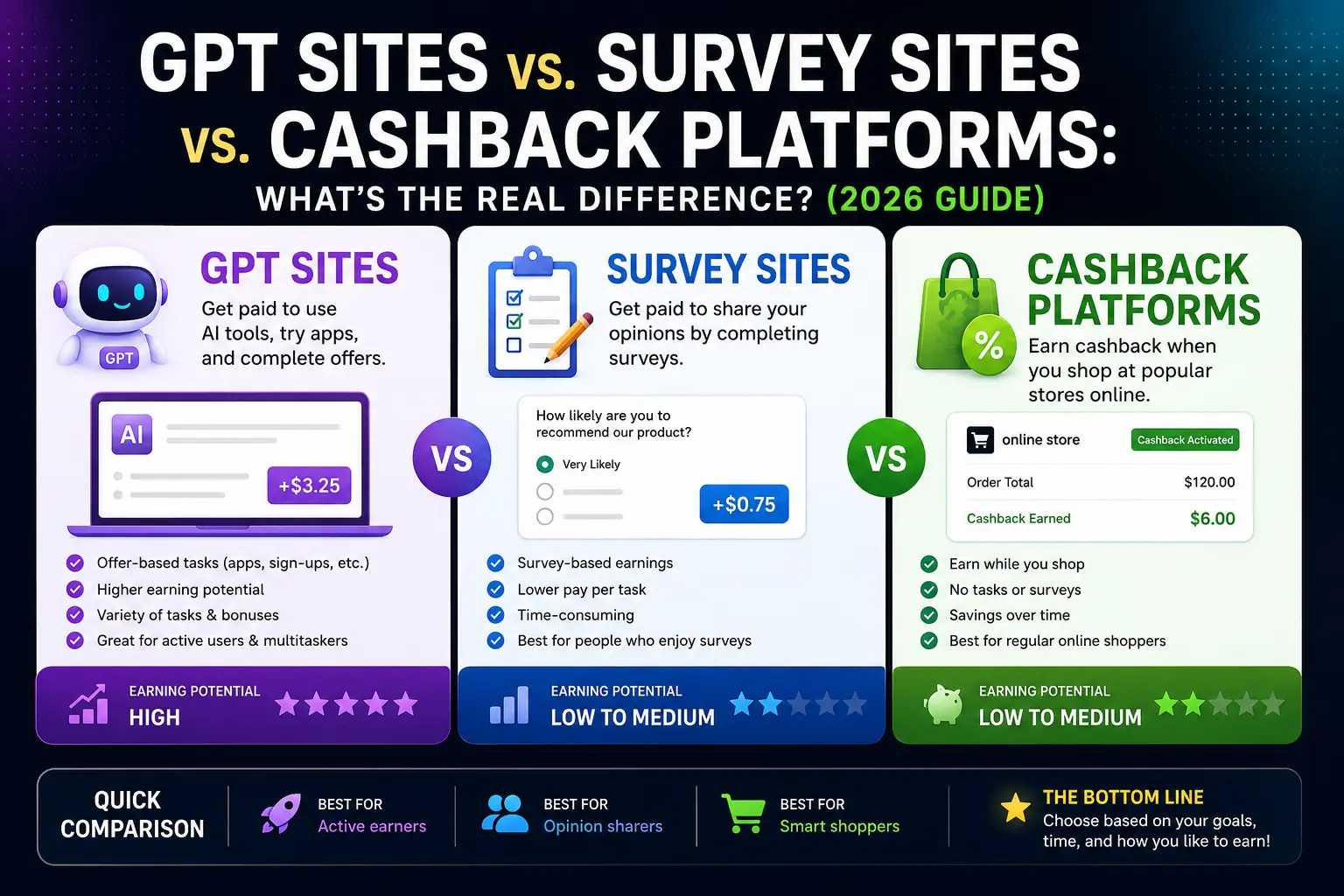
For a deeper comparison of how cashback differs from traditional GPT, read our guide on GPT Sites vs. Survey Sites vs. Cashback Platforms.
4. The Microtask & Crowdsourcing Platform
Microtask platforms operate on a different principle than offerwalls. Instead of users completing advertiser offers, they're completing small jobs posted by other users or AI companies who need human intelligence.
Think Amazon Mechanical Turk, Clickworker, or Appen. Tasks include image tagging, data verification, content moderation, transcription, and AI training data creation.
How the money flows: Requesters (the people posting tasks) pay the platform a fee per task. The platform takes a commission (typically 20 — 40%) and passes the rest to the worker. Some platforms also charge requesters a monthly subscription for access to the workforce.
Why this model is powerful:
- You control pricing (unlike offerwalls where CPA rates are fixed by advertisers)
- Recurring revenue from enterprise clients who need ongoing data labeling
- AI boom = massive demand for human-verified training data
- Higher task payouts attract more serious, higher-quality workers
Startup requirements:
- Task marketplace infrastructure (posting, claiming, submitting, reviewing)
- Quality control systems (gold standard tests, consensus scoring, worker ratings)
- Payment escrow system to protect both requesters and workers
- API for enterprise clients to programmatically post tasks
Realistic revenue potential: $8,000 — $75,000+/month. The AI data labeling market alone is worth billions, and companies like Scale AI have built unicorn-level businesses on this model.
The human element: I've spoken with microtask platform operators who say the hardest part isn't technology — it's quality control. One bad actor posting spam tasks can destroy worker trust. One sloppy worker can ruin a client's dataset. Your reputation lives and dies on quality assurance.
5. The Mobile App Reward Platform
This is the 2026 evolution of GPT. Instead of a website, you build a mobile app that rewards users for everyday activities: walking, exercising, listening to music, charging their phone, or even just unlocking their screen.
Apps like Sweatcoin, Current Rewards, and Mode Earn Phone have proven this model works. Users don't even feel like they're — working — — they're just living their lives and earning passive rewards.
How the money flows: You monetize through:
- Offerwall integration within the app (same CPA model)
- Advertisements (rewarded videos, interstitials)
- Subscription tiers (premium users earn 2x rewards)
- Data monetization (aggregated, anonymized user behavior data)
Why mobile apps dominate in 2026:
- Push notifications re-engage users automatically
- Location data enables geo-targeted offers
- Camera access enables receipt-scanning cashback
- App stores provide organic discovery (if you rank well)
Startup requirements:
- Native iOS and Android development (or React Native/Flutter)
- Offerwall SDK integration (we covered this in detail here)
- Ad network integration (AdMob, Unity Ads, ironSource)
- Backend infrastructure for reward tracking and fraud prevention
- App store compliance (both Apple and Google have strict policies on reward apps)
Realistic revenue potential: $15,000 — $200,000+/month. Mobile apps have higher monetization per user than websites because of the additional ad inventory and engagement mechanics.
The warning: App store policies are getting stricter. Apple cracked down on — passive earning — apps in 2024, and Google followed in 2025. Your app needs genuine utility beyond just — earn money — — fitness tracking, music streaming, or productivity features that justify the reward layer.
6. The Hybrid — Super App — GPT Platform
This is the model that the biggest players use. Swagbucks isn't just a survey site or a cashback app — it's everything. Surveys, cashback, games, videos, search, shopping, and a referral program all in one ecosystem.
Why hybrids win:
- Users have multiple reasons to open your app daily
- If one revenue stream dries up, others compensate
- Cross-promotion between features increases retention
- Higher lifetime value per user justifies higher acquisition costs
The architecture of a hybrid platform:
- Core earning layer: Offerwalls + surveys + microtasks
- Passive layer: Cashback + receipt scanning + paid emails
- Engagement layer: Daily bonuses, streaks, leaderboards, contests
- Social layer: Referral program, friend leaderboards, team challenges
- Monetization layer: Ads, premium subscriptions, data insights
Startup requirements: Everything from models 1 — 5 combined. This is not a weekend project. You need:
- A full development team (or a very experienced full-stack developer)
- Multiple API integrations (offer walls, survey routers, affiliate networks)
- Sophisticated analytics to track which features drive retention
- Significant marketing budget to acquire initial users
Realistic revenue potential: $50,000 — $500,000+/month. But you're competing with platforms that have raised millions in funding and have 10+ years of user data.
My honest take: Don't start here. Build one core feature first, prove product-market fit, then expand. Swagbucks started as a paid search engine in 2008. Freecash started focused purely on game offers. Master one thing, then diversify.
7. The Niche/Vertical GPT Platform
This is my favorite model for solo entrepreneurs and small teams. Instead of competing with Swagbucks for general users, you build a GPT platform for a specific audience.
Examples that are working in 2026:
- Gamer-focused GPT: Earn rewards for playing specific games, streaming on Twitch, or participating in esports tournaments
- Student-focused GPT: Earn by completing study challenges, referring classmates, or participating in campus research
- Crypto-focused GPT: Earn Bitcoin or Ethereum for tasks, appealing to the Web3 crowd
- Fitness-focused GPT: Earn rewards for hitting workout goals, tracked via wearable integration
- Eco-focused GPT: Earn rewards for sustainable actions (recycling, reducing carbon footprint)
Why vertical platforms crush general ones:
- Lower customer acquisition costs (targeted marketing)
- Higher engagement (users feel the platform was — made for them — )
- Better advertiser match (brands in your niche pay premium rates)
- Community building potential (Discord servers, forums, events)
Startup requirements:
- Deep understanding of your niche audience
- Tailored offer inventory (you might need direct advertiser deals)
- Community management tools
- Branding that resonates with your specific demographic
Realistic revenue potential: $3,000 — $40,000+/month. Smaller scale than hybrids, but often more profitable because of lower acquisition costs and higher user loyalty.
A real example: I know a founder who built a GPT platform specifically for mobile gamers. Instead of generic offerwalls, he partnered directly with indie game studios for exclusive — play-to-earn — campaigns. His user base is only 50,000 — tiny compared to Swagbucks — but his revenue per user is 3x higher because advertisers in the gaming niche pay premium rates for engaged players.
8. The GPT Review & Aggregator Site
Wait — this isn't a GPT platform where users earn money. It's a content business about GPT platforms. But hear me out, because this can be incredibly lucrative.
Sites like Survey.now and EarnLab's blog don't just run platforms — they also publish reviews, comparisons, and guides that rank in Google. They monetize through:
- Affiliate commissions (referring users to GPT platforms)
- Sponsored listings (platforms paying for featured placement)
- Display advertising
- Lead generation (selling qualified signups to platforms)
How the money flows: When you refer a user to Swagbucks through your affiliate link, Swagbucks pays you $2 — $5 per signup (sometimes more). If your review article gets 10,000 monthly visitors and 5% convert, that's 500 signups ?? $3 = $1,500/month from one article.
Why this model is brilliant:
- No user support, no payment processing, no fraud detection
- Content compounds — a good article ranks for years
- Multiple monetization streams per visitor
- Can be run solo with strong SEO skills
Startup requirements:
- SEO expertise (this is 90% of the game)
- Content creation ability (or budget to hire writers)
- Affiliate relationships with GPT platforms
- Website with fast loading speed and clean UX
- Email list for recurring traffic
Realistic revenue potential: $2,000 — $30,000+/month from affiliate commissions alone. Top GPT review sites likely earn significantly more.
The content strategy that works:
- — Best GPT sites for [specific audience] — (students, gamers, international users)
- — [Platform name] review: Is it legit — (high intent searches)
- — How to earn $X per month on GPT sites — (tutorial content)
- Comparison posts ( — Freecash vs. Swagbucks vs. EarnLab — )
The catch: SEO takes 6 — 12 months to gain traction. You need patience and consistent publishing. But once you rank, the traffic is essentially free.
9. The White-Label GPT SaaS Platform
This is the B2B play. Instead of building a consumer-facing GPT site, you build the infrastructure that lets other entrepreneurs launch their own GPT platforms.
You provide:
- Pre-built website templates
- Integrated offerwalls and survey routers
- Payment processing and wallet systems
- Admin dashboards and analytics
- Fraud detection and user management
Your customers pay you a monthly SaaS fee ($99 — $999/month) plus a revenue share on their earnings.
Why this model is recession-proof:
- Recurring revenue (SaaS subscriptions)
- Your customers do the marketing (you just provide the tools)
- Scales without proportional support burden (self-service onboarding)
- High retention (customers build their brand on your platform)
Startup requirements:
- Robust, scalable backend architecture
- Multi-tenant database design
- White-label customization options
- Integration with 10+ offerwall and survey providers
- Comprehensive documentation and support
Realistic revenue potential: $10,000 — $100,000+/month in SaaS fees alone, plus revenue share.
The challenge: This requires serious technical expertise. You're not just building a GPT site — you're building a platform for building GPT sites. Think Shopify, but for reward platforms. If you don't have a strong technical co-founder, this isn't the model to start with.
10. The Content Locking & Incentive Network
This is the most aggressive GPT model, and it comes with the highest risk — but also the highest short-term returns.
Content locking works like this: a user wants access to a premium file, video, article, or tool. Instead of paying money, they — unlock — it by completing an offer from your wall (installing an app, taking a survey, signing up for a trial). You get paid by the advertiser, and the user gets access to the content.
Where it's used:
- File sharing sites ( — Complete this offer to download — )
- Online tools ( — Unlock the full report — )
- Gaming sites ( — Get free gems by completing offers — )
- Educational resources ( — Unlock this course chapter — )
How the money flows: Same CPA model as offerwalls, but conversion rates are often higher because the user is motivated by access to specific content they want.
The dark side: Content locking has a reputation problem. Many networks were built on pirated content, fake — hacks, — or misleading promises. Google and ad networks have cracked down hard. If you go this route, you need impeccable compliance:
- Only lock content you own or have rights to
- Be transparent about what the user is getting
- Never promise something you can't deliver
- Follow all advertiser guidelines to the letter
Realistic revenue potential: $5,000 — $50,000+/month, but with significant regulatory and reputational risk.
My recommendation: Unless you have deep experience in compliance and content creation, skip this model. The other nine on this list are more sustainable.
How to Choose the Right GPT Business for You
After studying this space for years and watching dozens of platforms launch, scale, or fail, here's my framework for choosing your model:
| If you are — Build this model Why | ||
| A solo developer with limited capital | Niche GPT Platform or Review Site | Low startup costs, focused scope |
| A marketer with SEO skills | GPT Review & Aggregator Site | No tech overhead, content compounds |
| A team with mobile dev experience | Mobile App Reward Platform | Highest growth potential in 2026 |
| An experienced full-stack team | White-Label SaaS or Hybrid Super App | Highest revenue ceiling |
| Someone with CPA/affiliate experience | Offerwall Platform | Best margins, proven model |
| A community builder | Niche/Vertical GPT | Loyalty and retention advantages |
If you're still on the fence about whether GPT businesses are even viable in 2026, I wrote a brutally honest breakdown based on years of actual platform usage: Are GPT Websites Still Profitable in 2026?. Spoiler: they are, but only if you approach them with the right expectations and model.
The Technical Stack You'll Need (Regardless of Model)
Every GPT business, no matter the type, needs these core components:
1. User Management & Authentication
- Registration, login, password reset, email verification
- KYC/AML compliance for higher payouts (required in many jurisdictions)
- Multi-factor authentication for security
2. Wallet & Ledger System
- Real-time balance tracking
- Transaction history
- Pending/completed/declined status for each task
- Audit trail for compliance
3. Offer/Task Integration
- API connections to offerwall providers
- Webhook handling for postbacks
- Duplicate conversion prevention
- Revenue tracking per offer source
4. Fraud Prevention
- VPN/proxy detection (MaxMind, IPQualityScore)
- Device fingerprinting
- Velocity checks (multiple accounts from one device)
- Automated account suspension for suspicious patterns
5. Payment Processing
- PayPal, Payoneer, bank transfer, crypto, gift cards
- Minimum threshold management
- Withdrawal queue and approval workflow
- Tax documentation (1099s for US users)
6. Analytics & Reporting
- Revenue per user, per offer, per GEO
- Conversion rates by traffic source
- Churn and retention metrics
- Advertiser performance dashboards
If you're technically inclined and want to build this yourself, our offerwall website builder's guide includes code examples for Laravel, S2S postbacks, and secure reward processing.
Common Mistakes That Kill GPT Businesses
I've watched too many promising GPT startups die within six months. Here are the fatal errors:
1. Starting With No Capital Reserves
You need cash to pay users before advertiser payments clear. If you can't float $10,000 — $50,000 in pending withdrawals, you'll have angry users and a dead platform.
2. Ignoring Fraud Until It's Too Late
One bot farm can drain your entire month's profit in a weekend. Build fraud detection from day one, not month six.
3. Copying Swagbucks Exactly
You can't out-Swagbucks Swagbucks. They have 15 years of advertiser relationships, user data, and brand recognition. Find your angle, your niche, or your unique feature.
4. Underpaying Users
Word travels fast in the GPT community. If your payouts are 20% lower than competitors for the same offers, users will leave and never return. The spread is your profit, but gouging users is a race to the bottom.
5. Neglecting Support
GPT users are anxious about their money. A support ticket unanswered for 48 hours becomes a Trustpilot review, then a Reddit thread, then a reputation crisis. EarnLab's sub-20-minute live chat response time isn't a luxury — it's a competitive advantage.
Revenue Benchmarks: What Success Actually Looks Like
Let me ground this in reality with numbers from platforms I've researched:
| Platform Type Monthly Users Avg. Revenue/User Monthly Revenue Timeline to Scale | ||||
| Survey-only site | 10,000 | $0.50 | $5,000 | 12 — 18 months |
| Offerwall platform | 25,000 | $1.20 | $30,000 | 6 — 12 months |
| Cashback app | 50,000 | $0.80 | $40,000 | 18 — 24 months |
| Microtask marketplace | 5,000 workers | $3.00 | $15,000 | 12 — 18 months |
| Mobile reward app | 100,000 | $1.50 | $150,000 | 12 — 18 months |
| Hybrid super app | 500,000 | $2.00 | $1,000,000 | 24 — 36 months |
These are successful benchmarks. Most GPT businesses never reach these numbers. The ones that do share common traits: relentless focus on user experience, aggressive fraud prevention, and smart marketing.
The Future of GPT Businesses: Where This Is Heading
The GPT landscape in 2026 looks very different than it did in 2020. Here's what's changing:
AI-Powered Personalization
Platforms are using AI to match users with the highest-paying offers they're most likely to complete. Instead of showing everyone the same wall, the wall adapts to each user's behavior, location, and preferences.
Crypto & Web3 Integration
More platforms are paying in Bitcoin, Ethereum, or stablecoins. This appeals to international users who don't have PayPal access and reduces payment processing fees.
Subscription Tiers
The — freemium — model is arriving in GPT. Pay $9.99/month for 2x earnings, instant withdrawals, and exclusive high-paying offers. This creates predictable recurring revenue for the platform.
Regulatory Scrutiny
Governments are catching up. The EU's DAC7 requires platforms to report user earnings over — 2,500/year. The US is tightening KYC requirements. Compliance is becoming a competitive advantage, not just a cost center.
AI-Generated Tasks
Microtask platforms are increasingly offering AI training data tasks — labeling images for self-driving cars, rating chatbot responses, verifying AI outputs. This market is exploding and pays significantly more than traditional surveys.
Final Thoughts: Start Building
The GPT economy isn't a get-rich-quick scheme. It's a real business that requires real work, real capital, and real persistence. But for entrepreneurs willing to learn the ecosystem, build solid technology, and treat users with respect, the opportunity is genuine.
I've laid out ten distinct models, each with different risk profiles, capital requirements, and revenue potentials. My advice? Pick the one that aligns with your skills and resources, start small, prove the concept with 1,000 users, and then scale.
The $5 billion GPT market isn't going anywhere. The question is: will you be a user clicking for pennies, or the platform owner collecting the spread?
Related Reading:
- How Big Is the GPT Market and Who Uses These Platforms?
- The Real Economics Behind a Successful GPT Platform
- Are GPT Websites Still Profitable in 2026?
- GPT Sites vs. Survey Sites vs. Cashback Platforms
- How to Create an Offerwall Website: Complete Builder's Guide
- How to Add an Offerwall SDK to Android & iOS Apps
Have you built or used a GPT platform? I'd love to hear about your experience in the comments below. And if you found this guide helpful, share it with someone who's been talking about starting an online business but doesn't know where to begin.

Comments (0)
No comments yet. Be the first to share your thoughts!