
What Is MMWall?
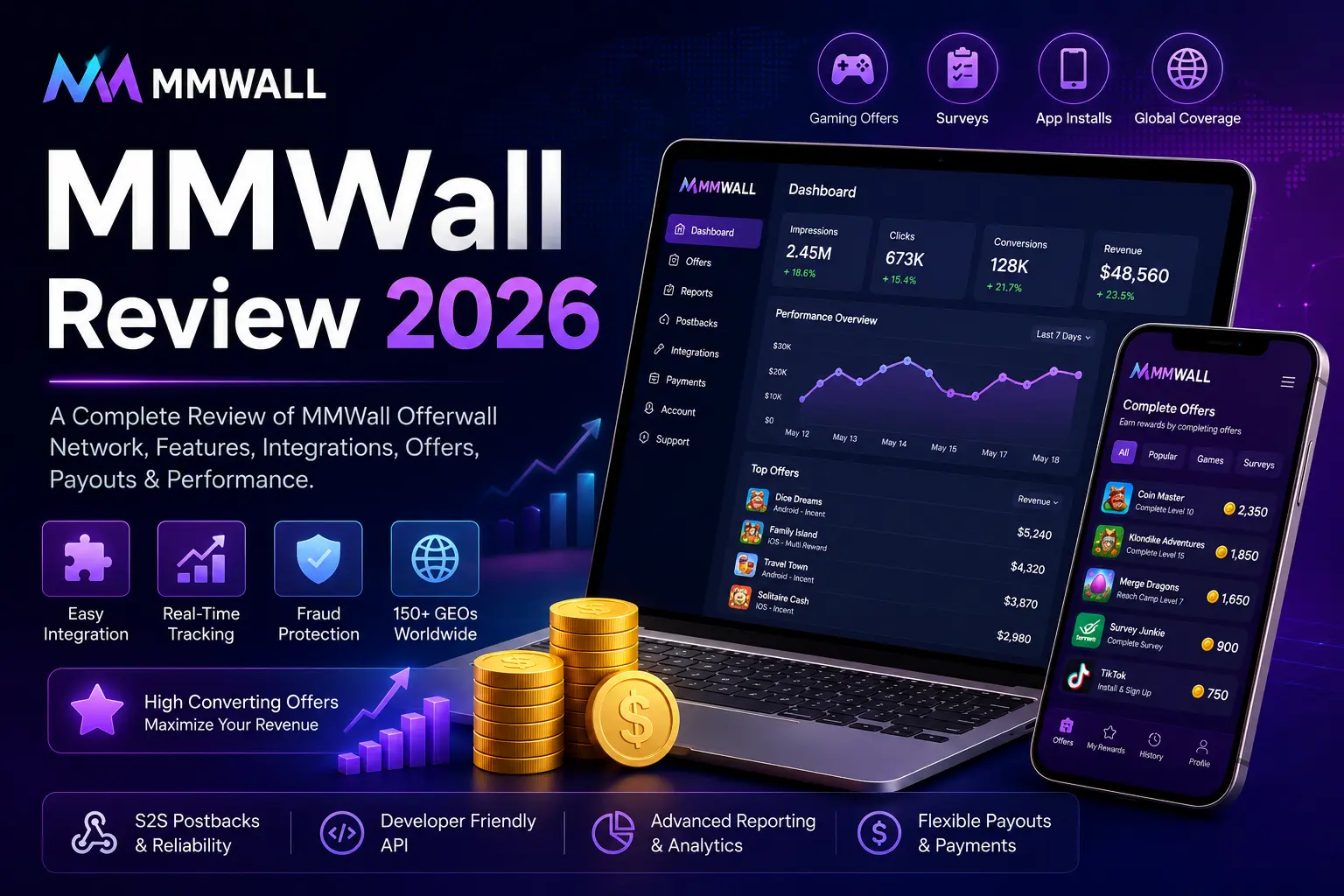
MMWall (also branded as MM Wall) is a hosted offerwall platform that helps publishers monetize websites and mobile apps through incentivized offers, surveys, games, and reward-based advertiser campaigns.
Unlike competitors that require complex SDK installations and multiple API integrations, MMWall takes a deliberately simple approach. Its official documentation emphasizes a hosted web offerwall architecture with server-to-server postbacks — meaning no SDK is required to get started.
For publishers running GPT sites, loyalty programs, cashback platforms, or reward apps, this simplicity can significantly reduce time-to-launch. You pass a user ID, open the hosted wall, and MMWall handles the rest: offer presentation, campaign routing, and conversion tracking.
The platform claims to have processed over 100 million offer interactions and uses an algorithmic bidding system designed to route traffic toward higher-paying campaigns automatically.
Important: Public user feedback on MMWall is mixed. While some users report positive experiences, Trustpilot contains complaints about missing rewards and slow support responses. We recommend testing MMWall with controlled traffic before committing your full user base.
Who Should Use MMWall?
MMWall is best suited for publishers who already have an audience and want to add a reward-based monetization layer quickly.
Ideal Use Cases:
- GPT and rewards websites
- Survey and cashback platforms
- Loyalty and points-based membership sites
- Mobile apps with virtual currencies
- Gaming communities and entertainment apps
- Developers testing offerwall monetization without SDK overhead
The Core Workflow:
This streamlined flow eliminates unnecessary engineering complexity. MMWall also handles user-facing offer support directly — when automatic tracking fails, users can submit screenshots that MM Wall forwards to advertisers for reward recovery.
Supported Platforms & Integration
MMWall's hosted architecture makes it compatible with virtually any platform capable of handling HTTP requests.
Website Integration
The web integration uses a hosted URL with these parameters:
- Publisher ID
- User ID
- Optional SubID
- Optional advertising identifier
- Postback URL
This architecture supports PHP, Laravel, WordPress, Node.js, Python, and custom web applications. The key advantage: you never need to manually sync offer catalogs.
Android Integration
MMWall recommends opening the hosted wall in Chrome or an Android WebView:
plain
Critical implementation detail: Configure URL handling for intent URLs so users can correctly navigate to Google Play Store when clicking app-install offers. Without this, conversions will leak.
iOS & React Native
- iOS: Supported with Apple advertising identifier (follow current App Tracking Transparency requirements)
- React Native: Use the
LinkingAPI orreact-native-webview
API & SDK Availability
| Feature Availability | |
| Native SDK | Not required |
| Public Offers API | Not clearly documented |
| iFrame Support | Verify with account manager |
| Hosted Wall | Fully supported |
Publisher tip: If your project requires a custom offer frontend or programmatic campaign selection, contact MMWall directly to ask about private API access before committing.
MMWall Postback System Explained
The postback system is one of MMWall's most clearly documented technical features. When a user completes a conversion, MMWall sends a server-to-server callback to your endpoint.
Postback Parameters:
| Parameter Purpose | |
user_id | Identifies the user to credit |
amount | Reward value in your app currency |
payout | USD payout to the publisher |
transaction_id | Prevents duplicate credits |
user_ip | Conversion IP address |
subid | Additional tracking parameter |
offerid | Completed offer identifier |
offername | Offer name for logging |
Retry Behavior
If your server does not return HTTP 200, MMWall retries the postback at 1-minute intervals for up to 10 attempts. This prevents temporary outages from causing permanent missing rewards.
Postback Security Best Practices
MMWall supports optional SHA-1 HMAC hashing and server IP whitelisting. For production deployments, implement all available protections:
- — Enforce HTTPS on your postback endpoint
- — Enable HMAC hash verification
- — Whitelist MMWall server IPs
- — Deduplicate by
transaction_id - — Validate
amountanduser_id - — Log every postback for audit trails
Never credit users based on browser redirects alone. The server-to-server postback is your source of truth.
Offer Types & Inventory
MMWall's consumer-facing product focuses on surveys and games, but the actual inventory extends broader depending on GEO and device.
Available Offer Categories:
- Surveys — Market research and opinion panels
- Mobile App Installs — CPI campaigns across categories
- Gaming Offers — Install, reach level, complete milestone, play duration
- Registrations & Signups — Account creation campaigns
- Trials & Subscriptions — SaaS and service trials
- Financial Services — Banking, investment, and fintech offers
- Lead Generation — Form completions and quote requests
Gaming Inventory Specifics
Gaming offers can drive exceptional engagement, but they carry more complex attribution requirements:
- First-time install only
- Specific level or milestone achievement
- Completion within a defined time window
- No previous installation history
Monitor gaming offers by revenue per active user (RPU), not just headline payout. Gaming campaigns have higher dispute rates than surveys.
Attribution Windows
MMWall does not publish a universal attribution window (e.g., 7, 30, or 60 days). Attribution periods vary by:
- Campaign type
- Advertiser requirements
- Conversion event complexity
- Tracking provider
Always review individual offer terms or contact support for campaign-specific attribution rules.
GEO Coverage & Localization
MMWall markets itself as an international offerwall with offer text localized into 31 languages.
However, the platform does not publish a definitive country-by-country inventory table. Offer availability varies significantly by:
- Country and region
- Device type (iOS vs. Android)
- Current advertiser demand
- Traffic quality scores
Critical for publishers: A wall that performs well in the United States may have dramatically different inventory in India, Southeast Asia, Latin America, or Eastern Europe. Always test MMWall in your target GEOs before scaling.
Survey Inventory Considerations
Survey availability fluctuates daily. A user seeing ten surveys today might see only two tomorrow. For this reason, serious rewards platforms typically combine multiple offerwall providers to maintain consistent inventory depth.
Payouts, Payments & Revenue Model
MMWall operates on the standard offerwall revenue share model:
plain
Revenue Flexibility
The postback separates amount (your app currency) from payout (USD). This lets you maintain custom exchange rates:
Example: $1.00 advertiser payout — 1,000 internal points
Business rule: Never pass 100% of network payout to users unless you have alternative revenue streams. Maintain margin for sustainability.
Payment Transparency Issues
MMWall does not clearly publish the following in public documentation:
- Minimum payout thresholds
- Payment schedule (net-30, net-15, etc.)
- Supported payment methods
- Publisher payment currency options
Payment methods to confirm with your account manager:
- PayPal
- Bank transfer / Wire
- Minimum withdrawal amount
- Payment frequency and net terms
- Chargeback deduction policies
- Tax documentation requirements
Get all commercial terms in writing before launching. Offerwall payment policies change frequently.
Security & Fraud Prevention
MMWall states it focuses on compliance and offer quality, particularly around Google Play policies for incentivized installs. However, publisher-side fraud controls remain essential.
Recommended Fraud Controls:
- One reward per
transaction_id(deduplication) - One account per person enforcement
- Device-level anomaly detection
- IP velocity and proxy/VPN monitoring
- Multi-account detection
- Unusual conversion-rate thresholds
- Chargeback and reversal monitoring
- Reward holds for high-risk campaigns
The network's fraud prevention and your fraud prevention are separate layers. You need both.
Pros & Cons
MMWall Strengths
| Strength Details | |
| Simple Integration | Hosted wall with no SDK required |
| Cross-Platform | Works on web, Android, iOS, React Native |
| Postback Reliability | 10 retry attempts with HMAC security |
| Gaming + Surveys | Diverse inventory types |
| Localization | 31 language localizations |
| User Support | Direct offer issue resolution for users |
MMWall Weaknesses
| Weakness Details | |
| Limited Public API | No documented JSON offer feed |
| No Native SDK | Fewer native capabilities than competitors |
| Payment Opacity | Terms not publicly published |
| Mixed Reviews | Trustpilot complaints about support and missing rewards |
| GEO Variance | Inventory quality changes significantly by country |
| Hosted Dependency | Less UI customization than API-first platforms |
MMWall Alternatives
No single offerwall is universally best. Consider these alternatives for benchmarking:
| Alternative Best For | |
| AyeT-Studios | Mobile gaming with developer-oriented APIs |
| Lootably | Broad mix of surveys, games, and rewards |
| RevU | Established offerwall with comparable inventory |
| OfferWalls | Hosted walls with APIs and signed postbacks |
The Multi-Wall Strategy
Instead of asking "Which offerwall is best?" ask:
"Which combination produces the highest verified revenue per active user?"
Run MMWall alongside 1 — 2 competitors and compare:
- Revenue per active user (RPU)
- Conversion rate by offer type
- Offer availability by GEO
- Reward dispute rate
- Reversal and chargeback rate
- Support response quality
- Payment reliability
Final Verdict & Rating
MMWall is a solid choice for publishers prioritizing fast deployment over deep customization. Its hosted-wall architecture, cross-platform compatibility, and reliable postback system make it particularly attractive for rewards websites and mobile apps that want to avoid SDK complexity.
MMWall Review 2026: Final Rating
| Category Rating | |
| Overall | 7.4/10 |
| Integration Simplicity | 9/10 |
| Website Support | 8/10 |
| Mobile Support | 8/10 |
| Postback Security | 8.5/10 |
| API Flexibility | 5.5/10 |
| SDK Availability | 5/10 |
| Survey Inventory | 7.5/10 |
| Gaming Inventory | 7.5/10 |
| GEO Reach | 7/10 |
| Fraud/Security | 7.5/10 |
| Reporting Transparency | 6.5/10 |
| Publisher Support | 6.5/10 |
| Payment Transparency | 6/10 |
| Ease of Deployment | 9/10 |
Bottom Line
MMWall deserves a place in your testing portfolio, especially if you run a rewards website or mobile app and need a straightforward, no-SDK offerwall. The integration is clean, the postback system is well-documented, and the gaming + survey combination provides monetization diversity.
However, the lack of public API documentation, unclear payment terms, and mixed user reviews mean you should start with limited traffic, verify every postback, track revenue and user rewards separately, and compare performance against competitors before scaling.
For serious rewards businesses: Benchmark MMWall against multiple networks. Keep the providers that deliver the best verified revenue, conversion quality, support, and payment reliability — not just the ones advertising the highest payout.
Frequently Asked Questions
Is MMWall legit?
MMWall operates as a real offerwall platform with documented integration systems and publisher accounts. However, public user reviews are mixed, with both positive experiences and complaints about missing rewards and support delays. We recommend testing with controlled traffic before full deployment.
Does MMWall require an SDK?
No. MMWall explicitly markets itself as requiring no SDK. Integration uses a hosted web URL that you open via browser, WebView, or Linking API.
What platforms does MMWall support?
MMWall supports websites, Android apps, iOS apps, and React Native applications through its hosted URL architecture.
How does MMWall postback work?
When a user completes an offer, MMWall sends a server-to-server HTTP request to your configured postback URL with parameters including user_id, amount, payout, and transaction_id. It retries failed postbacks up to 10 times.
What offer types does MMWall have?
MMWall offers surveys, mobile app installs, gaming offers (level completion, milestones), registrations, trials, subscriptions, and lead-generation campaigns. Inventory varies by GEO.
What is the MMWall minimum payout?
MMWall does not publicly publish a universal minimum payout threshold. Contact your account manager for current commercial terms including minimums, payment methods, and schedules.
How do I integrate MMWall on my website?
- Create a publisher account and obtain your Publisher ID
- Configure your postback URL endpoint
- Construct the hosted wall URL with your Publisher ID and User ID
- Test a live offer and verify postback delivery
- Implement transaction deduplication and HMAC verification
- Launch to a limited traffic segment before scaling
What are the best MMWall alternatives?
Top alternatives include AyeT-Studios (mobile gaming APIs), Lootably (diverse inventory), RevU (established offerwall), and OfferWalls (API + hosted hybrid). The best strategy is to run multiple offerwalls simultaneously and compare revenue per user.






Comments (0)
No comments yet. Be the first to share your thoughts!