
Why I Decided to Build a GPT Website (And Why You Should Too)
Three years ago, I was running a small affiliate blog in the — make money online — niche. The traffic was decent — around 15,000 monthly visitors — but the revenue was frustratingly thin. I'd spend weeks crafting content, only to earn pennies from display ads and sporadic affiliate commissions. Then I noticed something: my audience wasn't just reading about making money online. They were actively looking for ways to earn. Every day, I'd get emails asking, — Where can I complete offers for cash — or — Which GPT site actually pays —
That observation changed everything.
I started researching the Get-Paid-To economy more seriously. I signed up for Swagbucks, Freecash, PrizeRebel, and a dozen smaller platforms. I completed offers, cashed out, studied their UX, and reverse-engineered their business models. What I discovered was staggering: the GPT market was already worth over $5 billion and growing at roughly 14% annually. More importantly, the barrier to entry for building a platform wasn't as high as I assumed — provided you approached it with the right technical foundation and business strategy.
So I built one. It took six months from first line of code to first paying user. The learning curve was brutal. I made mistakes with postback handling that cost me revenue. I integrated the wrong CPA networks and watched my effective CPM crater. I underestimated fraud and had to rebuild my detection systems from scratch. But eventually, it worked. And in this guide, I'm going to save you from every painful mistake I made.
If you're reading this, you're probably asking the same question I did: Can I actually build a GPT website from scratch and make it profitable? The answer is yes — but only if you understand that a GPT site isn't just — a website with some offers on it. — It's a financial platform. It handles real money, real user trust, and real advertiser relationships. Treat it like a hobby, and it will fail. Treat it like a business, and it can become a serious revenue stream.
Understanding the $5 Billion GPT Economy
Before you write a single line of code, you need to understand the ecosystem you're entering. The GPT economy operates on a simple three-sided marketplace:
Users complete tasks (surveys, app installs, sign-ups, video views) and earn rewards.
Advertisers pay for those completed actions because they're acquiring customers, data, or engagement.
You (the platform) sit in the middle, taking a cut of the advertiser's payment and passing the rest to the user as their reward.
The economics are beautiful in their simplicity, but brutal in their execution. Advertisers typically pay between $0.50 and $50 per completed action depending on the vertical. Your platform keeps anywhere from 20% to 50% of that payout, depending on your negotiation power and network relationships. The rest goes to the user.
What makes this model powerful is scale. A single user might only earn you $0.30 per day. But 10,000 active users? That's $3,000 daily revenue. 100,000 users? You're looking at a seven-figure annual business. The real economics behind successful GPT platforms revolve around three metrics: user acquisition cost (UAC), lifetime value (LTV), and offer conversion rate. Master those, and you've built a money-printing machine.
But here's what most newcomers miss: the money isn't in having an offerwall. It's in having the best offerwall for your specific audience. Generic platforms get generic results. The winners in this space are the ones who curate offers aggressively, optimize their UX obsessively, and build trust relentlessly.
Phase 1: Planning Your GPT Platform
Defining Your Niche and Audience
The biggest mistake I see new builders make? Trying to be everything to everyone. — We'll have surveys, apps, games, videos, cashback, and microtasks! — Sounds great on paper. In reality, it spreads you thin and creates a confusing user experience.
Instead, pick a lane:
- Survey-focused platforms appeal to users who want predictable, low-effort earnings
- App install / CPE (Cost Per Engagement) platforms attract mobile gamers and app enthusiasts
- Mixed offerwall platforms work best when you have the curation engine to surface the right offers to the right users
- Niche GPT sites (crypto rewards, gaming rewards, student-focused) can command higher engagement because they speak to a specific community
I started with a generalist approach and regretted it. My conversion rates were mediocre because I was showing gaming offers to survey takers and survey offers to gamers. When I narrowed my focus to mobile app discovery — helping users find and try new apps for rewards — my EPC (earnings per click) doubled within 60 days.
Choosing Your Monetization Model
There are several ways to structure a GPT platform:
1. Direct CPA Network Integration (Recommended)
You integrate directly with CPA networks like MaxBounty, CPAlead, or MyLead. You get API access to offers, set your own reward margins, and handle everything from display to postback processing. This gives you maximum control and the highest margins — typically 30-50% of the advertiser payout.
2. Third-Party Offerwall SDKs
You embed an existing offerwall (like RevU, IronSource, or AdGate) into your site. Easier setup, but they take a significant revenue share. Your margins might drop to 15-25%. Good for testing, bad for long-term profitability.
3. Hybrid Model
You run direct CPA integrations for your core offers, then backfill with third-party offerwalls for geographic or vertical coverage you can't fill yourself. This is what most successful platforms do in 2026.
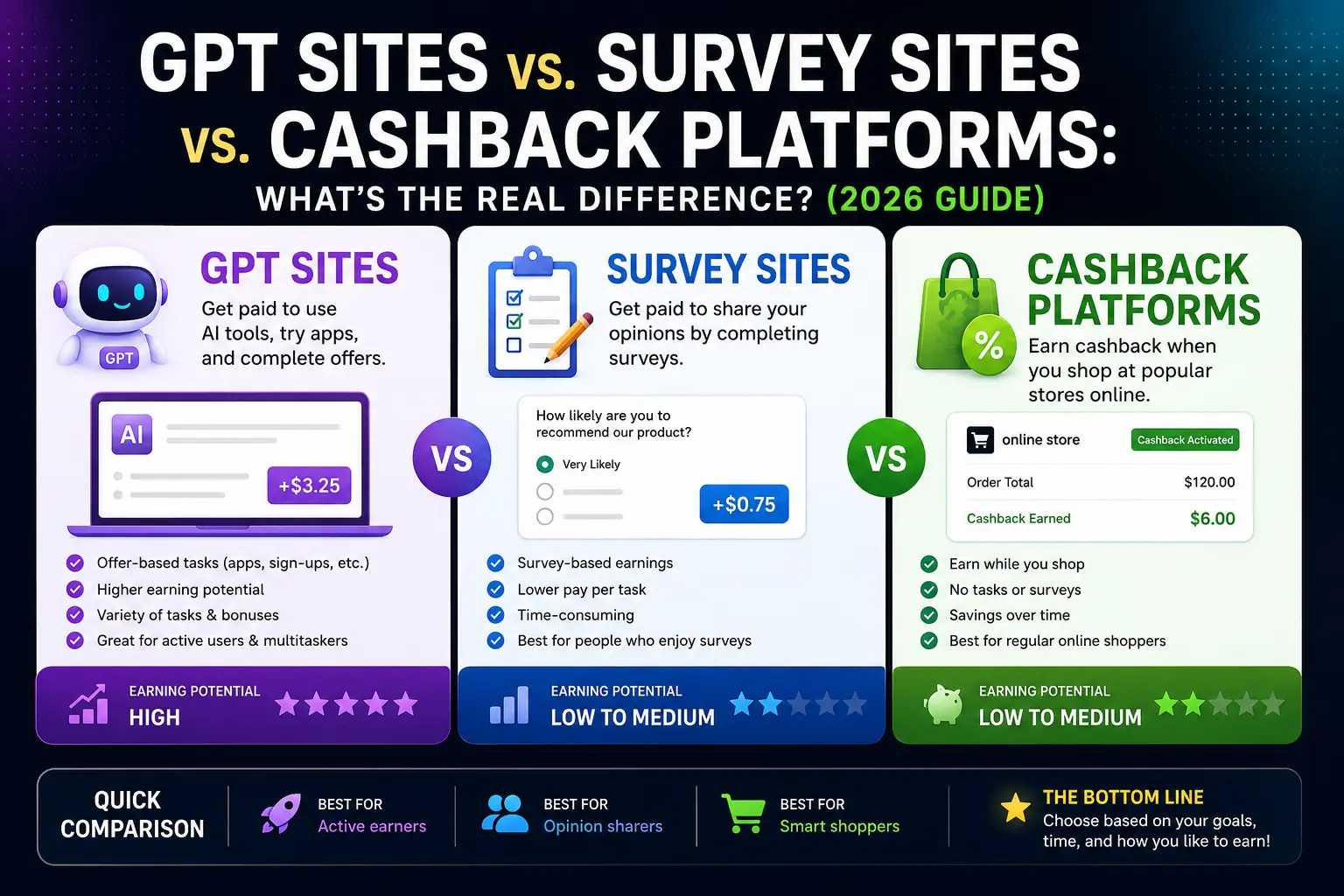
For a scratch build, I recommend starting with direct CPA integration for one or two networks, then expanding. The difference between GPT sites, survey sites, and cashback platforms matters here — make sure you understand which model fits your audience before you commit.
Legal and Compliance Foundation
Before launch, you need:
- Terms of Service — Cover user eligibility, prohibited activities, reward policies, and account termination
- Privacy Policy — GDPR and CCPA compliance are non-negotiable; you're collecting behavioral data
- Cookie Consent — Required in most jurisdictions
- Anti-Money Laundering (AML) Policies — If you're handling significant volume, some regions require KYC for withdrawals above certain thresholds
- Age Restrictions — Most CPA networks require users to be 18+; some allow 13+ with parental consent for specific verticals
I learned this the hard way when a European user filed a GDPR complaint because I didn't have a proper data deletion process. Cost me $2,000 in legal fees to fix what should have been a $50 template. Don't skip compliance.
Phase 2: Choosing the Right Tech Stack
Your tech stack is the foundation everything else builds on. Choose wrong, and you'll be rewriting core systems six months in. Choose right, and you can scale to hundreds of thousands of users without breaking a sweat.
The Frontend: What Users See
For a GPT platform, your frontend needs to be:
- Fast — Users abandon slow offerwalls immediately
- Responsive — 60-70% of GPT traffic is mobile
- SEO-friendly — Organic traffic is your cheapest acquisition channel
In 2026, the dominant choices are:
React + Next.js — This has become the default for production web apps. Next.js supports server-side rendering, static generation, and API routes in a single framework. If you're building a modern, dynamic offerwall interface, this is where I'd put my money. The component-based architecture makes it easy to build reusable offer cards, filter systems, and user dashboards.
Vue.js + Nuxt — A solid alternative if your team prefers Vue's learning curve. Slightly less ecosystem depth than React, but faster to prototype with.
Plain HTML/CSS/JS — Only if you're building the simplest possible MVP and plan to rebuild immediately after validation. I don't recommend this for anything beyond a proof of concept.
The Backend: Where the Money Happens
This is where your postbacks get processed, your user balances get updated, and your fraud detection runs. It needs to be reliable, secure, and fast.
PHP / Laravel — Don't let anyone tell you PHP is dead. Laravel remains dominant in CMS and e-commerce contexts, and for good reason. It's production-ready out of the box with packages for payments (Cashier), API auth (Sanctum), queues (Horizon), and more. If you have PHP experience, this is a fast path to production. Offshore Laravel developers are also the most affordable and abundant talent pool globally.
Node.js / Express or NestJS — Excellent if your frontend is React and you want JavaScript across the stack. Great for real-time features (live leaderboards, instant notifications). NestJS adds structure if you're building a team. The ecosystem for SaaS tooling is mature but less vertically integrated than Laravel.
Python / Django or FastAPI — Best if you plan to integrate ML/AI features later (fraud detection, offer recommendation engines). FastAPI is particularly strong for API-heavy applications. The tradeoff is slightly higher development costs and a smaller talent pool for web-specific work.
Go — If you're planning for massive scale from day one, Go's performance is unmatched. But development speed is slower, and the talent pool is thinner. I wouldn't recommend this for a first build unless you have Go expertise in-house.
For most builders, I recommend Laravel for the backend API and Next.js for the frontend. This combination gives you rapid development, excellent security defaults, and a clear scaling path.
The Database
PostgreSQL is my recommendation for a GPT platform. It handles complex queries well, has excellent JSON support for flexible offer data, and scales vertically better than MySQL for write-heavy workloads (which your conversions table will be).
You'll need tables for:
- Users (auth, profile, balances, fraud scores)
- Offers (cached from CPA networks, with your margins applied)
- Conversions (postback records — this table grows fast)
- Transactions (withdrawals, deposits, reward history)
- Fraud Logs (IP records, device fingerprints, behavior patterns)
Infrastructure & Hosting
- VPS/Cloud: DigitalOcean, Linode, or AWS EC2 for your application servers
- CDN: Cloudflare (free tier handles most needs)
- Queue System: Redis for processing postbacks asynchronously
- SSL: Let's Encrypt (free) or Cloudflare SSL
- Monitoring: Sentry for error tracking, Grafana for metrics
Your postback endpoint must be on HTTPS. CPA networks will reject HTTP endpoints, and rightfully so — you're handling financial transactions.
Phase 3: Architecture & Database Design
This is the section most — how to build a GPT site — guides skip entirely. They'll tell you to — install WordPress and a plugin. — That's fine if you want a blog. It's catastrophic if you're building a financial platform.
Core System Architecture
A production GPT platform has four integrated systems:
1. User Management System
- Registration, authentication, email verification
- Profile management, referral tracking
- Balance tracking (available, pending, lifetime)
- KYC/verification workflows for high-value withdrawals
2. Offer Management System
- API sync with CPA networks (pull offers, update caps, refresh creatives)
- Offer categorization and tagging
- Geo-targeting and device filtering
- Margin calculation and reward pricing
- A/B testing framework for offer placement
3. Tracking & Attribution System
- Click tracking (redirect through your server to the network)
- Postback receiving and validation
- Conversion deduplication
- Reversal handling
- Real-time balance updates
4. Fraud Detection System
- Device fingerprinting
- IP analysis and geolocation verification
- Velocity checks (too many conversions too fast)
- Proxy/VPN detection
- Behavioral pattern analysis
Database Schema Essentials
Here's a simplified version of what your core tables should look like:
Index aggressively on conversions.transaction_id, conversions.user_id, and conversions.created_at. Your conversions table will be your highest-traffic table, and slow queries here will kill your platform.
The Offer Sync Engine
You need a background job that runs every 15-30 minutes to:
- Pull fresh offers from each CPA network API
- Normalize the data (different networks use different field names)
- Apply your margin calculations
- Update or insert into your offers table
- Deactivate offers that have hit their daily cap
- Log any API errors for monitoring
This is where Laravel's queue system (Horizon) or Node.js workers with Bull Queue shine. Never do this synchronously during a user request.
Phase 4: Offerwall API Integration & Postback Tracking
This is the technical heart of your platform. Get this wrong, and users don't get paid. When users don't get paid, they leave, complain, and trash your reputation on Reddit and Trustpilot.
How Offerwall Tracking Works
The data flow looks like this:
The critical piece is the sub-ID parameter (usually sub1, sid, or click_id). This is how you know which user completed the offer. Without it, you cannot credit anyone.
Building the Postback Handler
Your postback endpoint is the most security-sensitive part of your entire application. Here's what a robust handler needs to do:
1. Validate the Source
Check that the request comes from an IP address belonging to the CPA network. Most networks publish their server IP ranges in their documentation.
2. Validate the Secret Token
Include a secret token in your postback URL that only you and the network know. Rotate it quarterly.
3. Check for Duplicates
Use a unique index on transaction_id to prevent the same conversion from being credited twice. Networks sometimes send duplicate postbacks during retries.
4. Validate the Payout
Cross-reference the payout amount against your expected payout for that offer. If it differs by more than 20%, flag it for manual review.
5. Handle Reversals
Advertisers sometimes reverse conversions (user refunded, fraudulent completion). Your handler must deduct the previously credited amount from the user's balance.
6. Return Proper HTTP Codes
200 OKfor successful processing (prevents network retries)403 Forbiddenfor invalid secrets or IPs500 Server Erroronly for genuine unexpected errors (triggers network retry)
Here's pseudocode for a production-ready handler:
For a deeper technical dive, check out our complete builder's guide to creating an offerwall website.
Working with Multiple CPA Networks
No single network has enough offers to fill a global platform. Most successful GPT sites aggregate from 3-5 networks. Here's how to manage that:
Normalize Offer Data
Each network returns offers in a different format. Create an internal — unified offer — structure and map network-specific fields to it during your sync process.
Separate Postback Endpoints
Use /api/postback/network-a, /api/postback/network-b, etc. This lets you apply network-specific validation rules and makes debugging much easier.
Unified Display
Merge all offers into a single sorted list. Users shouldn't know (or care) which network provides each offer.
Track Network Attribution
Record which network each conversion came from. This is essential for revenue reconciliation and identifying which networks perform best for your audience.
Recommended CPA Networks for Beginners
Based on my experience and current market data:
MaxBounty — Excellent for structured content and search traffic. Requires a phone interview, but approval is straightforward if you can explain your traffic source clearly.
CPAlead — Lowest barrier to entry. Light application process, no interview for small publishers. Great for your first test.
MyLead — Good for beginners with low payout thresholds and weekly withdrawals.
CrakRevenue — Strong in gaming and entertainment verticals. High-converting offers but more compliance scrutiny.
For a full breakdown of the best networks by category, Business of Apps maintains an updated list of top CPA affiliate networks.
Phase 5: Building the User Experience
You can have the best offers in the world, but if your UX is clunky, users will bounce before they click anything. I've seen platforms with worse offer selection outperform competitors simply because they were easier to use.
The Offerwall Interface
Your offerwall page should answer three questions within 3 seconds:
- What can I earn? — Clear reward amounts, prominently displayed
- What do I need to do? — Concise, scannable requirements
- How long will it take? — Estimated completion time
Offer Cards should include:
- App/brand logo (builds trust)
- Clear title and description
- Reward amount in the user's local currency
- Estimated time to complete
- Difficulty indicator (easy/medium/hard)
- Category tag (Games, Surveys, Sign-ups, etc.)
Filtering & Sorting are critical:
- By category
- By reward amount (high to low)
- By estimated time (quick wins first)
- By device compatibility
- By — trending — or — most completed —
I A/B tested offerwall layouts extensively. The winner was a clean card grid with a sticky filter bar at the top. Users spent 40% more time on that layout and completed 23% more offers.
The User Dashboard
Your dashboard is where trust is built or broken. It needs to show:
- Available Balance — What they can withdraw now
- Pending Balance — Earnings awaiting advertiser confirmation
- Lifetime Earnings — Social proof and motivation
- Recent Activity — Every click, conversion, and withdrawal
- Progress to Next Withdrawal — Gamification element
Withdrawal System
This is where most new platforms fail. Users need to feel confident they'll actually get paid.
Supported Methods (in order of popularity):
- PayPal
- Cryptocurrency (USDT, BTC, ETH)
- Gift Cards (Amazon, Visa prepaid)
- Bank Transfer (for high-volume users)
Critical Features:
- Minimum withdrawal threshold ($1-$5 is standard for new platforms)
- Processing time transparency ( — PayPal: 24-48 hours — )
- Withdrawal history with status tracking
- Email notifications at each stage (requested, processing, completed)
I started with a $10 minimum and watched my user retention crater. Dropped it to $3, and completion rates jumped 35%. Sometimes you have to sacrifice margin for volume.
Mobile Experience
If your platform isn't optimized for mobile, you're dead in the water. Most offer completions happen on smartphones. Your mobile experience should be:
- Thumb-friendly navigation
- Fast-loading offer cards
- One-tap offer starts
- Sticky header with balance visible
- Bottom-sheet filters instead of sidebar menus
If you're also building a mobile app, our guide on how to add an offerwall SDK to Android and iOS covers the technical implementation.
Phase 6: Fraud Prevention & Security
Fraud is the silent killer of GPT platforms. I lost nearly $8,000 in my first three months because I didn't take this seriously enough. Here are the attack vectors you need to defend against:
Types of GPT Fraud
1. Multi-Accounting
One person creates dozens of accounts to exploit referral bonuses or complete the same offer multiple times.
2. VPN/Proxy Abuse
Users mask their location to access higher-paying offers intended for other countries.
3. Click Fraud / Botting
Automated scripts complete offers or generate fake clicks.
4. Offer Reversal Fraud
Users complete offers and then request chargebacks or refunds.
5. Postback Spoofing
Attackers send fake postbacks to your endpoint to generate free credits.
Defense Strategies
Device Fingerprinting
Collect 20+ device attributes (screen resolution, fonts, WebGL signatures, canvas fingerprints, timezone, language) and hash them into a fingerprint. Flag accounts sharing fingerprints.
IP Intelligence
- Block known datacenter IPs (DigitalOcean, AWS, etc.) from user registration
- Check IP against proxy/VPN blacklists (IPQualityScore, MaxMind)
- Compare IP geolocation against user's stated country
Velocity Checks
- Max 3 registrations per IP per day
- Max 5 offer completions per hour per user
- Flag users who complete offers faster than humanly possible
Behavioral Analysis
- Mouse movement patterns (bots move in straight lines)
- Time-on-page metrics
- Conversion rate anomalies (if a user converts on 90% of offers they click, they're probably cheating)
Postback Security
- IP whitelisting (only accept postbacks from known network IPs)
- Secret token validation
- Transaction deduplication
- Payout validation against expected values
Account Verification
- Email verification mandatory
- Phone verification for withdrawals above $10
- ID verification for withdrawals above $50
Mistplay's research on offerwall best practices emphasizes that modern offerwalls must balance revenue generation with fraud prevention to maintain long-term platform health.
Building Trust with Users
Fraud prevention isn't just about stopping cheaters — it's about protecting legitimate users. When you catch a fraud ring, publicize it (anonymously) in your community. Users respect platforms that protect the integrity of the ecosystem.
Also, be transparent about your fraud detection. I include a simple line in my Terms: — We use automated systems to detect fraudulent activity. False positives are rare, but if you believe your account was flagged incorrectly, contact support. — This sets expectations and reduces angry tickets.
Phase 7: Monetization & Revenue Optimization
Setting Your Margins
This is where art meets science. Your margin is the difference between what the advertiser pays and what you pay the user.
Typical Margins by Vertical:
- Surveys: 25-35%
- App installs (CPI): 30-45%
- Sign-ups (CPL): 35-50%
- Purchases (CPS): 20-30%
- Video views: 40-60%
I started with a flat 30% across all offers. Big mistake. Some offers converted so well I could have taken 45% and still paid users competitively. Others were so competitive I needed to drop to 20% to get any conversions at all.
Dynamic Margin Strategy:
Analyze each offer's EPC and conversion rate weekly. High-performing offers can absorb higher margins. Low-performing offers need lower margins or deactivation.
Revenue Optimization Tactics
1. Offer Ranking
Sort your offerwall by a weighted score, not just payout:
This surfaces offers that actually convert, not just ones that pay well.
2. Geo-Optimization
Different countries have different offer availability and payouts. Create region-specific offerwalls. US users see high-paying app installs; Indian users see more survey opportunities.
3. Retargeting Campaigns
Email users who clicked offers but didn't complete them. — Still interested in earning $3.50 from Coin Master? Here's a tip to reach Level 5 faster. —
4. Referral Programs
A strong referral system is your cheapest acquisition channel. Structure it as:
- Referrer gets 10% of referee's lifetime earnings
- Referee gets $1 sign-up bonus
- Minimum referee activity required before referrer gets paid (prevents abuse)
5. Leaderboards & Gamification
Weekly earning leaderboards with small prizes ($5-$25) drive massive engagement. Users will complete extra offers just to climb the ranks.
The Numbers That Matter
Track these metrics religiously:
| Metric Target Why It Matters | ||
| DAU/MAU Ratio | >20% | Measures stickiness |
| Average Revenue Per User (ARPU) | >$0.25/day | Your core unit economics |
| Offer Click-Through Rate | >8% | Offerwall UX quality |
| Conversion Rate (Click to Complete) | >12% | Offer quality and targeting |
| Withdrawal Request Rate | >60% of eligible users | Trust indicator |
| Fraud Rate | <2% | Platform health |
For a deeper understanding of what makes GPT platforms profitable, read our breakdown of the real economics behind successful GPT platforms.
Phase 8: Launch, Test & Scale
Pre-Launch Testing Checklist
Before you let a single real user on your platform:
Functional Testing:
- User registration and login work across devices
- Email verification delivers and validates
- Offerwall loads and displays correctly
- Click tracking redirects properly to advertiser pages
- Postback handler receives, validates, and credits correctly
- Duplicate postbacks are rejected
- Reversal postbacks deduct user balance
- Withdrawal requests process correctly
- Referral tracking attributes correctly
Security Testing:
- Postback endpoint rejects invalid secrets
- Postback endpoint rejects requests from unknown IPs
- SQL injection attempts are blocked
- XSS attempts in user inputs are sanitized
- Rate limiting works on all endpoints
Load Testing:
- Postback endpoint handles 100 requests/minute
- Offerwall loads in under 2 seconds with 500 offers
- Database queries complete in under 100ms
Soft Launch Strategy
Don't blast Reddit and Twitter on day one. Start with a soft launch:
Week 1-2: Invite 50-100 beta users from your personal network. Give them a small bonus for feedback. Watch your logs like a hawk.
Week 3-4: Open to a single traffic source (one Facebook group, one subreddit, one Discord community). Monitor conversion rates and fraud signals.
Month 2: Scale to multiple channels. Start SEO content marketing. Begin outreach to CPA network account managers for better payouts.
Month 3+: Paid acquisition if your unit economics support it. If your ARPU is $0.30/day and your CPA is $0.50, you break even in under 2 days. That's a green light for paid traffic.
Scaling Infrastructure
As you grow:
- Database: Add read replicas for offerwall queries. Shard conversions table by month if you hit millions of records.
- Caching: Redis for offer data and user sessions
- CDN: Cloudflare for static assets and DDoS protection
- Monitoring: Set up alerts for zero postbacks in 1 hour (network issue), error rate >1%, or withdrawal queue backing up
Common Mistakes That Kill New GPT Sites
I've made most of these. Learn from my pain:
1. Integrating Too Many Networks Too Soon
Start with 1-2 networks. Master the integration. Adding five networks at launch creates a debugging nightmare when conversions don't track properly.
2. Ignoring Mobile UX
If your offerwall doesn't work perfectly on a 6-inch screen, you've lost 60% of your audience before you start.
3. Setting Withdrawal Minimums Too High
Users need to experience a cashout quickly to trust your platform. $10 minimums kill momentum. Start at $1-$3.
4. Poor Postback Validation
I once credited a user $4,200 because I didn't validate payout amounts. A spoofed postback with an inflated payout slipped through. That mistake cost me real money and credibility.
5. Neglecting Customer Support
GPT users are anxious about getting paid. If they email you and don't hear back in 24 hours, they assume you're a scam. Hire support help before you think you need it.
6. Copying Big Platforms Exactly
Swagbucks can afford to be generic — they have brand recognition. You can't. Find a niche, a unique angle, or a superior UX to differentiate.
7. Not Reading Network Terms
Some CPA networks prohibit incentivized traffic for certain offers. Running those on a GPT site gets you banned from the network and clawbacks on your earnings.
Final Thoughts: Is It Worth It in 2026?
If you're wondering whether GPT websites are still profitable, the answer is a qualified yes.
The market is more competitive than it was five years ago. Users are savvier. Advertisers are pickier. The days of throwing up a generic offerwall and watching the money roll in are over.
But the opportunity is still massive for builders who:
- Understand their niche deeply
- Build robust, secure technology
- Curate offers obsessively
- Protect their ecosystem from fraud
- Treat users with respect and transparency
I won't sugarcoat it: building a GPT platform from scratch is hard work. It's not a weekend project. It's not passive income. It's a real business that requires real engineering, real marketing, and real customer service.
But if you do it right, it's also one of the most scalable online business models available. Your marginal cost per user approaches zero. Your revenue compounds as your user base grows. And in a world where everyone is looking for side income, you're building the infrastructure that connects ambition with opportunity.
Start small. Build smart. Scale carefully. And never, ever skip the postback validation.
Ready to build? Start with our complete offerwall builder's guide for the technical deep-dive, or explore how the GPT market works to validate your niche before you commit.

Comments (0)
No comments yet. Be the first to share your thoughts!