
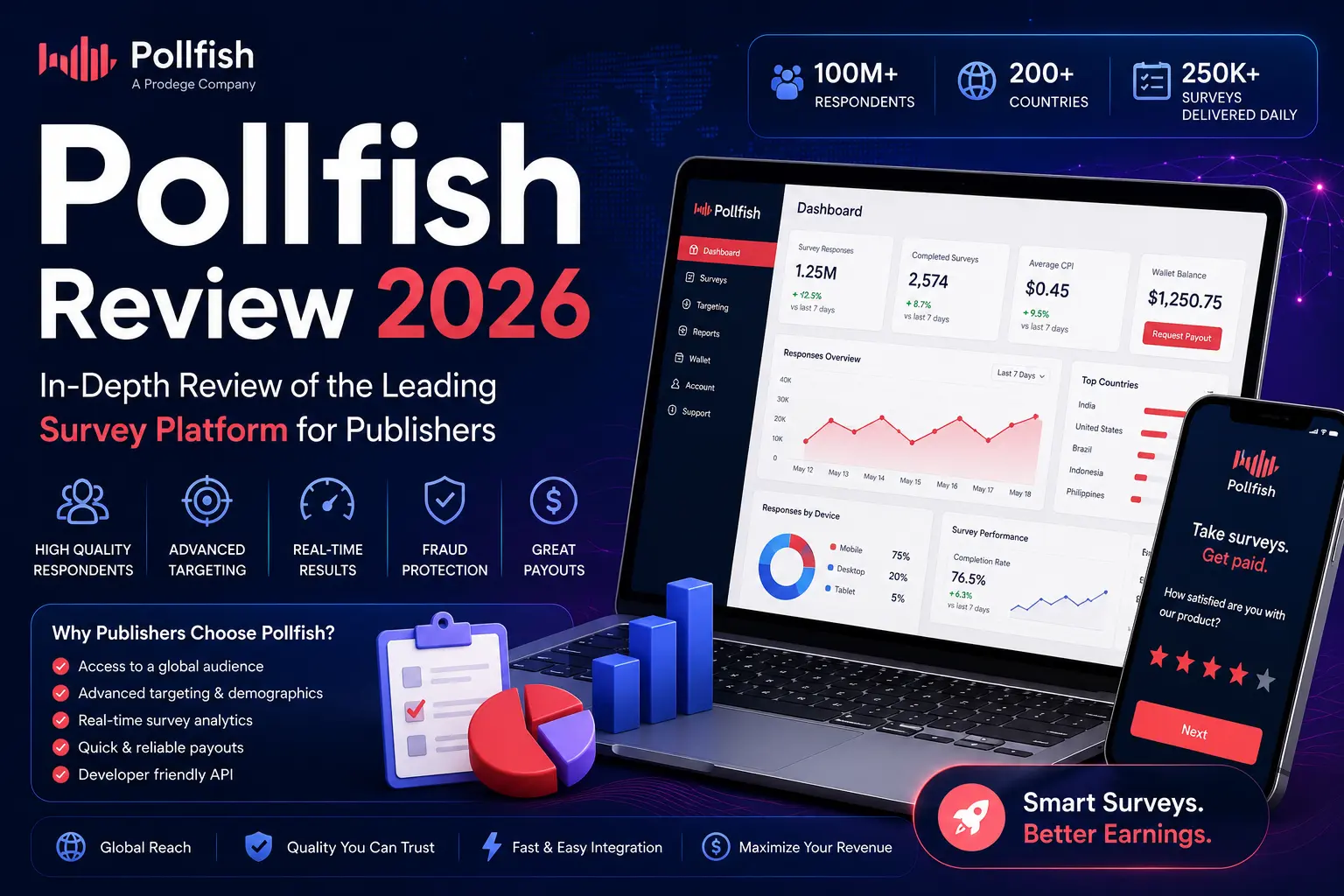
Pollfish is one of the more unusual names in the publisher monetization market because it sits at the intersection of market research, rewarded surveys, mobile monetization, and offerwalls.
For a publisher, the important question is not simply whether Pollfish has surveys. The real question is whether its inventory, integration options, tracking infrastructure, and reward economics make sense for your particular website, app, game, or rewards platform.
I spent time looking at Pollfish from that publisher/developer perspective rather than treating it as another generic "paid survey site." That distinction matters. Pollfish was originally built around mobile survey distribution and has historically been particularly strong in rewarded surveys. Its documentation and developer ecosystem also show support for SDK-based integrations, offerwall mode, API delivery, and server-to-server callbacks.
There is also an important 2026 caveat: some of the older Pollfish publisher documentation and GitHub integrations have been archived, while current Prodege infrastructure is increasingly visible alongside Pollfish branding. So publishers should verify the exact current onboarding and integration route before building a new production integration around older examples.
With that in mind, here is my detailed Pollfish review.
1. Overview
Pollfish is a mobile-first survey and market-research platform that allows researchers to reach consumers while giving participating publishers a way to monetize their audiences with rewarded surveys and survey offerwalls.
The original Pollfish proposition was straightforward:
Researcher — Pollfish — Publisher/App — User
A researcher pays for qualified survey responses. Pollfish distributes those surveys to eligible users. The publisher receives revenue when users complete qualifying surveys and can then give the user an internal reward such as coins, points, credits, extra lives, or another virtual benefit.
Pollfish has also developed an offerwall approach in which users can see multiple available surveys instead of being presented with a single survey at a time. Pollfish described this as a way for publishers to increase engagement and give users more choice.
The company is now part of Prodege, giving it access to a much broader consumer ecosystem. Pollfish currently advertises access to more than 250 million consumers across 60+ countries on its research side, although publishers should distinguish that research-side audience figure from guaranteed monetization inventory for a particular app or GEO.
That distinction is important.
A large respondent network does not mean every publisher will receive a large number of monetizable surveys.
Survey inventory depends heavily on:
- GEO
- age
- gender
- demographics
- user profile
- survey demand
- campaign quotas
- device
- traffic quality
- timing
- available research budgets
Pollfish itself has historically emphasized that surveys are not comparable with traditional display advertising where publishers expect a predictable fill rate. A survey can be available for one demographic and completely unavailable for another at exactly the same time.
My verdict: Pollfish is best understood as a specialized rewarded-survey monetization platform, not a conventional display ad network.
2. Who is it for?
Pollfish is primarily suited to publishers that have an audience willing to exchange time and attention for rewards.
The strongest candidates include:
- Mobile app developers
- Mobile game developers
- Rewards/GPT platforms
- Loyalty applications
- Cashback platforms
- Entertainment apps
- Community platforms
- Education and utility apps
- Websites with a strong rewards component
- Platforms with an existing virtual currency
The model works particularly well when the publisher already has a reward economy.
For example, imagine a game where a user has run out of coins.
Instead of forcing that user to purchase coins, the game can offer:
"Complete a survey and receive 500 coins."
This creates a straightforward value exchange.
Pollfish has specifically promoted rewarded surveys as an alternative or complement to rewarded advertising and in-app purchases.
3. Supported platforms
Pollfish has historically supported:
- Android
- iOS
- Web
- API-based implementations
- Offerwall integrations
- Cross-platform frameworks through community/official plugins
The native mobile SDK model has been one of Pollfish's defining strengths.
Official Pollfish repositories document Android and iOS integrations, while Flutter and React Native plugins have also existed. However, this is an area where I would be careful in 2026 because some older repositories were archived on May 28, 2026.
For a new project, don't blindly copy an old SDK tutorial. Confirm the currently supported Prodege/Pollfish integration before committing your production architecture.
4. Website support
Pollfish has supported survey distribution beyond native mobile applications, and its offerwall model has historically been available for web environments as well.
Pollfish itself describes offerwalls as existing in both web and mobile environments.
For a website publisher, however, the experience is somewhat different from integrating a conventional advertising tag.
The ideal website use case is a site where users already have a reason to participate in a reward system.
Examples:
- GPT website
- Rewards website
- Loyalty portal
- Community with points
- Educational rewards platform
- Consumer research community
A normal content blog with no reward economy is not necessarily the natural home for Pollfish.
5. App support
This is where Pollfish has historically been strongest.
The Pollfish SDK was designed specifically to bring surveys into mobile apps without forcing users to leave the application. Pollfish's own material describes Android and iOS SDK integrations and emphasizes in-app survey monetization.
The developer can choose between:
- A single rewarded survey
- Offerwall mode
- Custom reward flows
- User identification
- Server-side reward callbacks
That makes Pollfish considerably more useful than a simple survey URL.
6. Game support
Games are one of Pollfish's strongest use cases.
A survey can become part of the game's virtual economy:
- Earn coins
- Unlock a level
- Get extra lives
- Unlock a feature
- Receive energy
- Remove ads
- Obtain a temporary boost
Pollfish has repeatedly described rewarded surveys as particularly suitable for games because the user voluntarily enters the reward flow rather than being interrupted by an advertising format.
The most natural placement is usually something like:
Free Coins — Surveys — Complete Survey — Receive Coins
This is much more intuitive than inserting a survey randomly into gameplay.
7. Integration methods
Pollfish has historically provided several integration approaches.
The major options are:
- SDK
- API
- Offerwall
- Server-to-server callbacks
- Platform-specific plugins
The SDK is the easiest choice for native mobile applications.
The API becomes more interesting when the publisher wants complete control over the user interface and server-side architecture.
Pollfish's API examples demonstrate an offerwall flow where the publisher requests available surveys and then renders the resulting survey experience.
8. API availability
Yes. Pollfish has an API.
There are actually several API-related surfaces.
The documented ecosystem has included:
- Publisher/application management APIs
- Performance/reporting APIs
- Survey distribution APIs
- Offerwall APIs
- Server-to-server callbacks
Third-party API documentation derived from Pollfish's published interfaces identifies a dashboard API and a survey distribution/offerwall API.
The API approach is particularly attractive for developers who don't want the SDK to control the entire survey presentation.
One example is Pollfish's official API offerwall example on GitHub, which demonstrates retrieving an offerwall and handling events such as survey availability, screening, completion, and closure.
API rating: 8.5/10
The capability is strong, but developers should verify the current API documentation because some historical documentation URLs now redirect into Prodege's newer documentation infrastructure.
9. iFrame availability
This needs a qualification.
Pollfish has supported web-based and API-driven survey/offerwall experiences, but I would not recommend treating "iframe support" as a guaranteed first-class Pollfish feature without confirming it with the current publisher onboarding team.
The older Pollfish architecture focused heavily on SDK and API integrations.
If your project specifically requires:
<iframe src="...">as the core integration method, confirm the exact current implementation before choosing Pollfish.
For a modern web rewards platform, an API or officially supported web integration is preferable to building your business around an undocumented iframe endpoint.
iFrame verdict: verify before implementation.
10. SDK availability
Historically, SDK support has been one of Pollfish's biggest advantages.
Pollfish has provided SDK integrations for:
- Android
- iOS
- Flutter
- React Native
- Mediation environments
Its Flutter plugin documentation shows support for both Android and iOS, reward mode, offerwall mode, request UUIDs, user properties, and release mode.
The React Native plugin similarly supports Android and iOS and includes reward and offerwall modes.
However, there is an important 2026 warning:
Several historical Pollfish GitHub repositories are now archived.
That doesn't automatically mean Pollfish monetization has disappeared. It means developers should avoid assuming that an old SDK repository represents the current recommended integration.
SDK rating: 8/10 for historical capability; verify current production SDK status before new deployment.
11. Postback system
Pollfish has supported server-to-server callbacks, and this is one of the most important features for serious publishers.
The basic architecture is:
User completes survey — Pollfish verifies completion — Pollfish sends S2S callback — Publisher credits user
Pollfish has explicitly recommended S2S callbacks for rewarding users because server-side verification provides better protection against fraudulent reward claims.
Historical Pollfish documentation exposes callback concepts such as:
- Request UUID
- Transaction ID
- Click ID
- CPA
- Reward value
- Reward name
- Status
- Termination reason
- Signature
The API ecosystem documentation also identifies signed S2S completion callbacks.
For a serious GPT platform, this is exactly what you want.
Never rely exclusively on a client-side "survey completed" event to credit withdrawable money.
12. Tracking
Pollfish supports user-level identification and transaction tracking mechanisms designed to connect the survey interaction with the publisher's user.
One important identifier is the request UUID.
The SDK documentation describes request UUID as a unique identifier for a user that can also be passed through server-to-server callbacks.
This is useful for mapping:
Pollfish transaction — Your internal user ID — Reward transaction
That architecture makes reconciliation significantly easier.
For a rewards platform, I recommend maintaining your own immutable transaction record containing:
- Internal user ID
- Pollfish request UUID
- Transaction ID
- Survey ID if available
- Reward amount
- Publisher revenue
- Timestamp
- Status
- Callback signature/result
That makes support disputes much easier to investigate.
13. Attribution window
Pollfish is different from an app-install CPA network.
There isn't a conventional attribution window in the same sense as:
Click — install within 7 days — reward
Instead, the core monetization event is generally tied to survey eligibility and completion.
That means the traditional "1-day / 7-day / 30-day attribution window" question is not the most useful way to evaluate Pollfish.
For survey monetization, what matters more is:
- Session identification
- User identity
- Survey eligibility
- Completion verification
- Transaction ID
- S2S confirmation
- Fraud checks
Verdict: Pollfish is not primarily an attribution-window-driven offerwall.
14. Offer types
Pollfish's core offer is the survey.
Depending on the specific product and current inventory, publishers may encounter:
- Market research surveys
- Rewarded surveys
- Survey offerwalls
- Screening-based surveys
- Short-form surveys
- Longer research questionnaires
Pollfish has historically positioned surveys as a premium alternative to conventional advertising, while its broader Prodege ecosystem can expose publishers to additional rewarded activities.
This is an important distinction.
If your business absolutely requires:
- App installs
- Game milestones
- Free trials
- Subscriptions
- Lead generation
- Purchases
then a general-purpose offerwall network may provide broader inventory.
Pollfish is strongest when surveys are the primary product you want to monetize.
15. GEO coverage
Pollfish has a genuinely international footprint.
Its current research platform advertises access to 250M+ consumers across 60+ countries, while older Pollfish materials described availability across more than 160 countries.
But don't interpret those figures as guaranteed publisher inventory.
A publisher in the United States may experience completely different inventory from a publisher in Egypt, Brazil, India, Germany, or the Philippines.
Survey demand follows research budgets.
The practical rule is:
Large global coverage — equal monetization in every country.
For GEO-specific publishers, test actual revenue per 1,000 eligible users rather than relying on the headline respondent count.
16. Survey inventory
Survey inventory is Pollfish's core strength.
The platform has access to research demand from brands and market researchers, and Pollfish has historically highlighted surveys associated with major brands and research organizations.
However, survey inventory behaves differently from banner advertising.
A user may see:
- 10 surveys today
- 3 surveys tomorrow
- zero surveys the next day
Another user in the same application may see completely different inventory.
Why?
Because surveys are targeted.
Researchers may request:
- Women aged 25 — 34
- Android users
- People who bought a certain product
- People living in a specific city
- Parents
- Gamers
- Professionals
- Specific income groups
Therefore, user demographics directly influence monetization potential.
17. Gaming inventory
Pollfish is not primarily a traditional game-offer network.
Its gaming strength comes from rewarded survey monetization inside games.
The publisher can use surveys as an alternative reward path alongside:
- Rewarded video
- IAP
- Other offerwalls
- Virtual currency systems
Pollfish has specifically documented placements such as Free Coins sections and other rewarded locations within mobile games.
For a game developer, this makes Pollfish more interesting as a complementary monetization channel than as a complete replacement for an offerwall containing hundreds of app-install and game-progress offers.
18. Fraud prevention
Fraud prevention is essential because publishers are effectively converting advertiser-funded actions into user rewards.
Pollfish has historically used device information, demographic profiling, screening, and quality mechanisms to determine whether a user is eligible for a survey. Its methodology documentation describes the use of mobile device identifiers and respondent information to help target and verify survey participation.
The S2S callback architecture adds another layer of protection.
For publishers, the best practice is:
- Never trust client-side completion alone
- Validate callback signatures
- Store transaction IDs
- Prevent duplicate transaction processing
- Make rewards idempotent
- Keep an audit trail
- Detect suspicious user behavior
- Don't allow users to manipulate reward parameters
Pollfish's own guidance recommends S2S callbacks for rewarding users.
Fraud/security rating: 8/10
19. Reporting
Reporting is another strong area.
Pollfish's historical offerwall dashboard has provided information such as:
- eCPM
- Conversions
- Funnel events
- Revenue
- GEO performance
- Survey provider performance
- User logs
- S2S callback information
Pollfish specifically described real-time reporting and the ability to drill down by country and survey provider.
That is valuable because survey monetization should be optimized by actual performance, not by headline payout.
For example:
| MetricWhy it matters | |
| Requests | Measures demand |
| Survey availability | Measures inventory |
| Starts | Measures user interest |
| Completions | Measures conversion |
| Revenue | Measures monetization |
| eCPM | Compares GEO/value |
| Screen-outs | Measures targeting quality |
| Callback status | Confirms reward delivery |
A publisher should analyze these metrics separately for each GEO.
20. Reward flexibility
Pollfish gives publishers considerable flexibility in how they reward users.
The user does not necessarily need to receive cash directly.
The publisher can create its own reward economy:
- Coins
- Points
- Credits
- Energy
- Lives
- Premium features
- Virtual currency
- Ad removal
- Other digital benefits
Pollfish has historically documented reward mode and virtual reward customization.
This is especially useful for games and GPT platforms.
For example:
Pollfish pays publisher $1.00 — publisher gives user 700 coins
The publisher controls the economics.
21. Payout model
The core publisher model is performance-based.
Publishers earn when users complete qualifying surveys.
Pollfish has historically described its model as CPA-based, with publishers paid per completed survey.
The exact publisher payout isn't a fixed universal number.
It varies according to:
- Survey value
- Market
- Target audience
- Survey length
- Research demand
- Campaign economics
- User eligibility
Older Pollfish publisher materials cited completed-survey payouts ranging from roughly $0.30 to several dollars, but these should be treated as historical examples rather than a current guaranteed rate card.
This is one of the places where I would avoid trusting old review articles that promise a specific "average Pollfish payout."
There is no single payout applicable to every publisher.
22. Payment methods
This is one area where Pollfish's public publisher-facing documentation does not provide a sufficiently clear current universal payment-method list for me to recommend a specific method as guaranteed in 2026.
Historically, publisher monetization has been handled through the Pollfish publisher relationship and dashboard.
Therefore, don't build your accounting system around an assumption such as:
"Pollfish definitely pays every publisher through PayPal."
Confirm the available payment method, payment threshold, invoicing requirements, and payment schedule during publisher onboarding.
Rating: 6.5/10 for publicly documented transparency.
The monetization mechanism is clear; current payment-method documentation is less clear.
23. Approval requirements
Pollfish is not simply a case of grabbing a random tracking URL and immediately sending traffic.
Mobile developers have historically needed to:
- Create a developer account
- Add their app
- Obtain API keys
- Integrate the SDK
- Test the integration
- Publish the application
- Request account/app verification
The official Flutter integration documentation explicitly describes requesting approval from the Pollfish dashboard after publishing.
This is normal for a serious monetization platform.
It also means Pollfish is not the ideal choice for someone looking for an anonymous, zero-review integration.
24. Minimum traffic
I could not find a reliable current official Pollfish source establishing a universal minimum monthly traffic requirement for publishers.
That is actually preferable to inventing a number.
Older publisher models and current onboarding can differ depending on:
- Platform
- GEO
- App category
- Traffic quality
- Integration type
- Business model
- Compliance
So I would not publish a claim such as:
"Pollfish requires 10,000 monthly users."
unless Pollfish confirms that requirement for the specific account.
For publishers with smaller audiences, the best approach is to apply and ask the publisher team directly.
25. Publisher support
Historically, Pollfish has advertised dedicated publisher support, including 24/7 support for its survey offerwall.
Support is particularly important with survey monetization because many "missing reward" complaints aren't actually payment problems.
They can originate from:
- Screen-outs
- Quota exhaustion
- Duplicate completions
- Fraud detection
- Tracking errors
- Incorrect reward logic
- User ID mismatches
- Callback failures
A publisher needs proper logs before contacting support.
If your platform is processing thousands of rewards, support quality becomes almost as important as payout rates.
26. Strengths
1. Strong survey specialization
Pollfish's biggest advantage is that surveys are not an afterthought. They are the company's historical core product.
2. Excellent mobile orientation
The SDK model was built around mobile apps and rewarded surveys.
3. Good fit for games
The reward model maps naturally to virtual economies.
4. Offerwall support
Publishers can expose multiple survey opportunities rather than relying on a single survey.
5. S2S callbacks
This is essential for reliable reward processing.
6. Detailed reporting
Historical publisher dashboards have offered detailed performance information.
7. Global audience
Pollfish's broader research ecosystem has significant international reach.
8. Flexible reward economics
Publishers can determine how much virtual currency to give users.
9. Strong research-side demand
The platform is connected to legitimate market-research demand rather than being purely an affiliate offer aggregator.
27. Weaknesses
1. Survey inventory is unpredictable
This is probably the biggest weakness for publishers expecting ad-network-style consistency.
2. Screen-outs can frustrate users
A user can start a survey and discover that they aren't qualified.
Pollfish itself explains that screening can happen after a user has entered a survey.
3. Not a complete CPA offerwall
If your users want dozens of app installs and game milestones, Pollfish isn't necessarily the best single network.
4. Current developer documentation needs verification
Several historical repositories were archived in 2026.
5. Payment documentation isn't especially transparent publicly
Publishers should confirm payment details before deployment.
6. Revenue varies significantly by GEO
A publisher shouldn't assume that U.S. performance will resemble Egypt, India, or other emerging markets.
7. Not ideal for every website
Pollfish makes more sense when the website has a reward mechanism.
28. Best use case
The best Pollfish use case is:
A mobile app or game with an existing reward/virtual-currency system and users in commercially valuable survey markets.
A good implementation might look like this:
Game — Free Coins — Pollfish Offerwall — Survey — S2S Callback — Credit Coins
This is simple, understandable, and aligned with the product.
A second strong use case is a GPT/rewards platform where Pollfish is one survey provider among several.
In that model, Pollfish doesn't have to carry the entire platform.
You can combine it with other providers to reduce inventory gaps.
For a publisher building a serious rewards business, that is the approach I would prefer.
29. Who should avoid it
I would avoid relying on Pollfish as the primary monetization network if:
- Your website has no reward mechanism
- Your audience is extremely small
- Your traffic is concentrated in low-demand GEOs
- You need predictable CPM advertising
- You need thousands of non-survey CPA offers
- Your business depends heavily on app-install attribution
- You cannot implement S2S tracking
- You expect every user to receive an offer
- You don't have a way to handle survey screen-outs
Pollfish can be excellent, but it isn't magic inventory.
30. Alternatives
Pollfish should usually be compared against several different categories rather than one competitor.
CPX Research
A strong choice if your primary objective is survey volume.
It is particularly relevant for GPT and survey-focused platforms.
TheoremReach
Another survey-focused provider that can be useful when you want additional survey inventory and diversification.
BitLabs
Worth considering for publishers that want a broader rewards ecosystem involving surveys and other rewarded activities.
AdGate Media
More suitable when your objective is a traditional offerwall containing app installs, registrations, subscriptions, and game-related offers.
Lootably
A useful alternative for publishers that want broader CPA-style offerwall inventory.
A multi-offerwall strategy
For a serious rewards platform, I would not necessarily choose Pollfish OR another network.
I would use:
Pollfish + CPX Research + TheoremReach + a general CPA offerwall
That creates redundancy.
If Pollfish has weak inventory for one user, another provider may have something relevant.
For publishers building their own rewards infrastructure, the broader concept is covered in Hansal Dev's guide:
What Is an Offerwall? Meaning, Mechanics, and Earning Potential
The broader mobile monetization discussion is also covered here:
Mobile App Monetization Platform: The Complete 2026 Guide
And for a wider network comparison:
Best Offerwall Sites (2026): Top Networks Ranked for High Payouts
31. Final rating
Pollfish Publisher Rating: 8.2/10
| Category | Rating |
| Survey inventory | 9/10 |
| Mobile support | 9/10 |
| Game support | 9/10 |
| SDK ecosystem | 8/10 |
| API | 8.5/10 |
| S2S postbacks | 9/10 |
| Tracking | 8.5/10 |
| Reporting | 8.5/10 |
| GEO coverage | 9/10 |
| Fraud protection | 8/10 |
| Reward flexibility | 9/10 |
| Publisher support | 8/10 |
| Payment transparency | 6.5/10 |
| Non-survey offer variety | 6.5/10 |
| Documentation freshness | 6.5/10 |
Final verdict
Pollfish remains a serious option for publishers who want to monetize users through rewarded surveys, particularly mobile applications and games.
Its biggest strength is also its specialization: Pollfish understands survey monetization extremely well.
The platform's rewarded-survey model can work particularly well when integrated into an existing virtual economy. A game can give users coins. A rewards application can give points. A loyalty platform can give credits. The publisher earns revenue from completed research while the user receives something immediately useful.
The important thing is not to confuse Pollfish with a traditional advertising network.
You shouldn't install it and expect every user to see an offer.
You shouldn't evaluate it only by looking at the highest advertised survey payout.
And you shouldn't build your business around old SDK tutorials without checking the current integration path.
The more sensible approach is to treat Pollfish as a premium survey-demand source inside a diversified monetization stack.
For a mobile game, rewards app, GPT platform, or loyalty product, I would definitely test it.
For a general content website with no reward economy, I would look elsewhere.
For a serious rewards platform, my preferred architecture would be to integrate Pollfish alongside several complementary offerwall and survey providers, then route users according to GEO, inventory, conversion rate, and revenue.
That is ultimately where Pollfish makes the most sense in 2026: not necessarily as your entire monetization strategy, but as a strong survey component inside a larger rewards ecosystem.
Overall: 8.2/10 — Recommended for mobile apps, games, and rewards platforms; best used as part of a diversified offerwall strategy.
Trusted resources
For the most reliable technical information, use the official Pollfish/Prodege documentation and repositories rather than old third-party integration tutorials.
- Pollfish official website
- Pollfish Survey Platform
- Pollfish quality and methodology information
- Pollfish official GitHub organization
- Pollfish Flutter integration repository
- Pollfish React Native integration repository
- Pollfish API offerwall example
Research note: Product capabilities, documentation, SDK status, inventory, GEO availability, approval policies, and payment arrangements can change. The ratings above reflect the publisher/developer perspective and the publicly available information reviewed for this 2026 edition, rather than guarantees of revenue or inventory for an individual account.




Comments (0)
No comments yet. Be the first to share your thoughts!