
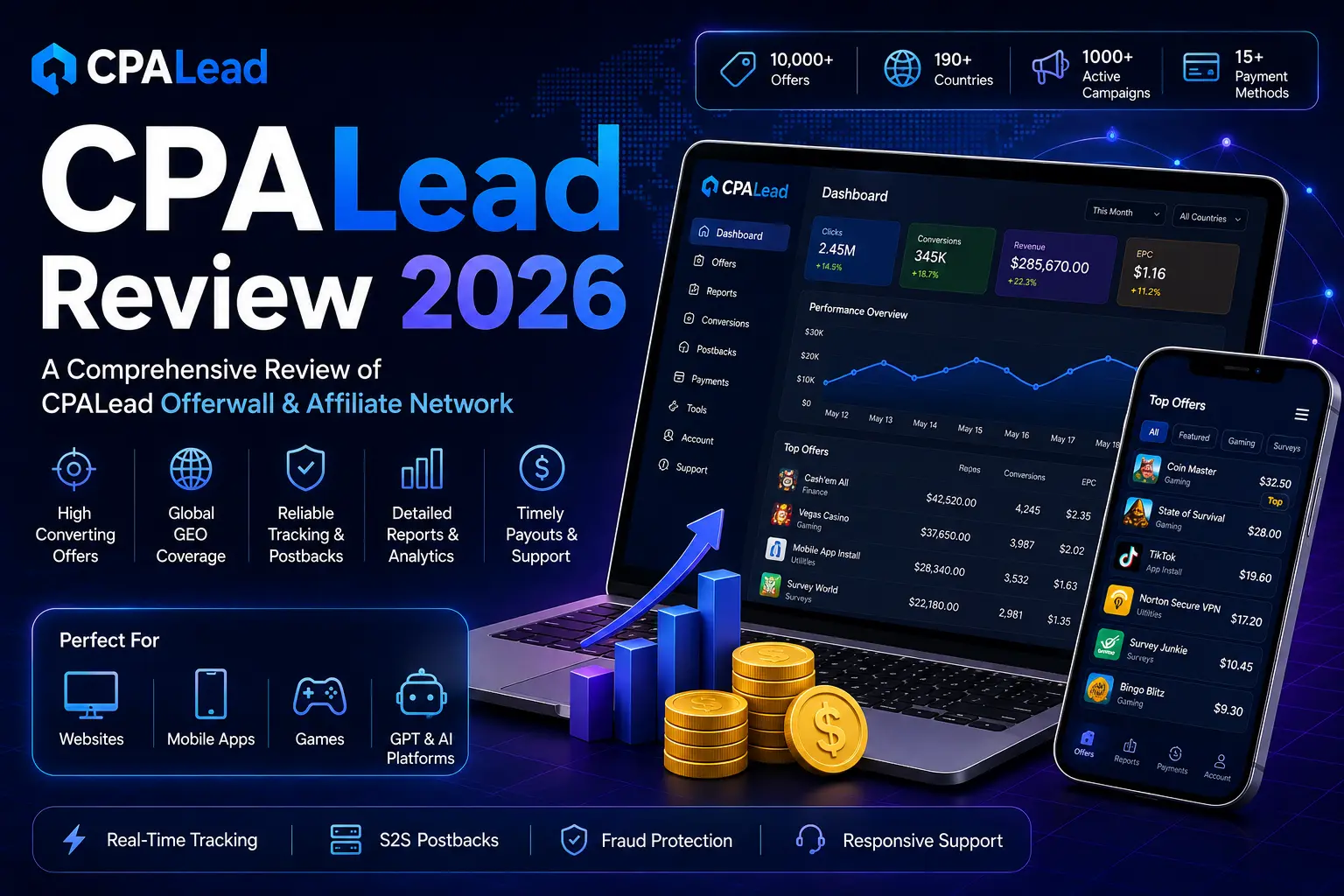
1. Overview
CPAlead is one of the older names in the CPA/CPI affiliate and offerwall industry. The platform says it has operated since 2006 and currently positions itself as a marketplace connecting advertisers with publishers, offerwall owners, API partners, and direct traffic sources.
For publishers, the interesting part is that CPAlead is not limited to traditional affiliate links. Its current ecosystem includes offerwalls, publisher API feeds, direct promotion, lockers, landing pages, CPA campaigns, CPI campaigns, CPE offers, and selected click-based opportunities.
That makes CPAlead considerably more interesting for a developer running a rewards website, GPT platform, mobile application, or game than it would be for someone who simply wants to copy an affiliate link and start sending random traffic.
The current publisher system is clearly aimed at people who already have traffic. CPAlead explicitly says it is designed for publishers with an existing website, mobile app, or established social audience rather than complete beginners starting from zero.
There is also a meaningful technical layer behind the platform. The publisher API can return offers in JSON or JSONP, while the postback system can send completed conversion data to a publisher's server. Offerwall integrations can use a hosted page, iframe, script, or Android integration.
That is the reason I would not judge CPAlead simply by looking at individual offer payouts.
The better question is:
Can CPAlead reliably fit into the monetization infrastructure of your website, app, or game?
For established publishers, the answer can be yes. For people with no traffic and no technical implementation, the answer is much less attractive.
2. Who is it for?
CPAlead is best suited to publishers who already control an audience.
The most obvious users are:
- Website owners
- GPT and rewards platforms
- Offerwall websites
- Mobile application developers
- Game developers
- Loyalty and rewards platforms
- Content-locking websites
- Social-media creators with an established audience
- Affiliate marketers
- Traffic businesses
- Developers building custom offer systems through APIs
CPAlead's current signup flow separates publishers into Content Locking, Direct Promotion, and Offer Wall/API paths, which is a useful indication of how broad its publisher model has become.
One important caveat is that CPAlead does not present itself as a "learn affiliate marketing from zero" network.
Its own publisher documentation states that publishers should already understand where their traffic comes from and be capable of sending traffic quickly after approval.
That is actually a positive from a serious publisher's perspective. Networks that accept every applicant often end up with large amounts of low-quality traffic, spam, incentives, bots, and abuse.
3. Supported platforms
CPAlead supports several publishing environments rather than forcing everything through one format.
The current platform supports:
Websites: through direct links, content lockers, landing pages, offerwalls, and iframe/script integrations.
Mobile apps: through offerwall integrations and mobile-focused CPA/CPI campaigns.
Games: through offerwalls and game-related CPA, CPI, and CPE campaigns.
Custom platforms: through the Publisher API.
Social traffic: through direct promotion of individual offers.
The marketplace documentation specifically lists offerwalls, API feeds, direct links, lockers, and landing pages as publisher traffic paths.
4. Website support
Website publishers are probably the easiest audience to serve with CPAlead.
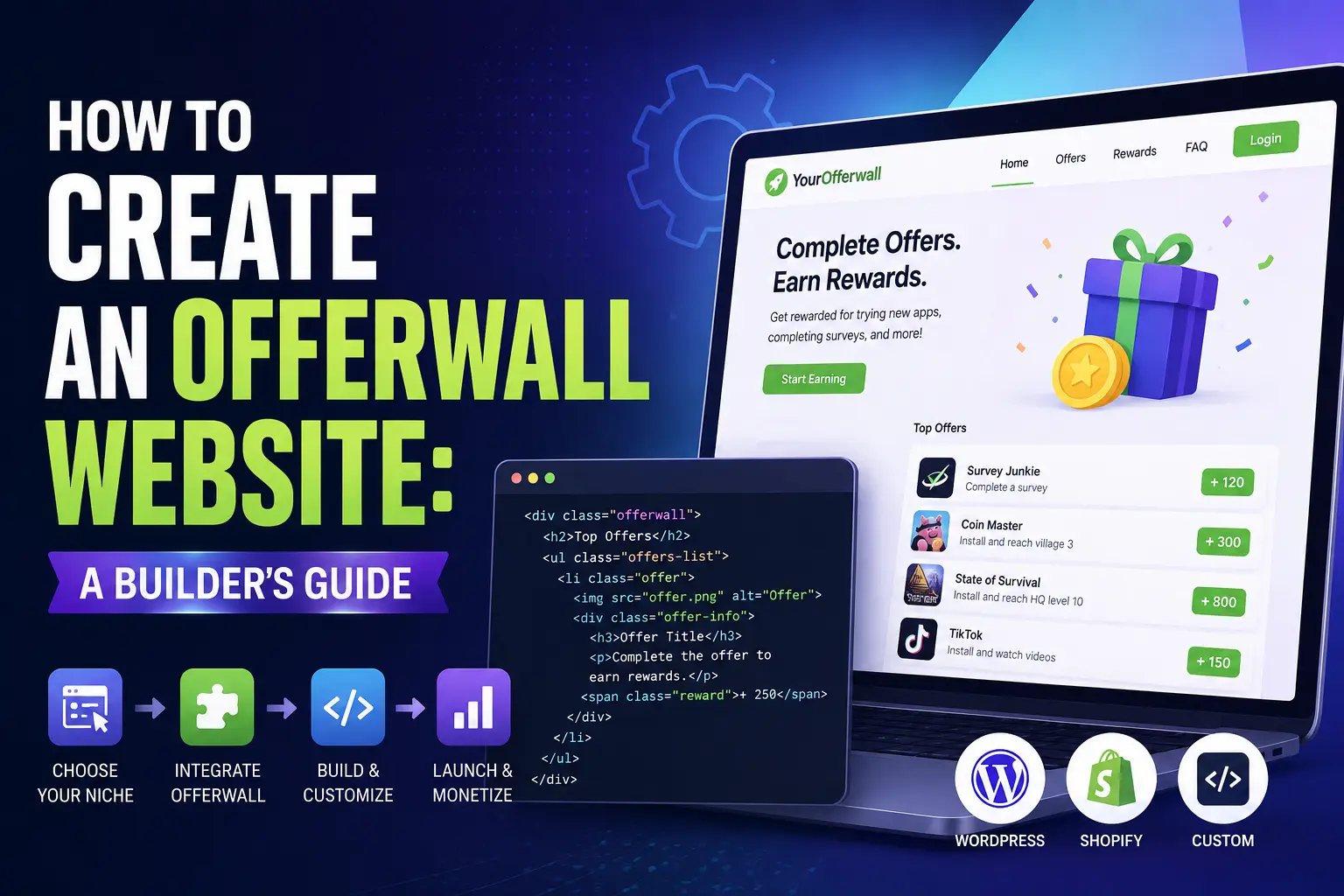
You can use a hosted offerwall, embed the offerwall into a page through an iframe, open it from a button using the supplied script, or use direct tracking links and content-locking tools.
The current offerwall builder also provides customization options for branding, headlines, instructions, reward names, HTML, and CSS.
This matters because a rewards website should not feel like an external advertising page bolted onto the product.
A branded wall with a reward currency such as Points, Coins, Credits, Gems, or another internal name can make the integration feel much more native.
CPAlead also allows publishers to pass their own user identifier through subid, which is one of the most important pieces when building a proper reward system.
5. App support
Mobile apps are an important part of CPAlead's marketplace.
The current marketplace includes both iOS and Android campaigns, and publishers can use the offerwall inside a mobile product rather than relying exclusively on external web traffic.
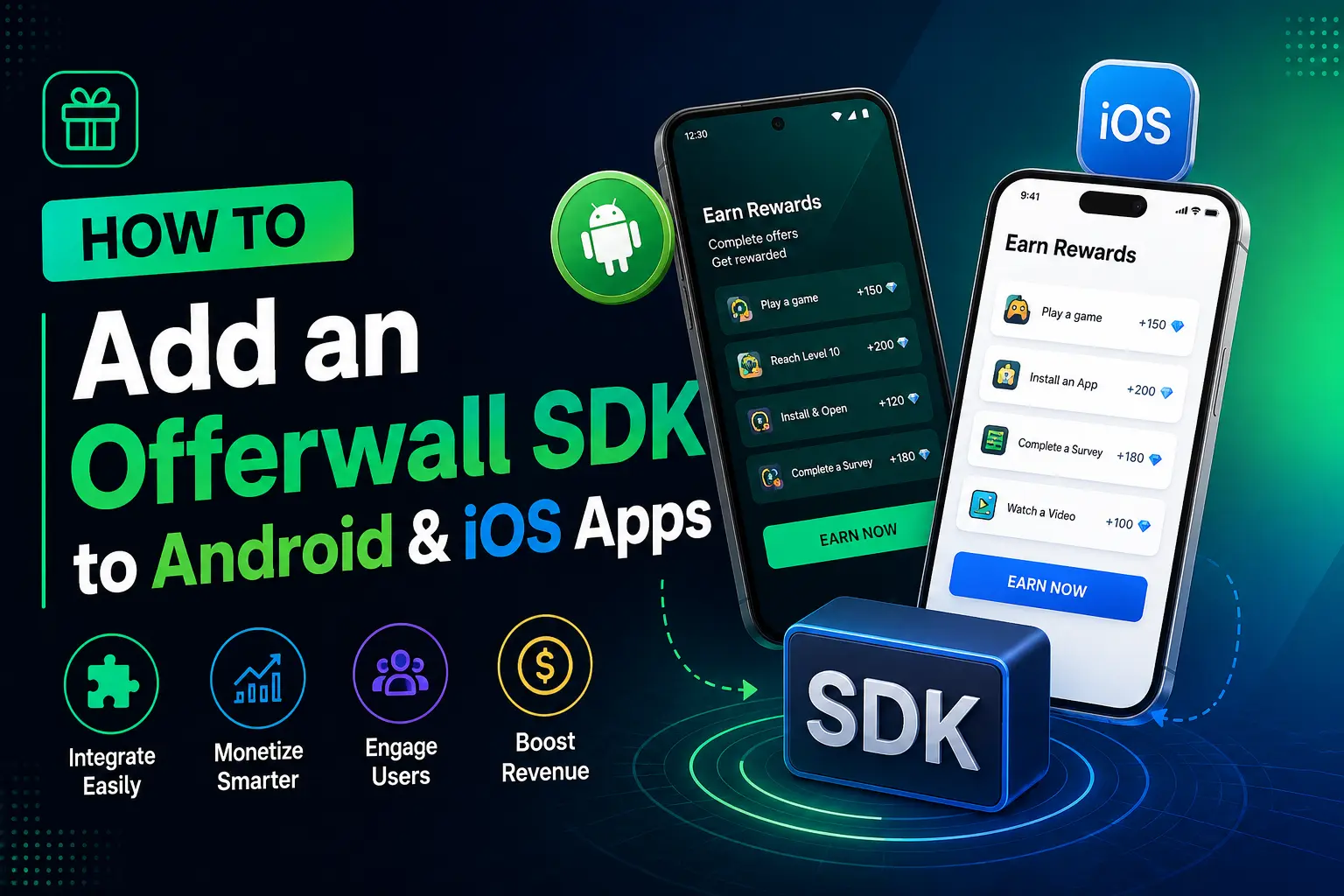
The offerwall documentation currently provides an Android integration path. The supplied implementation opens the hosted CPAlead wall using a URL containing the publisher's user identifier.
This is an important distinction.
CPAlead clearly supports app-based offerwall monetization, but publishers should not confuse that with having a modern universal mobile SDK for every platform.
For straightforward deployments, opening the hosted reward wall from the application can be enough.
For a highly customized native experience, however, the API route may be more appropriate.
6. Game support
Gaming is one of the stronger reasons to consider CPAlead.
Current marketplace inventory includes game installs, app opens, registrations, level completions, gameplay milestones, and CPE-style campaigns.
Examples visible in the current marketplace include offers involving reaching specific game levels, installing and playing games, and completing defined gaming activities.
This works particularly well with free-to-play games.
A player who does not purchase anything can still become monetizable through an optional reward section:
Complete an external offer — receive in-game currency — developer earns advertising revenue.
That can create a useful secondary monetization channel without replacing conventional ads or in-app purchases.
For game developers building a reward-driven economy, this model can be particularly powerful.
7. Integration methods
CPAlead currently gives publishers several integration options.
The most important are:
Direct links:
Send users directly to CPAlead tracking URLs.
Iframe:
Embed a hosted offerwall directly inside your website or application interface.
Script:
Use CPAlead's supplied script to open the reward wall from your own button or interface.
Android integration:
Open the hosted offerwall from an Android application.
Publisher API:
Retrieve the offer catalog and build your own user interface and business logic.
This is one of CPAlead's strongest areas.
You can start with an iframe when speed matters, then migrate to an API-driven implementation when you need more control.
8. API availability
Yes. CPAlead has a dedicated Publisher API.
The current API supports:
- Offer retrieval
- Country filtering
- Device filtering
- Incremental updates
- Conversion lookup
- Reversal retrieval
- JSON responses
- JSONP
- OpenAPI documentation
The default offer response limit is 2,500, while the documentation states that the maximum can be increased to 5,000 through the API request.
The API can also expose country-specific payouts and event-based offers.
That is particularly useful for developers creating their own offerwall.
Instead of displaying a CPAlead interface, you can retrieve the campaigns, choose your own UI, determine how offers are sorted, and connect the result to your own reward database.
9. iFrame availability
Yes.
CPAlead's current offerwall system provides an iframe embedding method.
The iframe approach is probably the fastest option for a website that wants a branded rewards page without developing an entire offer marketplace from scratch.
The main downside is control.
An iframe is convenient, but the publisher still depends on CPAlead's interface and hosted environment.
For a serious SaaS-style rewards platform, I would generally start with iframe testing and move to API integration once the business model proves itself.
10. SDK availability
This area requires some caution.
Older CPAlead material references a CPAlead SDK for mobile CPI campaigns, particularly in the context of advertiser-side app tracking.
However, the current publisher offerwall documentation does not present a general modern cross-platform publisher SDK comparable to the SDK offering of specialist mobile monetization companies.
Instead, the current publisher implementation emphasizes hosted walls, iframe, scripts, direct links, API integration, and Android code.
Therefore, I would rate CPAlead's current publisher SDK story as limited or unclear, rather than advertising it as a full native SDK solution.
For developers who specifically want a deeply integrated iOS/Android SDK, this is an area where competitors may have an advantage.
11. Postback system
The postback system is one of CPAlead's strongest technical features.
CPAlead can notify a publisher's server after a qualifying conversion is recorded.
The current publisher postback system uses an HTTP GET request and supports macros including:
{campaign_id}{campaign_name}{subid}{subid2}{subid3}{payout}{lead_id}{country_iso}{event_key}{event_name}{event_payout}{password}
The {lead_id} field is especially useful for preventing duplicate credits when retries occur.
For a rewards website, the basic architecture should be:
CPAlead conversion — postback — your server — verify conversion — credit user — record transaction.
Do not credit users simply because they clicked an offer.
CPAlead itself recommends using the postback signal as the basis for reward processing.
12. Tracking
CPAlead offers several layers of tracking.
For standard CPA/CPI offers, tracking links are generated with values that allow conversions to be associated with publishers.
For offerwalls, subid can identify the specific user.
For API-driven systems, the exact tracking link supplied by the API should be used instead of manually reconstructing the URL.
The system also exposes conversion information and reversal data through APIs, which makes it possible to maintain a more accurate internal accounting system.
This is important for GPT platforms.
Your database should not simply have:
user — balance
It should have a proper transaction ledger:
user — offer — lead ID — payout — status — timestamp — reversal status
That is how you avoid creating accounting problems later.
13. Attribution window
This is one of the areas where publishers should avoid oversimplified claims.
CPAlead does not appear to publish one universal attribution window that applies to every offer.
Attribution depends on the campaign, advertiser, tracking platform, and conversion rules.
For example, CPAlead's current AppsFlyer documentation describes click lookback settings measured in hours or days and gives a 5 — 7 day range as a typical configuration for CPI campaigns.
That should not be interpreted as "CPAlead always uses a seven-day attribution window."
The correct approach is to inspect the individual offer and its conversion requirements.
14. Offer types
CPAlead has a relatively broad offer mix.
Depending on account access and inventory, publishers can encounter:
- CPA
- CPI
- CPE
- CPC-related opportunities
- App installs
- Registrations
- Lead forms
- Free trials
- Surveys
- Gaming activities
- App engagement
- Content offers
- Multi-step conversions
The Publisher API currently returns CPA, CPI, and CPE offers by default, while native CPC access is account-dependent.
This variety is useful because different audiences convert differently.
A gaming audience may prefer game installs and level-based offers.
A general audience may respond better to surveys and lead generation.
A software audience may perform well with app installations and trials.
15. GEO coverage
CPAlead has broad international inventory.
CPAlead's current publisher and offer pages describe a marketplace serving publishers globally, and its current offer catalog displays campaigns across numerous countries and regions.
The platform also exposes country filtering through its API, including automatic country selection using the visitor's country.
This matters because GEO is one of the biggest variables in offerwall monetization.
A publisher targeting the United States cannot expect the same inventory or payout levels as one targeting Egypt, India, Brazil, Germany, or the Philippines.
CPAlead's offer API also supports country-specific payout data, so developers can make more intelligent decisions based on the visitor's GEO.
16. Survey inventory
Surveys are clearly present in the current CPAlead marketplace.
Current examples include survey completion campaigns and survey-related reward offers, including mobile-specific inventory and region-specific campaigns.
However, I would not describe CPAlead as a pure survey specialist.
Its catalog is much broader.
That is actually useful for a general-purpose rewards website because survey inventory can fluctuate significantly by country and demographic profile.
When survey supply decreases, app installs, registrations, game offers, and other CPA/CPE campaigns can provide additional monetization opportunities.
For a site whose entire business depends on surveys, though, a specialist survey provider may be a better primary network.
17. Gaming inventory
Gaming is one of the more visible categories in the current marketplace.
The catalog includes:
- Game installs
- New-user bonuses
- Level-based rewards
- Gameplay milestones
- App opens
- CPE game campaigns
- Game-testing campaigns
- Multi-step game activities
Current examples include campaigns requiring users to reach levels, install games, or play for a defined period.
This makes CPAlead particularly interesting for:
- Gaming GPT sites
- Reward apps
- Gaming communities
- Loyalty platforms
- Casual gaming audiences
The quality of the gaming catalog will still vary by GEO, device, and advertiser demand.
18. Fraud prevention
Fraud prevention is critical to CPA networks because advertisers only pay for legitimate actions.
CPAlead explicitly prohibits self-completing offers, paying people with real money to complete offers, pay-per-view traffic, artificial engagement, and several other forms of abusive traffic.
The rules also distinguish between prohibited monetary incentives and permitted virtual rewards. Rewarding users with points, gems, credits, or in-game items through an offerwall is allowed under the stated rules.
This distinction is extremely important for GPT developers.
You can run:
Offer completion — virtual points — user reward
without turning the system into a paid-click farm.
CPAlead also states on current offer pages that its system detects users attempting to complete their own offers.
That does not mean fraud is impossible.
No serious affiliate network can eliminate all fraud.
It means CPAlead has controls and explicit compliance policies that publishers need to follow.
19. Reporting
CPAlead provides reporting through the publisher dashboard and technical APIs.
The current offerwall documentation specifically refers to Statistics and Postback Logs, allowing publishers to inspect activity after launching their wall.
The Publisher API also provides conversion and reversal endpoints.
For developers, this is important because the dashboard should be treated as the network's reporting layer while your own database remains the authoritative ledger for user rewards.
The API's reversal endpoint can also be used to retrieve bad-lead or reversal information, allowing a custom platform to reconcile transactions.
20. Reward flexibility
Reward customization is a strong feature of the offerwall system.
CPAlead allows publishers to define the currency name displayed to users, such as:
Points, Coins, Credits, Gems, Cash, or another reward label.
The wall also calculates reward values based on the points-per-dollar setting configured by the publisher.
This means CPAlead can fit different business models.
For example:
1 USD advertiser payout — 1,000 internal points
or
1 USD advertiser payout — 100 gems
The exact economics are under the publisher's control, though the platform still needs to remain profitable after user rewards, payment costs, chargebacks, reversals, and other operating expenses.
21. Payout model
CPAlead primarily operates around performance-based monetization.
Publishers earn when users complete qualifying actions rather than simply receiving a fixed amount for displaying offers.
The marketplace includes CPA and CPI campaigns, along with selected CPE and click-related opportunities depending on account access.
Another notable feature is that many source-connected offers can support daily payments.
CPAlead currently promotes daily payout availability and says that more than 1.2 million publisher payments have been issued to more than 117,000 publishers.
Those numbers are company-reported figures, so they should be treated as CPAlead's own stated payment history rather than an independently audited industry statistic.
22. Payment methods
CPAlead currently supports several publisher payment methods.
The publisher page lists:
- PayPal
- Payoneer
- Wire transfer
- ACH
- USDT
CPAlead also introduced USDT Fast Pay with a $25 minimum for supported Fast Pay earnings, including Solana and Ethereum networks.
This is a useful addition for international publishers, particularly those who have difficulty receiving conventional affiliate payments.
However, payment availability can depend on the specific payment system, publisher status, and type of earnings.
23. Approval requirements
Approval is one of CPAlead's biggest differences from beginner-friendly affiliate platforms.
The network explicitly says it accepts publishers with existing traffic.
There are currently two notable access paths.
Performance Approval:
No deposit when approved, but publishers must earn at least $25 during the first 14 days after approval to keep the account active.
Publisher Pro:
Requires a $100 refundable deposit, which CPAlead says is refunded after earning $100 within the first 30 days. Publisher Pro also provides stronger access and support.
This is not the kind of approval model I would recommend to someone who has just purchased a domain and has no audience.
It makes much more sense for an established website, app, social account, or rewards product.
24. Minimum traffic
CPAlead does not appear to publish a simple requirement such as:
"You need 10,000 monthly visitors."
Instead, its requirement is performance-oriented.
The company states that publishers should already have traffic and be able to generate earnings quickly after approval. Under the Performance Approval path, the current requirement is at least $25 within the first 14 days.
That is actually more meaningful than an arbitrary traffic number.
A site with 5,000 highly relevant visitors can outperform a site with 100,000 low-quality visitors.
So I would interpret CPAlead's minimum traffic requirement as:
You need enough real traffic to demonstrate that you can produce legitimate conversions.
25. Publisher support
Support depends partly on the access level.
CPAlead's Publisher Pro path currently advertises better support in addition to higher limits and increased campaign access.
The technical documentation is another positive point.
CPAlead has separate public documentation for:
- Offerwalls
- Publisher API
- Postbacks
- Rules
- Campaigns
- Tracking
For developers, good documentation can sometimes be more valuable than a flashy support promise.
The biggest strength here is that important integration details are publicly documented rather than hidden behind a sales call.
26. Strengths
1. Broad monetization options
CPAlead is more than a traditional CPA network. Offerwalls, APIs, lockers, direct links, CPI, CPA, and CPE provide multiple ways to monetize.
2. Strong developer functionality
The Publisher API and postback system make CPAlead suitable for custom products instead of only simple websites.
3. Good offerwall infrastructure
The hosted wall can be deployed quickly using direct links, iframe, scripts, or Android integration.
4. International inventory
Country filtering and GEO-specific campaign data are useful for global publishers.
5. Gaming inventory
Game installation, gameplay, level, and CPE campaigns provide strong opportunities for gaming and rewards audiences.
6. Flexible payments
PayPal, Payoneer, ACH, wire, and USDT provide more options than many smaller CPA networks.
7. Long operating history
CPAlead states that its marketplace dates back to 2006 and currently reports more than 1.2 million publisher payments.
27. Weaknesses
1. Not beginner-friendly
CPAlead is explicitly oriented toward publishers who already have traffic.
2. Approval can be demanding
The performance requirements mean that a newly launched website may struggle to maintain access.
3. SDK story is not as strong as specialist mobile platforms
The current publisher documentation focuses on hosted integrations and APIs rather than a comprehensive modern native SDK ecosystem.
4. Offer quality varies
As with most CPA marketplaces, not every offer deserves the same level of confidence.
Publishers need to look at conversion requirements, GEO restrictions, device requirements, payout, and traffic rules.
5. Inventory depends on GEO
A huge catalog globally does not mean that every country will have equally attractive offers.
6. The economics require careful reward management
For a GPT platform, advertiser payout is not your profit.
You still have to pay users, cover withdrawal costs, handle reversals, protect against fraud, and operate the platform.
28. Best use case
The strongest CPAlead use case is a real rewards product with an existing audience.
For example:
Imagine you have a GPT website with 20,000 monthly active users.
Instead of sending every user to random affiliate links, you create an "Earn" section containing:
- Surveys
- App installs
- Game offers
- Sign-up offers
- CPE campaigns
CPAlead supplies the offers.
Your platform controls the user experience.
The postback updates the user's balance.
Your database records the transaction.
The user eventually withdraws the reward through your own cashout system.
That is where CPAlead makes sense.
It also works well for mobile applications and games where users already understand the concept of earning virtual currency.
29. Who should avoid it
I would avoid CPAlead in several situations.
You have no traffic.
This is the most obvious case. CPAlead is not positioned as a beginner traffic-generation course.
You need a turnkey native SDK.
If your business depends heavily on a polished native iOS/Android SDK rather than a hosted wall or API, compare specialized mobile monetization providers before committing.
You want only surveys.
CPAlead has survey inventory, but it is a broader CPA/CPI marketplace rather than a dedicated survey infrastructure.
You depend on prohibited traffic sources.
CPAlead's rules explicitly prohibit several traffic and incentive practices, including PPV traffic and paying people with real money to complete offers.
You cannot implement postbacks correctly.
For a serious reward platform, tracking is not optional.
30. Alternatives
CPAlead should not be evaluated in isolation.
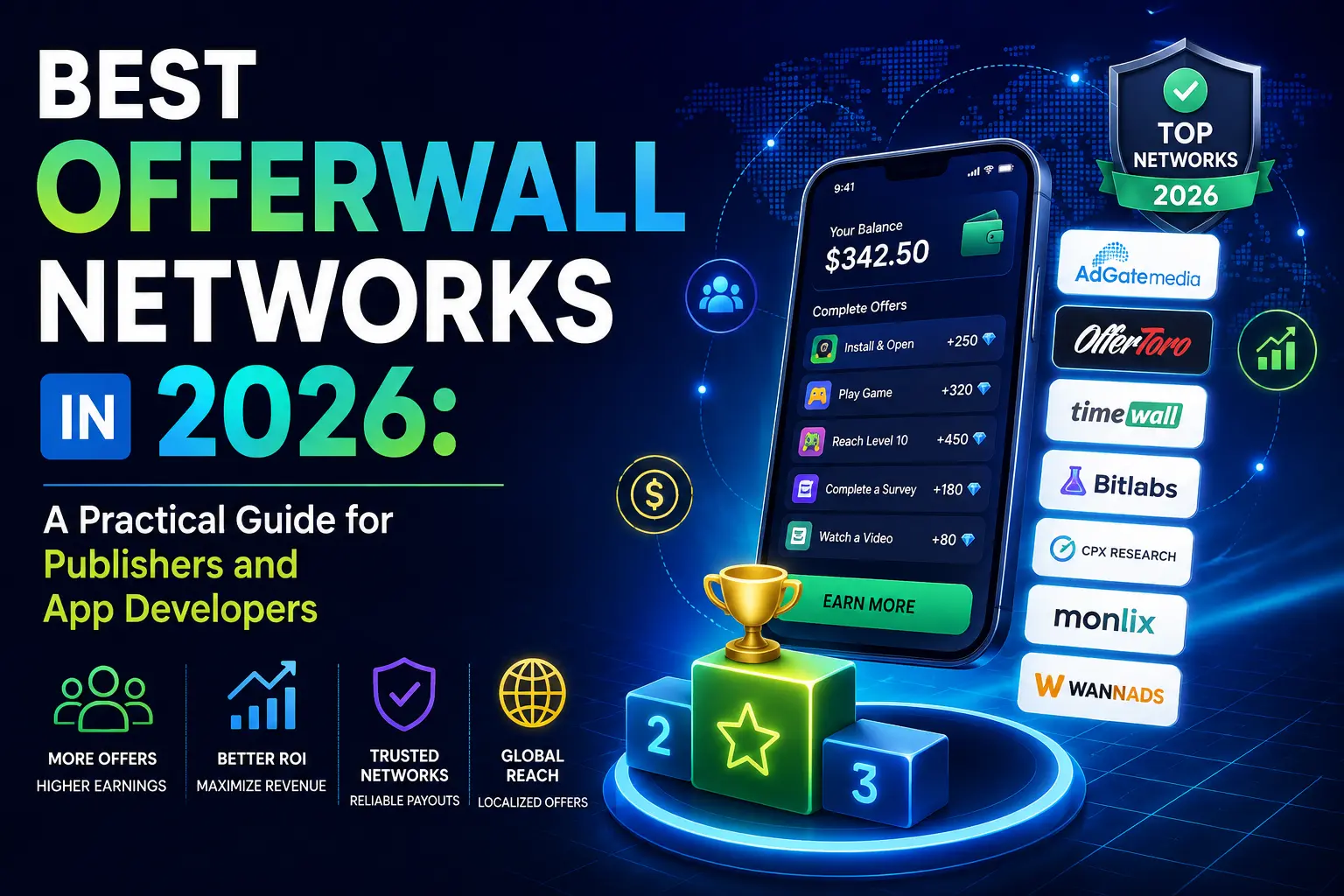
For a serious offerwall business, compare it with other networks based on your actual audience rather than simply asking which one has the highest advertised payout.
Useful categories to compare include:
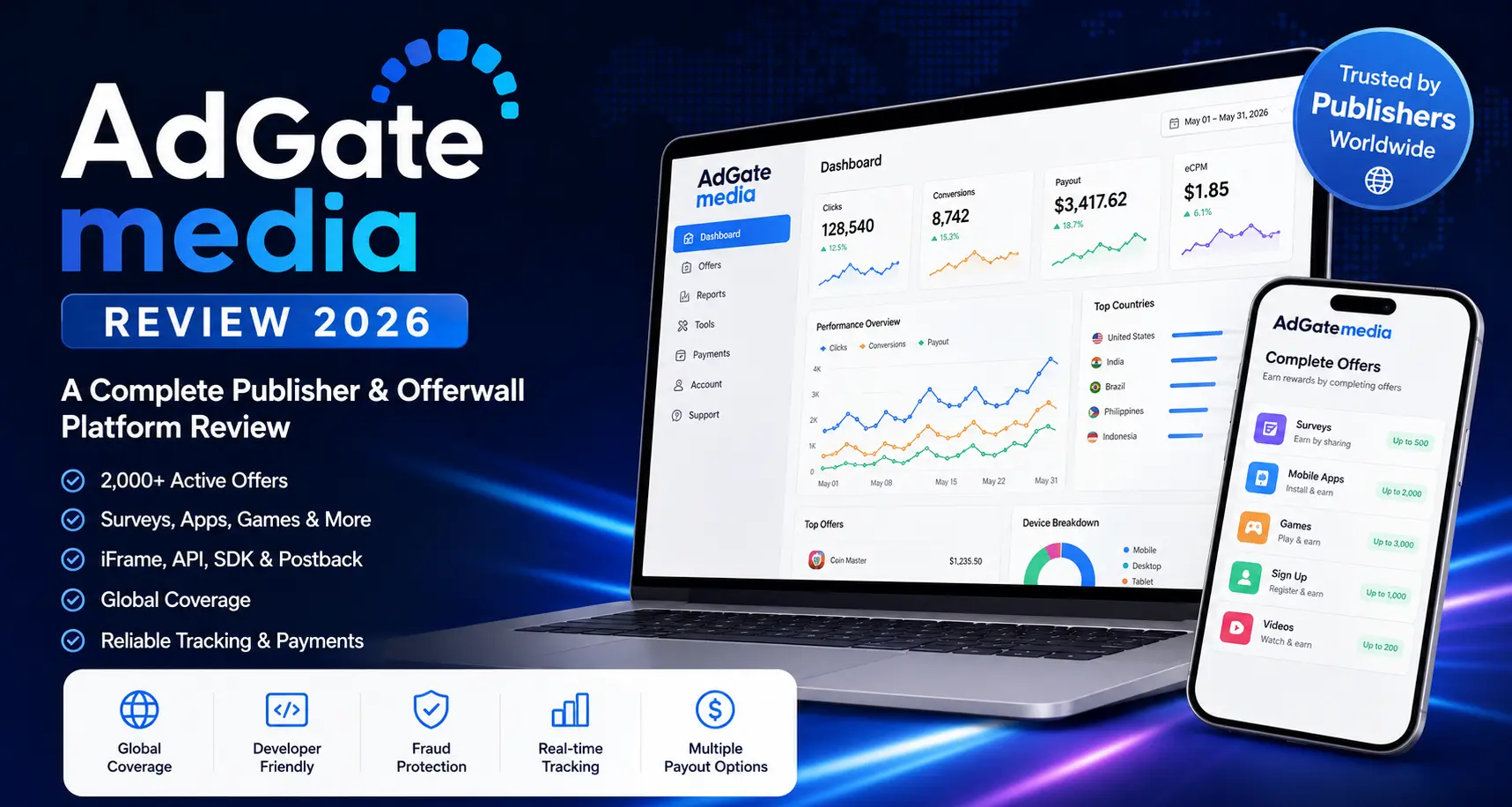
AdGate Media:
A strong alternative for publishers looking for a traditional offerwall experience with broad task inventory.
Lootably:
Worth evaluating for rewards platforms and publishers focused on offerwall monetization.
Adjoe:
Particularly relevant for mobile app monetization and rewarded engagement.
Torox:
Useful for publishers looking for another broad affiliate/offerwall inventory source.
RevU:
Worth considering when survey and offerwall depth are especially important.
The best setup for a serious GPT or rewards platform is often not choosing one network.
It is running multiple offerwalls and allowing users to select the offers that convert best.
This is also consistent with the broader offerwall model: inventory changes continuously according to geography, advertiser demand, device, and campaign availability.
For more background, see our guide:
What Is an Offerwall? Meaning, Mechanics, and Earning Potential
You can also compare CPAlead against other networks through:
Best Offerwall Sites 2026: Top Networks Ranked for High Payouts
For developers building a monetization platform rather than simply promoting offers, our mobile monetization guide is also relevant:
Mobile App Monetization Platform: The Complete 2026 Guide
31. Final rating
CPAlead Overall Rating: 8.4/10
| CategoryRating | |
| Offer Variety | 8.7/10 |
| Offerwall | 9.0/10 |
| API | 8.8/10 |
| Postback & Tracking | 9.0/10 |
| Website Support | 9.0/10 |
| Mobile Support | 8.0/10 |
| Gaming Inventory | 8.8/10 |
| Survey Inventory | 7.8/10 |
| GEO Coverage | 8.8/10 |
| Payment Options | 9.0/10 |
| Publisher Approval | 6.8/10 |
| Publisher Support | 8.0/10 |
| Documentation | 8.8/10 |
| Native SDK Availability | 6.5/10 |
| Overall | 8.4/10 |
Final verdict
CPAlead is still a serious option for publishers in 2026, but it is not the type of network that I would recommend simply because "it has lots of offers."
Its real strength is the combination of offer inventory + offerwall infrastructure + API + postback tracking + international campaigns + multiple payout methods.
That combination makes it particularly useful for developers building products around rewards.
The strongest scenario is a website, app, game, GPT platform, or loyalty product that already has real users and needs a reliable way to turn user activity into additional revenue.
The biggest limitation is the other side of that equation: CPAlead expects publishers to bring legitimate traffic. The current Performance Approval route requires at least $25 in earnings during the first 14 days, while Publisher Pro requires a refundable $100 deposit under its published terms.
So I would not treat CPAlead as a "start from zero" affiliate network.
I would treat it as infrastructure for publishers who already have an audience.
From a technical perspective, I particularly like the fact that CPAlead does not force every publisher into one integration model. A developer can start with a hosted offerwall, move to an iframe, experiment with direct offers, and eventually build a custom API-powered interface with server-side postbacks and its own reward ledger.
That progression is practical.
It lets you validate the business before investing heavily in custom development.
The one area where I would be more cautious is native mobile integration. CPAlead clearly supports mobile traffic and mobile offerwalls, but the current publisher documentation does not position a comprehensive modern native SDK as one of its headline strengths. Developers who need deep SDK-level control should compare CPAlead against mobile-first monetization platforms before making a final decision.
There is also another important lesson here for publishers: do not choose an offerwall network based solely on the highest payout.
A $10 offer that rarely tracks is worse than a $3 offer that converts consistently.
Likewise, a network with thousands of global offers is not necessarily better for an Egyptian, Indian, Brazilian, or European audience if most of those campaigns are unavailable in the target GEO.
The variables that matter in practice are:
offer availability + conversion rate + tracking reliability + reversal rate + user experience + payout speed.
That is where CPAlead deserves its 8.4/10 rating.
It is not perfect, and the approval and SDK limitations keep it from being a clear 9.5/10 choice for every publisher.
But for an established publisher, developer, rewards platform, or game looking for a broad CPA/CPI offer ecosystem with serious technical integration options, CPAlead remains a network worth testing.
Bottom line
Best for: Established websites, GPT platforms, reward apps, games, offerwall owners, developers, and publishers with existing traffic.
Best feature: The combination of offerwalls, API, and server-side postbacks.
Biggest weakness: Strict publisher access requirements and a less compelling native SDK story.
Best strategy: Start with the hosted offerwall, measure actual conversion performance in your GEO, then move to API integration if the numbers justify a custom implementation.
Verdict: Recommended for established publishers — especially developers building reward-based websites, apps, and gaming platforms.
Trusted resources
CPAlead Publisher Documentation:
CPAlead Offerwall Documentation:
CPAlead Publisher API:
CPAlead Publisher API Documentation
CPAlead Postback Documentation:
CPAlead Publisher Postback Documentation
CPAlead Network Rules:
CPAlead Network Rules & Compliance
CPAlead Privacy Policy:
AppsFlyer Attribution Documentation:
AppsFlyer Attribution Documentation
FTC Endorsement Guides:


Comments (0)
No comments yet. Be the first to share your thoughts!