
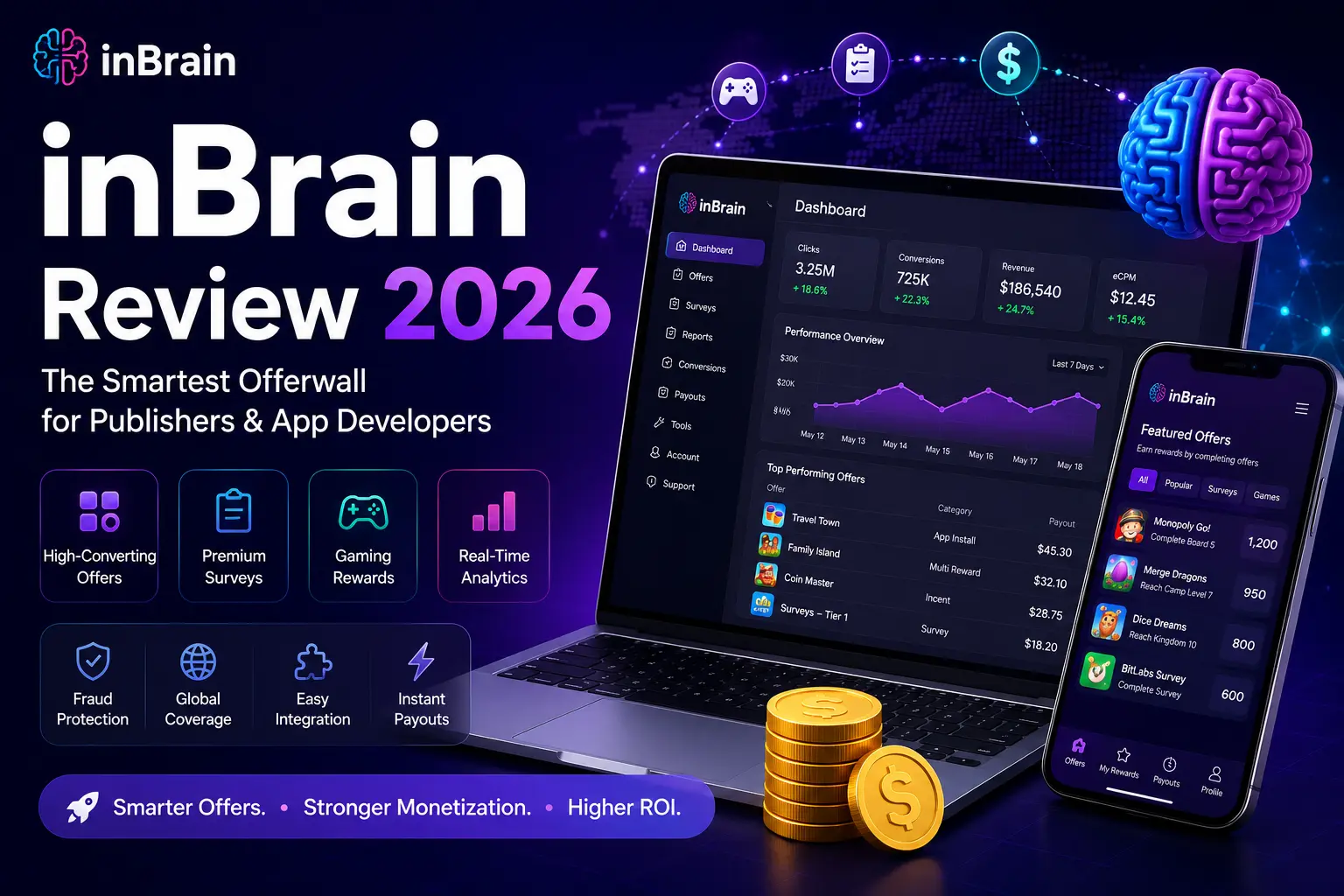
1. Overview
inBrain is a survey monetization platform designed primarily for publishers that want to turn unused user attention into revenue through rewarded market-research surveys.
It is important to understand what inBrain is — and what it is not.
Unlike a traditional affiliate offerwall built around app installs, free trials, subscriptions, registrations, and gaming milestones, inBrain's core business is survey monetization. The platform connects publishers with survey inventory and gives users an opportunity to earn the publisher's virtual currency for participating in market research.
The company operates under the Dynata ecosystem. Dynata acquired inBrain.ai in 2021, combining inBrain's mobile-first survey technology with Dynata's large first-party research-data operation. inBrain describes its platform as infrastructure connecting brands and market researchers with consumers through monetizable mobile applications.
For publishers, that distinction matters. If your objective is to add a reliable survey wall to a rewards app, loyalty product, mobile application, or web platform, inBrain is directly relevant. If your objective is to offer hundreds of mobile games and CPA offers, it is not the most natural single-provider solution.
The current inBrain product lineup includes:
- Survey Wall
- Native Surveys
- Monetization API
- Survey Wall Link
- iFrame integration
- Mobile SDK integrations
- Publisher dashboard
- Server-to-server callbacks
- Revenue and survey controls
The company specifically markets the Survey Wall as its flagship publisher integration and emphasizes minimal development effort, yield management, display of survey value and duration, UX customization, currency sales, and partial rewards.
From a publisher's perspective, that is the interesting part: inBrain is not simply selling access to surveys. It provides several ways of deciding how much control you want over the user experience.
2. Who is it for?
inBrain is best suited to:
- Mobile app developers
- Rewards and loyalty applications
- GPT-style platforms
- Survey and research communities
- Cashback platforms that want an additional survey channel
- Entertainment applications
- Social applications
- Educational applications
- Finance applications with reward mechanics
- Mobile games that want to monetize non-paying users
- Web publishers interested in rewarded surveys
The strongest fit is a platform that already has users and an internal reward currency.
For example, imagine a mobile application where users earn 1,000 coins for completing a particular action. Instead of developing your own survey infrastructure, you can use inBrain to supply survey opportunities and receive revenue when users complete qualifying research activities.
This model fits particularly well with the broader offerwall concept, where advertisers pay for measurable actions and publishers create a reward mechanism around those actions. Our broader guide to the model explains the economics and mechanics in more detail: What Is an Offerwall? Meaning, Mechanics, and Earning Potential
I would be less enthusiastic about inBrain if the entire business model depends on gaming offers, app installs, subscriptions, or CPA lead generation. In that case, you would probably want to supplement inBrain with another offerwall rather than treat it as your complete monetization stack.
3. Supported platforms
inBrain supports both mobile and web-oriented monetization approaches.
For mobile applications, the platform provides SDK-based integrations for Android and iOS. Its current iOS documentation, for example, documents the InBrainSurveys SDK and supports Swift, Xcode, CocoaPods, Swift Package Manager, and manual framework installation.
For Android, inBrain provides an Android SDK integration through Gradle, with its documentation covering SDK configuration and survey presentation.
For websites, inBrain provides:
- iFrame
- Survey Wall Link
- API-based integration
That makes the platform considerably more flexible than a mobile-only survey SDK.
4. Website support
Yes. inBrain supports websites.
The most straightforward web implementation is the iFrame integration, which allows publishers to display an inBrain survey wall directly on a website.
The company describes the integration as a single block of iFrame code. Publishers create a unique identifier through the Publisher Dashboard, after which inBrain's system provides survey opportunities for visitors. The wall can be placed on a web page and customized to match the publisher's branding and currency system.
There is also a Survey Wall Link option for publishers that prefer a simpler URL-based experience.
For a website owner, this is useful because you do not necessarily have to build an entire survey interface from scratch.
5. App support
Mobile applications are arguably where inBrain makes the most sense.
The platform offers SDK-based monetization and provides both a conventional Survey Wall and Native Surveys.
The Survey Wall handles the survey presentation for you, while Native Surveys gives the publisher considerably more control over how individual surveys appear inside the application.
The current iOS documentation also exposes both survey and offer-wall functionality, meaning publishers can potentially present more than one type of opportunity through the SDK configuration.
For developers, this reduces the amount of infrastructure that has to be built internally.
6. Game support
inBrain can be used inside games, but this needs an important qualification.
It is not primarily a gaming offerwall network.
Its main monetization asset is survey inventory. Therefore, a game developer would typically use inBrain to monetize players who are willing to exchange time and opinions for in-game currency.
This can work especially well in free-to-play games.
A player who does not want to purchase virtual currency could instead complete a survey and receive coins, energy, gems, or another in-game resource.
However, if your game monetization strategy specifically requires:
- Install-and-play campaigns
- Reach-level offers
- Mobile game milestones
- CPA gaming campaigns
- Subscription offers
then a specialist offerwall may provide broader inventory.
7. Integration methods
inBrain provides several integration routes:
- Mobile SDK
- Native Surveys
- Monetization API
- Survey Wall Link
- iFrame
- Server-to-server callbacks
This is one of the strongest aspects of the platform.
A small app can use the ready-made Survey Wall, while a larger product can use the API or Native Surveys to build a more customized experience.
The official product documentation confirms the availability of the Survey Wall, Native Surveys, Monetization API, Survey Wall Link, and iFrame.
8. API availability
Yes. inBrain provides a Monetization API.
The API is intended for publishers that want more control over the survey experience rather than simply displaying the standard Survey Wall.
According to the official documentation, API integration requires a Publisher Dashboard account and API credentials supplied through the inBrain account team. The documentation specifically warns that the API credentials used for the Monetization API are separate from the API keys used for SDK integration.
This is an important implementation detail.
A developer should not assume that creating an application in the dashboard automatically gives access to every API endpoint.
The API can be particularly valuable when you want to:
- Retrieve survey inventory
- Build your own survey interface
- Control how surveys are presented
- Pass user information
- Apply filtering
- Integrate survey events into an existing rewards engine
9. iFrame availability
Yes.
The inBrain iFrame is one of the easiest options for web publishers.
The company describes it as a simple integration that exposes survey inventory through a single iFrame implementation. Publishers can customize the experience and place the wall on their own pages.
This is useful for:
- GPT websites
- Rewards websites
- Loyalty portals
- Survey communities
- Cashback platforms
- Web applications
For a small publisher, iFrame can be significantly easier than building an API-driven survey interface.
10. SDK availability
Yes.
inBrain has mobile SDK support for at least Android and iOS.
The Android documentation provides Gradle-based installation instructions, while the iOS SDK documentation supports modern Apple development workflows including Swift Package Manager and CocoaPods.
The SDK can expose:
- Survey Wall
- Surveys availability checks
- Native Surveys
- User identification
- Session identification
- Reward callbacks
- Server-side reward processing
For a mobile developer, the SDK is probably the easiest way to get started.
11. Postback system
This is one of inBrain's stronger technical features.
inBrain supports server-to-server callbacks for survey outcomes.
When a survey is completed, inBrain can send an HTTP POST request containing information such as:
- Panelist ID
- Reward type
- Reward ID
- Reward amount
- Session ID
- Revenue amount
- Test status
- Signature
The callback system also supports failure/disqualification events.
This is particularly important for reward platforms.
Your server should not simply trust a client-side event and immediately issue valuable currency. A server-side callback gives you a much more reliable mechanism for validating the event before crediting the user.
The callback also contains a unique Reward ID that can be used to detect duplicate events.
12. Tracking
inBrain provides tracking through its SDK, API, and callback infrastructure.
The publisher supplies a unique user identifier, which can then be associated with survey activity.
The iOS SDK documentation explains that the publisher can set a unique application user ID, and that this identifier is returned as the PanelistId through S2S callbacks.
The publisher terms also require tracking mechanisms and state that Dynata uses its tracking/reporting system to track performance and activity.
For production systems, I would recommend:
- Generate a stable internal user ID.
- Pass that ID consistently.
- Store every Reward ID.
- Make callbacks idempotent.
- Log revenue and reward amounts separately.
- Keep test events separate from production events.
That architecture prevents a surprising number of reward-crediting problems.
13. Attribution window
This is an area where publishers should avoid applying terminology from traditional affiliate networks too literally.
inBrain's primary product is survey participation, not app-install attribution.
Therefore, a conventional 7-day, 30-day, or 60-day attribution window is not the central public-facing concept in the same way it is with CPA affiliate offers.
Instead, the important events are:
- Survey availability
- Survey initiation
- Completion
- Disqualification
- Quota failure
- Reward event
- Revenue event
The callback documentation explicitly distinguishes completed and unsuccessful survey events.
If your business requires a specific attribution or conversion window for accounting purposes, that is something I would confirm directly with your inBrain account representative rather than assume from standard affiliate-network conventions.
14. Offer types
inBrain is primarily survey-focused.
The main inventory includes:
- Paid surveys
- Rewarded surveys
- Native surveys
- Survey Wall opportunities
- Survey opportunities delivered through API
- Survey opportunities through web/iFrame integrations
The current SDK documentation also contains an Offers Wall option, which indicates that the platform can expose offer functionality through its mobile wall configuration.
Still, I would classify inBrain as a survey-first monetization provider, not as a traditional all-purpose CPA offerwall.
15. GEO coverage
inBrain operates internationally and is connected to Dynata's global research infrastructure.
Dynata states that its reach encompasses more than 62 million consumers and business professionals globally and that it serves customers across North America, South America, Europe, and Asia-Pacific.
That gives inBrain access to a substantial international research ecosystem.
However, publishers should not interpret that as meaning that every user in every country will see the same inventory.
Survey supply depends heavily on:
- Country
- Language
- Age
- Gender
- Demographics
- Research demand
- Survey quotas
- Device
- User profile
- Current advertiser campaigns
This is especially important for publishers targeting lower-volume GEOs.
16. Survey inventory
Survey inventory is the heart of inBrain.
The platform's value comes from matching users with surveys that are relevant to their profiles and current research demand.
inBrain highlights yield management, which is designed to connect users with suitable survey opportunities. It also provides controls for survey value and duration.
The platform's documentation confirms that publishers can request minimum and maximum survey values and minimum and maximum survey lengths through placement filters.
This is useful because not every publisher wants to show every possible survey.
For example, a rewards application might decide that showing a two-minute survey worth almost nothing is not worth the user-interface space.
17. Gaming inventory
Gaming is not inBrain's strongest differentiator.
The company can be relevant to gaming publishers because surveys can be exchanged for in-game currency, but the platform should not be compared directly with a dedicated gaming offerwall on gaming inventory depth.
If your primary goal is:
"Give my players hundreds of game-install campaigns and progression offers."
then inBrain probably should not be your only provider.
If your goal is:
"Give non-paying players another way to earn premium currency."
then inBrain becomes much more interesting.
This distinction is critical when calculating expected revenue.
18. Fraud prevention
Fraud prevention is essential in rewarded-survey monetization because fraudulent activity can damage both the publisher and the research ecosystem.
inBrain/Dynata's publisher terms explicitly prohibit misleading, deceptive, fraudulent, and bad-faith activity. The terms also allow compensation to be withheld for fraudulent leads, conversions, or completed activities.
The terms specifically mention issues such as:
- Speeding
- Fraud
- Duplicate activity
- Fraudulent traffic generation
- Impression spam
- Illegal activity
- Multiple leads from the same individual/entity/IP
- Other unacceptable activity
For publishers, the lesson is straightforward: do not treat survey traffic as unrestricted incentive traffic.
Avoid:
- Bots
- VPN abuse
- Multiple accounts
- Forced survey completion
- Misleading reward claims
- Artificial traffic
- Automated submissions
Fraud prevention is not merely a network-side concern. Your own reward system should also maintain sensible controls.
19. Reporting
inBrain provides a Publisher Dashboard with reporting and revenue visibility.
The platform specifically advertises real-time revenue tracking through its publisher dashboard.
A useful publisher reporting setup should monitor:
- Revenue
- Survey completions
- Disqualifications
- Reward amounts
- GEO performance
- User activity
- Revenue per active user
- Survey availability
- Completion rates
One advantage of the platform is that the reward amount and actual revenue amount can be represented separately in callback data.
That makes it easier to maintain an internal currency exchange model.
20. Reward flexibility
This is another strong point.
Publishers determine their own in-app currency economics.
The inBrain documentation describes the Publisher Currency as the amount of virtual currency a publisher wants to give users for each dollar earned from survey completion.
For example, a publisher could conceptually define:
- $1 revenue = 100 coins
- $1 revenue = 1,000 points
- $1 revenue = 10 credits
The exact economics are up to the publisher's reward system and commercial agreement.
inBrain also supports partial rewards for certain survey disqualifications. The documentation states that partial rewards are available on a case-by-case basis and currently limits partial rewards to six per 24-hour period.
That is a meaningful UX feature because a user can spend several minutes answering screening questions and otherwise receive nothing when they are disqualified.
21. Payout model
The publisher revenue model is fundamentally performance based.
The publisher earns revenue from qualifying survey activity, while users receive the publisher's virtual currency.
The callback data provides a RevenueAmount, representing the USD revenue associated with the survey outcome, while Reward represents the amount of the publisher's in-app currency that should be awarded.
This distinction is important.
Your revenue is not necessarily the same thing as the value of coins you give the user.
You control the conversion between the two.
However, publisher payment terms can depend on the specific commercial arrangement or Work Order. The published publisher terms state that, unless otherwise specified, invoices are paid within 90 days after receipt of an undisputed invoice.
The same terms specify a $20 accumulated-fee threshold for receiving payments by check.
Because payment arrangements can differ, I would not publish a blanket claim that every inBrain publisher is paid on one universal schedule or through one universal payment method.
22. Payment methods
Public publisher documentation does not provide a sufficiently detailed, current universal list of every payment method available to every publisher.
The publisher terms explicitly reference payments and invoicing, and specifically mention check payments and a $20 threshold for checks.
For larger publishers, payment arrangements may be defined through the commercial agreement or Work Order.
Therefore, the sensible approach is to confirm the available payment method, currency, invoice requirements, payment schedule, and threshold with inBrain before building your financial model around the network.
This is preferable to repeating outdated affiliate-network information that may not apply to your account.
23. Approval requirements
inBrain is not a completely anonymous "paste a link and start sending traffic" system.
The publisher terms give Dynata the right to review and approve aspects of the publisher's services and require publishers to cooperate with review and approval requests.
Publishers must also comply with applicable laws and privacy requirements.
The publisher terms require websites used to interact with recruited consumers to maintain a privacy policy that accurately explains the collection, processing, storage, transfer, and disposal of personal data.
That means serious publishers should have:
- A legitimate website or application
- Clear ownership information
- A privacy policy
- A compliant reward system
- Real users
- Transparent traffic sources
- No fraudulent acquisition methods
24. Minimum traffic
I could not find a current official public page establishing a universal minimum monthly traffic requirement for every inBrain publisher.
That is important because many offerwall reviews publish numbers such as "10,000 monthly users required" without a current primary source.
I would not treat such claims as established inBrain policy.
The better approach is to apply directly through the publisher program and ask about eligibility based on:
- Monthly active users
- GEO distribution
- Platform
- Application category
- Traffic source
- User engagement
- Existing monetization
- Compliance history
The official site currently promotes the program to "1000's of publishers," indicating that the platform works with a broad publisher base.
25. Publisher support
inBrain provides documentation, a Publisher Dashboard, support resources, and account-level assistance.
The API documentation specifically instructs publishers to contact their account representative or inBrain support for API credentials and configuration questions.
The platform also maintains dedicated technical documentation for:
- SDK integration
- S2S callbacks
- API
- iFrame
- Native Surveys
- Testing
That is a positive sign for developers.
The quality of documentation matters more than marketing claims once you are debugging reward-crediting issues at 2 a.m.
26. Strengths
Strong survey specialization
inBrain's biggest advantage is focus.
It is built around rewarded surveys rather than trying to be everything at once.
Multiple integration methods
Publishers can choose between SDK, Native Surveys, API, iFrame, and Survey Wall Link.
Good developer controls
User IDs, session IDs, callbacks, placement filters, reward configuration, and survey filtering provide meaningful control.
Partial rewards
Partial rewards for qualifying disqualifications can improve the user experience.
Server-to-server callbacks
The callback infrastructure provides a reliable foundation for reward processing.
Dynata ecosystem
The connection with Dynata gives inBrain access to a large market-research infrastructure and first-party data ecosystem.
Web support
The iFrame and link-based approaches make the platform useful beyond mobile applications.
27. Weaknesses
Survey-first rather than offerwall-first
If your users want games, app installs, subscriptions, and CPA offers, inBrain alone may leave significant inventory gaps.
Inventory varies by GEO
A publisher should never assume that the survey experience seen in the United States will be replicated in Egypt, India, Brazil, or another market.
API access requires additional coordination
The documentation indicates that Monetization API credentials require contact with an account representative.
That is reasonable for a managed monetization platform but less convenient than an entirely self-service API.
Payment information is not completely transparent publicly
The published terms provide useful information, but publishers should confirm their exact payment arrangement before relying on generic payment assumptions.
Survey disqualifications remain unavoidable
Even with good matching, surveys have demographic requirements and quotas. No survey network can eliminate screen-outs completely.
28. Best use case
The best inBrain use case is a mobile or web rewards product with an existing user base that wants high-quality rewarded survey inventory.
Examples include:
Rewards app
Users complete surveys and receive coins that can later be exchanged for rewards.
Loyalty platform
Customers earn loyalty points by participating in research.
Mobile game
Non-paying users complete surveys in exchange for game currency.
GPT platform
inBrain becomes one of several earning channels alongside other offerwalls.
Consumer application
Users can unlock premium features by completing rewarded surveys.
For a multi-offerwall product, inBrain can work particularly well as the survey specialist rather than as the only network.
That is also consistent with the broader strategy of combining multiple monetization sources instead of depending on one offerwall. Our mobile monetization guide covers this broader architecture: Mobile App Monetization Platform: The Complete 2026 Guide
29. Who should avoid it?
I would avoid making inBrain the primary monetization provider if:
- Your users primarily want game offers.
- Your business depends heavily on app-install campaigns.
- You need a huge CPA offer catalog.
- You require a completely self-service affiliate network.
- You have almost no active users.
- Your traffic quality is questionable.
- Your platform cannot implement privacy and tracking requirements.
- Your business model depends on aggressive incentivized traffic.
It is also not a magic solution for a new website with no audience.
A survey wall does not manufacture users.
It monetizes users you already have.
30. Alternatives
There are several credible alternatives worth testing rather than choosing a provider purely from a review.
TheoremReach
TheoremReach is a strong alternative for rewarded surveys and supports web integrations, iFrame, SDKs, APIs, and S2S reward callbacks. Its documentation lists iOS, Android, React Native, Unity, web, API, and publisher-management integrations.
TheoremReach Publisher Documentation
It is particularly interesting when you want survey monetization with a broader integration ecosystem.
BitLabs
BitLabs is another strong option if you want surveys combined with offers, games, cashback, and other earning opportunities. Its documentation supports iframe/web integration, APIs, and multiple mobile SDKs.
BitLabs Developer Documentation
This makes BitLabs more attractive when the goal is a broader offerwall rather than a survey-centric implementation.
CPX Research
CPX Research is another survey-focused provider with API and SDK documentation. Its API can return available surveys for individual users, making it a reasonable candidate for publishers that want programmatic survey integration.
The practical approach
For a serious rewards platform, I would not automatically choose one provider.
A better architecture is often:
inBrain + another survey provider + a broader offerwall
Then measure:
- Revenue per 1,000 active users
- Survey fill rate
- Completion rate
- Screen-out rate
- Average reward
- Revenue per session
- Credit latency
- Reversal rate
- GEO performance
This turns the choice from a marketing comparison into a measurable monetization experiment.
31. Final rating
inBrain Rating: 8.6/10
| CategoryRating | |
| Survey inventory | 9/10 |
| Mobile SDK | 9/10 |
| API | 8.5/10 |
| iFrame/Web | 9/10 |
| Postbacks | 9/10 |
| Tracking | 9/10 |
| Reward flexibility | 9/10 |
| Fraud controls | 8.5/10 |
| Reporting | 8.5/10 |
| GEO potential | 8.5/10 |
| Gaming inventory | 6/10 |
| CPA offer variety | 6/10 |
| Documentation | 8.5/10 |
| Publisher suitability | 9/10 |
| Overall | 8.6/10 |
Final verdict
inBrain is one of the more interesting options for publishers that specifically want to monetize users through rewarded surveys.
Its strongest feature is not simply the number of surveys available. The real advantage is the combination of:
- Survey Wall
- Native Surveys
- SDKs
- Monetization API
- iFrame
- Survey Wall Link
- S2S callbacks
- Reward configuration
- Placement filtering
- Partial disqualification rewards
- Publisher reporting
The technical side is mature enough for serious applications, while the ready-made Survey Wall gives smaller publishers a relatively straightforward starting point.
The biggest mistake would be evaluating inBrain as though it were a conventional CPA offerwall.
It is better viewed as a survey monetization specialist that can become one component of a larger rewards ecosystem.
For a rewards app, loyalty platform, GPT site, or mobile game, I would seriously test inBrain — especially if survey revenue is currently missing from the monetization mix.
For a platform where gaming and app-install offers are the main attraction, I would pair it with another network rather than rely on it alone.
Before launch, I would also verify the commercial terms directly with inBrain, particularly payment schedule, payment method, GEO availability, API access, and expected survey inventory for your specific traffic profile.
The official publisher resources and legal documentation are available here:
inBrain Publisher / Survey Wall
inBrain Publisher Terms of Service
Hansal Dev Offerwall Networks 2026
Bottom line: If your priority is survey monetization with strong mobile integration, flexible reward handling, and reliable server-side tracking, inBrain deserves a place on the shortlist. If your priority is maximum offer diversity, especially gaming and CPA offers, use it as part of a multi-network monetization strategy rather than as your only provider.


Comments (0)
No comments yet. Be the first to share your thoughts!