
1. Overview
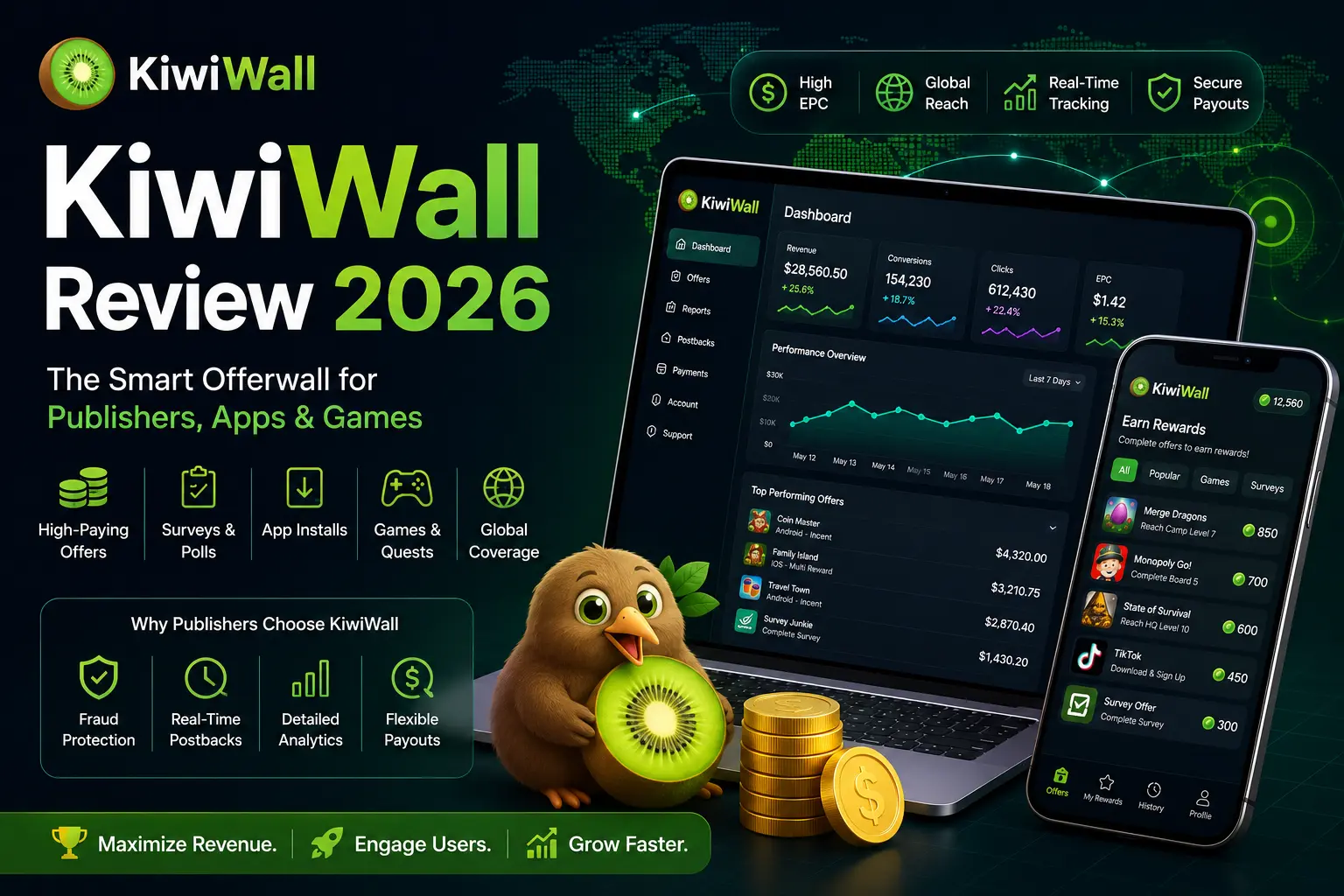
KiwiWall is an offerwall and performance-monetization platform designed primarily for publishers that want to monetize users through completed offers rather than conventional display advertising.
The basic model is straightforward: a website, app, game, GPT platform, or other reward-based product integrates KiwiWall, users see available offers, and users receive virtual rewards after completing qualifying actions. KiwiWall sits between the publisher, advertiser demand, tracking layer, and reward experience.
The official KiwiWall terms describe its service as a platform through which users can earn virtual currency by completing advertising offers. The documented use cases include websites, online games, social applications, social networks, and similar applications.
What makes KiwiWall interesting in 2026 is that its public documentation has become considerably more technical than the typical "add our offerwall and make money" pitch. Current documentation focuses heavily on postbacks, traffic quality, segmentation, offer routing, attribution, reconciliation, and controlled scaling.
That matters because an offerwall is easy to install but surprisingly difficult to operate well.
A publisher can have thousands of offers and still make poor money if:
- tracking identifiers are inconsistent;
- conversions are not reconciled correctly;
- low-quality traffic is allowed to scale;
- users are shown irrelevant offers;
- postbacks are delayed or duplicated;
- reward values are poorly configured;
- the wall is placed where accidental clicks are common.
My practical view is that KiwiWall is more interesting for serious publishers than for someone simply looking for a quick affiliate link.
The platform's current positioning is clearly operational: control traffic, track conversions, manage quality, and scale what works.
For additional background on the economics of this business model, see the Hansal Dev Offerwalls section.
2. Who is it for?
KiwiWall is primarily suited to publishers that own a destination where users can interact with rewarded offers.
That includes:
- GPT websites;
- rewards platforms;
- loyalty websites;
- mobile apps;
- games;
- communities;
- web applications;
- social/reward platforms;
- publishers with mixed web and app traffic.
KiwiWall itself distinguishes publishers from affiliates. Affiliates send traffic to campaigns, while publishers own the destination or reward experience where an offerwall is integrated.
This distinction is important.
If you are a media buyer looking for CPA campaigns, you are looking at KiwiWall from the advertiser/affiliate side.
If you own a GPT site and want users to complete offers for coins, points, or another internal reward, you are a publisher.
For a publisher, KiwiWall makes the most sense when you already have users and need another monetization layer.
It is much less compelling if you have no meaningful audience and expect the offerwall itself to generate traffic.
3. Supported platforms
KiwiWall supports the major publisher environments relevant to offerwalls:
- websites;
- mobile applications;
- online games;
- reward platforms;
- social applications;
- other digital applications.
Its official GDPR documentation explicitly describes publishers installing the offerwall on websites and apps, while its terms reference online games and social applications as supported environments.
The important point is that KiwiWall is not restricted to one particular type of GPT website.
A publisher can build an experience around an offerwall rather than simply placing a banner on a page.
4. Website support
Website integration is one of KiwiWall's strongest use cases.
For a traditional website, the simplest implementation can be an embedded offerwall rather than building the entire offer catalog, tracking system, and user interface yourself.
The current KiwiWall documentation specifically describes the iFrame route as the fastest integration path and recommends it for teams that want to launch quickly without taking on unnecessary engineering complexity.
This is particularly useful for:
- GPT websites;
- loyalty sites;
- reward portals;
- gaming communities;
- cashback-style products;
- membership platforms.
For a small publisher, an iFrame can remove a substantial amount of development work.
For a larger publisher, the API/feed approach becomes more attractive because it provides greater control over offer selection and routing.
5. App support
KiwiWall can also be used in mobile applications.
Its own GDPR documentation specifically identifies websites and apps as publisher environments.
For an app, the important consideration is not simply whether an offerwall can technically be displayed.
The real questions are:
- How is the user identified?
- How is the click associated with that user?
- How are conversions reported?
- How are rewards credited?
- How are reversals handled?
- How are duplicate events prevented?
These are the areas where KiwiWall's postback and tracking architecture become more important than the visual offerwall itself.
6. Game support
Gaming is a natural fit for KiwiWall.
Its terms explicitly mention online games and social applications, and the offerwall model itself works particularly well in games because virtual currency is already a natural part of the product.
For example, a game can give players:
- coins;
- gems;
- energy;
- credits;
- premium currency;
- XP;
- other virtual rewards.
The player completes an external offer and receives an in-game reward.
This model can be particularly effective when positioned after a user reaches a progression barrier rather than interrupting normal gameplay.
KiwiWall's own placement guidance similarly emphasizes high-intent placement rather than simply putting the wall in the most visible location.
7. Integration methods
KiwiWall currently documents three practical integration approaches:
- iFrame
- Offer Feed API
- Hybrid integration
The iFrame approach is the easiest starting point.
The Feed API provides more control.
The hybrid approach combines both, allowing a publisher to keep standard placements on an iFrame while using feed-based integration for areas where custom routing is worthwhile.
This is one of the better aspects of KiwiWall's current architecture.
You do not necessarily have to choose between "simple" and "fully custom" on day one.
A sensible progression is:
iFrame — validate traffic — stabilize tracking — introduce API/feed control — optimize by GEO/source/device.
That approach reduces technical risk.
8. API availability
Yes — KiwiWall provides an Offer Feed API.
The current documentation positions the Feed API as the higher-control option for publishers that need custom offer logic, segmentation, routing, and quality controls.
API integration becomes valuable when you want to decide:
- which offers are shown;
- which GEOs receive certain offers;
- which devices receive particular offers;
- which traffic sources receive particular campaigns;
- how offers are ranked;
- which campaigns should be excluded;
- how your internal reward system interacts with offer data.
The trade-off is engineering complexity.
An API does not automatically create a better business.
If your traffic is small and your primary objective is getting an offerwall online quickly, iFrame is probably the better starting point.
If you operate a mature GPT platform with multiple traffic segments, API control can become substantially more valuable.
9. iFrame availability
Yes. iFrame integration is explicitly supported.
KiwiWall describes iFrame as the fastest integration route and provides a dedicated setup guide.
This is probably the most attractive feature for smaller publishers.
You can avoid building:
- offer browsing;
- offer cards;
- offer categorization;
- much of the offer-selection interface;
- parts of the tracking presentation.
However, an iFrame should not be treated as "zero technical work."
You still need to correctly handle:
- user identification;
- placement identifiers;
- tracking parameters;
- reward crediting;
- postbacks;
- duplicate events;
- reversals;
- fraud controls.
The wall can be simple while the underlying reward system remains serious engineering.
10. SDK availability
I could not find current official KiwiWall documentation publicly advertising a dedicated Android or iOS SDK.
That means I would not market KiwiWall as an SDK-first offerwall unless KiwiWall confirms otherwise directly during onboarding.
This is an important distinction.
KiwiWall clearly supports apps, but app support is not the same thing as a native SDK.
For an app developer who specifically wants a polished native SDK with Android/iOS packages, developer documentation, lifecycle hooks, and built-in mobile UI components, this should be treated as a potential limitation.
For developers comfortable using a web-based wall or API-driven implementation, it is less significant.
11. Postback system
Postbacks are one of KiwiWall's strongest technical features.
Its official postback documentation specifies server-to-server conversion notifications and provides a substantial set of parameters, including:
- status;
- transaction ID;
- sub IDs;
- gross payout;
- affiliate amount;
- offer ID;
- offer name;
- category;
- mobile operating system;
- app ID.
The documented status values include:
1= Success2= Reversal
This is important for a reward platform.
A conversion should not simply be credited once and forgotten.
If an advertiser reverses a conversion, your reward ledger needs a mechanism for dealing with that reversal.
KiwiWall's postback model provides the data required to build that logic.
The current documentation also recommends strict identifier management and replay-safe handling when implementing S2S postbacks.
12. Tracking
KiwiWall provides tracking around the click-to-conversion lifecycle.
The available postback fields show that tracking can include multiple sub IDs, offer identifiers, transaction IDs, device/OS information, and conversion status.
This is useful for publishers that want to answer questions such as:
- Which placement generated the conversion?
- Which traffic source generated it?
- Which GEO performed best?
- Which offer produced the highest approved revenue?
- Which campaign has a high reversal rate?
- Which segment is producing poor-quality conversions?
The current KiwiWall guidance strongly emphasizes this kind of operational visibility rather than relying only on headline earnings or EPC.
That is exactly the right approach for an offerwall business.
13. Attribution window
KiwiWall does not publicly document a single universal attribution-window value that I could verify.
This is one area where publishers should avoid assuming a standard number such as 7, 14, 30, or 90 days.
Attribution can depend on:
- advertiser;
- offer;
- conversion event;
- campaign rules;
- tracking method;
- click/session behavior.
The safest approach is to treat attribution terms as campaign-specific unless KiwiWall gives you a defined value during onboarding.
For a production GPT platform, this should be documented internally before you build reward logic around delayed conversions.
14. Offer types
KiwiWall supports performance-oriented offers rather than relying on one advertising format.
Third-party industry listings have historically identified KiwiWall with CPL, CPI, and CPS campaigns, while KiwiWall's own postback documentation references categories such as Offer, Mobile, CC, and Video.
Depending on GEO and inventory, users may encounter offers involving:
- app installs;
- registrations;
- lead forms;
- purchases;
- subscriptions;
- mobile actions;
- surveys;
- video-related actions;
- gaming activities.
The actual mix should be considered dynamic.
A publisher should never assume that the offer catalog seen today will be identical next month.
15. GEO coverage
KiwiWall's current advertiser-facing materials state that its network is available across 150+ countries.
That is a meaningful number for a global publisher.
However, "150+ countries" should not be interpreted as "equal inventory everywhere."
Offerwall monetization is highly GEO-dependent.
A Tier-1 audience may have:
- more offers;
- higher payouts;
- more app-install inventory;
- more purchase offers;
- stronger advertiser demand.
Other markets may have substantially lower inventory.
For that reason, GEO-level reporting is more useful than a headline global coverage number.
16. Survey inventory
KiwiWall can be relevant to survey-based monetization, but I would be careful about treating surveys as a guaranteed permanent inventory category.
Survey availability changes according to:
- country;
- demographics;
- survey demand;
- quota;
- user profile;
- advertiser requirements.
This means a user in the United States may see a very different survey experience from a user in Egypt, Brazil, India, or another market.
If surveys are the central reason you are choosing an offerwall, verify the actual survey supply for your target GEOs before committing.
For a broader understanding of how surveys fit into GPT monetization, the Hansal Dev Offerwalls archive provides related coverage.
17. Gaming inventory
Gaming is one of the areas where KiwiWall's model makes particular sense.
Its official terms explicitly reference online games, and mobile/app-related offer data is part of the documented tracking structure.
Gaming offers can be particularly attractive because they can generate larger cumulative user value than a simple registration.
Examples include:
- install a game;
- reach a particular level;
- complete a milestone;
- make a purchase;
- subscribe;
- complete a defined in-game objective.
For a GPT site, gaming offers can also provide longer engagement paths.
For a game developer, the same mechanism can become an additional monetization layer.
18. Fraud prevention
Fraud prevention is increasingly important for offerwalls because the economic model creates a direct incentive for abuse.
Common attack patterns include:
- duplicate accounts;
- VPN/proxy abuse;
- emulator traffic;
- device manipulation;
- fake conversions;
- incentivized traffic where it is not permitted;
- repeated offer completion;
- click manipulation;
- postback replay.
KiwiWall's current advertiser materials reference controls including device fingerprinting, IP checks, duplicate detection, click caps, and postback validation.
The platform also emphasizes quality review and controlled scaling.
That is a positive sign.
But publishers should not outsource all fraud responsibility to the network.
You should still maintain:
- account-level limits;
- device-level controls;
- reward velocity limits;
- suspicious-session detection;
- withdrawal review;
- immutable transaction IDs;
- idempotent reward processing.
19. Reporting
KiwiWall's current positioning emphasizes performance reporting around:
- conversions;
- approvals;
- rejections;
- payout;
- EPC;
- source;
- placement;
- sub IDs;
- GEO;
- device.
Its advertiser documentation also emphasizes source-level reporting and reconciliation.
For a serious publisher, this is more important than simply seeing "today's revenue."
The most useful reporting structure is:
traffic — clicks — conversions — approved conversions — reversals — net payout.
If your reporting stops at clicks or raw conversions, you do not really know whether the wall is profitable.
20. Reward flexibility
KiwiWall is designed around virtual rewards.
Its terms describe users earning virtual currency through completed advertising offers.
That makes the platform flexible for different reward economies.
You can potentially use:
- coins;
- points;
- credits;
- gems;
- XP;
- internal currency.
The important distinction is that KiwiWall does not need to be your actual reward wallet.
Your platform should maintain its own authoritative ledger.
For example:
This gives you much better control over reversals and disputes.
21. Payout model
The publisher's business model is performance-based.
You earn when users generate qualifying conversions, rather than simply receiving payment for impressions.
Third-party historical industry data has listed KiwiWall with CPL, CPI, and CPS models and previously reported Net-20 payment terms.
However, because those commercial details can change, I would treat third-party payment information as historical reference rather than a guaranteed 2026 contractual term.
The key number for a publisher is not the advertised gross payout.
It is:
Net approved payout after reversals and rejected conversions.
That is the number that belongs in your revenue model.
22. Payment methods
Historically, third-party network listings have identified PayPal and wire transfer as KiwiWall publisher payment methods and have reported no minimum PayPal payment threshold.
However, I would verify the current payment options and threshold directly with KiwiWall before publishing a fixed payment-policy claim.
This distinction matters because the current public KiwiWall terms discuss payment methods such as credit card, mobile billing, PayPal, and others primarily in the context of users purchasing virtual currency. That is not the same thing as publisher payout methods.
So the safe conclusion is:
Publisher payment options exist, but current payout terms should be confirmed during onboarding.
23. Approval requirements
KiwiWall does not appear to publish a simple universal public checklist such as:
"You need X monthly visitors to join."
Instead, current materials emphasize traffic quality, source context, tracking discipline, and controlled onboarding.
The publisher launch documentation recommends defining:
- traffic source;
- GEO;
- placement;
- identifiers;
- conversion event;
- quality controls;
- reconciliation ownership.
That suggests a quality-first approval process rather than a simple traffic-count threshold.
24. Minimum traffic
No current universal minimum traffic requirement is publicly documented in the sources I could verify.
That is actually preferable to inventing a number.
If you have:
- a legitimate website;
- a functioning app;
- a real audience;
- clear traffic sources;
- clean tracking;
you can apply and determine eligibility with KiwiWall directly.
For very small publishers, approval may be less important than economics.
Even if accepted, an offerwall with very little user activity will not generate meaningful revenue.
25. Publisher support
KiwiWall's documentation is unusually focused on implementation and operational issues.
There are dedicated materials covering:
- integration paths;
- iFrame setup;
- Feed API use cases;
- postback parameters;
- postback troubleshooting;
- launch procedures;
- placement strategy;
- fraud and quality controls.
Its GDPR documentation also states that publisher information is stored on secured infrastructure and notes publisher communication around issues such as fraud and payments.
My assessment here is positive from a documentation perspective.
The bigger question is not whether documentation exists; it is how quickly and effectively support handles an individual publisher's tracking or payout issue.
That is something you should test during onboarding.
26. Strengths
The biggest KiwiWall strengths are:
1. Multiple integration options
You can start with iFrame and move toward API or hybrid integration as your needs become more sophisticated.
2. Strong postback documentation
The available transaction and sub-ID fields make the platform suitable for serious reward accounting.
3. Global reach
The current advertiser materials claim 150+ GEOs.
4. Website, app and gaming use cases
The platform is not restricted to a single publisher format.
5. Quality-focused architecture
Current KiwiWall materials repeatedly emphasize controlled traffic scaling, fraud prevention, approval quality and reconciliation.
6. Good fit for GPT platforms
The virtual-currency model maps naturally onto GPT economics.
27. Weaknesses
KiwiWall is not perfect.
1. Public commercial information is incomplete
Important publisher details such as current payout thresholds, exact payment schedules and approval criteria are not all presented clearly in one public specification.
2. No clearly documented native SDK
For mobile developers looking specifically for a ready-made Android/iOS SDK, this is a disadvantage.
3. Attribution-window information is limited
Publishers should not build assumptions around a universal attribution period without confirmation.
4. Offer availability is GEO-dependent
A large global network does not mean equal inventory across all countries.
5. Technical control comes with technical responsibility
The API and postback capabilities are useful, but they also require competent implementation.
6. Historical user feedback is mixed
Third-party review data should be interpreted carefully. Trustpilot currently shows a small review sample with a large share of one-star reviews, including complaints about pending rewards and payout discrepancies.
A small review sample is not enough to establish that the platform is generally unreliable, but it is enough to justify testing the complete conversion and payout lifecycle before scaling aggressively.
28. Best use case
The best KiwiWall use case, in my view, is:
A GPT, reward website, app, or game with existing users that wants a technically controllable offerwall and is prepared to monitor postbacks and conversion quality.
This is where the platform's strengths line up.
A strong implementation would look like:
- start with one placement;
- use iFrame initially;
- pass consistent user/sub identifiers;
- monitor conversions;
- validate postbacks;
- measure reversals;
- segment by GEO;
- identify high-performing offers;
- introduce API/feed control where needed;
- scale gradually.
KiwiWall itself recommends controlled rollout rather than immediately pushing large volumes through multiple placements.
That is advice I agree with.
29. Who should avoid it?
I would look elsewhere if:
- you have no existing audience;
- you want a native mobile SDK as the primary integration;
- you need a completely self-contained reward and wallet system;
- you are unwilling to maintain postback logic;
- you expect guaranteed high payouts in every GEO;
- you want a simple "paste one link and forget about it" solution;
- you do not have the ability to investigate conversion disputes.
KiwiWall is better suited to publishers that treat monetization as an operational system rather than a widget.
30. Alternatives
KiwiWall is not the only option.
Depending on your business model, alternatives worth comparing include:
AdGate Media
A well-known offerwall option for GPT and reward platforms. It is worth considering when offer variety and established publisher infrastructure are priorities.
RevU
RevU is another established performance-offer provider that can be relevant for publishers looking for offers, tracking and rewarded monetization.
Lootably
Lootably is particularly relevant to GPT and reward-site operators looking for a modern offerwall experience.
Pollfish
Pollfish is more survey-focused than a general offerwall. It becomes more interesting when surveys rather than app installs and CPA offers are the primary monetization objective.
Adjoe
Adjoe is especially relevant to mobile-app monetization and rewarded user acquisition.
The right comparison is not "which network has the highest advertised payout?"
Instead compare:
| FactorWhat to measure | |
| Fill | Offers available to your actual users |
| EPC | Earnings per click |
| Approval | Approved / raw conversions |
| Reversals | Reversed conversions |
| GEO | Performance by country |
| Tracking | Postback reliability |
| Integration | iFrame, API, SDK |
| Support | Response and resolution time |
| Payment | Method, threshold, schedule |
| Fraud | Detection and rejection quality |
For more offerwall-related material, the Hansal Dev blog has dedicated content covering GPT businesses, offerwall implementation and monetization.
31. Final rating
KiwiWall Review Score: 8.2/10
| Category | Rating |
| Offerwall functionality | 8.5/10 |
| Website support | 9/10 |
| App support | 8/10 |
| Game support | 8.5/10 |
| iFrame integration | 9/10 |
| API/feed integration | 8.5/10 |
| SDK availability | 5/10 |
| Postback system | 9/10 |
| Tracking | 8.5/10 |
| GEO coverage | 9/10 |
| Fraud controls | 8.5/10 |
| Reporting | 8/10 |
| Documentation | 8.5/10 |
| Payment transparency | 6.5/10 |
| Publisher suitability | 8.5/10 |
Final verdict
KiwiWall is a serious offerwall option for publishers that want more than a basic list of affiliate offers.
Its strongest feature is not simply the number of offers. It is the combination of iFrame integration, Feed API capability, postback tracking, sub-ID support, traffic controls, GEO segmentation and performance-oriented reporting.
That combination makes it particularly interesting for GPT websites, reward platforms, apps and games.
The technical architecture is also where KiwiWall separates itself from simpler offerwall implementations. The platform documents the mechanics behind conversion tracking rather than treating the offerwall as a black box. Its current integration documentation explicitly supports an iFrame-first approach, a higher-control Feed API route, or a hybrid model.
There are still things I would verify before making KiwiWall a primary monetization partner:
- current publisher payout schedule;
- current payment methods;
- minimum payout threshold;
- approval criteria;
- actual offer availability in your target GEOs;
- attribution rules for important campaigns;
- mobile integration options;
- reversal handling;
- support response times.
I would also avoid judging KiwiWall purely from advertised offer counts.
For a real GPT or reward platform, 10,000 mediocre offers are less valuable than 500 offers that actually convert, track correctly and remain approved.
The same principle applies to payout.
A $10 advertised conversion is meaningless if the traffic generates poor approval rates, delayed postbacks, reversals or user complaints.
The metric that ultimately matters is net approved revenue per active user, segmented by GEO, device, traffic source and placement.
That is why my overall rating lands at 8.2/10 rather than giving KiwiWall an unrealistic 9.5 or 10.
KiwiWall looks strongest for publishers that are willing to operate their offerwall professionally: control the traffic, maintain clean identifiers, validate postbacks, monitor fraud, test placements and scale only after the numbers prove themselves.
For a small publisher looking for the easiest possible implementation, start with the iFrame.
For an established GPT platform or reward app with meaningful traffic and an engineering team, the API/feed and hybrid options are much more interesting.
And for anyone considering KiwiWall as a major revenue source, the sensible approach is simple: test it with a controlled percentage of traffic, measure approved revenue rather than raw conversions, and compare the results against your existing offerwall partners before moving significant volume.
Bottom line: KiwiWall deserves consideration in a modern offerwall stack, particularly for GPT sites, reward platforms, apps and games. Its strongest areas are integration flexibility, tracking and operational control. Its biggest weaknesses are incomplete public commercial details and the lack of clearly documented native SDK support. Treat it as a performance platform that needs monitoring — not as a plug-and-forget monetization widget.
Sources & further reading
- KiwiWall official website
- KiwiWall Postback Documentation
- KiwiWall Terms & Conditions
- KiwiWall GDPR information
- KiwiWall Publisher Integration Paths
- KiwiWall iFrame Offerwall Setup Guide
- KiwiWall Offer Feed API Use Cases
- KiwiWall Publisher Launch Checklist
- KiwiWall Platform Guide
- KiwiWall placement strategy guide
- Trustpilot KiwiWall reviews
- Hansal Dev Blog
Editorial note: Public KiwiWall documentation was used as the primary source for technical capabilities. Where current public documentation does not specify a commercial term — such as a universal attribution window, minimum traffic requirement, or current publisher payout threshold — I have explicitly marked it as unverified rather than filling the gap with an assumption. Third-party review and network data is treated as supplementary evidence, not as definitive proof of current commercial terms.







Comments (0)
No comments yet. Be the first to share your thoughts!