
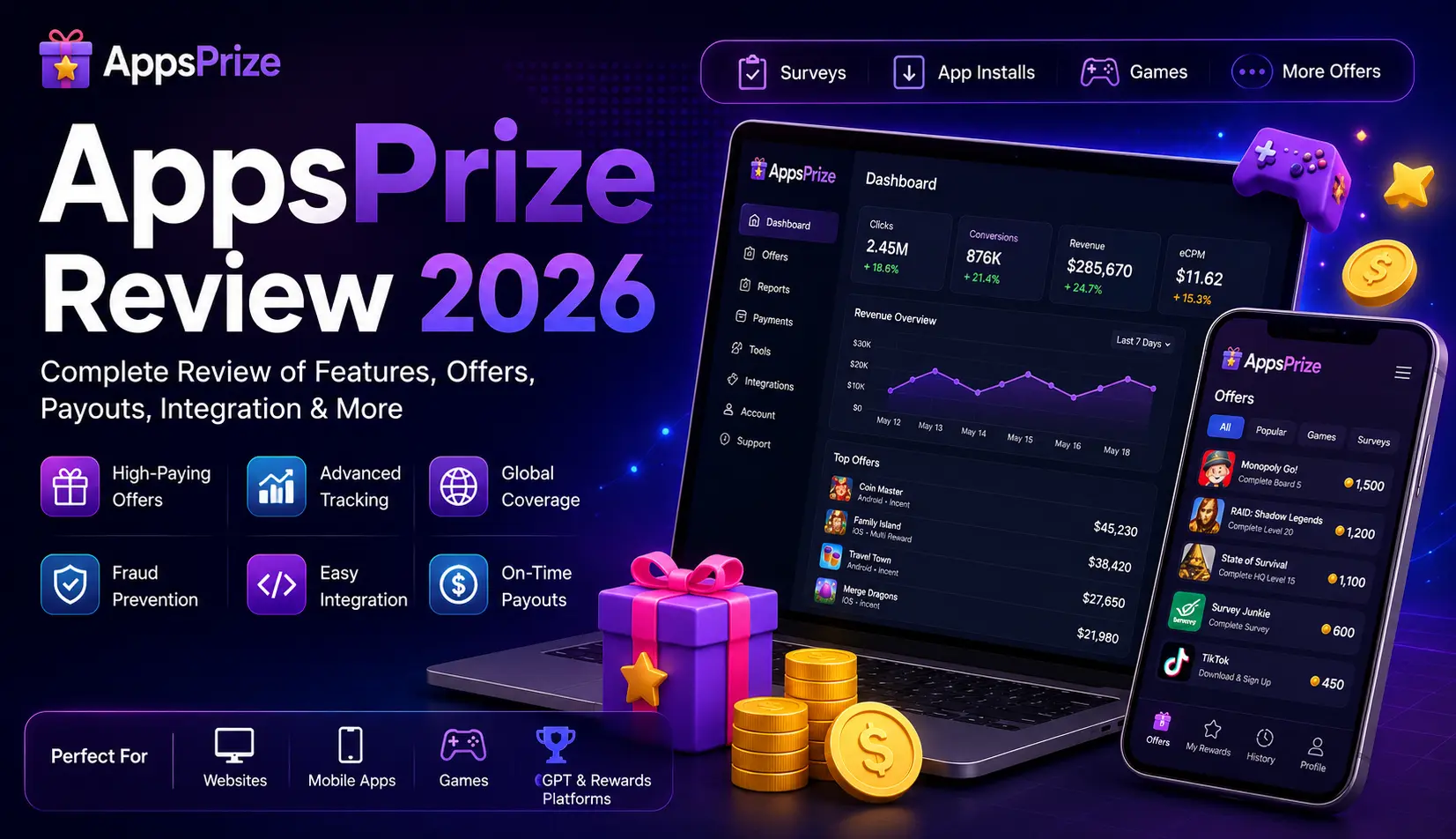
1. Overview
AppsPrize is a rewarded engagement and offerwall product operated by AppSamurai. Its main proposition is straightforward: publishers give their users a place to discover apps, games, and reward-driven tasks, while the publisher earns advertising revenue from completed user activity.
What makes AppsPrize more interesting than a basic install wall is its emphasis on playtime and multi-step engagement. Users can earn rewards for spending time inside partner apps or completing defined events and milestones. The platform also supports task-based campaigns, where a user may receive incremental rewards for completing several actions rather than being rewarded only once for an installation.
AppsPrize has also expanded beyond a traditional mobile SDK. Its current publisher documentation describes a Web SDK that can run through a URL or be embedded into a website or web application using an iframe. For more advanced publishers, AppSamurai documents a Campaign Pull API that can return live campaigns, targeting information, bids, creatives, tracking URLs, and event goals.
That combination makes AppsPrize worth considering for publishers that want more than another banner-ad placement.
My practical view is that AppsPrize makes the most sense when you already have an engaged audience. The offerwall is not something I would treat as a substitute for an acquisition strategy. It is a monetization and engagement layer that works best when users already have a reason to return to your app, website, loyalty product, or game.
For additional reading on monetization and publisher technology, see the HansalDev blog.
2. Who is it for?
AppsPrize is primarily aimed at publishers and developers that have an existing user base.
The platform can make sense for:
- Mobile game developers
- Reward apps
- Loyalty applications
- Entertainment apps
- Utility applications with active users
- QSR and loyalty apps
- Web applications
- Browser-based games
- Hybrid mobile products
- Publishers looking for incremental advertising revenue
AppSamurai specifically positions AppsPrize for mobile games, but its current Web SDK documentation also covers web applications and browser games. AppSamurai has additionally described use cases in loyalty and QSR applications where users earn points through gameplay.
The important distinction is between traffic volume and engagement quality.
A website with 100,000 low-engagement visitors may not necessarily be a better AppsPrize publisher than an application with 20,000 highly active users. Rewarded offers work because users voluntarily perform actions. If nobody interacts with the wall, inventory does not automatically become revenue.
3. Supported platforms
AppsPrize currently supports several integration environments.
The official publisher documentation identifies:
- Android
- React Native
- Unity
- Web applications
- Websites
- Browser-based experiences
- Hybrid mobile experiences
The Android SDK targets Android API level 23 and higher, while separate documentation covers React Native and Unity integrations. The Web SDK provides a browser-based route without requiring a native SDK installation.
One point worth highlighting is that the current documentation does not present AppsPrize as a generic "install one SDK everywhere" product. Different environments have different integration paths.
For Android developers, the native SDK is the obvious choice. For a website, the Web SDK or iframe makes considerably more sense.
4. Website support
Yes. AppsPrize supports websites and web applications.
The current Web SDK documentation describes a lightweight browser implementation that requires no package installation or native build. A publisher can launch the experience through a URL or embed it into its own product.
This is particularly useful for:
- Reward websites
- Browser games
- Loyalty portals
- Web-based communities
- Hybrid applications
- Desktop-oriented products with mobile users
For a website owner, this significantly reduces the technical barrier compared with integrating a native mobile SDK.
The Web SDK also supports URL parameters for personalization and localization, while tracking and analytics are designed to feed results back into the publisher's backend.
5. App support
AppsPrize is strongly oriented toward mobile applications.
The native SDK provides the offerwall experience inside the application and can track users' reward progress. Android documentation shows initialization using an app token, advertising ID, and publisher-defined user ID. Additional information such as country, language, age, gender, acquisition channel, network, and placement can be supplied for targeting.
That user ID is especially important. It gives the publisher a stable way to associate rewards with its own user account system.
From an engineering perspective, I would treat that ID mapping as one of the first things to test. If your internal user ID, AppsPrize user ID, and reward ledger do not line up cleanly, debugging reward disputes later becomes unnecessarily painful.
6. Game support
Games are one of AppsPrize's strongest use cases.
The platform's Rewarded Playtime model is specifically designed around users trying mobile games and receiving rewards for engagement. AppsPrize also supports task-based structures where users progress through levels or other milestones.
This is useful for both sides of the ecosystem.
For the host publisher:
- More user engagement
- Additional monetization
- More reasons for users to return
For the advertiser:
- Installs
- Gameplay
- Level completion
- Purchases
- Deeper post-install engagement
The Campaign Pull API documentation demonstrates that campaigns can contain event goals such as completing a level or making a purchase, with individual bids and time limits.
That makes AppsPrize more sophisticated than an install-only wall.
7. Integration methods
AppsPrize provides several integration paths:
- Web SDK
- iFrame
- Native mobile SDK
- Campaign Pull API
- Server-to-server reward callbacks
The appropriate method depends heavily on how much control you want.
Web SDK: fastest option for web products.
iFrame: useful when you want the offerwall embedded inside an existing interface.
Native SDK: appropriate for Android, Unity, and React Native applications.
Campaign Pull API: designed for publishers that want to retrieve campaign information and build their own presentation layer.
S2S callbacks: important when you want rewards to be processed securely on your own backend.
This is one of AppsPrize's better characteristics. You are not forced into one integration model.
8. API availability
Yes. AppsPrize has a Campaign Pull API.
The official documentation says the API allows server-to-server publishers to retrieve live campaigns available to their placements. Campaign objects can include:
- Campaign ID
- App title
- App category
- Store URL
- Platform
- Bid
- Campaign type
- Target countries
- Tracking URL
- Creatives
- Event goals
- Suggested reward amounts
- Event time limits
- Completion information
Authentication uses a publisher-specific API key issued by the technical account manager.
This is important because an API changes the role of AppsPrize from a simple embedded wall into something that can participate in a publisher's own monetization architecture.
The API is particularly attractive if you want to build custom offer cards, promotional banners, notifications, or campaign-specific landing experiences.
9. iFrame availability
Yes.
AppsPrize's current Web SDK documentation explicitly states that the Web SDK can be embedded using an iframe.
For many website owners, this will probably be the simplest implementation.
The advantage is obvious: you can retain control over the surrounding website while placing the offerwall inside a designated rewards area.
The downside is equally obvious: an iframe gives you less control than a full API implementation.
For a startup validating an idea, I would start with the simpler integration. I would only move to API-driven rendering after proving that the offerwall actually generates meaningful engagement.
10. SDK availability
AppsPrize has SDK support for Android, React Native, and Unity, with the Web SDK providing a separate browser-based integration path.
The SDK exposes functionality for:
- Initialization
- Offerwall launching
- Campaign opening
- Reward updates
- Permission handling
- Reward payout
- Notifications
- UI customization
The mobile SDK also supports selecting between time-based and task-based offerwall experiences.
For Unity developers, AppsPrize provides an integration package through OpenUPM and documents Android dependency setup.
11. Postback system
The postback system is one of the technically stronger parts of AppsPrize.
AppsPrize supports server-to-server payout notifications. When an event occurs, AppsPrize can send an HTTP POST request to the publisher's endpoint.
The callback can contain fields including:
user_idcoin_amountcoin_currencycpi_bidpayout_currencydevice_idtrans_idevent_nameevent_tokenevent_coin_amountapp_bundle_idapp_namelevelsecondspointstype
The request type can identify events such as installs, rewards, and task events.
More importantly, AppsPrize provides a signature mechanism based on SHA-256. Publishers are expected to verify the signature rather than blindly trusting incoming reward requests.
That is exactly the kind of implementation detail I want to see in a reward platform.
Do not credit users merely because an HTTP request arrived. Verify the signature, validate the transaction ID, make reward processing idempotent, and store the transaction in your own ledger.
12. Tracking
Tracking is built into the AppsPrize experience.
The platform associates users with offers and tracks events such as installs, playtime, levels, and other tasks. The Campaign Pull API also exposes tracking URLs generated during the S2S integration process.
For mobile applications, AppsPrize uses advertising identifiers and user identifiers as part of its tracking architecture. Its documentation also describes permissions related to tracking usage of other applications on the device.
This deserves attention from privacy-conscious publishers. The AppsPrize privacy policy states that information such as installed applications, usage duration/history, device information, IP address, operating system, and general location may be processed for service purposes.
If you operate in a regulated market, review the applicable privacy and consent requirements before deployment.
13. Attribution window
AppsPrize does not appear to publish one universal attribution-window number that applies to every campaign.
Instead, campaign-level event data can include a time limit. The Campaign Pull API, for example, exposes event-level time limits such as seven or thirty days.
That suggests attribution and completion rules are better understood at the campaign/event level rather than as one fixed AppsPrize-wide number.
This is an important distinction for publishers. If you are forecasting revenue, do not assume that every offer behaves identically.
Check:
- Campaign start date
- Campaign end date
- Event deadline
- Install requirements
- Event requirements
- Platform
- GEO
- Daily caps
The API exposes several of these fields directly.
14. Offer types
AppsPrize supports multiple rewarded engagement structures.
The main categories visible in its documentation are:
- Time-based offers
- Task-based offers
- Multi-step rewards
- Level-based events
- Purchase events
- Install events
- Daily quests
- Hybrid reward structures
AppsPrize SDK 2.0 introduced a more gamified task structure using Common, Epic, and Legendary tasks. It also introduced Daily Quests and Second Chance functionality for certain hybrid offers.
This is one of the platform's strongest differentiators.
Instead of saying "install this app and get X points," a publisher can participate in a deeper engagement model.
15. GEO coverage
AppsPrize has promoted global coverage, with AppSamurai previously stating availability in more than 60 countries.
However, publishers should not confuse "global availability" with equal inventory in every country.
Offer supply is naturally stronger in some markets than others because advertiser demand, purchasing power, device penetration, and campaign targeting differ by GEO.
The Campaign Pull API supports country, region, and city targeting fields, which confirms that geographic availability is campaign-specific.
For publishers in Tier-2 and Tier-3 markets, I would test the actual wall with users from your major GEOs before making revenue assumptions.
16. Survey inventory
This is an area where AppsPrize requires careful positioning.
AppsPrize is primarily presented by AppSamurai as a rewarded app/game engagement platform, particularly around mobile games and playtime. It is not positioned as a survey-first network in the same way as specialist survey offerwalls.
Some third-party descriptions associate AppsPrize with surveys and sign-up tasks, but the strongest official documentation focuses on app installs, gameplay, task events, and rewarded engagement.
Therefore, if your entire business model depends on a deep survey inventory, I would compare AppsPrize directly against survey specialists rather than assuming it will provide the same survey depth.
For game-heavy audiences, however, that limitation may not matter.
17. Gaming inventory
Gaming is where AppsPrize looks most compelling.
AppSamurai describes AppsPrize as a way to bring mobile game offers to publishers and monetize users through Rewarded Playtime. The platform's documentation supports time-based play rewards and event-driven tasks.
The Campaign Pull API can expose:
- Game category
- Game description
- Platform
- Store URL
- Event goals
- Level events
- Purchase events
- Completion rates
- Average completion times
- Suggested rewards
That data can be valuable when deciding which offers deserve prominent placement.
For gaming publishers, this is probably the single biggest reason to test AppsPrize.
18. Fraud prevention
AppsPrize has a clear anti-fraud focus.
AppSamurai describes AppsPrize as using validated reward events and fraud-aware payouts to reduce revenue loss from invalid activity.
The S2S system adds another important layer because reward events can be verified cryptographically using a signature.
From a publisher's perspective, fraud prevention matters for two reasons:
- You do not want to give rewards to fake users.
- You do not want advertisers to reject your traffic because of poor-quality conversions.
The second point is frequently overlooked. Offerwall economics are not just about maximizing completed offers. A publisher needs sustainable traffic quality.
AppsPrize's privacy documentation also mentions fraud prevention as a reason for retaining certain data.
19. Reporting
AppsPrize provides reporting capabilities, including a Revenue Reporting API in its SDK 2.0 ecosystem.
AppSamurai states that the Revenue Reporting API provides detailed insights into ad revenue, while the Campaign Pull API provides live campaign information.
This is useful for publishers that want to connect monetization data to their own analytics stack.
At minimum, I would monitor:
- Offer impressions
- Offer clicks
- Starts
- Installs
- Completed events
- Rewarded users
- Revenue
- Revenue per active user
- Conversion rate
- Completion rate
- Refund/chargeback behavior
- GEO performance
- Platform performance
A wall can look impressive while producing disappointing economics. Reporting should be judged on whether it helps you understand that difference.
20. Reward flexibility
AppsPrize allows publishers to work with their own virtual currency system.
The S2S payout documentation includes coin_amount and coin_currency, meaning the publisher can define how the reward is represented in its own product.
This is important because 1 USD of advertiser value does not necessarily need to become "1 coin."
You might choose:
- 1 USD = 1,000 points
- 1 USD = 10,000 coins
- Variable reward ratios
- GEO-specific reward economics
The correct exchange rate depends on your broader product economy.
If users can earn points through several activities, the AppsPrize reward rate should be designed so that the offerwall complements — not destroys — your existing economy.
21. Payout model
AppsPrize supports two major reward payout approaches.
Server-to-server payout
AppsPrize sends reward information to your backend, and your system is responsible for crediting the user.
This is the approach AppSamurai recommends because it provides greater security and transparency.
SDK payout
The SDK can also handle rewards directly through its reward functionality if the publisher cannot implement server-side processing.
For a serious publisher, I would choose S2S whenever possible.
Your own backend should remain the source of truth for:
- User balance
- Transaction ID
- Reward amount
- Currency
- Offer ID
- Event
- Timestamp
- Verification status
That architecture makes disputes substantially easier to investigate.
22. Payment methods
Public AppsPrize documentation is relatively limited regarding a standardized publisher payment-method list and universal payout schedule.
This is one area where I would not invent a PayPal, Payoneer, bank-transfer, or cryptocurrency list simply because those methods are common in the industry.
AppsPrize's public publisher documentation focuses much more heavily on technical reward delivery than on a fixed public publisher payment table. Its commercial materials direct publishers toward contacting the team about monetization.
Therefore, payment terms should be confirmed during onboarding.
Ask specifically about:
- Publisher payout currency
- Minimum payout threshold
- Payment frequency
- Payment method
- Net terms
- Fees
- Chargebacks
- Payment hold periods
- Tax documentation
That is a better approach than relying on outdated third-party lists.
23. Approval requirements
AppsPrize is not presented as an anonymous instant-access traffic platform.
The publisher workflow involves adding an app and obtaining the necessary credentials, and the Campaign Pull API specifically states that its API key is issued by a technical account manager.
The commercial onboarding process also asks publishers to provide information about their app or game.
In practical terms, expect some form of publisher review and technical onboarding.
You should have ready:
- Website or app URL
- Product description
- Traffic sources
- Main GEOs
- User volume
- Monthly active users
- Platform information
- Reward model
- Integration requirements
24. Minimum traffic
I could not find a reliable public AppsPrize source stating a universal minimum monthly traffic requirement.
That is actually useful information in itself.
Many offerwall networks change acceptance criteria depending on the publisher's product, GEO, traffic quality, and business model.
So I would avoid articles claiming that AppsPrize requires a specific number such as 10,000, 50,000, or 100,000 monthly users unless that figure is supplied directly by AppsPrize for your account.
The official monetization page instead asks publishers to provide their app or game details and discuss their needs with the monetization team.
For a small publisher, the right question is therefore not "Do I meet an arbitrary traffic number?" but "Does AppsPrize consider my audience and product commercially useful?"
25. Publisher support
AppsPrize provides publisher documentation and support through the AppSamurai ecosystem.
The documentation includes detailed technical material covering:
- SDK installation
- Initialization
- Offerwall launching
- Rewards
- Web SDK
- iFrame
- API
- UI customization
- S2S payout
The current documentation explicitly directs publishers to contact the support team if they need help.
This is a positive sign for technical teams.
For non-technical publishers, however, the quality of account management during commercial onboarding may be more important than the documentation itself. That is something worth evaluating directly during the sales/onboarding process.
26. Strengths
Strong gaming orientation
AppsPrize has a genuine focus on gaming and rewarded playtime rather than treating games as just another offer category.
Multiple integration options
Web SDK, iframe, native SDKs, Campaign Pull API, and S2S callbacks give publishers flexibility.
Strong event model
The platform supports installs, levels, purchases, time-based rewards, daily quests, and deeper task events.
Good developer controls
Campaign IDs, API access, reward callbacks, user IDs, localization, and UI customization are useful for mature products.
Fraud-aware architecture
S2S signatures and validated reward events are important features for a reward-based business.
Web support
The Web SDK makes AppsPrize relevant to publishers that do not have a native mobile application.
27. Weaknesses
Limited public commercial information
Publisher payout schedules, payment methods, and minimum traffic requirements are not presented as a simple public table.
That makes independent financial forecasting harder.
Gaming-heavy positioning
If your users primarily want surveys, AppsPrize may not be the strongest first choice.
Technical complexity at the advanced level
The basic integration is relatively straightforward, but a serious API/S2S implementation requires backend engineering.
Tracking/privacy considerations
Because the service can process device, application-usage, and related information, privacy and consent should be treated as part of the integration — not as an afterthought.
Inventory varies by GEO
"Global" does not mean equal offer density everywhere. Campaign targeting is explicitly country/region dependent.
28. Best use case
The strongest AppsPrize use case is a mobile app or game with an already-engaged audience that wants additional monetization without forcing users to spend money.
A particularly good setup would be:
Free mobile game — AppsPrize Play & Earn section — user installs partner game — completes levels/playtime — publisher receives validated event — user receives virtual currency.
It can also work well for loyalty applications.
For example, AppSamurai has described a QSR use case where customers play games and receive loyalty points, creating an engagement loop between purchases.
That is more interesting than simply placing an offerwall on an otherwise empty website.
29. Who should avoid it?
I would hesitate to recommend AppsPrize as the primary monetization solution for:
- Websites with extremely low engagement
- Publishers looking primarily for survey inventory
- Products with no meaningful reward economy
- Traffic dominated by bots or incentivized manipulation
- Publishers unwilling to implement proper reward verification
- Businesses that require completely transparent public payout terms before signing up
AppsPrize is also not suitable for publishers expecting every user to generate revenue.
The economics depend on users actually engaging with offers.
30. Alternatives
AppsPrize should not be evaluated in isolation.
RevU
RevU is a strong alternative if you want an offerwall with an SDK-free architecture. Its publisher product supports apps, games, and websites, with iFrame, hosted, and API-based integrations.
Lootably
Lootably is worth testing if you want a broader offerwall architecture with iFrame, direct-link, and Offers API integrations.
AdGate Media
AdGate Media is another established option for publishers looking to monetize app and website audiences through rewarded advertising.
Offerwall.com
Offerwall.com is another option for websites and applications, with support for surveys, app installs, customizable widgets, reporting, and fraud controls.
The best alternative depends on your audience. A gaming publisher should not necessarily choose the same network as a survey-heavy rewards website.
31. Final rating
AppsPrize Review Score: 8.4/10
| CategoryRating | |
| Overall platform | 8.5/10 |
| Gaming inventory | 9.0/10 |
| Task-based offers | 9.0/10 |
| SDK | 8.5/10 |
| Web support | 8.5/10 |
| iFrame | 8.5/10 |
| API | 8.5/10 |
| Postbacks | 9.0/10 |
| Tracking | 8.5/10 |
| Fraud prevention | 8.5/10 |
| Reporting | 8.0/10 |
| GEO reach | 8.0/10 |
| Survey inventory | 6.5/10 |
| Reward flexibility | 8.5/10 |
| Public payout transparency | 6.5/10 |
| Publisher suitability | 8.5/10 |
Final verdict
AppsPrize is one of the more technically interesting offerwall platforms to consider in 2026, particularly if your product has a gaming, loyalty, or highly engaged mobile audience.
Its strongest feature is not simply the existence of an offerwall. The real value is the combination of playtime rewards, task-based campaigns, event-level tracking, API access, S2S callbacks, campaign-level data, and multiple integration paths.
The Campaign Pull API is especially notable for more advanced publishers because it exposes campaign metadata, targeting, bids, creatives, tracking URLs, and event goals rather than forcing every publisher into a fixed wall interface.
The main caveat is transparency around commercial terms. Public technical documentation is strong, but information about publisher payment schedules, payment methods, minimum traffic, and account-specific commercial requirements is less explicit. Those details should be confirmed directly during onboarding.
My practical recommendation is therefore simple:
Test AppsPrize if you operate a mobile game, loyalty app, reward product, or engaged web platform.
Start with the simplest integration that lets you measure real performance. Then, if the numbers justify it, move toward S2S reward processing and API-driven customization.
Do not judge the network solely by the number of offers displayed.
Judge it by:
- Revenue per active user
- Offer-start rate
- Conversion rate
- Event completion
- Reward cost
- Net revenue
- GEO performance
- User retention
- Fraud rate
- Support quality
That is the difference between adding an offerwall and building a profitable monetization channel.
For developers and site owners researching the broader offerwall ecosystem, the HansalDev blog is also a useful place to compare AppsPrize with other offerwall and rewarded-ad platforms.
Official resources
- AppsPrize Web SDK documentation
- AppsPrize SDK documentation
- AppsPrize Campaign Pull API documentation
- AppsPrize SDK 2.0 overview
- AppsPrize privacy policy
- AppsPrize terms of use
Bottom line: AppsPrize is a strong candidate for publishers that want to turn user engagement — especially gaming engagement — into an additional revenue stream. It is less compelling as a survey-first solution, and publishers should confirm commercial terms before committing. For the right audience, however, its combination of SDK, Web SDK, iFrame, API, task-based rewards, playtime mechanics, and S2S infrastructure makes it a serious offerwall platform rather than just another embedded rewards widget.


Comments (0)
No comments yet. Be the first to share your thoughts!