
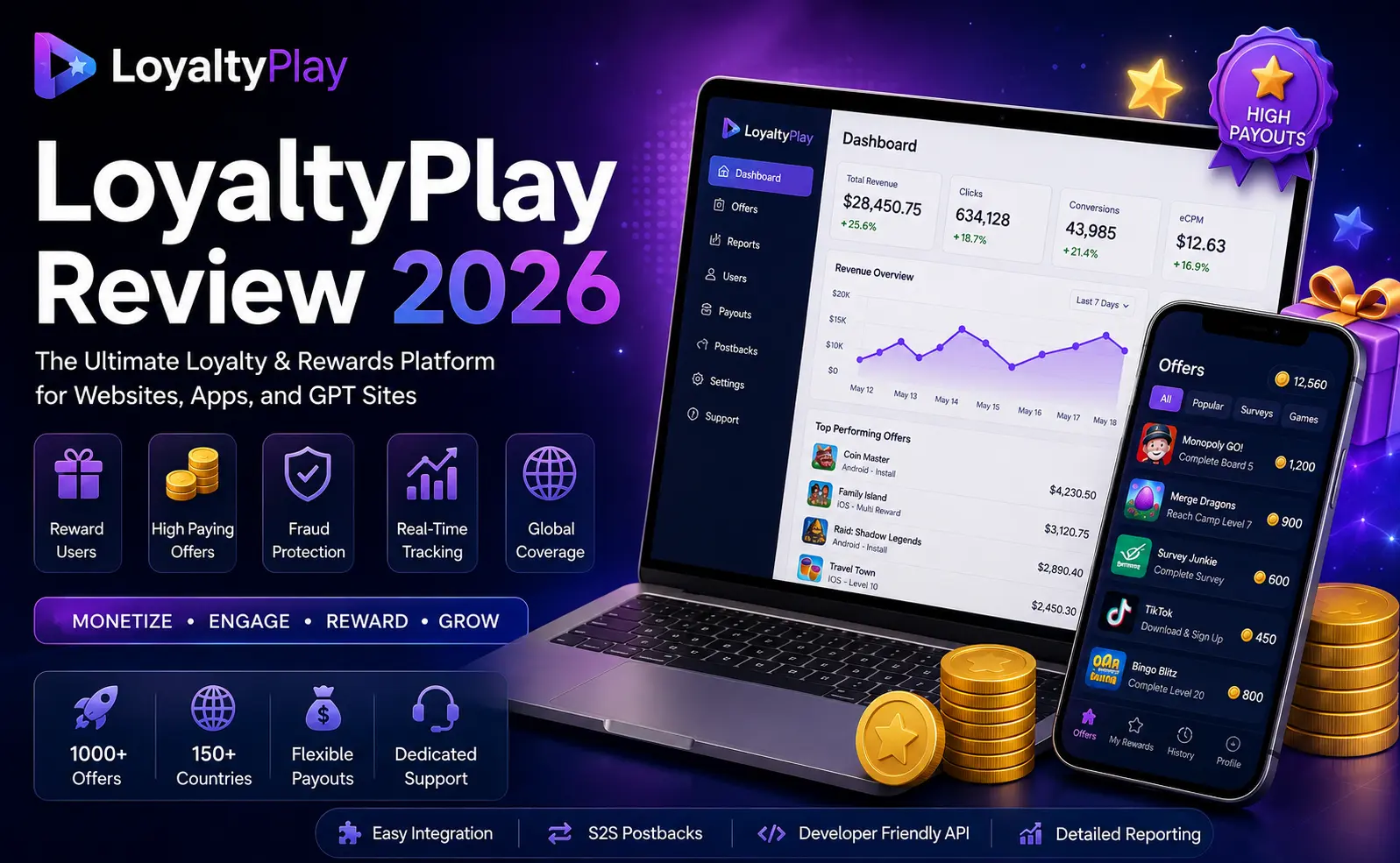
LoyaltyPlay is one of the more interesting developments in the rewarded monetization market because it does not position itself as a generic offerwall packed with surveys, app installs, videos, and miscellaneous CPA campaigns.
It comes from Mistplay, a company that has spent years building a business around rewarded mobile gaming. LoyaltyPlay was officially introduced in May 2025 as a gaming reward hub designed to let app publishers add game-based rewards to their own products.
That distinction matters.
If you are running a rewards app, GPT platform, loyalty program, fintech product, utility app, entertainment service, or another product with an internal currency, the real question is not simply whether LoyaltyPlay has "offers."
The more important question is whether those offers can create a sustainable loop:
User plays a game — user earns your virtual currency — user has a reason to return — your platform generates monetization revenue — the reward becomes partially self-funding.
That is the model LoyaltyPlay is trying to build.
I also found an important difference between LoyaltyPlay and many traditional offerwall networks during my research: Mistplay publicly emphasizes gaming inventory, repeat engagement, customization, and long-term loyalty rather than treating the offerwall as simply another advertising placement.
There is another reason this review needs some nuance. LoyaltyPlay is a relatively young B2B product, and Mistplay does not publicly document every commercial and technical detail that publishers normally want to see before integration. Therefore, where a feature is not publicly confirmed — such as exact payment schedules, minimum traffic requirements, attribution-window specifications, or a current public API reference — I will explicitly say so rather than fill the gaps with assumptions.
That is important when evaluating an offerwall.
1. Overview
LoyaltyPlay is a gaming-focused reward and monetization platform from Mistplay designed primarily for app publishers, brands, retailers, and other digital businesses that want to use mobile gaming as an engagement and revenue mechanism.
Mistplay announced LoyaltyPlay in May 2025, describing it as an extension of its experience in rewarded gaming and a way for publishers to introduce game-based engagement into their own products.
The concept is straightforward.
A publisher has users who may not be paying customers. Instead of showing those users another conventional advertisement, the publisher gives them an opportunity to earn the platform's own rewards by discovering and playing mobile games.
For example:
- A GPT website could reward users with points.
- A fintech app could reward users with loyalty currency.
- A shopping application could offer points for game engagement.
- An entertainment platform could give users credits.
- A rewards application could add gaming as another earning method.
Mistplay says LoyaltyPlay can be customized to fit the publisher's existing brand and user experience, while its recommendation engine matches games to users. The company also says it has partnerships with hundreds of mobile games across multiple genres.
One of the strongest pieces of evidence is not the marketing page but the growing list of publisher case studies.
For example, Caveduck integrated LoyaltyPlay into its web platform and reported a 134% increase in incremental revenue and a 66% increase in ARPDAU.
GeoSmile reported that LoyaltyPlay eventually represented 20% of its total revenue, while the number of users interacting with its offerwall increased by 1.5x.
These are publisher-reported case studies rather than independent audits, so they should be viewed as evidence of potential — not guaranteed performance.
My initial verdict: LoyaltyPlay looks considerably more compelling for gaming-oriented rewarded monetization than for publishers searching primarily for survey inventory.
2. Who Is It For?
LoyaltyPlay is primarily designed for publishers that already have an engaged user base and an internal reward or currency system.
Mistplay specifically identifies app publishers as a core audience and says that having an in-app currency is enough to enable the product.
Potentially strong users include:
- GPT and rewards applications
- Loyalty platforms
- Fintech applications
- Shopping and cashback products
- Utility apps
- Entertainment platforms
- Freemium services
- Community platforms
- AI applications with virtual currencies
- Apps trying to monetize non-paying users
- Websites with reward-based engagement models
The Caveduck case is particularly interesting because it demonstrates that the model is not limited to conventional rewards apps. Caveduck used LoyaltyPlay to let free users earn additional virtual currency and continue using its AI chat service.
This is probably one of LoyaltyPlay's most important advantages: the publisher does not necessarily need to be a gaming company.
3. Supported Platforms
LoyaltyPlay supports both mobile applications and web-based experiences.
Mistplay's public material discusses Android and iOS opportunities, while the Caveduck case demonstrates an actual web-platform implementation.
This makes LoyaltyPlay more interesting than a solution restricted to one mobile operating system.
For publishers, the important distinction is:
Android: strongly aligned with Mistplay's historical rewarded-gaming expertise.
iOS: increasingly important and specifically highlighted in publisher success stories.
Web: demonstrably supported through real-world publisher deployments such as Caveduck.
The GeoSmile case is particularly relevant for iOS. GeoSmile said that 70% of its users were on iOS and that LoyaltyPlay helped address its previous shortage of attractive iOS offer inventory.
4. Website Support
Yes — website monetization is supported.
This is no longer theoretical. Caveduck integrated LoyaltyPlay into its web platform and used it to monetize non-paying users. The publisher reported a 134% increase in incremental revenue and a 66% increase in ARPDAU.
This is important because many gaming-reward products are heavily associated with mobile applications.
LoyaltyPlay's web case demonstrates that a publisher can use game-based rewards outside a traditional mobile-only environment.
For a website, the ideal implementation would normally be something like:
User account — LoyaltyPlay experience — game offer — tracked engagement — verified conversion — publisher reward — internal currency balance.
The exact implementation details should be agreed with Mistplay during onboarding because the public LoyaltyPlay documentation does not expose a comprehensive developer reference comparable to some competing offerwall APIs.
5. App Support
Mobile applications are clearly one of LoyaltyPlay's primary use cases.
Mistplay describes LoyaltyPlay as a product for app publishers and specifically discusses both Android and iOS opportunities.
The strongest practical advantage here is that LoyaltyPlay is built around mobile game demand, rather than simply aggregating unrelated digital tasks.
For an app whose audience already understands points and rewards, the addition can feel natural:
"Need more credits? Play one of these games and earn them."
That is considerably more engaging than displaying a generic banner.
6. Game Support
Gaming is where LoyaltyPlay is strongest.
Mistplay says LoyaltyPlay has partnerships with hundreds of leading mobile games across multiple genres and uses recommendation technology to personalize the game inventory presented to users.
Mistplay's broader rewarded-gaming background is also significant. The company has been operating in rewarded mobile gaming since 2016, according to its corporate materials.
The offer experience can involve more than a simple install.
Depending on the campaign, users may be rewarded for:
- Installing a game
- Playing for a period of time
- Reaching a milestone
- Completing a progression objective
- Performing specified in-game actions
Mistplay's publisher material specifically describes rewards based on time spent playing or in-game milestones.
This creates a deeper engagement model than conventional CPI-only campaigns.
7. Integration Methods
LoyaltyPlay supports integration into existing publisher products, but Mistplay does not publicly publish a complete list of all current integration mechanisms in the same level of technical detail found in some competing networks.
Public evidence indicates that LoyaltyPlay can be integrated into web platforms and apps, and a public third-party package repository shows an Android SDK under the com.mistplay:loyaltyplay package.
The safest interpretation is:
- Mobile integration: supported
- Web integration: supported
- SDK-based Android integration: historically/publicly evidenced
- Custom integration: potentially available through publisher onboarding
- Exact current integration stack: confirm with Mistplay
Do not confuse the existence of an old SDK artifact with proof that it represents the current recommended integration architecture.
8. API Availability
A public, comprehensive LoyaltyPlay publisher API reference is not clearly available.
This is one area where LoyaltyPlay is less transparent publicly than some competing offerwalls.
Mistplay's public publisher materials focus more on the product, use cases, customization, and business outcomes than on exposing an open developer API specification.
Therefore, if your engineering team requires:
- Offer API
- Real-time offer feed
- Custom frontend
- Server-to-server event processing
- Automated reporting
- Custom user identifiers
- Programmatic offer filtering
you should ask Mistplay for the current publisher integration documentation before committing to development.
Rating for public API transparency: 6/10.
That does not mean the technology is incapable. It means the publicly available documentation is limited.
9. iFrame Availability
There is evidence that LoyaltyPlay can support web deployments, but Mistplay's current public material does not provide a definitive public iFrame specification.
This distinction matters.
A web integration does not automatically mean that the product is available as a simple copy-and-paste iFrame.
If your preference is:
"Give me an iframe URL and I will put it inside my website."
you should confirm this directly with the LoyaltyPlay team.
For publishers with engineering resources, a deeper integration may provide a better user experience anyway because the reward experience can be incorporated more naturally into the existing product.
10. SDK Availability
There is clear public evidence of a LoyaltyPlay Android SDK.
Maven Central currently lists the artifact com.mistplay:loyaltyplay, with version 0.4.3 visible in the public repository.
However, there is an important caveat.
The artifact history is older than the current LoyaltyPlay product launch, meaning developers should not automatically assume that the public Maven artifact represents the complete or recommended 2026 integration path.
The existence of the SDK is useful evidence that SDK-based integration has existed, but I would request the current official SDK documentation before using the dependency in a new production application.
11. Postback System
LoyaltyPlay operates in a performance-marketing environment where conversion verification is fundamental.
However, Mistplay does not publicly expose a detailed current LoyaltyPlay postback specification in the sources I found.
That means publishers should not assume the exact parameters, signature method, event states, reversal handling, or retry behavior.
Before integration, ask for:
- Conversion callback documentation
- User ID parameter requirements
- Offer ID parameters
- Transaction ID
- Reward amount
- Currency
- Conversion status
- Reversal/chargeback notifications
- Signature verification
- Retry policy
- Duplicate-event handling
This is particularly important because an offerwall is ultimately a financial system between advertisers, the network, the publisher, and the end user.
12. Tracking
Tracking is one of the critical parts of any rewarded offerwall.
LoyaltyPlay's core model depends on correctly connecting:
publisher user — offer click — game install — game activity — qualifying event — reward — publisher revenue.
Mistplay's own discussion of the offerwall economy emphasizes the importance of transparency, fraud detection, pending rewards, verification, and chargebacks in rewarded monetization.
For publishers, the practical questions should be:
- How is the user identified?
- How are clicks attributed?
- How are installs matched?
- How are milestones verified?
- What happens when attribution fails?
- How are duplicate conversions handled?
- How are reversals communicated?
- How long can a conversion remain pending?
These are more important than simply asking whether a network "has tracking."
13. Attribution Window
The exact current LoyaltyPlay attribution window is not publicly disclosed in the sources reviewed.
This is a commercial detail that should be obtained from the publisher agreement or account manager.
Do not assume a standard 7-day, 30-day, or 60-day attribution period.
For gaming campaigns, attribution can be particularly complicated because a user may install a game, return days later, and then complete a qualifying milestone.
Before signing, request the attribution rules in writing.
14. Offer Types
LoyaltyPlay's core offer category is gaming-based rewarded offers.
Common mechanics include:
- Game installs
- Game progression
- Milestone rewards
- Time-based gameplay rewards
- Engagement-based rewards
Mistplay specifically describes its model as rewarding users for time spent playing or reaching in-game milestones.
This is the main difference between LoyaltyPlay and broad offerwall networks.
If your business needs hundreds of survey providers, shopping offers, lead-generation campaigns, and miscellaneous CPA offers, another network may provide broader inventory.
If you want high-quality gaming campaigns, LoyaltyPlay becomes much more attractive.
15. GEO Coverage
LoyaltyPlay has an international footprint.
Mistplay positions its gaming inventory across global markets, and its publisher case studies include companies operating in North America, Asia, Europe, and other markets.
Examples from published case studies include:
- United States
- Canada
- Japan
- South Korea
- Southeast Asia
- Australia
- Other international markets
However, GEO availability is campaign-dependent.
A publisher should never interpret "global coverage" as "the same inventory exists in every country."
For a traffic base concentrated in Egypt, India, Pakistan, Nigeria, Bangladesh, or other Tier-2/Tier-3 markets, request actual GEO-level offer availability before forecasting revenue.
16. Survey Inventory
This is not LoyaltyPlay's strongest category.
LoyaltyPlay is fundamentally a gaming reward hub, not a survey-first network.
Mistplay has discussed offerwalls in the context of survey applications, and LoyaltyPlay can complement survey-based monetization by adding gaming opportunities.
That is different from saying LoyaltyPlay itself is a major survey network.
If your priority is:
"I need the maximum possible survey inventory."
then networks specializing in survey monetization may be better suited.
If your objective is:
"I already have surveys, but I want a higher-value gaming layer."
LoyaltyPlay makes much more sense.
17. Gaming Inventory
Gaming inventory is LoyaltyPlay's strongest category.
This is the area where Mistplay has an obvious competitive advantage.
The company has spent years building relationships with mobile-game advertisers, and its own materials describe an extensive catalog of games across genres and markets.
The benefit for publishers is not simply having more offers.
The real advantage is the possibility of creating multi-session engagement.
A survey might produce one completed transaction.
A game campaign can potentially generate:
- Install
- Day-one activity
- Multiple milestones
- Longer engagement
- Repeat visits
- Additional reward events
That can make gaming offers much more powerful for retention-oriented products.
18. Fraud Prevention
Fraud prevention is essential for rewarded monetization because publishers are effectively paying users for measurable actions.
Mistplay publicly emphasizes trust, quality, and fraud protection as important components of its offerwall approach.
However, LoyaltyPlay does not publicly publish a detailed technical fraud specification covering every detection signal.
So I would classify its fraud infrastructure as:
Strong strategic positioning, limited public technical disclosure.
Publishers should ask about:
- Device-level fraud
- VPN/proxy detection
- Emulator detection
- Multiple-account behavior
- Incentive abuse
- Install fraud
- Attribution manipulation
- Chargebacks
- Reversals
- Reward clawbacks
- Suspicious user review
This is especially important for GPT sites because fraud can destroy margins very quickly.
19. Reporting
LoyaltyPlay obviously needs reporting internally to support publisher monetization, but public documentation does not provide a detailed list of every publisher reporting field available in the dashboard.
At minimum, a serious publisher should expect visibility into metrics such as:
- Revenue
- Conversions
- Offer performance
- User engagement
- Geographic performance
- Game performance
- Reward volume
- Conversion status
Before launching, ask whether reporting is:
- Real time
- Near real time
- Daily
- Exportable
- Available through API
- Broken down by GEO
- Broken down by campaign
- Broken down by user
- Available by device/platform
This is an area where the onboarding conversation matters more than marketing copy.
20. Reward Flexibility
Reward flexibility is one of LoyaltyPlay's strongest conceptual features.
Mistplay says LoyaltyPlay can provide rewards through a publisher's existing in-app currency and describes the model as a self-funding reward loop.
This means the publisher can potentially control the economic relationship with its own users.
For example:
1 USD advertiser value — publisher revenue — user receives internal points — points have a defined redemption value.
The publisher does not necessarily have to send cash directly to the user for every completed game milestone.
This makes LoyaltyPlay especially attractive for platforms with an existing virtual economy.
21. Payout Model
For publishers, LoyaltyPlay's fundamental monetization model is performance-based.
Mistplay describes the publisher model around revenue generated from user engagement with game offers, including CPI-based monetization for publishers.
However, the exact publisher revenue share is not publicly disclosed as a universal fixed percentage.
That is normal for larger B2B monetization partnerships.
Your actual economics may depend on:
- GEO
- Traffic quality
- Volume
- User profile
- Campaign demand
- Platform
- Offer type
- Contract terms
I would not trust websites claiming a universal LoyaltyPlay revenue-share percentage unless they provide a current contract or official source.
22. Payment Methods
Exact publisher payment methods and payment schedule are not publicly documented in sufficient detail.
This is one of the questions I would ask before onboarding.
Confirm:
- Payment method
- Payment currency
- Payment frequency
- Minimum payout threshold
- Net payment terms
- Chargeback treatment
- Tax documentation
- International payment availability
- Bank transfer availability
- Payment processing fees
The absence of a public payout table should not automatically be interpreted as a weakness; enterprise publisher arrangements often negotiate these details directly.
But it does mean you should not build your financial model around an assumed payment schedule.
23. Approval Requirements
LoyaltyPlay is a B2B publisher product rather than a completely anonymous self-service widget.
Mistplay directs prospective publishers toward contacting the company to discuss the solution.
That means approval is likely to involve evaluation of:
- Publisher/product type
- Traffic quality
- User base
- GEO
- Monetization model
- Compliance
- Reward structure
- Technical implementation
The exact approval checklist is not publicly listed.
For serious publishers, this is actually preferable to an uncontrolled network where practically anyone can deploy incentivized traffic.
24. Minimum Traffic
No universal public minimum traffic requirement was found.
This is important because many offerwall publishers search specifically for "minimum traffic" before applying.
Mistplay's public LoyaltyPlay materials do not state a fixed minimum monthly MAU, DAU, pageview, or session threshold.
Therefore:
Do not assume that there is a 10K, 50K, or 100K-user requirement.
Instead, apply with your actual:
- MAU
- DAU
- GEO distribution
- Platform
- Retention
- Average session duration
- Existing reward currency
- User demographics
The quality and type of traffic can be more important than raw volume.
25. Publisher Support
Publisher support appears to be one of LoyaltyPlay's strengths.
Mistplay says LoyaltyPlay is backed by an in-house global support team.
The GeoSmile case is even more interesting because the publisher specifically highlighted having a Japanese point of contact as a factor that reduced communication concerns.
For an international publisher, support quality matters because offerwall problems can quickly become user-support problems.
A missing reward is not just a technical issue.
The user sees:
"I completed the offer and didn't receive my points."
Then your support team has to investigate it.
A strong network partner should help you resolve those cases efficiently.
26. Strengths
1. Strong gaming specialization
This is the biggest advantage.
LoyaltyPlay is backed by Mistplay's experience in rewarded gaming and access to game advertisers.
2. Android and iOS relevance
The platform is designed for modern mobile ecosystems, and publisher case studies demonstrate meaningful iOS use cases.
3. Web monetization
Caveduck provides real-world evidence that LoyaltyPlay can be used to monetize web traffic, not just mobile applications.
4. Strong retention potential
Game milestones naturally encourage repeat engagement.
5. Customization
Mistplay explicitly positions LoyaltyPlay as customizable to the publisher's existing brand and user experience.
6. Non-paying user monetization
This is one of the most compelling applications.
Caveduck used LoyaltyPlay specifically to monetize users who were not purchasing subscriptions or premium currency.
7. Established rewarded-gaming expertise
LoyaltyPlay is not being built by a company entering gaming rewards for the first time.
Mistplay has been active in rewarded gaming for years.
27. Weaknesses
1. Limited public technical documentation
This is the biggest weakness from a developer's perspective.
Important integration details are not exposed publicly at the same level as some API-first offerwall competitors.
2. Limited public pricing information
There is no universal public revenue-share table.
3. Limited survey specialization
If surveys are your primary monetization strategy, LoyaltyPlay is not the obvious first choice.
4. Gaming dependency
Its greatest strength is also a limitation.
A publisher that wants a huge mixture of surveys, shopping, subscriptions, lead generation, videos, and miscellaneous CPA offers may need another network.
5. Enterprise-style onboarding
Publishers looking for an instant self-service integration may find the process less convenient than smaller networks that provide immediate API keys.
6. Attribution details require confirmation
The public information does not provide enough detail to independently verify every attribution rule.
28. Best Use Case
The best LoyaltyPlay use case is a high-engagement app or website with an existing virtual currency and a significant non-paying user base.
The ideal example looks like this:
"I have 100,000+ active users. They already understand points. I want to give them another way to earn those points while generating revenue for my platform."
That is almost exactly the problem LoyaltyPlay is designed to solve.
Good examples include:
- GPT websites
- Rewards apps
- Loyalty apps
- AI applications
- Cashback platforms
- Utility applications
- Freemium products
- Entertainment apps
The Caveduck case demonstrates this model very well: users received additional virtual currency by engaging with offers, while the platform generated incremental revenue.
29. Who Should Avoid It?
LoyaltyPlay may not be the best choice if:
- You have almost no traffic.
- Your audience has little interest in gaming.
- Your product has no reward currency.
- Your main objective is survey monetization.
- You need a large number of non-gaming CPA offers.
- You require a fully public API before talking to a sales team.
- You need transparent public payout terms.
- Your traffic is concentrated in GEOs with limited gaming demand.
- Your users are extremely sensitive to leaving your core product.
It may also be unnecessary for a publisher that already has excellent gaming demand from another network and does not want another integration.
30. Alternatives
LoyaltyPlay should not be evaluated in isolation.
Depending on your product, there are several established alternatives worth comparing.
Tapjoy
Tapjoy, now part of Unity's monetization ecosystem, has a long history in offerwall monetization and supports multiple campaign formats and deeper publisher tooling. Mistplay itself lists Tapjoy among the major offerwall alternatives.
PubScale
PubScale is another option if you want a more developer-facing offerwall environment with documented APIs and server-to-server callbacks.
Its documentation publicly describes an Offers API and S2S callback system.
AdGate Media
AdGate is a well-known offerwall competitor worth considering for publishers seeking broader offer inventory.
Adjoe
Adjoe is particularly relevant when rewarded mobile engagement and app monetization are central to the business.
RevU
RevU is another established performance-offer provider and can be useful when you need a broader CPA/offer ecosystem.
ayeT-Studios
ayeT-Studios is worth comparing when survey and offerwall inventory are both important.
The right comparison depends heavily on your GEOs, user profile, traffic volume, and whether gaming or survey monetization is the priority.
Mistplay's own 2025 comparison of 20+ offerwall providers is useful as a starting point for evaluating LoyaltyPlay alongside other networks.
31. Final Rating
LoyaltyPlay Review Score: 8.7/10
| CategoryRating | |
| Gaming inventory | 9.5/10 |
| App monetization | 9/10 |
| iOS potential | 9/10 |
| Android potential | 9/10 |
| Web support | 8.5/10 |
| Reward model | 9/10 |
| Customization | 9/10 |
| Publisher support | 9/10 |
| Fraud/transparency | 8/10 |
| Reporting transparency | 7.5/10 |
| Public API documentation | 6/10 |
| Survey inventory | 5.5/10 |
| Public payout transparency | 6/10 |
| Overall | 8.7/10 |
Final Verdict: Is LoyaltyPlay Worth Trying?
Yes — particularly if gaming is a meaningful part of your monetization strategy.
After looking at LoyaltyPlay from the perspective of a publisher rather than simply reading its marketing claims, I think the strongest argument for the platform is its specialization.
LoyaltyPlay is not trying to be everything.
It is built around the idea that games can become a monetization and retention mechanism inside another product.
That makes sense.
A user who completes a survey may earn points once.
A user who starts a mobile game can potentially return several times, complete multiple milestones, and keep interacting with your reward system.
That difference is important for products where retention matters as much as immediate revenue.
The public case studies also make the proposition more credible. GeoSmile reported LoyaltyPlay reaching 20% of total revenue, while its offerwall user base increased 1.5x. Caveduck reported a 134% increase in incremental revenue and a 66% ARPDAU improvement after integrating LoyaltyPlay into its web platform. TodaySoft also reported significant international monetization gains after adopting the platform.
I would not, however, interpret these numbers as expected results for every publisher. They are individual case studies, and performance depends heavily on GEO, traffic quality, user demographics, product design, reward economics, and offer availability.
The main weakness is transparency.
If you are a developer who wants to read a complete public API reference, calculate your exact revenue share before applying, inspect the full postback schema, and understand the attribution window without speaking to a sales representative, LoyaltyPlay currently leaves too many questions unanswered.
That is the main reason I would not give it a 9.5 or 10.
But if you operate a serious app or website with a real user base, an internal currency, and users who enjoy gaming, LoyaltyPlay deserves a test.
My recommendation
Best for: Gaming-focused rewarded monetization, loyalty apps, GPT platforms, freemium products, mobile apps, and publishers with non-paying users.
Use with caution if: You primarily need surveys or a very broad CPA offer catalog.
Technical recommendation: Request the current integration documentation, postback specification, attribution rules, reporting capabilities, fraud policy, and commercial terms before development.
Business recommendation: Start with a controlled GEO/user segment rather than immediately exposing the entire user base. Measure revenue per active user, offer conversion rate, reward cost, retention impact, support tickets, reversals, and net margin.
Overall: LoyaltyPlay is one of the more compelling gaming-oriented offerwall solutions available to publishers in 2026, particularly because it combines Mistplay's rewarded-gaming background with a publisher-facing monetization model. Its public documentation is not as transparent as I would like, but the real-world publisher results make it a platform worth testing.
For publishers researching offerwall monetization more broadly, it is also worth building a structured comparison of providers rather than selecting a network solely from advertised payout figures. Your GEO mix, user behavior, reward economy, fraud rate, and retention profile can completely change which network performs best.
For more publisher-focused monetization guides and offerwall research, see the HansalDev Blog.
Trusted Sources & Further Reading
- LoyaltyPlay — Official Mistplay Publisher Page
- Mistplay announcement: LoyaltyPlay launch
- Mistplay — 20+ Offerwall Networks Comparison
- Caveduck LoyaltyPlay Case Study
- GeoSmile LoyaltyPlay Case Study
- TodaySoft LoyaltyPlay Case Study
- Maven Central — LoyaltyPlay Android SDK Artifact
- PubScale Offerwall API Documentation
- HansalDev Blog — Offerwall & Publisher Monetization Guides
Last reviewed: August 2026.


Comments (0)
No comments yet. Be the first to share your thoughts!