
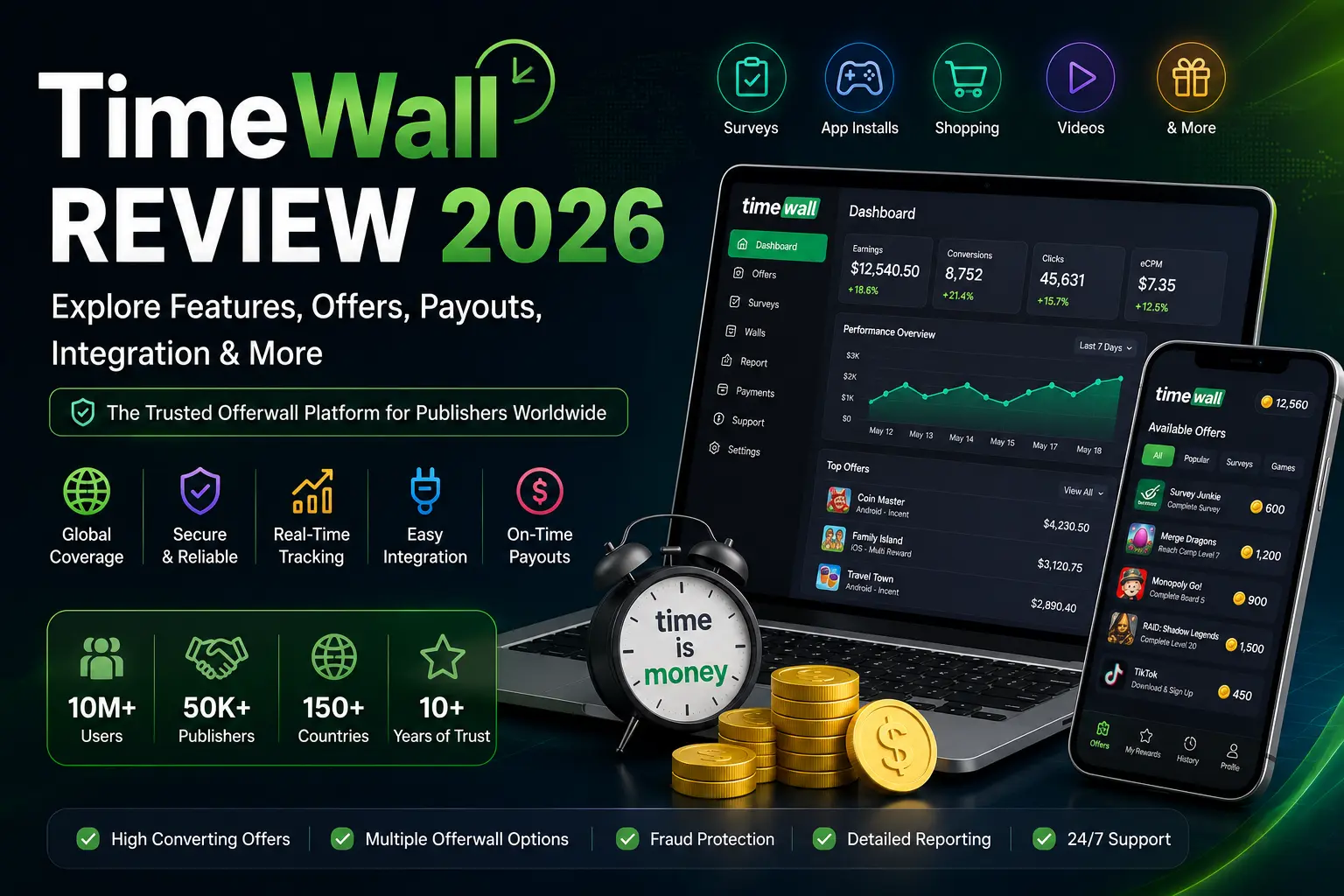
TimeWall is one of those offerwall platforms that looks simple from the outside but becomes much more interesting when you evaluate it as a publisher rather than as an end user.
At first glance, the proposition is straightforward: put an offerwall in front of your users, let them complete surveys, tasks, clicks, apps, and games, and earn revenue from activity that would otherwise be difficult to monetize.
But publishers should look beyond the offer count.
What matters in practice is whether the network fits your audience, how easily it can be integrated, how reliably conversions are tracked, how much visibility you get into failed postbacks, what payment options are available, and how strict the approval process is.
TimeWall currently positions itself for reward sites, faucets, mobile apps, and virtual-currency websites. Its official publisher-facing site also highlights real-time analytics, offerwall deployment, country/user reporting, and postback management.
This review evaluates TimeWall specifically from a publisher and monetization perspective.
Important methodology note: TimeWall does not currently publish a complete developer documentation portal covering every possible API, SDK, or iFrame implementation detail. Where documentation is not publicly available, this review explicitly says so instead of assuming that a feature exists.
1. Overview
TimeWall is an incentive-based offerwall and task monetization platform operated by Australian Clearing Pty Ltd, an active Australian private company registered under ABN 26 625 700 156. The Australian Business Register lists the company as active, with GST registration from July 2020.
The platform is designed to monetize users through reward-based actions rather than traditional advertising impressions.
The current TimeWall website promotes several important capabilities:
- Reward and offerwall monetization
- Survey inventory
- Microtasks
- Click-based tasks
- Mobile app and reward-site monetization
- Real-time analytics
- Country-level reporting
- User and offerwall-level reporting
- Failed-postback detection
- Postback retry/refire tools
- Multiple publisher payment methods
- Live support
TimeWall also operates its own advertising ecosystem. Advertisers can launch click or task campaigns with targeting by country, device type, operating system, browser, and gender, with hourly and daily caps. TimeWall says campaigns are reviewed before going live.
That matters because direct advertiser relationships can potentially give an offerwall inventory that is not entirely dependent on external affiliate feeds.
TimeWall itself claims to have been in affiliate marketing for more than 25 years, although that statement refers to the business's broader history and should not be interpreted as meaning that the current TimeWall product has operated unchanged for 25 years.
2. Who is it for?
TimeWall is primarily suited to publishers that already have an audience and need a monetization layer for users who are not buying something directly.
That includes:
- GPT and rewards websites
- Loyalty platforms
- Faucet websites
- Cashback or incentive platforms
- Virtual-currency websites
- Reward-based communities
- Mobile applications
- Gaming-related platforms
The official publisher signup page specifically targets website owners and states that approval requires at least 5,000 unique visitors per month.
That immediately tells us something useful: TimeWall is not really positioning itself as a beginner monetization network for a brand-new site with zero traffic.
For a publisher already receiving meaningful traffic, however, the threshold is reasonable.
3. Supported platforms
TimeWall explicitly presents itself as supporting:
- Websites
- Reward sites
- Faucets
- Mobile apps
- Virtual-currency platforms
The platform's homepage specifically names reward sites, faucets, mobile apps, and virtual-currency websites as target publisher categories.
There is also clear evidence of TimeWall being embedded into third-party reward platforms, including current rewards websites that list TimeWall alongside other offerwalls and survey providers.
The practical takeaway is that TimeWall is not limited to one publishing model.
4. Website support
Website support: Yes.
This is one of TimeWall's clearest use cases.
The publisher portal is explicitly designed for website owners, and TimeWall provides an account-based dashboard for managing offerwalls and monitoring performance.
The official website says publishers can create and deploy offerwalls quickly and analyze results by:
- Day
- Month
- Offerwall
- User
- Country
It also provides tools for finding failed postbacks and refiring them.
For a Laravel, PHP, WordPress, custom GPT, or similar web platform, this is the environment where TimeWall makes the most obvious sense.
5. App support
App support: Yes.
TimeWall explicitly markets itself to mobile-app publishers.
There is also evidence of mobile-app offerwall usage through third-party reward applications and platforms.
However, publishers should distinguish between supporting mobile applications as a business model and having a polished native SDK for Android and iOS.
TimeWall's public website confirms app monetization, but the current public documentation does not expose a comprehensive native SDK reference comparable to what larger mobile monetization providers publish.
That is an important limitation for development teams.
6. Game support
Game-related inventory: Yes.
TimeWall's current product includes gaming-related offers.
TimeWall publicly announced a Games tab as part of its TimeWall 2.0 product update, along with a Featured tab combining games, surveys, tasks, and clicks.
That makes TimeWall particularly relevant for:
- Gaming communities
- Reward apps
- GPT platforms
- Loyalty apps
- Users who prefer game-based rewards over surveys
The main caveat is that inventory will vary by country, device, advertiser demand, and the user's profile.
7. Integration methods
TimeWall clearly supports publisher-side offerwall deployment, but its public documentation is less detailed than some enterprise competitors.
The current official site emphasizes the ability to create and deploy new offerwalls in seconds.
The practical integration model appears to revolve around passing a publisher's user identity into TimeWall and receiving reward information back through postback infrastructure.
This is enough for a conventional reward website, but publishers building a highly customized infrastructure should request the latest technical integration documentation directly from TimeWall before development.
8. API availability
Public API documentation: Not clearly available.
This is one of the areas where TimeWall deserves a lower score for technical transparency.
A search of the current public TimeWall site does not reveal a conventional, openly accessible developer API reference with endpoint documentation, authentication specifications, request examples, response schemas, rate limits, and versioning information.
That does not necessarily mean TimeWall has no API.
It means the API is not sufficiently documented publicly for me to recommend treating it as a documented self-service API product.
For a publisher whose architecture depends heavily on API-first integration, this should be discussed with the TimeWall team before committing to the platform.
9. iFrame availability
iFrame support: Not publicly documented as a formal developer feature.
TimeWall is clearly embedded inside external rewards platforms, and third-party sites demonstrate embedded TimeWall experiences.
However, there is a difference between observing an embedded deployment and having official documentation for a publisher-facing iFrame integration.
I would therefore classify this as:
Likely available in practice, but not sufficiently documented publicly.
A developer should not build a production integration based solely on an assumption about the embedding method.
10. SDK availability
Public SDK documentation: Not clearly available.
This is another area where TimeWall trails the documentation standards of larger mobile monetization platforms.
The service supports mobile apps, but I could not verify a current public Android/iOS SDK documentation set from TimeWall itself.
That means mobile developers should verify:
- Native SDK availability
- Android support
- iOS support
- SDK versions
- Required permissions
- User identity handling
- App tracking requirements
- Release and maintenance policy
before planning a native implementation.
For a web-first GPT business, this is less important. For a large mobile gaming company, it matters much more.
11. Postback system
This is one of TimeWall's strongest areas.
The official site explicitly mentions failed-postback detection and the ability to refire postbacks with one click.
That feature is far more important than it sounds.
Reward platforms routinely encounter situations where:
- a user completes an offer,
- the advertiser confirms the conversion,
- but the publisher does not receive or process the callback correctly.
When that happens, the technical problem can quickly become a support problem.
A system that lets the publisher identify failed callbacks and retry them reduces the amount of manual reconciliation required.
There is also historical developer documentation describing TimeWall's GET-based postback format, including user ID, transaction ID, revenue, currency amount, hash, and offer type, with a requirement for an HTTP 200 response and a postback management interface for retrying failed calls.
Because that developer discussion is not current first-party documentation, I would verify the exact current parameter schema before implementation.
12. Tracking
Tracking is fundamental to any serious offerwall, and TimeWall provides several publisher-oriented tracking capabilities.
The official dashboard is designed around real-time statistics, including grouping by:
- Date
- Month
- Offerwall
- User
- Country
It also explicitly exposes failed postbacks.
This is a strong practical feature because a publisher needs more than total revenue.
You want to know:
Which users generate revenue?
Which countries perform best?
Which offerwalls generate the most?
Are failures concentrated around specific offers or users?
The more granular the reporting, the easier it becomes to optimize traffic allocation.
13. Attribution window
Publicly documented attribution window: Not clearly disclosed.
This is another specification that publishers should not guess.
Offer completion and attribution can involve:
- Click tracking
- Device identification
- Browser/session tracking
- App installation attribution
- Advertiser confirmation
- Delayed conversion reporting
TimeWall's public-facing materials explain that some activities can credit quickly while others may take significantly longer because of advertiser verification. Its Help Center notes that certain high-value surveys and offers can require advertiser confirmation for up to 10 — 30 days.
That is not the same as saying the formal attribution window is 30 days.
It simply means publishers should be prepared for delayed confirmation on certain offers.
14. Offer types
TimeWall has a broader mix than a traditional survey wall.
Current publicly visible categories include:
- Surveys
- Microtasks
- Clicks
- Website visits
- App-related offers
- Game offers
- Sign-up tasks
- Other incentive actions
The official TimeWall product is specifically marketed as a survey and microtask offerwall and also includes its own advertising ecosystem.
The TimeWall 2.0 product announcement further identifies:
- Games
- Surveys
- Tasks
- Clicks
- Featured offers
- Gifts
as part of the current user experience.
This diversity is useful because user preferences are not uniform.
Some users will never complete a 20-minute survey, but they might install a game.
Others dislike gaming and prefer short tasks.
A wider catalog can therefore increase overall engagement.
15. GEO coverage
TimeWall is positioned as a global monetization platform rather than a country-specific provider.
Its publisher dashboard includes country-level reporting, and its advertiser system supports country targeting.
That does not mean every GEO has equally strong inventory.
This distinction is extremely important.
A platform can technically accept traffic from many countries while still producing much stronger results in major advertising markets.
For most offerwall businesses, Tier-1 traffic tends to offer more attractive advertiser demand, while emerging markets may have lower inventory or lower revenue per active user.
So the right way to judge TimeWall's GEO coverage is not simply:
— Does TimeWall support my country —
It is:
— How much useful inventory does TimeWall have for my specific country and audience —
16. Survey inventory
Survey inventory is one of TimeWall's core categories.
The company describes itself as a Survey Offerwall and continues to actively promote survey functionality.
Its Help Center also explains the difference between quick tasks, app/game offers, and surveys, noting that surveys can pay more than simple tasks but may involve qualification and disqualification.
For publishers, the practical issue is not whether TimeWall has surveys.
It does.
The more important question is how much survey inventory your audience receives.
That depends on:
- Country
- Demographic profile
- Device
- Current advertiser demand
- Survey quotas
- User quality
- Survey provider availability
17. Gaming inventory
Gaming inventory is now a more visible part of the TimeWall product.
TimeWall's TimeWall 2.0 announcement added a dedicated Games tab and combined games with surveys, tasks, and clicks in its Featured section.
This makes TimeWall particularly interesting for publishers whose audience is already comfortable with game-based reward mechanics.
Gaming offers can also produce stronger engagement than simple clicks because advertisers can structure milestones.
A user might receive a small reward for installing a game and progressively larger rewards for reaching later milestones.
The downside is that such offers create more opportunities for tracking disputes, delayed confirmations, and user frustration when milestone conditions are not met.
18. Fraud prevention
Fraud prevention is an unavoidable issue for an incentive platform.
TimeWall's ecosystem clearly incorporates security and account-quality controls, although the public publisher documentation does not provide a detailed technical fraud-prevention whitepaper.
From the user side, there is substantial evidence of anti-abuse controls, including restrictions around VPN/proxy behavior and identity verification in some circumstances. User reports also describe accounts being challenged or restricted for suspected fraud or multiple-account activity.
That should not automatically be interpreted as a flaw.
A publisher needs an offerwall that protects advertiser economics.
The more relevant question is whether false positives are controlled well enough not to create excessive support problems.
That is difficult to determine publicly, so this is an area I would test with real traffic rather than relying on marketing claims.
19. Reporting
Reporting is one of TimeWall's strongest selling points.
The official site states that the dashboard provides real-time analytics and can group earnings by:
- Day
- Month
- Offerwall
- User
- Country
It also lets publishers identify failed postbacks and refire them.
For a publisher, this is exactly the type of dashboard information that matters.
A useful reporting system should answer:
Where is revenue coming from?
Which GEO is producing the best results?
Which users are most valuable?
What has changed since last week?
Which transactions failed?
TimeWall performs well conceptually in this category.
20. Reward flexibility
TimeWall is designed around publisher-defined reward economics rather than paying users directly in a universal format.
That makes it suitable for businesses that use:
- Points
- Coins
- Credits
- Virtual currency
- Reward balances
The important advantage is flexibility in how a publisher presents the underlying monetary value to its users.
This is particularly useful for GPT sites and games where the reward currency is part of the product experience rather than simply USD.
However, the exact reward conversion and publisher economics should be configured carefully.
A low-quality conversion rate can make an otherwise strong offerwall look unattractive to users.
21. Payout model
TimeWall operates on an offer/conversion-based monetization model.
The publisher earns when users complete qualifying advertiser actions and the conversion is accepted.
TimeWall itself emphasizes its own advertising platform and direct advertiser relationships, which potentially allows it to source traffic and offers beyond a pure aggregation model.
What TimeWall does not publicly advertise on its main publisher pages is a single universal revenue-share percentage for all publishers.
That is actually a good reason not to trust random — TimeWall pays X% — claims found on blogs.
Publisher economics can depend on:
- Offer type
- GEO
- Advertiser
- Volume
- Commercial agreement
- Campaign conditions
- Reversals and chargebacks
The sensible approach is to evaluate your effective revenue after real traffic rather than relying on a headline percentage.
22. Payment methods
TimeWall has one of the more flexible payment menus among offerwall platforms.
Its official site currently lists:
- Wire Transfer
- ACH Transfer
- AirTM
- Payeer
- Bitcoin
- Litecoin
- USDT
as publisher payment options.
This is a significant advantage, particularly for international publishers.
A network can have excellent revenue performance and still be inconvenient if the only withdrawal method requires expensive intermediary services.
TimeWall's multiple payment rails reduce that problem.
However, payment availability, fees, timing, thresholds, and eligibility can vary, so publishers should confirm current commercial terms after approval.
23. Approval requirements
The most important publicly stated requirement is straightforward:
Website owners need at least 5,000 unique visitors per month.
TimeWall explicitly says that applicants below this threshold should not sign up because their accounts will not be approved.
This is one of the clearest requirements published by TimeWall.
The likely intent is obvious: TimeWall wants publishers with enough traffic to produce meaningful advertiser volume.
For an established GPT site, this is not a particularly high requirement.
For a new site with little or no traffic, it can be a serious barrier.
24. Minimum traffic
5,000 unique visitors per month is the current published requirement for website-owner applications.
One point deserves emphasis:
This is not the same thing as saying that every type of publisher requires exactly 5,000 monthly visitors.
The wording on the public signup page is specifically directed at website owners.
Apps, larger businesses, and custom arrangements may be evaluated differently.
Still, for a standard website publisher, 5,000 monthly unique visitors is the number to plan around.
25. Publisher support
TimeWall promotes live chat support for site owners and users.
Its public contact page also directs users to a chat interface for support.
That is useful because offerwall monetization generates operational questions that automated documentation cannot always answer.
Typical publisher support issues include:
- Missing conversions
- Failed postbacks
- User disputes
- Offer removals
- Payment questions
- Tracking problems
- Account issues
TimeWall's postback retry tools reduce some of the workload, while live support provides another escalation path.
Still, as with any network, the real test is not whether support exists.
It is how quickly and accurately support resolves publisher problems.
26. Strengths
Strong publisher fundamentals
TimeWall has the basics that matter:
- Established reward-platform focus
- Website support
- Mobile app support
- Surveys
- Games
- Microtasks
- Country reporting
- User-level reporting
- Real-time analytics
- Postback failure monitoring
- Postback retry tools
- Multiple payment methods
Good fit for GPT platforms
The combination of surveys, games, clicks, and tasks makes the platform a natural fit for GPT and reward products.
Low-friction monetization concept
The product is designed around adding an offerwall instead of forcing a publisher to build advertiser relationships from scratch.
Flexible payments
The combination of bank transfers and crypto-oriented options is a meaningful operational advantage.
Real publisher reporting
The reporting system is not just a total revenue counter.
TimeWall explicitly promotes reporting by date, country, user, and offerwall.
27. Weaknesses
Technical documentation is not transparent enough
This is probably the biggest issue from a developer's perspective.
A modern monetization platform should ideally publish:
- API documentation
- SDK documentation
- Integration examples
- Authentication details
- Postback specifications
- Error codes
- Rate limits
- Version history
- Sandbox/testing procedures
TimeWall's public-facing ecosystem does not expose all of that in a centralized developer documentation portal.
SDK details are unclear
The service supports mobile apps, but public information about native SDK packaging and implementation is limited.
Attribution details are not sufficiently public
Publishers need clarity around attribution windows, tracking rules, and conversion confirmation.
Commercial terms are not fully public
The lack of a single public publisher revenue-share schedule makes it difficult to compare TimeWall purely on headline economics.
Fraud can become a support issue
Like almost every incentive ecosystem, TimeWall users report occasional disputes related to account restrictions, VPN detection, verification, or rejected offers.
This does not prove systematic failure, but it does mean publishers should expect to manage some user complaints around tracking and eligibility.
28. Best use case
TimeWall is particularly strong for:
Established GPT sites with at least several thousand monthly visitors.
It also makes sense for:
- Reward apps
- Faucet platforms
- Virtual-currency websites
- Loyalty systems
- Gaming communities
- Sites that want both surveys and task-based inventory
The strongest scenario is a publisher that already has users visiting an — Earn — or — Rewards — section and wants to monetize non-paying users.
That is exactly the problem TimeWall is built around.
29. Who should avoid it
TimeWall may not be the best first choice for:
Brand-new websites
The 5,000 monthly unique visitor requirement means a site without meaningful traffic is unlikely to qualify.
Developers requiring API-first architecture
The lack of a comprehensive public developer API reference creates unnecessary uncertainty during technical planning.
Developers looking for mature native SDK tooling
A mobile-first company should compare TimeWall against providers that publish detailed Android and iOS SDK documentation.
Publishers demanding absolute transparency on economics
If you need a fully public pricing/revenue-share structure before joining, TimeWall may require more direct commercial discussion.
30. Alternatives
TimeWall should not be evaluated in isolation.
The best offerwall depends on your audience and technical stack.
RevU
RevU is a strong alternative when publishers want a mature offerwall ecosystem and broad advertiser inventory.
It is especially relevant for publishers focusing on mobile apps and gaming audiences.
ayeT-Studios
ayeT-Studios is a strong choice for publishers looking for a broader mix of apps, tasks, and surveys.
AdGate Media
AdGate Media is another established name in the offerwall market and is worth comparing when task variety and publisher-side customization are priorities.
Lootably
Lootably is attractive for publishers that want a broader mix of offers and reward-media inventory.
Torox
Torox is another option worth testing, especially when the priority is larger app-install and performance-marketing inventory.
The important point
There is no universally best offerwall.
A publisher should run a controlled comparison using the same:
- Users
- GEOs
- Placement
- Traffic volume
- Reward conversion
- Time period
Then compare:
Revenue per active user, conversion rate, EPC/eCPM, reversal rate, support volume, and user retention.
This is much more useful than comparing marketing claims.
For broader background on how offerwalls work, see Hansal Dev's guide: What Is an Offerwall? Meaning, Mechanics, and Earning Potential
For a broader network comparison, see: Best Offerwall Sites (2026): Top Networks Ranked for High Payouts
For developers building an offerwall-based monetization product, this related guide is also useful: Mobile App Monetization Platform: The Complete 2026 Guide
31. Final rating
TimeWall Rating: 8.2/10
| CategoryRating | |
| Overall publisher value | 8.5/10 |
| Offer variety | 8.5/10 |
| Survey inventory | 8.0/10 |
| Gaming inventory | 8.0/10 |
| Website support | 9.0/10 |
| Mobile support | 7.5/10 |
| Tracking | 8.5/10 |
| Postbacks | 9.0/10 |
| Reporting | 9.0/10 |
| Payment flexibility | 9.0/10 |
| Fraud controls | 8.0/10 |
| Publisher support | 8.0/10 |
| API transparency | 6.0/10 |
| SDK transparency | 6.0/10 |
| Documentation | 6.5/10 |
| Approval accessibility | 7.5/10 |
Final verdict
TimeWall is a serious offerwall option for established publishers, particularly GPT sites, reward platforms, faucets, virtual-currency websites, and applications looking for a combination of surveys, tasks, clicks, and gaming inventory.
Its strongest advantages are not flashy features.
They are operational.
The platform provides publisher-oriented analytics, country and user reporting, multiple payment methods, and — most importantly — a system for detecting and retrying failed postbacks.
That last point is the sort of feature that becomes genuinely valuable once a publisher starts processing significant conversion volume.
The biggest weakness is technical transparency.
For developers, I would be much more comfortable recommending TimeWall if there were a centralized, modern developer portal covering API endpoints, SDKs, iFrame integration, attribution rules, authentication, callbacks, testing, and version history.
That does not make TimeWall a bad network.
It means the platform should be evaluated more like a publisher relationship than a pure self-service API product.
There is also an important practical difference between a network having inventory and a network having good inventory for your users.
TimeWall may work extremely well for one GEO and audience while being mediocre for another.
That is why the best strategy is not to install TimeWall and assume the job is done.
Run it alongside one or two competitors, measure the actual numbers, and compare:
- Revenue per active user
- Completed offers per 1,000 users
- Survey qualification rate
- Gaming conversion rate
- Reversal/chargeback rate
- Failed postbacks
- Support tickets
- User retention
- Effective publisher margin
From that perspective, TimeWall earns a strong rating because it covers the core requirements of modern reward monetization and has several genuinely useful publisher tools.
It is not the most transparent developer-first platform in the market, but it is a credible option for publishers that already have real traffic.
Trusted sources and further reading
Official TimeWall: TimeWall official website
TimeWall publisher registration: TimeWall publisher signup
TimeWall advertising information: TimeWall advertising platform
TimeWall Help Center: TimeWall Help Center
Australian Business Register — Australian Clearing Pty Ltd: ABN Lookup — Australian Clearing Pty Ltd
TimeWall company profile: TimeWall on LinkedIn
Related Hansal Dev guide: What Is an Offerwall? Meaning, Mechanics, and Earning Potential
Related Hansal Dev comparison: Best Offerwall Sites (2026): Top Networks Ranked for High Payouts







Comments (0)
No comments yet. Be the first to share your thoughts!