
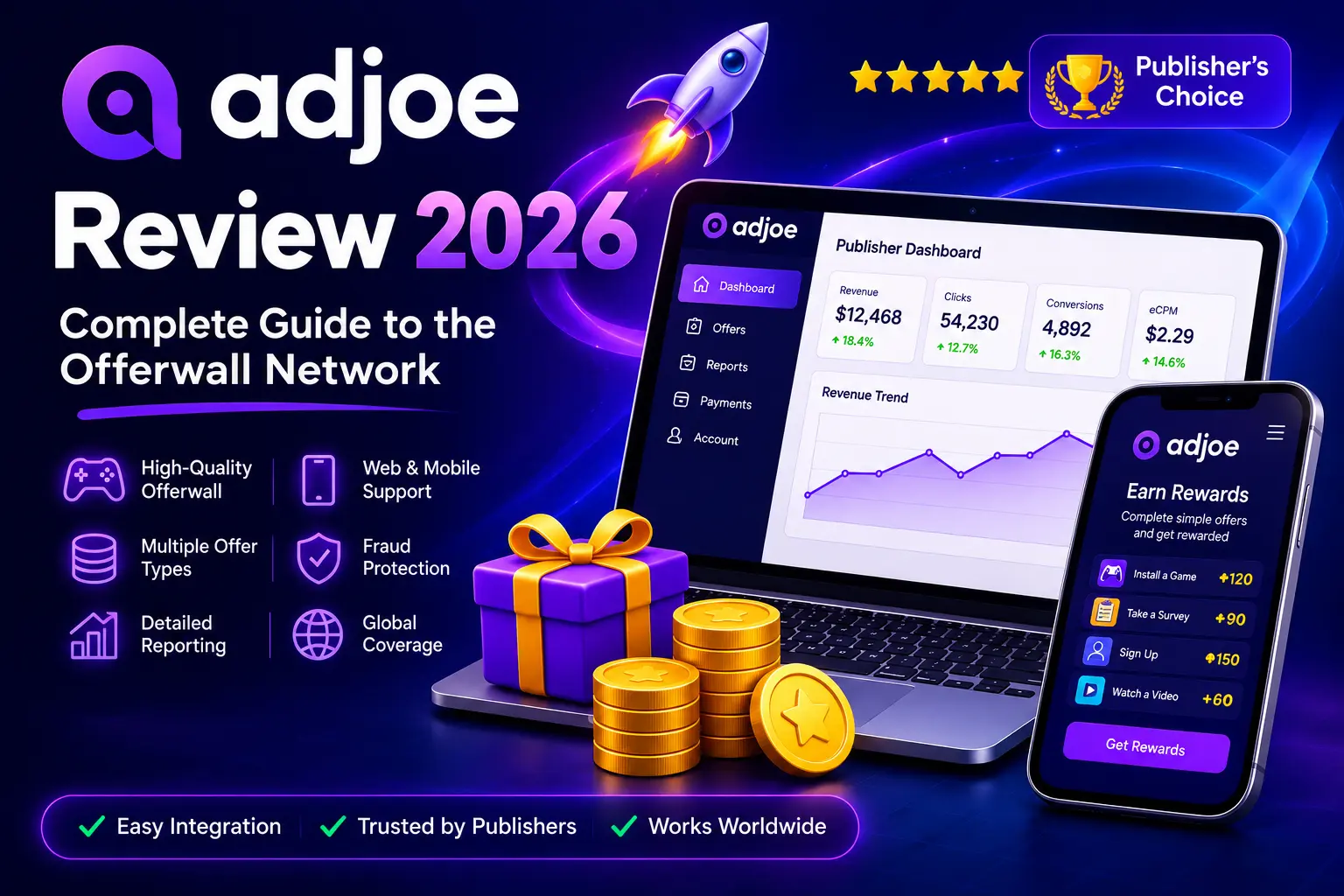
Adjoe has become one of the more recognizable names in rewarded mobile advertising, but it is also one of the platforms that can be misunderstood if you evaluate it like a traditional web offerwall.
Adjoe's core strength is mobile.
Its flagship rewarded product, Playtime, is built around a simple value exchange: users discover promoted mobile apps and games, engage with them, and receive rewards from the application they are already using. For the publisher, that interaction creates an additional monetization and engagement layer.
That distinction matters.
A publisher looking for a traditional web-based offerwall containing dozens of surveys, registrations, downloads and CPA offers may find Adjoe less suitable than a general-purpose offerwall network. A mobile app developer, however, especially one operating a rewards app, gaming app, loyalty platform or utility with an active user base, is looking at a very different product.
Adjoe describes Playtime as a mobile-app-centric rewarded ad unit for Android and iOS. Its current documentation also supports native SDKs plus wrappers for React Native, Flutter and Unity, while PlaytimeWeb provides a web-based option specifically in the iOS environment.
The company has also continued expanding globally. Current company material states that Adjoe operates across major markets including EMEA, North America, APAC and LATAM, while its recent communications cite more than 750 — 770 million mobile users reached annually and more than 1,000 apps or gaming studios within its wider ecosystem.
The question for publishers is not whether those numbers look impressive.
The better question is whether Adjoe fits your traffic, product, users and monetization model.
Here is the detailed answer.
1. Overview
Adjoe is a mobile advertising and monetization company focused heavily on rewarded advertising, app growth and user engagement.
Its best-known publisher product is Playtime, an arcade-style rewarded experience where users can discover mobile games and apps and receive rewards based on time spent or actions completed.
Adjoe's current documentation identifies two major reward approaches:
- Time-based campaigns, where users earn according to time spent in an advertised app or game.
- Event-based campaigns, where rewards are associated with milestones such as reaching a particular level, completing an action or making an in-app purchase.
That is one of the platform's biggest differences from a basic CPA offerwall.
The objective is not simply to get the user to install something and leave. The system is designed around deeper engagement.
For publishers, this can translate into more than direct advertising revenue. A well-positioned Playtime placement can potentially increase session length, provide another reason for users to return to the app, and help monetize users who do not purchase subscriptions or virtual goods.
Adjoe has published several publisher case studies reporting revenue and ARPDAU improvements after integrating Playtime. For example, BitBurst reported a 20% increase in Android ARPDAU and a 10% increase in overall revenue after adding Playtime, while other case studies report considerably larger increases. These are publisher case studies published by Adjoe rather than independently audited benchmarks, so they should be considered examples rather than guaranteed results.
2. Who is it for?
Adjoe is primarily suitable for:
- Mobile app developers
- Reward and loyalty applications
- GPT and rewards platforms with a mobile app
- Gaming-related apps
- Social and entertainment apps
- Cashback or points applications
- Utility applications with strong repeat usage
- Apps that already have an internal points or virtual currency system
It is particularly interesting for applications where rewards can be exchanged for something meaningful inside the product.
For example, imagine a loyalty application where the user normally earns points through surveys or purchases. Playtime can introduce another earning mechanism based on gaming.
The user gets an additional activity.
The app gets another monetization source.
The advertiser gets an engaged user.
That is the model Adjoe is optimized around.
3. Supported platforms
Adjoe's Playtime solution currently focuses on:
- Android
- iOS
- React Native
- Flutter
- Unity
- iOS web-based integration through PlaytimeWeb
The official documentation provides current SDK/API references for Android, iOS, React Native, Flutter and Unity.
The important point is that this is not equivalent to saying Adjoe offers the same integration experience on every platform.
Android is a particularly important environment for Playtime because usage-based tracking and permissions are deeply integrated into the mobile experience.
iOS is supported as well, but privacy and attribution constraints make implementation more involved.
4. Website support
This is one of the areas where publishers need to read the product positioning carefully.
Adjoe is not primarily a generic website offerwall provider.
Its main monetization technology is designed around mobile applications. Adjoe's official Playtime documentation explicitly describes the product as mobile-app-centric. It does, however, provide PlaytimeWeb, which is a web-based integration option intended for iOS scenarios where the native SDK cannot be integrated.
Therefore:
Website support: Limited compared with dedicated web offerwalls.
If your business is primarily a desktop GPT website, survey website or browser-based rewards platform, Adjoe should not be your first choice without confirming that your particular implementation is supported.
For a mobile-first business, the situation is very different.
5. App support
This is where Adjoe becomes significantly more attractive.
The platform is designed for mobile application monetization and offers a native SDK architecture.
The current documentation supports Android and iOS, while official wrappers are available for React Native, Flutter and Unity.
Adjoe also provides a sandbox environment for testing before production deployment.
For a professional application, this is important because offerwall implementation is not something you should release directly into production without testing attribution, reward callbacks, permissions and user flows.
6. Game support
Gaming is one of Adjoe's strongest areas.
Playtime is built around users discovering and playing mobile games and applications in exchange for rewards.
Adjoe describes Playtime as a mobile-games-centric rewarded ad unit, while its current campaign system includes time-based and event-based mechanics.
This makes it particularly attractive for:
- Casual gaming audiences
- Loyalty programs
- Reward applications
- Entertainment apps
- Non-gaming apps looking to introduce gaming as an engagement loop
Interestingly, Adjoe specifically positions Playtime as a way for non-gaming applications to add gaming-based engagement.
That can be more valuable than it initially sounds.
A rewards app can use gaming as another earning method without having to develop the game itself.
7. Integration methods
Adjoe offers several integration routes.
The main method is the Playtime SDK.
Current documentation covers:
- Native Android
- Native iOS
- React Native
- Flutter
- Unity
- PlaytimeWeb for supported iOS web-based implementations
The React Native and Flutter implementations ultimately integrate with native mobile SDK components.
For developers, the integration model is relatively conventional for a serious mobile adtech company:
- Create the application within Adjoe.
- Obtain the required identifiers and credentials.
- Integrate the SDK.
- Configure the user identity.
- Configure the reward mechanism.
- Configure server-to-server payout callbacks where appropriate.
- Test in sandbox.
- Move to production.
This is more involved than dropping a simple iframe onto a webpage, but it also gives the publisher substantially more control.
8. API availability
Yes.
Adjoe provides APIs, but it is important to understand what those APIs are designed to do.
The current publisher documentation includes a Revenue API that allows publishers to query reporting data such as revenue, country, platform, eCPM, offerwall exposure and other metrics.
There is also a User Ad Data Report API, which can provide detailed user-level advertising data subject to authorization. The documented data includes identifiers, country, revenue, eCPM, impression counts and publisher-defined identifiers.
Adjoe also provides API credentials as part of the integration process. For supported integrations, documentation references values such as the SDK hash, S2S token and API token.
So the answer is:
API: Yes, and it is useful for reporting and backend integration.
However, developers should not assume that Adjoe provides an unrestricted public "pull every offer and build your own offerwall" API comparable to a generic offerwall marketplace API.
9. iFrame availability
This is a weaker area.
Adjoe's principal solution is SDK-based, not iframe-based.
The company does provide PlaytimeWeb for certain iOS use cases, but that should not be interpreted as a general-purpose iframe offerwall solution for arbitrary websites.
Therefore:
Generic iframe offerwall: No clear public offering.
Web-based iOS integration: Yes, through PlaytimeWeb.
For a PHP/Laravel GPT website where you want to insert an offerwall inside a page with almost no application-side integration, Adjoe is not as straightforward as some traditional web-focused offerwall networks.
10. SDK availability
SDK support is one of Adjoe's strongest technical advantages.
Current documentation covers:
- Android
- iOS
- React Native
- Flutter
- Unity
The current API references show active versions across these platforms, and Adjoe continues to publish SDK updates and migration guides.
This is especially important for React Native and Flutter developers.
A platform can advertise "mobile support" while effectively requiring a native integration. Adjoe goes further by maintaining wrappers and documentation for popular cross-platform environments.
One important caveat is version management.
Mobile SDKs can create dependency conflicts, especially when Android Gradle, iOS deployment targets, App Attest, privacy requirements and other SDKs are involved.
Adjoe's own documentation therefore recommends maintaining compatible platform versions and following migration procedures when upgrading.
11. Postback system
Adjoe supports server-to-server communication for reward delivery.
The publisher can configure an S2S API endpoint that Adjoe calls when a user qualifies for a reward.
The publisher then handles the actual crediting of the user's internal account or virtual currency.
This is extremely important for a serious GPT, rewards or loyalty application.
You do not want your reward system to depend exclusively on browser JavaScript.
A robust architecture looks more like:
Advertiser — Adjoe — Verification — S2S callback — Publisher database — User balance
That gives the publisher greater control over:
- Duplicate protection
- Fraud checks
- Reward status
- Transaction IDs
- User balances
- Reversals
- Audit logs
Adjoe also documents fraud postbacks that can provide information about fraudulent users and the reasons associated with the determination.
12. Tracking
Tracking is one of the most technically important parts of the Adjoe ecosystem.
On Android, the SDK can identify users and handle usage-related permissions required by Playtime.
On iOS, attribution is more complicated because of Apple's privacy framework.
Adjoe's documentation recommends passing the IDFA where available because it helps attribute installs and ensure rewards are correctly assigned. It also explains that App Tracking Transparency should be handled before showing the catalog.
For PlaytimeWeb, Adjoe states that game downloads are tracked through postbacks from the mobile measurement partner, and that postbacks are normally delivered immediately but can sometimes take up to 24 hours.
This is an important practical point:
Offerwall tracking is never just a link click.
The platform has to understand:
- Which user initiated the offer
- Which application supplied the traffic
- Whether the app was genuinely installed
- Whether the user was already installed
- Whether the user completed the qualifying event
- Whether the action is fraudulent
- Whether the reward should be issued
That is why SDK configuration and user identity mapping matter.
13. Attribution window
Adjoe does not publicly publish a single universal attribution window that can be responsibly quoted as the standard for every campaign and platform.
That is actually a good example of why publishers should be careful with online reviews.
Attribution can depend on:
- Campaign type
- MMP configuration
- Operating system
- Advertising identifier availability
- Campaign rules
- Advertiser configuration
- Event requirements
Therefore:
Public universal attribution window: Not clearly disclosed.
Rather than inventing a 24-hour, 7-day or 30-day number, publishers should verify the campaign-specific attribution behavior with Adjoe or the advertiser/MMP configuration before promising users a fixed tracking period.
This is especially relevant for long-form gaming offers.
14. Offer types
Adjoe's strength is not unlimited offer diversity; it is deep rewarded engagement.
Its documented Playtime campaigns include:
Time-based offers
Users receive rewards based on time spent inside a promoted app or game.
Event-based offers
Users earn rewards after completing specified events or milestones.
Examples can include:
- Reaching a particular level
- Completing an in-app action
- Making an in-app purchase
- Watching advertising
- Completing a defined gameplay objective
- Signing up for a service
Adjoe's own documentation describes these two major campaign structures explicitly.
Adjoe's wider advertising portfolio also includes rewarded video, interstitial and other mobile ad formats, but Playtime remains the most relevant product when specifically evaluating it as an offerwall/rewarded-gaming monetization partner.
15. GEO coverage
Adjoe operates internationally.
The company has expanded its operations across:
- Europe
- North America
- Asia-Pacific
- Latin America
Its current communications specifically mention expansion in APAC and Latin America, while recent company material positions the platform as serving a large global mobile audience.
However, global availability should not be confused with equal inventory everywhere.
Offer inventory is naturally affected by:
- Advertiser demand
- Country
- OS
- Device
- User profile
- Campaign budgets
- Local market conditions
A US or German Android user may see a substantially different inventory from a user in a smaller GEO.
That is normal for performance advertising.
For publishers with traffic from Tier-1 GEOs, this can make Adjoe particularly interesting, while lower-value GEOs should be tested rather than assumed.
16. Survey inventory
This is one of the clearest distinctions between Adjoe and traditional offerwall companies.
Surveys are not the core of Adjoe's Playtime proposition.
Adjoe is heavily focused on rewarded gaming and app engagement.
There are publishers that combine Adjoe Playtime with their own survey systems. BitBurst, for example, operates a survey-focused rewards business and used Playtime to complement its existing survey monetization model rather than replace it.
That provides a useful lesson for publishers:
You do not necessarily need one network to provide every type of offer.
A stronger rewards platform can combine:
Adjoe + survey network + CPA network + direct offers
That creates diversification and reduces dependency on a single source of inventory.
For a website where surveys are the primary product, Adjoe would not normally be the first network I would choose.
17. Gaming inventory
Gaming inventory is where Adjoe stands out.
The platform is heavily associated with rewarded mobile gaming and Playtime.
This is particularly useful because gaming offers can generate significantly deeper engagement than simple install offers.
Instead of:
Install — Open — Reward
the experience can become:
Install — Play — Reach milestone — Continue playing — Complete another milestone — Earn additional rewards
This structure creates more opportunities for revenue and engagement.
Adjoe's own product documentation explicitly describes algorithms that prioritize games and apps according to the potential revenue they can generate and the likelihood that a user will engage with them.
This is one of the reasons the platform fits reward applications so well.
18. Fraud prevention
Fraud prevention is a major component of Adjoe's technology.
The company maintains dedicated anti-fraud technology, and its documentation describes signals related to manipulated devices, unexpected installation paths and multi-account behavior.
Adjoe also offers additional fraud tools involving mechanisms such as phone and face verification, although these are more advanced features and may require separate configuration.
For publishers, fraud prevention is a double-edged sword.
The good side is obvious:
Better filtering protects advertiser budgets and publisher relationships.
The downside is that aggressive fraud controls can sometimes create disputes when a legitimate user fails verification or when tracking conditions are not satisfied.
This is not unique to Adjoe. Every performance-based reward platform has to balance fraud protection against false positives.
The practical solution is not to disable fraud controls.
It is to build a proper transaction and support system so that questionable rewards can be investigated.
19. Reporting
Reporting is another strong area.
Adjoe provides a Revenue API capable of reporting by dimensions such as:
- Date
- Country
- Platform
- SDK hash
The API response can include metrics such as revenue, eCPM, offerwall exposure and SDK activity.
The User Ad Data Report API can provide more granular information, including user-level revenue and impression information, subject to authorization.
That means a serious publisher can move beyond:
"Yesterday we earned $300."
and start asking:
- Which countries generated it?
- Which platform performed better?
- Which app generated the revenue?
- What was eCPM?
- How many users opened Playtime?
- Which users generated revenue?
- How does performance compare by placement?
Those are the metrics that actually matter when scaling monetization.
20. Reward flexibility
Adjoe gives publishers flexibility because the reward ultimately belongs to the publisher's own application economy.
The publisher can reward users with:
- Points
- Coins
- Credits
- Virtual currency
- Loyalty balances
- Other internal reward units
The important architecture is that Adjoe confirms the qualifying event while the publisher controls the actual reward distribution through the S2S system.
That separation is valuable.
Your internal reward system does not need to become tightly coupled to Adjoe's user interface.
You can maintain your own:
- User wallet
- Reward ledger
- Bonus logic
- Conversion rates
- Withdrawal thresholds
- VIP system
- Referral system
Adjoe supplies the monetization event.
Your application owns the reward economy.
21. Payout model
From the publisher perspective, Adjoe is fundamentally a performance-based advertising monetization platform.
The publisher earns from advertiser activity generated through the platform, while the exact commercial terms depend on the partnership.
Adjoe publicly promotes metrics such as eCPM and ARPDAU and highlights premium demand, high engagement and incremental revenue.
However, there is an important limitation:
Adjoe does not publicly publish a universal publisher revenue-share percentage that applies to all publishers.
That is normal for larger private adtech relationships.
Rates can depend on factors such as:
- GEO
- Traffic quality
- DAU
- App category
- Platform
- Inventory
- User engagement
- Commercial relationship
Therefore, any review claiming "Adjoe always pays X%" without a current contractual source should be treated cautiously.
22. Payment methods
Public publisher documentation does not provide a universal, current list of payment methods and minimum payout thresholds that can be independently applied to every Adjoe publisher.
This means publishers should confirm payment terms during onboarding.
Do not choose Adjoe based on an unofficial blog claiming a specific payout method unless the information is confirmed by your account manager or publisher agreement.
For a professional evaluation, I would rate payment transparency as:
Average.
Not because there is evidence that Adjoe does not pay publishers, but because detailed commercial conditions are not exposed publicly in the same way as some smaller self-service networks.
23. Approval requirements
Adjoe appears to operate more like a managed mobile advertising partnership than a completely open, instant-access offerwall platform.
The official contact process requests information such as:
- Company name
- Company website
- App Store link
- Region
- Daily active users
- Product information
The publisher contact flow also directs developers toward documentation and account management.
This suggests that Adjoe evaluates publishers within a partnership framework rather than simply allowing anyone to register and immediately launch.
For that reason, a serious application with an established user base is likely to have a more compelling proposition than an empty application with no meaningful traffic history.
24. Minimum traffic
This is another point where the internet is full of questionable claims.
Adjoe does not appear to publish a single universal minimum traffic requirement on its public publisher documentation.
The official contact form asks for DAU, which strongly indicates that audience scale is considered during publisher discussions.
But there is no responsible basis for saying:
"You need exactly 10,000 DAU."
or:
"Adjoe accepts every publisher with 1,000 daily users."
Those numbers should not be presented as official unless Adjoe confirms them.
From a business perspective, the more useful way to think about the requirement is:
Adjoe is much more interesting once your app has enough recurring active users to produce meaningful rewarded engagement.
25. Publisher support
Support appears to be relatively strong for publishers who are accepted into the platform.
The documentation references an Account Manager for credentials and authorization of certain services, including reporting and integration-related access.
Adjoe also maintains extensive technical documentation.
That matters because SDK-based monetization can involve much more than simple HTML integration.
Developers may need help with:
- SDK versions
- Sandbox testing
- App identifiers
- Attribution
- S2S callbacks
- iOS tracking
- Android permissions
- Fraud issues
- Revenue reporting
A managed account relationship is a positive advantage here.
26. Strengths
Adjoe's biggest advantages are fairly clear.
Strong mobile focus
Adjoe is not pretending to be everything for everyone. Its technology is highly optimized around mobile applications.
Excellent rewarded gaming positioning
Playtime is one of the platform's defining strengths.
Strong SDK ecosystem
Native Android and iOS support plus React Native, Flutter and Unity make it accessible to modern app development teams.
Server-to-server reward infrastructure
The S2S payout model is appropriate for professional rewards platforms.
Strong reporting capabilities
The Revenue API and User Ad Data Report API provide useful backend visibility.
Serious anti-fraud infrastructure
Fraud controls are an important component of the platform rather than an afterthought.
Global reach
Adjoe operates across major mobile markets and has expanded significantly into APAC and LATAM.
Strong fit for loyalty and rewards applications
The Playtime model fits naturally into applications where users already understand earning points.
27. Weaknesses
Adjoe also has meaningful limitations.
Not a classic web offerwall
If your entire business is a PHP/Laravel GPT website, Adjoe may not provide the simple integration experience you expect from traditional offerwall networks.
Heavy gaming orientation
This is a strength when you need gaming inventory, but a weakness if your audience primarily wants surveys, registrations and mainstream CPA offers.
Commercial terms are not highly transparent publicly
Publisher payout rates, payment thresholds and minimum traffic requirements are not presented as simple universal public numbers.
More technical integration
SDK integration is far more involved than adding a JavaScript widget or iframe.
iOS tracking complexity
Apple's privacy environment adds additional requirements around tracking and attribution. Adjoe's documentation explicitly recommends IDFA handling and ATT integration for attribution.
Inventory varies by GEO
A "global" network does not mean every user sees the same offer volume.
28. Best use case
The strongest Adjoe use case is:
A mobile rewards, loyalty, gaming, entertainment or utility application with recurring users and an existing internal reward economy.
For example:
Imagine you operate an Android rewards application.
Users already earn points from surveys, referrals and daily activities.
You add a "Play Games" section powered by Playtime.
Now your users have another way to earn.
You earn advertising revenue.
Users spend more time inside your ecosystem.
Advertisers gain deeper engagement.
That is almost the textbook environment for Adjoe.
Another strong case is a non-gaming app that wants to use gaming as a retention tool.
Adjoe itself has published examples of apps adding Playtime as an incremental revenue layer alongside existing monetization models.
29. Who should avoid it
Adjoe may not be the right option for:
Small websites looking for plug-and-play offerwalls
A dedicated web offerwall can be easier.
Survey-first businesses
If 80% of your user activity revolves around surveys, Adjoe alone is unlikely to solve your inventory problem.
Very early-stage applications with minimal traffic
The integration effort may not justify the expected revenue before you have meaningful user activity.
Publishers wanting complete public pricing transparency
If your decision depends on an openly published revenue share, minimum payout and traffic threshold, Adjoe may feel less transparent than smaller self-service networks.
Businesses that do not want mobile SDK dependencies
If your project is purely web-based, an SDK-centered platform is not necessarily the most efficient choice.
30. Alternatives
Adjoe should be compared according to the type of monetization you actually need rather than simply by brand popularity.
AdGate Media
A strong alternative for broader offerwall usage, particularly when you need a wider mix of CPA-style offers.
Lootably
A useful alternative for publishers seeking a more traditional offerwall structure and a broader set of advertiser actions.
AdscendMedia
Worth evaluating for GPT, rewards and offerwall-oriented businesses.
Torox
Relevant for publishers that want broad performance marketing inventory across mobile and web environments.
Tapjoy
A major alternative when the focus is heavily centered on mobile games and rewarded advertising.
AppLovin
More relevant if your objective is broader mobile app monetization rather than specifically a Playtime-style offerwall.
Digital Turbine
Another large mobile advertising ecosystem worth comparing for app monetization and user acquisition.
The important lesson is that there is no universally best offerwall.
A publisher should compare:
- Revenue per active user
- Fill rate
- Reward completion rate
- GEO coverage
- eCPM
- Support quality
- Tracking reliability
- Fraud rejection rate
- User experience
- Payment conditions
A network producing a lower headline eCPM can still be more profitable if its retention and completion rates are better.
For a broader understanding of how offerwalls work, see our guide: [What Is an Offerwall? Meaning, Mechanics, and Earning Potential] Read the offerwall guide on Hansal Dev.
You can also compare different providers in [Best Offerwall Sites in 2026] Compare offerwall networks.
For developers evaluating the larger monetization picture, [Mobile App Monetization Platform: The Complete Guide] Read the mobile app monetization guide is also relevant.
31. Final rating
Adjoe Rating: 8.7/10
| CategoryRating | |
| Mobile monetization | 9.5/10 |
| Gaming inventory | 9.5/10 |
| SDK support | 9.2/10 |
| API & reporting | 9.0/10 |
| Tracking | 9.0/10 |
| Fraud prevention | 9.2/10 |
| Reward flexibility | 8.8/10 |
| GEO coverage | 9.0/10 |
| Publisher support | 8.8/10 |
| Survey inventory | 5.5/10 |
| Website support | 5.5/10 |
| Pricing transparency | 6.5/10 |
| Ease of integration | 7.5/10 |
Final verdict
Adjoe is a strong platform, but it is important to evaluate it for what it actually is.
It is not simply another generic offerwall.
Its competitive advantage is the combination of mobile SDK technology, rewarded gaming, deep user engagement, backend reporting, attribution infrastructure and anti-fraud systems.
That makes Adjoe particularly compelling for mobile rewards applications, loyalty products, gaming-related businesses and apps that already have a meaningful recurring user base.
The biggest mistake would be choosing Adjoe because you saw someone describe it as "a high-paying offerwall" and expecting it to behave like a traditional GPT website network.
Its real value is deeper.
Adjoe can become a monetization layer inside your mobile product rather than simply another page containing offers.
The gaming focus is also important. If your audience enjoys mobile games and your application already has a points, coins or loyalty system, Playtime can fit naturally into the product. Users are not being asked to leave your ecosystem and search for another rewards service. The earning mechanism becomes another feature inside your application.
Technically, Adjoe is also stronger than many smaller offerwall providers. Native Android and iOS SDKs, React Native, Flutter and Unity support, S2S reward callbacks, reporting APIs and dedicated fraud infrastructure create the type of architecture that makes sense for a serious production application.
The main caveats are equally important.
If your business is primarily a web-based GPT site, Adjoe is probably not the most straightforward first option. If you need a large survey catalog, Adjoe should usually be combined with a survey specialist rather than treated as the complete solution. And if you require fully public information about minimum traffic, payout thresholds and revenue-sharing percentages, you should expect to discuss those commercial conditions directly with Adjoe.
From a publisher's perspective, the most sensible strategy is therefore not:
"Should I use Adjoe?"
It is:
"Where does Adjoe fit in my monetization stack?"
For a mobile rewards platform, the answer can be very well.
For a desktop-only GPT website, the answer is much less convincing.
For a serious mobile application with strong engagement, gaming audiences and an internal reward system, Adjoe deserves a place on the shortlist.
Overall verdict: Recommended for mobile publishers, especially rewards and gaming-focused apps.
Trusted external resources
For technical implementation, the most reliable starting point is Adjoe's official developer documentation and API references rather than third-party summaries: [Adjoe Developer Documentation] Open Adjoe developer documentation.
For privacy and compliance considerations, publishers should also review Adjoe's current [Privacy Policy] Review Adjoe privacy policy and the applicable requirements of Apple and Google for advertising identifiers, tracking permissions and user consent.
Last researched and reviewed: August 25, 2026.


Comments (0)
No comments yet. Be the first to share your thoughts!