
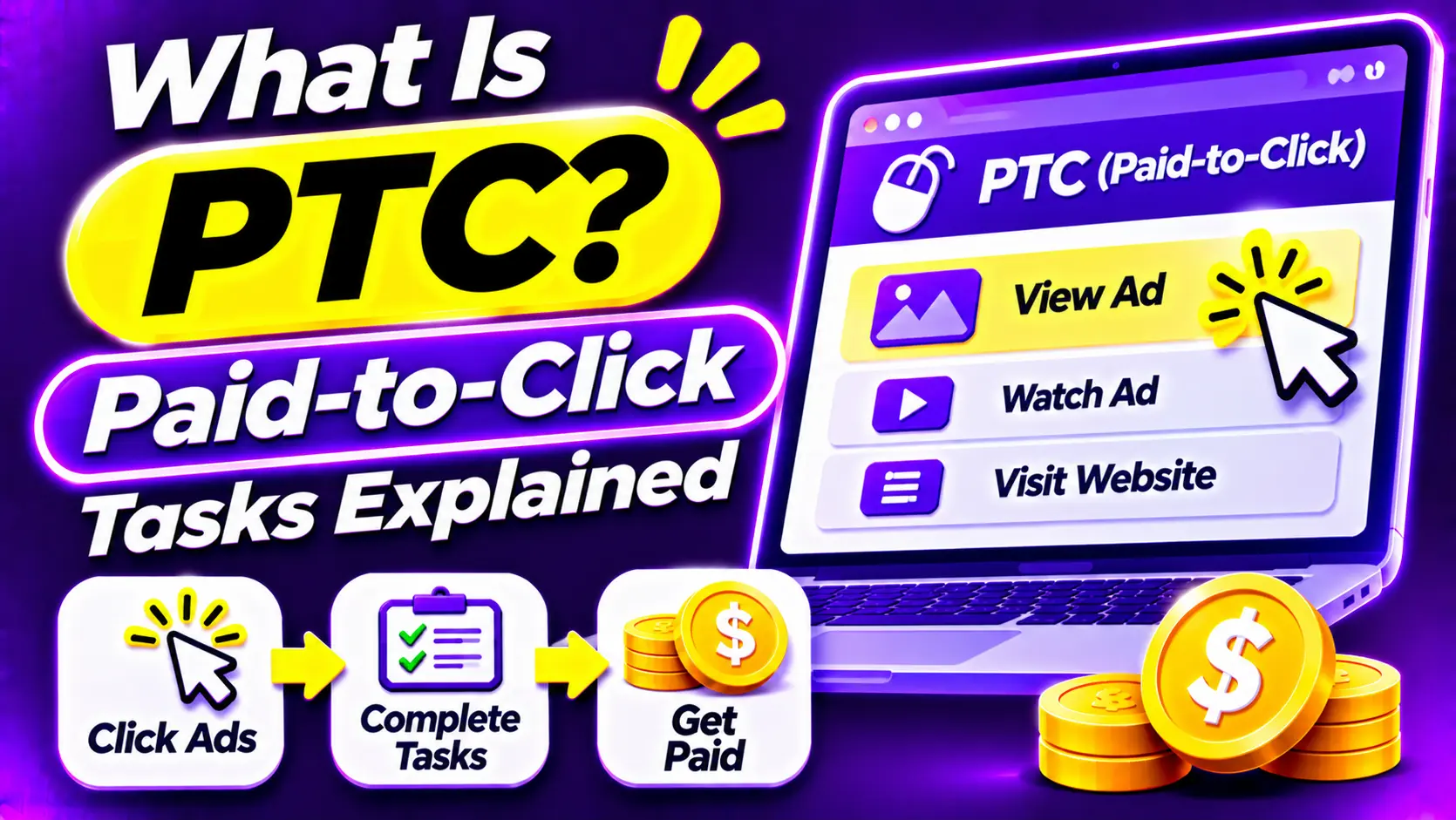
Paid-to-click (PTC) is one of the oldest earn mechanisms in the rewards space, and it still appears inside most modern GPT (get-paid-to) platforms. Understanding what PTC actually is, how it differs from offers and surveys, and where it fits in a rewards economy helps both members (who encounter PTC tasks) and operators (who decide whether to include them). This guide explains the PTC model, its mechanics, its economics, and its risks, and how it combines with other earn surfaces on a GPT site.
If you are new to the model, what a GPT website is and how users earn on GPT sites provide the necessary background. For how PTC fits into the broader business model, see how the GPT business model works.
What paid-to-click (PTC) is
Paid to click (PTC) is an online business model in which a website acts as an intermediary between advertisers and consumers: the advertiser pays for displaying ads on the PTC website, and a part of that payment goes to the viewer when they view the advertisement. According to the Wikipedia article on paid to click, PTC websites draw online traffic from people aiming to earn money from home, and the model shares similarities with pay-to-surf, since both use referral marketing as a promotional method.
In practice, a PTC task is simple: a member views an advertisement (often for a set number of seconds) or clicks a link, and earns a small reward for doing so. The reward per view is tiny, so PTC is rarely a primary income source for a member; it is usually a low-effort supplement inside a broader rewards platform.
The Wikipedia article also notes that the PTC model is usually combined with a variety of additional ways to earn, such as completing surveys and simple tasks, playing games, and shopping, and that users can redeem their earnings for cash through payment processors as well as a variety of gift cards. This combination is exactly how PTC appears inside modern GPT platforms: as one earn surface among several.
How PTC works on a GPT platform
On a GPT platform, PTC is typically implemented as a "view ads" or "click ads" section. The flow is straightforward:
- The operator (or an ad network) provides a set of ads with a payout per view or click.
- The member opens the PTC section and sees available ads, each with a reward value and a required view duration.
- The member views or clicks the ad for the required time.
- The platform credits the member's balance (often after a short verification or anti-fraud delay).
- The member redeems accumulated earnings through the platform's cashout flow.
Because the per-action reward is small, PTC sections usually impose daily limits (number of ads per day) and view-time requirements to make the economics work for the advertiser and the operator. The platform's ledger records each credit with a source and running balance, so PTC earnings are auditable alongside offer, survey, and task earnings.
PTC vs offers, surveys, and tasks
PTC is often confused with other earn surfaces. The differences matter for both members and operators:
| Earn surface | What the member does | Reward size | Effort & attention |
|---|---|---|---|
| PTC (paid-to-click) | Views or clicks an advertisement for a set time | Very small per action | Low attention, high repetition |
| Offerwall offers | Completes a third-party offer (install, signup, purchase) | Small to large | Variable; often higher effort |
| Surveys | Answers questions for market research | Small to medium | Moderate attention, screening |
| Mini tasks | Submits proof of a manual task for review | Small to medium | Higher effort, reviewed |
| Streaks / spin wheel | Daily engagement actions | Small | Low effort, habit-based |
PTC sits at the low-reward, low-effort end. It is best suited as a daily-engagement filler that keeps members returning, not as a primary earning path. GPT vs survey sites vs cashback compares the broader reward models.
The economics of PTC for an operator
For an operator, PTC economics are thin. The advertiser pays a small amount per view or click; the operator keeps a margin and passes the rest to the member. Because per-action rewards are tiny, the model depends on volume and on low fraud. The risks:
- Click fraud: fraudulent clicks inflate advertiser costs and can terminate ad relationships. The Wikipedia article notes that fraudulent clicks have ramped up expenses for advertisers, placing the burden on them to determine valid clicks and request reimbursement.
- Ponzi-scheme risk: the Wikipedia article warns that a Ponzi scheme could attempt to market itself as a successful Internet advertising services company under the guise of a PTC website, citing Traffic Monsoon, charged by the U.S. Securities and Exchange Commission. Operators should ensure their PTC model is a genuine ad-intermediary business, not a recruitment or deposit scheme.
- Thin margins: with tiny per-view payouts, revenue depends on scale and on advertiser relationships; a small site rarely earns much from PTC alone.
- Member expectations: if PTC is marketed as high-earning, members will be disappointed; set expectations clearly.
PTC therefore works best as a supplementary surface inside a broader GPT platform (alongside offers, surveys, tasks, and referrals) rather than as a standalone business. How GPT sites make money covers the broader revenue model.
Fraud controls and PTC
Because PTC is low-value per action, it is a frequent target for automation: bots can view ads faster and more cheaply than humans. Operators need controls that make automated viewing unprofitable:
- Captcha or proof-of-human: require a human check before crediting PTC views, especially for new accounts.
- Throttling and daily caps: limit views per member per day to prevent bulk automation.
- View-time enforcement: require the ad to be displayed for the full duration before crediting.
- Device and IP checks: flag or block suspicious patterns (multiple accounts, datacenter IPs, VPN/proxy).
- Ledger audit trail: record each PTC credit with source and running balance so abuse is traceable.
These controls should ship enabled by default and be configurable. A platform without them will be farmed, and the operator pays for it in advertiser chargebacks and wasted payouts.
PTC and the member experience
For members, PTC is attractive because it requires little skill and no qualification, but the earnings are small. Members should:
- Treat PTC as a small supplement, not a primary income.
- Follow the platform's rules (view durations, daily caps) to avoid having earnings voided.
- Combine PTC with higher-value surfaces (offers, surveys, tasks) for meaningful returns.
- Redeem through the platform's standard cashout flow, which is reviewed by the operator.
Operators should present PTC honestly: clear reward values, clear daily limits, and clear payout terms. Overstating PTC earnings damages trust and increases support load.
When to include PTC in your platform
PTC makes sense when:
- You want a low-effort daily engagement surface that brings members back.
- You have advertiser relationships or ad networks that pay for views/clicks.
- Your platform already has higher-value surfaces (offers, surveys, tasks) so PTC is supplementary.
- You can enforce anti-fraud controls (captcha, throttles, view-time, IP/device checks).
PTC is a poor fit when:
- You have no verified advertiser demand for views/clicks.
- You cannot enforce anti-fraud controls (you will be farmed).
- You market it as high-earning (expectations will be broken).
- Your platform's economics depend on PTC as the primary revenue source.
If you are evaluating platform software, check whether PTC is included, how view-time and daily caps are configured, and whether PTC credits flow through the same ledger and cashout queue as other earnings. The overall structure of a GPT website covers how these surfaces fit together.
PTC and referral marketing
Referral marketing is central to PTC. Both PTC and pay-to-surf use referral programmes as a promotional method: members are encouraged to invite others, and referrers earn a share of their referrals' activity. In a GPT platform, this means PTC earnings can feed into a referral commission structure, which amplifies growth but also amplifies fraud risk (fake referrals farming PTC views). Operators should decide whether PTC earnings count toward referral commissions and state the rule clearly, since ambiguity invites abuse and support disputes.
A sensible default is to pay referral commission only on higher-value surfaces (offers, surveys, tasks) and exclude PTC views, because PTC's tiny per-action value makes referral commissions on it negligible for the referrer and costly to track. Whatever you choose, document it in the platform's terms and in the admin settings so members and moderators apply it consistently.
Measuring PTC performance
Operators should track PTC with the same discipline as other earn surfaces, even though per-action values are small. Useful metrics include:
- Views per member per day: indicates engagement and helps set daily caps.
- Credit rate: the share of started views that result in a credited reward; a low rate suggests view-time enforcement or fraud filtering is working (or that members are abandoning).
- Revenue per view: advertiser payout per credited view, which determines whether PTC is economically viable.
- Fraud indicators: captcha failure rate, duplicate IPs, datacenter IP share, and view-time anomalies.
- Cashout contribution: how much of total member payouts trace back to PTC earnings.
If PTC contributes little to revenue but consumes support and fraud-management time, it may not be worth keeping. Conversely, if PTC drives daily return visits that lift higher-value surfaces, it earns its place even with thin direct margins. Measure before deciding, and revisit the decision periodically.
PTC in modern GPT platforms: implementation notes
When evaluating or building PTC inside a GPT platform, consider these implementation details:
- Separate PTC credits in the ledger: tag each credit with source type "PTC" so reporting and fraud analysis can isolate it.
- Configurable view duration and reward: make these admin settings, not hard-coded values, so you can tune economics without a release.
- Daily caps per member: enforce server-side, not client-side.
- View-time verification: credit only after the full duration elapses; use server-side timers, not client events.
- Anti-fraud gating: captcha, throttles, IP/device checks before crediting.
- Cashout integration: PTC earnings should flow through the same cashout queue and audit trail as other earnings, not a separate path.
- Clear member communication: show reward value, daily cap, and view duration up front.
These details determine whether PTC is a maintainable surface or a support burden. Platforms that implement PTC as a first-class earn surface with proper controls are easier to operate and audit than those that bolt it on as an afterthought. When evaluating a platform, ask how PTC credits are tagged in the ledger and whether they share the cashout queue with other earnings.
Frequently asked questions
What does PTC stand for?
PTC stands for paid to click. It is an online business model where a website acts as an intermediary between advertisers and consumers: the advertiser pays for displaying ads, and a part of that payment goes to the viewer when they view or click the advertisement.
How much can you earn from PTC?
PTC rewards are very small per view or click, so PTC is rarely a meaningful income on its own. It works best as a low-effort supplement inside a broader rewards platform that also includes offers, surveys, and tasks. Any site promising high earnings from PTC alone should be treated with caution.
Is PTC safe and legitimate?
PTC can be legitimate when it is a genuine ad-intermediary business with real advertiser demand and proper fraud controls. Risks include click fraud and schemes that market themselves as PTC but operate as Ponzi or recruitment schemes. Verify the platform's advertiser relationships, payout history, and anti-fraud measures before participating.
Should a GPT platform include PTC?
PTC is worth including as a supplementary daily-engagement surface when you have verified advertiser demand and can enforce anti-fraud controls (captcha, throttles, view-time enforcement, IP/device checks). It is a poor fit as a primary revenue source or without fraud controls, since it will be farmed.
Final takeaway
PTC (paid-to-click) is a simple, low-reward earn surface where members view or click ads for small payments. It works best as a supplementary daily-engagement tool inside a broader GPT platform, backed by real advertiser demand and strong anti-fraud controls. Treat PTC honestly in your marketing, keep it out of your primary revenue plan, and verify any platform's PTC implementation before relying on it. When in doubt, measure PTC's contribution to revenue and support cost before committing to it.
Related Guides
Frequently Asked Questions
What is paid-to-click (PTC)?
Paid-to-click is a task type where users earn small rewards for viewing ads or completing simple clicks. It is usually one surface among many on a GPT platform.
Is PTC still worth including on a rewards site?
PTC can add engagement but margins are thin and fraud risk is high. Most platforms treat it as a secondary earn surface alongside offers and surveys.







Comments (0)
No comments yet. Be the first to share your thoughts!