
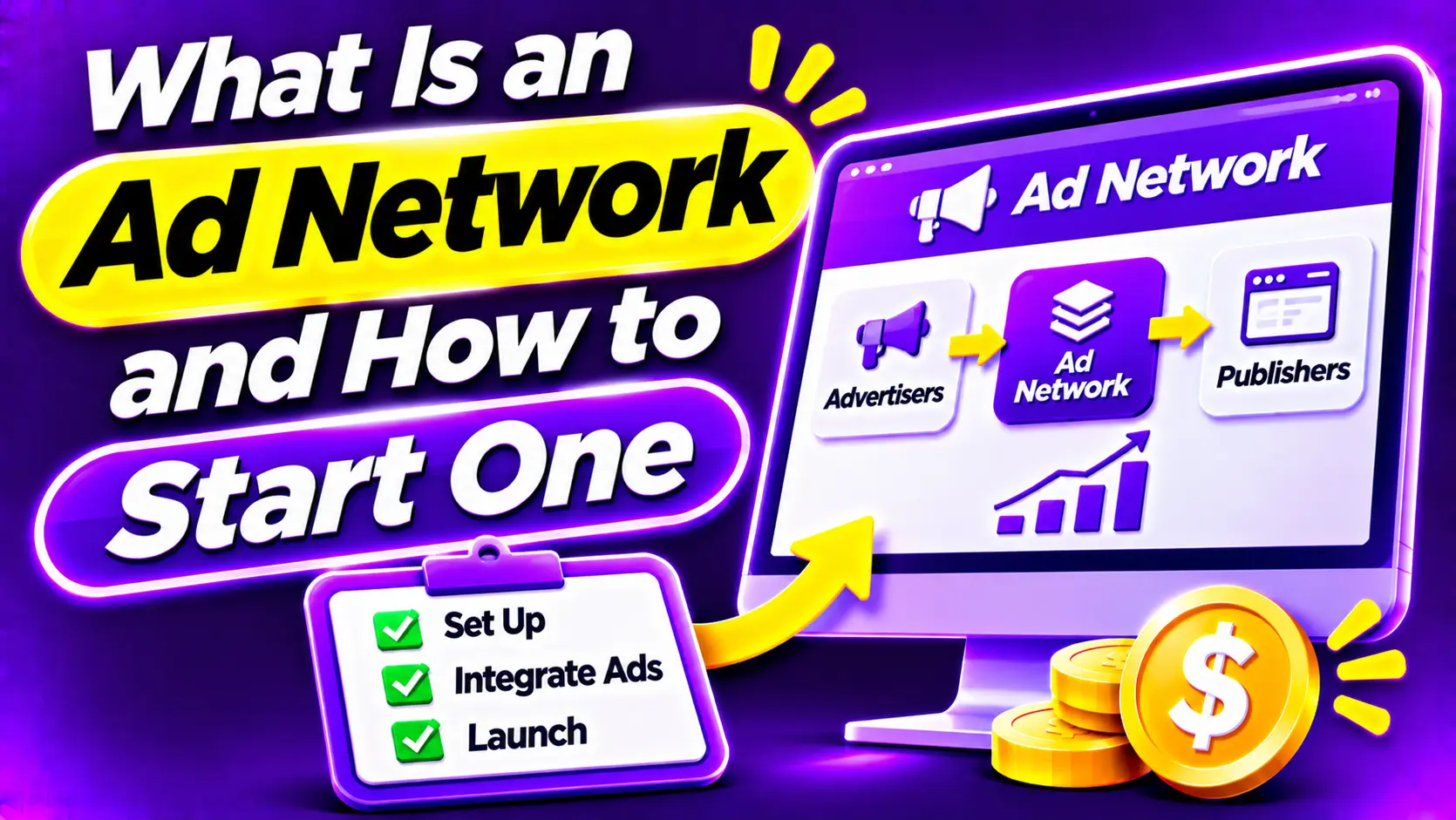
An ad network is a platform that connects advertisers who want to buy ad placements with publishers who have space to show those ads. It sits in the middle of that marketplace: advertisers fund campaigns, publishers place ad tags or integrations on their sites or apps, and the network selects and serves ads, tracks impressions and clicks, and manages reporting and payments according to its rules. If you are exploring how to start an ad network, the key is understanding both the marketplace roles and the operational systems required to run delivery, moderation, and payouts reliably.
Running an ad network is not just about displaying ads. It involves coordinating two different user groups, enforcing policies, measuring delivery accurately, and handling money flows in a way that is transparent and auditable. A platform can provide the software foundation, but the operator is responsible for configuring rules, reviewing activity, and maintaining the processes that keep the marketplace functioning. Understanding these pieces up front makes it easier to evaluate whether an ad network model fits your goals and what it takes to operate one day to day.
What an ad network is
At its simplest, an ad network aggregates advertising demand and publisher inventory so the two sides do not have to negotiate every placement individually. Advertisers define campaigns, creatives, and targeting preferences; publishers provide placements and traffic; and the network handles matching, serving, and measurement. This intermediary role is what distinguishes an ad network from a single advertiser buying space directly on one site, or a single publisher selling only its own inventory.
Ad networks can support different buying models and formats, but the common thread is a shared system that records what was served, attributes results, and determines how money moves between participants. For a broader view of platform business models that also connect supply and demand around monetization, see GPT business models explained and how the GPT business model works. While ad networks differ from reward or offer-based platforms in how value is exchanged, they share the same need for clear workflows, reliable tracking, and consistent rules.
The value of an ad network comes from coordination and scale. Advertisers gain access to multiple placements through one relationship, and publishers gain access to demand without selling each slot manually. The network's job is to make that exchange predictable: ads should be delivered according to defined conditions, results should be recorded accurately, and each party should be able to understand how performance and payments are calculated.
How an ad network works
Advertisers create and fund campaigns
Advertisers set up campaigns with creatives, destination URLs, and the targeting or delivery options the platform supports. Depending on the network, campaigns may run on prepaid credit, budgets, or other billing arrangements. Before ads go live, a network may require moderation or approval so creatives and destinations meet its policies. This review step helps protect publishers, users, and the operator by reducing the risk of inappropriate or non-compliant ads entering the system.
Campaign setup is also where operational details are defined. The advertiser needs to know which formats are available, how targeting works, and how delivery will be measured. Clear campaign controls and reporting help advertisers understand what they are buying, while approval workflows give the operator a way to enforce standards consistently.
Publishers verify placements and add ad tags
Publishers register properties (such as domains) and place ad tags or scripts where ads should appear. Many networks require some form of verification before serving, so ads are delivered only on approved placements. Once integrated, the publisher's placements request ads from the network and display the returned creative to visitors. Verification and placement controls are important because they help ensure ads appear in intended contexts and that inventory is associated with the correct publisher account.
Onboarding publishers is not just a technical step. It includes setting expectations about traffic quality, allowed placements, and how earnings are calculated. When a network provides clear integration instructions and verification requirements, it becomes easier for publishers to implement tags correctly and for operators to manage inventory quality over time.
The ad server selects, serves, and tracks ads
When a placement requests an ad, the network's serving logic selects an eligible campaign for that format and context, records an impression, and tracks interactions such as clicks. Tracking data feeds reporting for both advertisers and publishers and supports billing or crediting rules. The quality of this pipeline — selection, frequency controls, logging, and attribution — determines whether the network can operate consistently at scale.
Serving is a continuous process rather than a one-time action. Each request must be evaluated against the campaign's eligibility conditions, the placement's characteristics, and the network's policies. Accurate logging is essential because it underpins reporting, reconciliation, and dispute resolution. If impressions or clicks are not recorded reliably, it becomes difficult to maintain trust between advertisers, publishers, and the operator.
Payouts and reconciliation
Publishers earn based on the network's terms (for example, impressions or clicks, as defined by that network) and request withdrawals or receive payouts through the platform's process. Because invalid traffic, reversals, or policy issues can affect balances, networks typically include review steps, fees or thresholds, and records that reconcile what was served with what is paid. A transparent payout workflow helps publishers understand when earnings become payable and what conditions apply.
Reconciliation ties together delivery data and financial outcomes. Operators need to be able to review how balances were calculated, why a request was approved or adjusted, and how any reversals were handled. Even when a platform automates parts of this process, clear records and defined review states remain important for accountability and support. In practice, keeping payout rules consistent and easy to follow reduces disputes and helps both operators and publishers work from the same understanding of how earnings move from recorded delivery to final payment.
Ad formats and targeting basics
Ad networks can serve a range of formats depending on their product design. Common examples include display banners, text ads, and behavioral or notification-style formats, but the exact set varies by platform. Targeting options also differ: some networks filter by country, keywords, or placement context, while others offer more granular controls. When evaluating or building a network, focus on the formats and targeting the platform actually implements rather than assuming every option is available.
Format choice affects both user experience and operational complexity. Some formats require specific creatives or placement behavior, while others may involve additional delivery considerations. Similarly, targeting capabilities influence how precisely advertisers can reach audiences and how inventory is matched. Defining supported formats and targeting rules clearly helps avoid mismatches between what advertisers expect and what the network can deliver. It is also helpful to document how each format is requested and displayed, what assets are required, and how performance is measured for that format, so both advertisers and publishers have a consistent understanding of what "delivery" means in your network.
| Component | Role in the network | What to define clearly |
|---|---|---|
| Advertiser campaigns | Supply demand, creatives, and spend or credit | Approval rules, targeting options, billing model, and reporting metrics |
| Publisher placements | Provide inventory and traffic | Verification steps, allowed formats, ad tags, and traffic policies |
| Ad serving and tracking | Match and deliver ads, record events | Selection logic, impression/click tracking, frequency controls, and logs |
| Payout workflow | Credit and pay publishers | Thresholds, fees, review states, and how disputes or reversals are handled |
What to consider before starting an ad network
Starting an ad network is as much an operations challenge as a software choice. You need a way to onboard and verify both advertisers and publishers, moderate campaigns and placements, serve ads reliably, and maintain accurate financial records. A self-hosted platform can provide the core application, but you still supply policies, pricing, payment arrangements, and day-to-day administration. Without clear operational processes, even capable software can be difficult to run effectively.
For example, Rovads (as described on its product page) is a self-hosted Laravel application that includes separate advertiser and publisher consoles plus an admin panel. Its documented capabilities include multiple ad formats (such as display, text, in-page push, web push, popunder, vignette, and playable), domain-gated serving with verification, campaign management and moderation screens, and a reviewed publisher withdrawal queue handled by the operator. Details such as available formats, targeting behavior, and default economics are defined by the release and its configuration, so operators should review the product documentation and set rates and policies before launch.
Before launch, it helps to plan a few practical areas: how advertisers will be approved and supported, how publisher inventory will be verified, what reporting both sides will see, and how payout requests will be reviewed and fulfilled. You should also decide how you will handle policy enforcement and issue resolution, since moderation and support are ongoing responsibilities. A simple launch checklist can include confirming ad format behavior, testing tracking and reporting with sample traffic, validating that verification and moderation workflows work as intended, and documenting payout rules so participants know what to expect.
It is equally important to define the boundaries of your network early. Decide which placements are acceptable, how you will respond to quality or policy concerns, and what information each party can access in their console or reports. Studying adjacent monetization models and networks can provide useful context; comparing approaches in resources like guides to offerwall networks can clarify how different platforms structure inventory, tracking, and payouts, even when the ad formats differ.
Measuring performance and maintaining trust
Measurement and trust go together in an ad network. Advertisers rely on reporting to understand delivery and outcomes, while publishers rely on accurate crediting to understand earnings. Consistent definitions for impressions, clicks, and other tracked events help reduce confusion, but the operator must also ensure that logs and reports reflect what actually happened in the serving pipeline. When metrics are defined clearly and recorded consistently, it becomes easier to compare performance, reconcile balances, and explain results to participants. Regularly reviewing reports and logs can also help operators spot issues early and keep delivery, tracking, and crediting aligned.
Maintaining trust also involves clear communication and predictable processes. When campaigns are moderated, when placements are verified, and when payout requests move through defined states, participants can better understand how decisions are made. Transparent policies and accessible records do not eliminate every issue, but they make it easier to investigate questions and maintain a stable marketplace over time. Over the long term, reliability in serving, reporting, and payout handling is often more important than adding complexity, because participants value systems they can understand and depend on.
Frequently asked questions
What is the difference between an ad network and buying ads directly?
Buying ads directly means an advertiser negotiates placements with a specific publisher. An ad network aggregates many advertisers and publishers into one system, handling matching, serving, tracking, and payment workflows across multiple placements.
Do I need separate systems for advertisers and publishers?
In practice, yes. Advertisers and publishers have different needs, permissions, and workflows, such as campaign management versus domain verification and ad tags. Many platforms provide separate consoles and an admin layer to moderate and reconcile both sides.
What ad formats can an ad network serve?
It depends on the platform. Some networks focus on display banners, while others also support formats such as text, push-style units, popunder, vignette, or interactive creatives. You should confirm the exact formats a specific platform implements and supports before planning campaigns or placements.
Are publisher payouts in an ad network fully automatic?
Not always. Many networks use a reviewed withdrawal or payout process with thresholds, fees, and approval steps, and the operator may pay out of band. Always check how a platform handles payout requests, reversals, and reconciliation so expectations are clear.
Final takeaway
An ad network succeeds in practice when it reliably connects advertiser demand with publisher inventory through clear serving, tracking, and payout workflows. If you plan to start one, define your formats, policies, and economics first, then carefully evaluate a platform that implements the controls you need — for a concrete example of a self-hosted implementation, review the Rovads ad network platform.

Comments (0)
No comments yet. Be the first to share your thoughts!